

 English
 Deutsch
 Español
 Français

Ultralight Internal-Lock Aluminum Trekking Poles for Stable, Comfortable Outdoor Travel
Content
- 1 Why Trekking Pole Design Matters in Real Outdoor Conditions
- 2 Product Overview
- 3 Core Construction and Functional Advantages
- 4 Internal Lock Versus External Lock Trekking Poles
- 5 Advantages Over Basic and Competing Trekking Poles
- 6 Performance on Different Terrain
- 7 Manufacturing Process and Quality-Control Strengths
- 8 Private-Label and OEM Development Potential
- 9 Packaging, Storage, and Transportation Considerations
- 10 How to Use the Trekking Pole Correctly
- 11 Maintenance and Service-Life Recommendations
- 12 Why CragHaven Outdoor Is a Suitable Manufacturing Partner
- 13 Selection Guide for Buyers and Outdoor Users
- 14 Q&A
- 14.1 What is an internal-lock trekking pole?
- 14.2 What are the main advantages of aluminum alloy trekking poles?
- 14.3 Is an internal lock better than an external lock?
- 14.4 How does the shock absorption system improve comfort?
- 14.5 Is the straight handle suitable for long-distance hiking?
- 14.6 Can the trekking pole be used for camping?
- 14.7 What should retailers consider when purchasing this product?
- 14.8 Can the product be customized for private-label sales?
- 14.9 How should the pole be maintained?
- 14.10 Who is this trekking pole designed for?
- 15 Conclusion
- 16 References
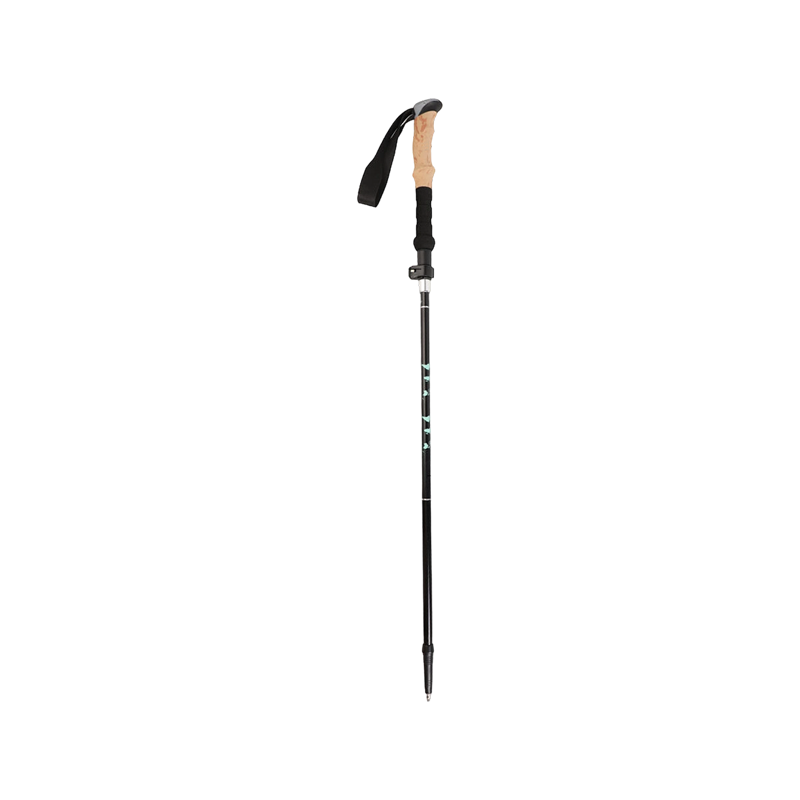
- 17 Product: Ultralight, internally locking aluminum alloy straight handle trekking pole with telescopic strap and shock absorption.
Trekking poles have become essential equipment for hikers, backpackers, mountaineers, and outdoor travelers who need additional balance, support, and control on changing terrain. A well-designed pole does more than provide a point of contact with the ground. It helps distribute physical effort, improve posture, reduce stress on the knees and ankles, and support a more confident walking rhythm over long distances. For these reasons, the structure, materials, locking system, handle design, and shock-management features of a trekking pole all deserve careful consideration.
The ultralight, internally locking aluminum alloy straight-handle trekking pole described in this article is designed for users who value dependable support without carrying unnecessary weight. It combines an aerospace-grade aluminum alloy shaft, an internal locking mechanism, a telescopic wrist strap, an ergonomic non-slip handle, and a built-in spring shock absorption system. Together, these components create a practical trekking tool for long-distance hiking, backpacking, mountain travel, camping trips, daily walking, and general outdoor use.
Unlike products that focus on one isolated specification, this trekking pole is developed as a complete system. The shaft must be strong enough to tolerate repeated loading. The locking mechanism must hold the selected length securely. The handle must remain comfortable during hours of use. The wrist strap must help users maintain control without creating pressure points. The shock absorption system must reduce impact while preserving a stable connection with the ground. The product’s value comes from how these elements work together.
Why Trekking Pole Design Matters in Real Outdoor Conditions
Outdoor terrain is rarely uniform. A hiking route can include compact soil, loose gravel, wet rocks, forest paths, steep ascents, long descents, and flat sections. Each surface changes the way force travels from the ground to the user’s body. A trekking pole provides an additional support point that can help the user respond to these changes more smoothly.
On an uphill section, poles can help users establish a steady rhythm and engage the upper body. On a downhill section, they can provide additional balance and help reduce the sudden loading that often affects the knees. On uneven ground, two poles can widen the user’s support base and improve confidence while stepping across roots, stones, and slippery surfaces.
However, the benefits of a trekking pole depend heavily on its construction. A pole that is too heavy can create fatigue in the hands and shoulders. A pole that slips during adjustment can interrupt movement or create a safety risk. A handle with poor ergonomics may cause discomfort, blisters, or reduced grip control. A shaft that bends excessively may feel unstable when the user places weight on it.
The product described here addresses these practical requirements through a balanced structure. Its aluminum alloy body provides a combination of low weight and mechanical strength. The internal locking system maintains a smooth outer profile and supports telescopic adjustment. The shock absorption system helps moderate impact. The straight handle and adjustable strap support a natural grip for extended use.
Product Overview
This trekking pole is an ultralight, internally locking aluminum alloy model with a straight ergonomic handle, telescopic wrist strap, and built-in spring shock absorption. It is intended for users who need a portable and adjustable support tool for hiking, trekking, camping, mountaineering, and everyday outdoor activity.
The shaft uses aerospace-grade aluminum alloy as its primary structural material. Aluminum alloy is widely used in outdoor equipment because it provides a useful balance between strength, weight, corrosion resistance, and manufacturing efficiency. Compared with heavier steel construction, aluminum alloy is easier to carry over long distances. Compared with some highly rigid composite materials, aluminum alloy can offer a more accessible balance of durability and cost for commercial outdoor products.
The internal lock is positioned inside the pole tube rather than using a large external clamp. This gives the pole a clean, streamlined appearance and reduces the number of parts exposed to branches, clothing, backpack straps, and accidental impact. The telescopic structure allows the user to adjust the pole to a suitable length for different body heights, terrain conditions, and walking styles.
The straight handle is shaped to support a natural hand position. Its non-slip surface helps the user maintain control when the palm is wet or when the pole is used during warm-weather activity. The telescopic wrist strap provides another layer of security, allowing the user to relax the grip while keeping the pole close to the hand.
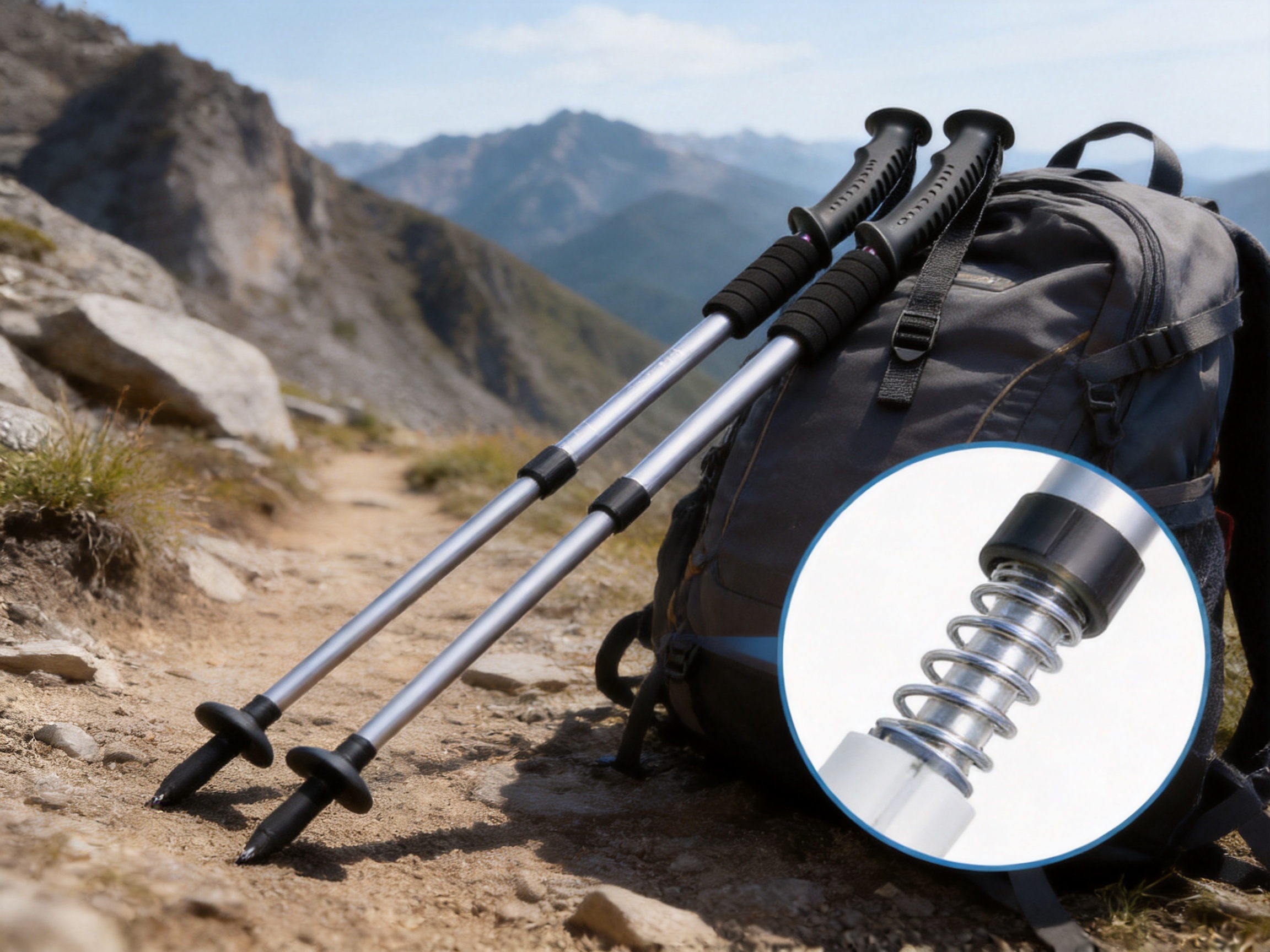
A built-in spring shock absorption system is integrated into the pole structure to help moderate impact. When the tip contacts a hard or uneven surface, the spring mechanism can absorb part of the vibration transmitted through the shaft. This feature is particularly valuable during extended descents, repeated contact with firm ground, and activities where users want to reduce stress on the knee joint and upper limbs.
Core Construction and Functional Advantages
Aerospace-Grade Aluminum Alloy Shaft
The shaft is the main load-bearing component of a trekking pole. It must remain sufficiently rigid during normal use while avoiding excessive weight. The aerospace-grade aluminum alloy body is selected to meet this balance between portability and structural reliability.
Aluminum alloy is suitable for trekking poles because it can be formed into thin-walled tubes with consistent dimensions. The resulting shaft can be light enough for backpacking while retaining useful resistance to bending and repeated loading. It also performs reliably across a broad range of outdoor temperatures and can be produced with a controlled surface finish for smooth telescopic movement.
For outdoor retailers and equipment brands, aluminum alloy construction provides another advantage: it supports scalable manufacturing. The material is compatible with established extrusion, cutting, forming, finishing, and assembly processes. This enables manufacturers to achieve stable product consistency across production batches while offering different colors, surface treatments, lengths, and packaging configurations.
The aluminum shaft also has a practical advantage over overly delicate ultralight designs. Some very light poles prioritize minimum weight to such an extent that they may feel fragile under frequent use. A properly engineered aluminum model can provide a more reassuring balance for users who want lightweight equipment but still expect dependable performance on regular hiking routes, camping trips, and mountain trails.
Internal Locking System
The internal locking system secures the telescopic sections from within the pole tube. By rotating the sections, the internal expansion component presses against the inner wall of the shaft and creates friction that holds the selected length.
This mechanism offers several meaningful advantages over external clamps. First, the outer surface remains clean and streamlined. There is no large lever extending from the shaft, so the pole is less likely to snag on vegetation, clothing, or luggage. This is useful when moving through narrow forest trails or packing the poles beside other equipment.
Second, the internal design can contribute to a compact visual and physical structure. With fewer external components, the pole is easier to hold and store. It can slide into a backpack compartment without a clamp catching on fabric or occupying additional space.
Third, the internal lock supports a simple appearance that appeals to users and buyers who prefer discreet, integrated equipment. The absence of a prominent external lever gives the product a more refined profile while maintaining adjustable functionality.
The internal mechanism also reflects a manufacturing philosophy based on integration. Instead of adding a separate external component that must be aligned and protected, the locking structure is installed within the shaft system. This requires attention to dimensional accuracy, component compatibility, friction control, and assembly quality. When these processes are managed correctly, the result is a durable and convenient adjustment system.
Straight Ergonomic Non-Slip Handle
The handle is the part of the trekking pole that remains in direct contact with the user for the greatest amount of time. An uncomfortable handle can turn an otherwise effective pole into a source of hand fatigue. The straight handle used in this product is intended to provide a familiar and versatile gripping position.
Its ergonomic shape supports a natural hand posture and allows users to change grip positions during long walks. A straight handle can be held near the top, center, or lower section depending on the slope and personal preference. This flexibility is useful when the user wants to shorten the effective reach on a steep climb or maintain a relaxed grip on level ground.
The non-slip exterior helps reduce unwanted movement between the hand and handle. Grip stability is especially important when the user is walking in humid conditions, wearing gloves, or moving over terrain that requires quick balance corrections. A secure surface can also reduce the need to squeeze the handle tightly, which may help limit hand and forearm fatigue.
The handle design is appropriate for users with different experience levels. Beginners can use it as a straightforward support point, while experienced hikers can coordinate the handle, strap, and pole tip to create a more efficient walking rhythm.
Telescopic Wrist Strap
The wrist strap is not merely an accessory. It helps maintain contact between the user and the pole while allowing the hand to remain relatively relaxed. When adjusted correctly, the strap supports the wrist from below and reduces the risk of dropping the pole if the grip loosens temporarily.
The telescopic strap can accommodate different hand sizes and clothing conditions. Users may need a tighter adjustment when moving quickly or on uneven terrain, while a more relaxed setting may be comfortable during a slow walk or rest period. The strap can also help distribute pressure between the hand and wrist instead of forcing the fingers to carry all of the gripping load.
For commercial product development, an adjustable strap improves usability across a wider customer base. It enables the same pole model to serve different users without requiring multiple handle sizes. It also supports customization options, including strap colors, branding, stitching details, and packaging presentation.
Built-In Spring Shock Absorption
The integrated spring shock absorption system is designed to reduce vibration and moderate impact when the pole tip meets the ground. Hard surfaces can transmit sudden force through the tip and shaft. Repeated impact may contribute to discomfort in the wrists, elbows, shoulders, and knees, especially during long descents.
A spring-based system introduces controlled movement within the pole. Instead of transmitting every contact force directly to the hand, the spring absorbs and releases part of the energy. This can create a smoother feeling during repeated use and help reduce the harshness of contact on firm terrain.
Shock absorption does not replace correct walking technique, suitable footwear, or careful route selection. It is a supporting feature rather than a guarantee against injury. Nevertheless, it can improve comfort when combined with correct pole length, a relaxed grip, and a steady walking rhythm.
The system may also make the pole more attractive to users who have previously experienced discomfort from rigid, non-absorbing poles. For older hikers, recreational walkers, and users returning to outdoor activity, impact reduction can be an important purchasing consideration.
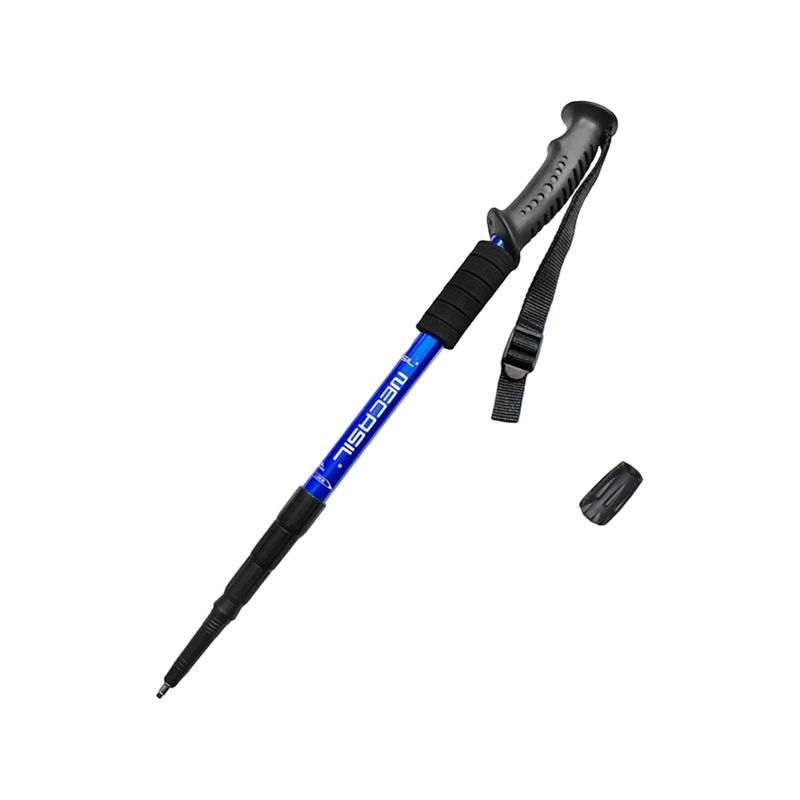
Ultralight, internally locking aluminum alloy straight handle trekking pole with telescopic strap and shock absorption.
Internal Lock Versus External Lock Trekking Poles
Internal and external locking systems both secure adjustable pole sections, but they provide different user experiences. An external lock uses a visible lever or clamp mounted on the outside of the shaft. An internal lock uses an expansion mechanism housed within the tube.
External locks are often praised for fast operation. The user can open a lever, slide the section, and close the lever. Because the mechanism is visible, it is easy to inspect and make minor adjustments. This can be useful on routes where pole length changes frequently between steep climbs, descents, and flat sections.
Internal locks generally require a twisting motion. Adjustment may take slightly longer, particularly for users who are unfamiliar with the mechanism. In return, the design offers a smoother outer profile, a more compact appearance, and fewer external parts that can catch or receive direct impact.
| Comparison Factor | Internal-Lock Aluminum Pole | External-Lock Trekking Pole |
|---|---|---|
| Lock position | Inside the shaft | Outside the shaft |
| Adjustment method | Twist to release and secure | Open and close a clamp |
| External profile | Smooth and streamlined | Visible clamp structure |
| Adjustment speed | Moderate | Usually fast |
| Portability | Compact and easy to pack | May require more external clearance |
| Snag resistance | Low risk of catching on gear | Clamp may catch on fabric or branches |
| Inspection | Internal parts require more attention | Visible parts are easy to check |
| Best suited to | Backpacking, long-distance trekking, streamlined travel | Frequent terrain-based adjustment |
The internal lock is therefore not automatically better for every user. Its advantage is strongest when compactness, smooth handling, appearance, and reduced external complexity are important. The external lock may be preferred by users who want the fastest possible adjustment and immediate visual confirmation of the clamp position.
This product is positioned for customers who want an integrated adjustable pole with a clean structure and reliable support. It is especially appropriate for long-distance trekking, backpacking, camping travel, and general hiking, where the pole may spend significant time attached to or stored inside a backpack.
Advantages Over Basic and Competing Trekking Poles
Balanced Weight and Strength
One of the most important competitive advantages is the balance between low weight and usable strength. A trekking pole must be light enough to carry but strong enough to tolerate repeated contact, directional changes, and normal user loading. The aluminum alloy shaft addresses this requirement without relying on a heavy steel construction.
Compared with basic low-cost poles that may use inconsistent materials or poorly controlled tubing, a carefully manufactured aluminum alloy pole can offer greater confidence in dimensional consistency and structural behavior. The user benefits from a product that feels stable in the hand while remaining suitable for long walks.
Integrated Shock Comfort
Many entry-level trekking poles provide only a rigid shaft and basic handle. While such poles can be functional, they may transmit more vibration to the user. The built-in spring shock absorption system gives this product a comfort advantage, particularly on hard paths and downhill sections.
The feature also helps differentiate the pole in retail and wholesale markets. Buyers often look for visible functional benefits that can be communicated easily. Impact reduction, improved comfort, and support for long-distance use are clear advantages that can help a product stand apart from a simple adjustable stick.
Reduced Snagging and Cleaner Storage
The smooth external profile of the internal locking design is valuable during travel. An external clamp may catch on backpack fabric, tent materials, tree branches, or other equipment when the pole is being removed from storage. The internal mechanism reduces this risk and contributes to easier packing.
This advantage is particularly relevant for travelers who carry several pieces of equipment. A pole that slides neatly into a bag or luggage compartment is easier to organize and less likely to interfere with other products.
Comfort During Extended Use
The combination of the straight ergonomic handle, non-slip surface, telescopic wrist strap, and shock absorption system supports extended use. Each element addresses a different source of discomfort. The handle supports the palm, the surface improves control, the strap reduces the need for constant gripping, and the spring system helps moderate vibration.
Competitor products may include one or two of these features, but the value of this model lies in their combination. Outdoor equipment is often used continuously for hours, so small improvements in grip and impact behavior can become significant over the course of a day.
Versatile Application Range
The product is suitable for more than one outdoor activity. It can support hiking on marked trails, backpacking journeys, camping access routes, mountain walks, travel excursions, and daily fitness walking. This versatility increases its usefulness for retailers and distributors because one product can address several customer groups.
For beginners, the pole provides stability and confidence. For experienced hikers, it offers adjustable support and practical portability. For travelers, it provides a compact tool that can be stored when not in use. For outdoor brands, it offers a flexible foundation for private-label development and market-specific customization.
Performance on Different Terrain
Flat Trails
On relatively flat terrain, the pole can be adjusted to a comfortable walking height that allows the elbows to remain slightly bent. The user can establish a regular alternating rhythm between the arms and legs. The non-slip handle and wrist strap help maintain a relaxed grip, while the lightweight shaft minimizes unnecessary arm fatigue.
Flat trails are often where users notice the importance of overall balance. A pole that is too heavy or poorly balanced can feel tiring even when the route itself is not difficult. The product’s ultralight construction is intended to support efficient movement over longer distances.
Uphill Sections
During an ascent, some users prefer a slightly shorter pole length. This can bring the hands closer to the body and make it easier to generate a controlled pushing action. The internal locking system allows the length to be changed according to the incline.
The straight handle provides flexibility for gripping higher on the shaft when additional shortening is needed temporarily. This can be useful when the user does not want to stop and make a full adjustment for a brief steep section.
Downhill Sections
On descents, a slightly longer pole may improve reach and help the user establish contact with the ground before placing the foot. This additional contact can support balance and reduce the tendency to lean too far forward.
The spring shock absorption system is particularly relevant on downhill terrain, where the poles may receive repeated loading. By softening the sensation of impact, it can help create a smoother and more comfortable descent when used with proper technique.
Loose Gravel and Uneven Ground
Loose gravel and uneven ground demand careful pole placement. The pole tip should be placed on a stable area rather than directly on a loose stone whenever possible. The aluminum shaft provides a responsive connection between the hand and tip, while the strap helps prevent accidental loss of control.
Users should remember that a trekking pole is a balance aid, not a substitute for careful foot placement. The pole should not be used to support loads beyond its intended application, and the locking mechanism should always be checked before entering difficult terrain.
Camping and Travel Routes
Camping routes often involve mixed conditions, including packed earth, grass, gravel, and short slopes near campsites. A lightweight telescopic pole is convenient for these changing environments. It can be adjusted for walking, folded or collapsed for storage, and carried with other camping equipment.
Its compact external profile also supports easier transportation. This is an important feature for customers who move between vehicles, airports, campsites, and trailheads.
Manufacturing Process and Quality-Control Strengths
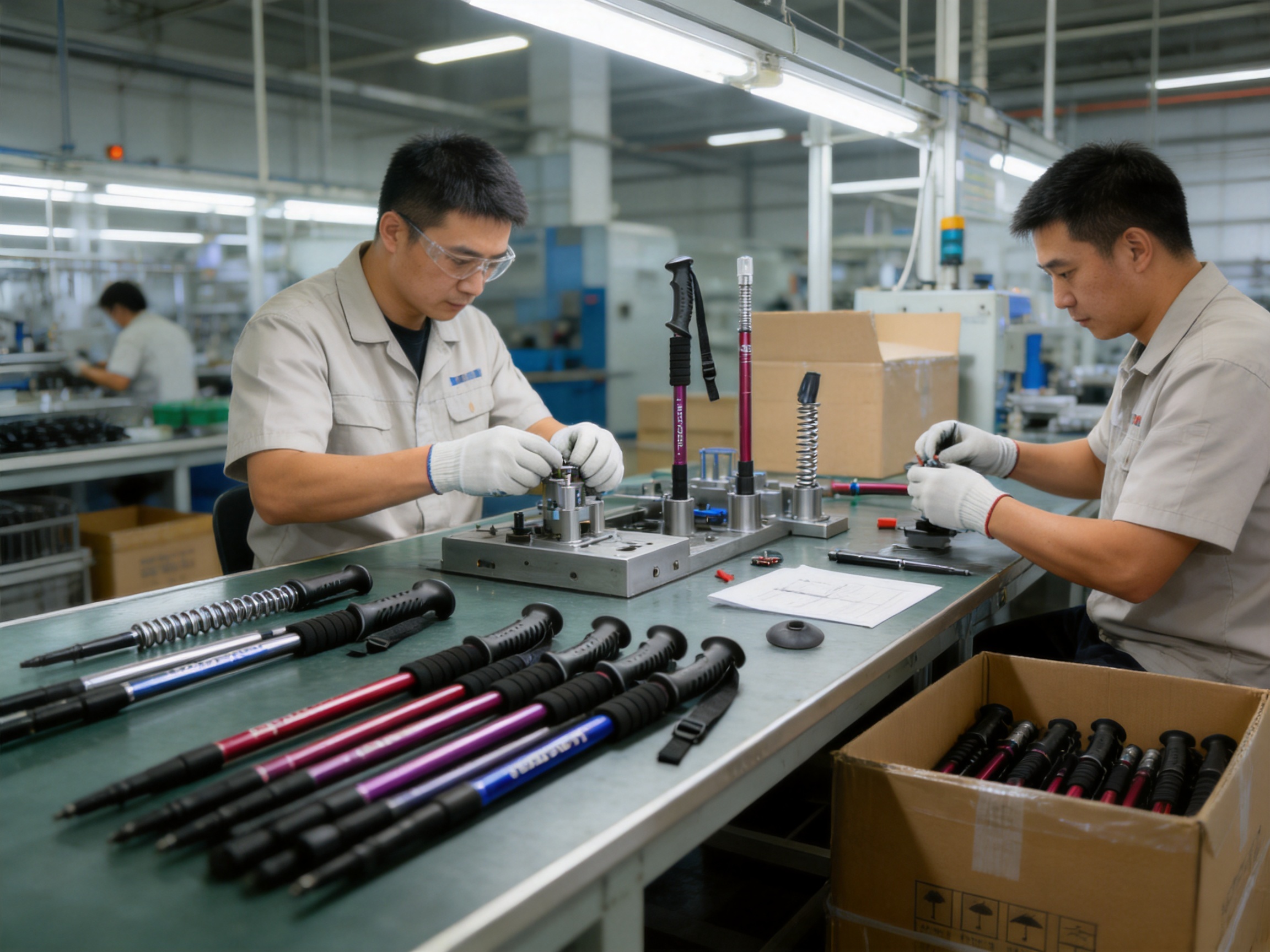
A reliable trekking pole is the result of controlled manufacturing rather than a single material choice. CragHaven Outdoor approaches product development through practical outdoor requirements, manufacturing feasibility, sampling, testing, and optimization. This approach helps transform a design concept into a stable, repeatable product suitable for global markets.
Application-Based Product Planning
The development process begins with usage scenarios. Instead of designing only around a list of specifications, the product is considered in relation to weather, terrain, carrying habits, walking duration, and user expectations. This helps identify which features genuinely contribute to outdoor performance.
For this trekking pole, the relevant requirements include low carrying weight, reliable telescopic adjustment, comfortable grip, protection against slipping, impact moderation, and compatibility with hiking and camping routines. These requirements guide the selection of the shaft material, internal lock, spring system, handle, strap, and finishing details.
Material Selection
Material selection affects performance, durability, appearance, and production stability. The aluminum alloy shaft is selected for its strength-to-weight balance and suitability for controlled tube production. The internal locking components must be compatible with the shaft dimensions and must maintain appropriate friction during repeated adjustment.
Handle materials are selected according to comfort, grip, surface durability, and resistance to normal outdoor moisture. Strap materials must provide flexibility and sufficient tensile performance. Spring components must be selected for consistent elastic response over repeated compression and release cycles.
A manufacturing partner with experience in outdoor products understands that material compatibility is as important as individual material quality. A strong shaft does not compensate for an unsuitable locking component. A comfortable handle does not solve a poor connection between the grip and shaft. The product must be evaluated as a complete assembly.
Precision Tube Processing
The shaft sections require controlled dimensions so that they can extend and retract smoothly while maintaining a secure fit. Cutting accuracy, tube diameter, wall consistency, and surface treatment all influence the final adjustment experience.
During production, the tube sections are processed to the required lengths and prepared for assembly. Edges must be finished carefully to avoid damage to internal components or user contact surfaces. Surface treatment can also improve visual quality and help protect the aluminum alloy from ordinary handling and outdoor exposure.
Internal Lock Assembly
The internal lock is installed inside the telescopic shaft and aligned with the corresponding section. Assembly accuracy is important because excessive friction can make adjustment difficult, while insufficient friction may reduce locking reliability.
Quality control should include repeated extension and contraction, verification of locking engagement, inspection of component seating, and evaluation of the mechanism after normal adjustment cycles. These checks help identify inconsistencies before products are packed for shipment.
The internal design requires disciplined assembly because the most important components are not immediately visible after completion. Process documentation, trained operators, and batch inspection therefore play an important role in maintaining consistent performance.
Shock Absorption Installation
The spring shock absorption assembly is integrated into the pole structure according to the product design. The spring must be positioned correctly so that it can move within its intended range without producing unwanted noise, excessive looseness, or interference with telescopic adjustment.
Assembly checks can verify spring placement, movement behavior, return action, and connection strength. The purpose is not to make the pole feel loose but to provide controlled impact moderation while retaining a stable walking response.
Handle and Strap Assembly
The handle is connected to the shaft with attention to alignment and attachment strength. The connection should remain secure during normal pushing, pulling, and rotational movement. The non-slip surface is inspected for consistency, while the strap is fitted and adjusted to ensure that it can be used comfortably by different customers.
Visual inspection is important at this stage. Uneven surfaces, incomplete finishing, loose threads, poor alignment, or visible defects can affect customer perception even if the pole remains mechanically functional. Outdoor equipment buyers often associate careful finishing with overall product reliability.
Functional Testing
Functional testing may include telescopic adjustment checks, locking tests, impact simulations, handle attachment checks, strap pull tests, and visual inspection. The exact testing program can be adapted to customer requirements, market standards, order volume, and intended application.
Testing is especially important for products intended for international distribution. Different markets may have different packaging, labeling, documentation, and quality expectations. A structured inspection process helps reduce supply-chain uncertainty and supports repeatable orders.
Sampling and Optimization
Before mass production, sampling allows the product team and customer to evaluate the actual physical design. Sample testing can reveal issues that may not be obvious in drawings or specifications, such as grip feel, adjustment effort, spring response, packed size, color accuracy, or strap comfort.
CragHaven Outdoor emphasizes repeated sampling and optimization as part of product development. This manufacturing-driven approach allows design decisions to be adjusted before large-scale production. It also helps ensure that the final product is not merely attractive in a catalog but practical in real outdoor conditions.
Private-Label and OEM Development Potential
The trekking pole is suitable for outdoor brands, distributors, retailers, and importers seeking a dependable product platform for OEM or private-label programs. The basic structure can be adapted to different market requirements while preserving its core functional advantages.
Potential customization areas include shaft color, surface finish, handle color, strap color, printed logos, packaging design, instruction materials, barcode labels, retail cartons, and product bundles. Customers may also discuss different length ranges, tip configurations, accessories, and packaging quantities depending on their target market.
A product platform with an internal lock and aluminum alloy construction can serve multiple market positions. It may be presented as an entry-level upgrade for casual hikers, a practical mid-range pole for regular outdoor users, or a branded accessory for camping and travel collections.
For distributors, product consistency is often more important than a single unusually low purchase price. Stable dimensions, repeatable colors, reliable assembly, and clear communication reduce the risk of customer complaints and replacement costs. A manufacturing partner involved in both design and production can provide more useful support than a sourcing intermediary with limited technical understanding.
CragHaven Outdoor combines outdoor application knowledge with China’s mature manufacturing ecosystem. This allows customers to communicate requirements directly, evaluate samples, refine details, and establish a repeatable production plan. The objective is to reduce uncertainty from initial concept through shipment.
Packaging, Storage, and Transportation Considerations
Trekking poles are frequently purchased as travel equipment, so packaging should protect the product while remaining efficient for storage and shipment. The telescopic structure helps reduce the packed length compared with a fixed-length pole. The smooth internal-lock profile also makes the product easier to arrange in cartons and retail packaging.
Packaging can be developed according to the customer’s sales channel. A retail brand may require a printed color box, product insert, barcode, and multilingual instructions. A wholesale distributor may prefer a more economical carton configuration. E-commerce customers may need reinforced packaging that protects the handle and tip during parcel delivery.
Instruction materials should explain how to adjust the internal lock, how to set the desired length, how to use the wrist strap, and how to check the mechanism before use. Clear instructions help reduce misuse and improve the customer’s first experience with the product.
Storage recommendations should include keeping the poles dry after use, removing dirt from the telescopic sections, and avoiding unnecessary force during adjustment. These simple practices can extend the service life of the locking components and maintain smooth operation.
How to Use the Trekking Pole Correctly
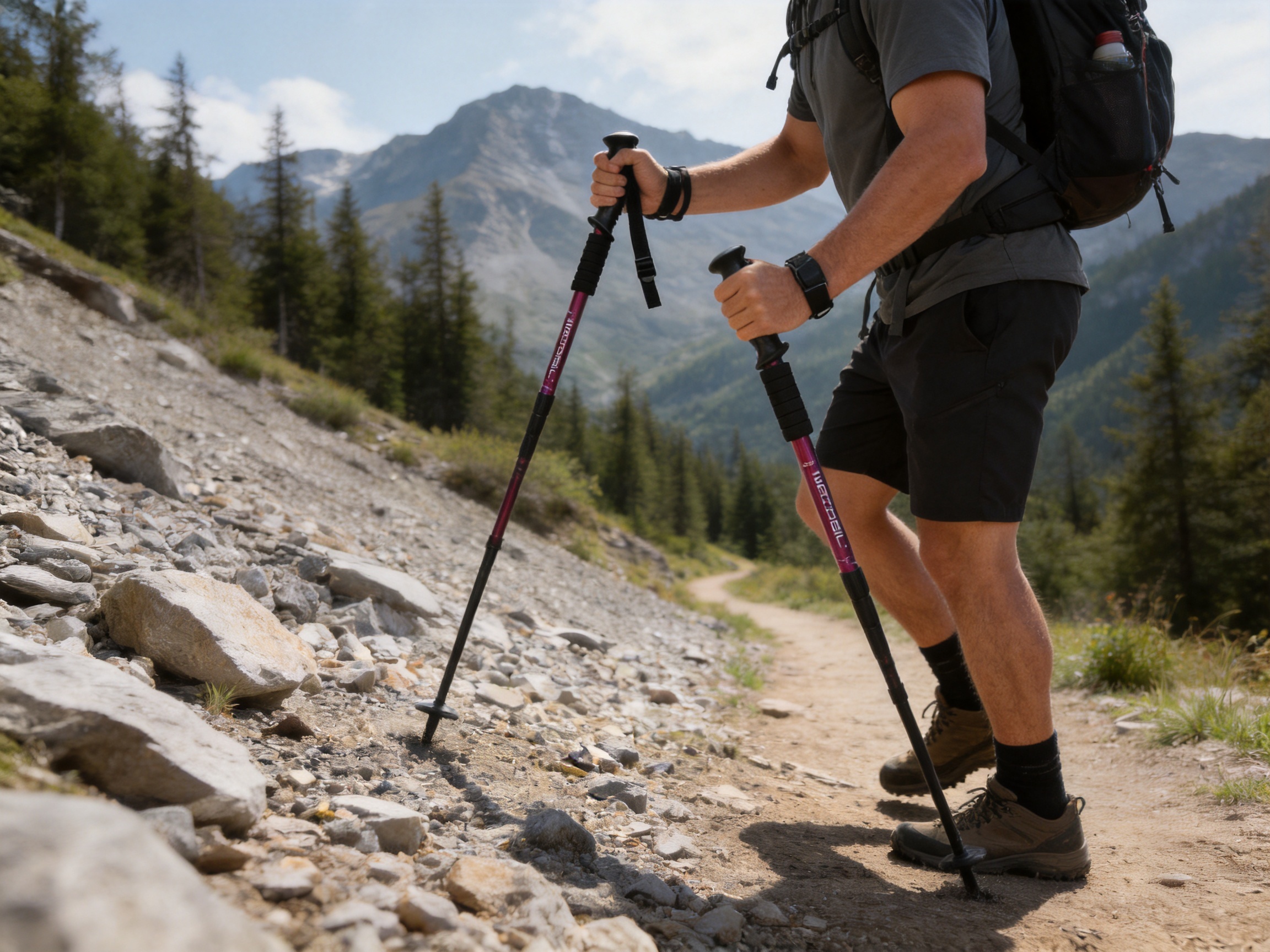
Correct adjustment is essential for comfort and control. On level ground, many users find a height that keeps the elbow slightly bent when the handle is held naturally. The exact position depends on body proportions, walking style, footwear, and personal preference.
When climbing, users may shorten the pole slightly to bring the hands closer to the body. When descending, a longer setting may provide better reach. Adjustments should be made before entering a difficult section whenever possible, and the internal lock should be checked after adjustment.
The wrist strap should be placed around the wrist from below according to the intended design of the strap. Users should avoid relying on an excessively tight grip. The strap and handle should work together so that the hand remains secure without unnecessary tension.
When walking with two poles, an alternating rhythm usually feels natural on moderate terrain. On steep or highly uneven sections, the user may place both poles forward for additional support. Pole tips should be positioned carefully, and the user should avoid placing the full body weight onto a pole in a way that exceeds normal product use.
After hiking, the poles should be wiped clean and allowed to dry before being collapsed for storage. Mud, sand, and moisture can affect internal components if they remain on the shaft for extended periods. Regular inspection can identify unusual looseness, damage, or wear before the next trip.
Maintenance and Service-Life Recommendations
Routine maintenance is simple but important. The telescopic sections should be kept free from heavy dirt and grit. If the pole has been used in wet conditions, it should be dried before storage. Users should not force the sections if they become difficult to rotate; instead, the cause should be checked and the components cleaned according to the product instructions.
The handle should be inspected for damage, especially after a fall or heavy impact. The strap should be checked for fraying or loose stitching. The spring shock absorption system should remain appropriately responsive and should not be ignored if it develops unusual noise or excessive movement.
Replacement parts and after-sales support can be discussed for OEM programs. Depending on the customer’s requirements, manufacturers may provide spare straps, tips, packaging components, or other service items. A clear after-sales process can strengthen long-term cooperation between the supplier and the buyer.
Why CragHaven Outdoor Is a Suitable Manufacturing Partner
CragHaven Outdoor is based in Hangzhou, China, and focuses on mountaineering, hiking, and camping applications. The company operates as both an outdoor brand and a cross-border manufacturing partner. Its product development philosophy is based on balance, stability, real-world use, and long-term value.
The company’s approach is not limited to listing technical parameters. It begins with the conditions in which outdoor products are used. Weather, terrain, time, carrying habits, and repeated handling all influence whether a product succeeds in the market. This perspective supports more practical decisions about materials, structures, and manufacturing details.
CragHaven Outdoor also emphasizes participation in design and manufacturing rather than relying only on factory sourcing. This creates a more direct connection between product requirements and production execution. Customers can communicate performance expectations, packaging needs, target pricing, and customization details with a partner that understands the product category.
China’s established outdoor manufacturing supply chain provides access to material suppliers, component producers, finishing facilities, packaging resources, and logistics services. When these resources are coordinated through a structured process, customers can benefit from efficient development and scalable production.
The company’s focus on sampling, testing, and optimization is particularly important for trekking poles. Small changes in handle shape, locking resistance, spring response, strap length, or shaft finish can influence the user experience. Repeated evaluation helps ensure that a product is practical rather than merely visually acceptable.
For global retailers and outdoor brands, communication quality is also a manufacturing strength. Clear specifications, timely sample feedback, consistent inspection records, and professional documentation help reduce misunderstandings. Long-term cooperation depends on stable processes as much as on the physical product.
Selection Guide for Buyers and Outdoor Users
Users choosing a trekking pole should first consider their main activity. Long-distance hikers may prioritize low weight, comfortable handling, and reliable adjustment. Backpackers may place greater emphasis on packed size and snag resistance. Mountain travelers may need impact comfort and flexible length adjustment. Casual walkers may value simplicity and easy handling.
The locking system should be selected according to adjustment habits. An internal lock is appropriate for users who prefer a smooth profile, compact structure, and integrated design. An external lock may be more suitable for users who change pole height very frequently and want a visible clamp.
Shaft material should be considered together with expected use. Aluminum alloy is a practical choice for customers who want a strong, serviceable, and cost-effective pole with low carrying weight. The product’s aerospace-grade aluminum alloy construction provides a suitable foundation for a broad range of outdoor activities.
Handle comfort should not be overlooked. A product may look impressive in photographs but become uncomfortable after several hours if the handle is poorly designed. The non-slip straight handle in this model is intended to support natural movement and extended use.
Shock absorption is another factor to evaluate. Users who frequently hike on firm surfaces, descend steep routes, or experience discomfort from vibration may appreciate a spring-assisted structure. The feature should be combined with proper technique and realistic expectations.
Q&A
What is an internal-lock trekking pole?
An internal-lock trekking pole uses an expansion mechanism located inside the shaft to secure telescopic sections. The user rotates the sections to release or tighten the mechanism. This creates a clean external profile and reduces the chance of snagging on clothing, vegetation, or backpack materials.
What are the main advantages of aluminum alloy trekking poles?
Aluminum alloy offers a useful balance of strength, low weight, durability, and production efficiency. It is suitable for users who want portable equipment that remains dependable during regular hiking, camping, and trekking. It is also practical for OEM production because it supports consistent tube processing and surface finishing.
Is an internal lock better than an external lock?
Neither system is universally better. An internal lock provides a streamlined structure, compact handling, and fewer exposed components. An external lock is often faster to adjust and easier to inspect visually. The best choice depends on whether the user prioritizes portability and clean design or rapid terrain-based adjustment.
How does the shock absorption system improve comfort?
The built-in spring moderates part of the vibration and impact created when the pole tip contacts the ground. This can make repeated contact feel smoother and may reduce discomfort in the hands, arms, and knees. It does not replace proper technique, suitable footwear, or careful movement.
Is the straight handle suitable for long-distance hiking?
Yes. A straight ergonomic handle allows users to vary their grip position and maintain a natural hand posture. When combined with the non-slip surface and adjustable wrist strap, it is suitable for extended walks and long-distance trekking.
Can the trekking pole be used for camping?
Yes. Its adjustable structure, low carrying weight, and compact profile make it suitable for camping routes, campsite access paths, travel, and general outdoor activities. Users should select the pole length and tip contact carefully according to the terrain.
What should retailers consider when purchasing this product?
Retailers should evaluate material quality, locking reliability, handle comfort, shock absorption, packaging, inspection procedures, customization options, minimum order requirements, and after-sales support. They should also request samples before placing a large order so the product can be assessed under realistic use conditions.
Can the product be customized for private-label sales?
Potential customization may include colors, printed logos, straps, packaging, labels, instructions, and product bundles. Specific options depend on order volume, production requirements, and the customer’s target market. Sampling is recommended before mass production.
How should the pole be maintained?
Keep the shaft sections clean and dry, remove dirt after use, inspect the handle and strap regularly, and avoid forcing the internal lock. The pole should be stored in a dry place after it has been cleaned and dried.
Who is this trekking pole designed for?
It is designed for hikers, backpackers, campers, mountaineers, recreational walkers, outdoor retailers, distributors, and private-label brands. Its combination of lightweight aluminum construction, internal locking, ergonomic grip, strap adjustment, and spring shock absorption supports a broad range of outdoor applications.
Conclusion
The ultralight internally locking aluminum alloy trekking pole is designed to provide practical support, comfort, and portability in a wide range of outdoor environments. Its aerospace-grade aluminum alloy shaft balances low weight with dependable structure. The internal lock creates a streamlined and pack-friendly profile. The straight non-slip handle supports natural grip positions, while the telescopic wrist strap improves control and reduces the need for constant squeezing. The built-in spring shock absorption system adds another layer of comfort during repeated contact and downhill movement.
Compared with basic rigid poles, the product offers a more complete user experience. Compared with external-lock designs, it provides a cleaner structure and lower snagging risk, while retaining adjustable functionality. Its value is not based on one isolated feature but on the coordinated performance of the entire system.
For global outdoor brands, retailers, and distributors, the product also represents a flexible OEM and private-label opportunity. CragHaven Outdoor combines application-focused product development, controlled material selection, sampling, testing, manufacturing coordination, and supply-chain experience. This creates a practical foundation for customers seeking reliable trekking equipment rather than short-term catalog products.
When properly adjusted and maintained, the trekking pole can support long-distance hiking, backpacking, camping, mountain travel, daily walking, and other outdoor activities. It reflects a manufacturing approach centered on real terrain, repeated use, user comfort, and stable long-term cooperation.
References
1. International Organization for Standardization. Walking Poles and Outdoor Equipment: General Product Safety and Performance Considerations.
2. American Society for Testing and Materials. Standard Practices for Mechanical Testing of Aluminum Alloy Components.
3. International Mountaineering and Climbing Federation. Recommendations for Safe Use of Trekking and Walking Poles.
4. Outdoor Industry Association. Consumer Trends in Hiking, Backpacking, and Camping Equipment.
5. Materials Science Reference Handbook. Aluminum Alloys in Lightweight Outdoor Product Construction.
6. Human Factors in Outdoor Equipment Design. Handle Ergonomics, Grip Control, and Repetitive-Use Comfort.
7. Manufacturing Quality Management Guide. Sampling, Inspection, Assembly Control, and Production Consistency for Outdoor Gear.
Product: Ultralight, internally locking aluminum alloy straight handle trekking pole with telescopic strap and shock absorption.



- Phone: +86-15968800379
- E-mail: [email protected]
- Address: Room 1002, Huishang Building, Gongshu District, Hangzhou City, Zhejiang Province.
Copyright © CragHaven Outdoor All Rights Reserved. Outdoor Gear Manufacturers Wholesale Mountaineering Camping Gear Suppliers
