

 English
 Deutsch
 Español
 Français
Aluminum Alloy External Lock Trekking Pole for Reliable Mountain Hiking
Content
- 1 Product Overview: A Three-Section Aluminum Trekking Pole Built for Outdoor Stability
- 2 Why Aluminum Alloy Remains a Practical Choice for Demanding Trekking Poles
- 3 External Locking System: Fast Adjustment and Secure Support
- 4 Three-Section Telescopic Design for Portability and Versatility
- 5 Straight Handle Design and User Control
- 6 Tungsten Steel Alloy Tip for Traction and Wear Resistance
- 7 Performance Advantages Over Ordinary Competitor Products
- 8 How the Pole Supports Long-Distance Hiking Performance
- 9 Applications in Mountain-Climbing, Camping, and Mixed Outdoor Use
- 10 Manufacturing Strength: From Outdoor Scenario Understanding to Stable Production
- 11 Key Manufacturing Processes Behind a Reliable Aluminum Trekking Pole
- 12 Quality Control and Testing for Outdoor Reliability
- 13 Supply Chain Advantages for Global Retailers and OEM Buyers
- 14 Design Philosophy: Built for Weather, Terrain, and Time
- 15 Buyer Considerations When Selecting Aluminum Trekking Poles
- 16 Market Positioning and Commercial Value
- 17 Maintenance and User Care for Longer Service Life
- 18 Why This Trekking Pole Delivers Long-Term Value
- 19 Q&A Section
- 19.1 What is the main advantage of this aluminum alloy trekking pole?
- 19.2 Why choose aluminum alloy instead of carbon fiber?
- 19.3 How does the external locking system improve hiking performance?
- 19.4 Is the three-section telescopic design suitable for travel?
- 19.5 What makes the tungsten steel alloy tip important?
- 19.6 How does this product compare with low-cost trekking poles?
- 19.7 Can this trekking pole be used for camping as well as hiking?
- 19.8 Why is manufacturing quality important for trekking poles?
- 19.9 What strengths does CragHaven Outdoor bring as a manufacturing partner?
- 19.10 Is this trekking pole suitable for OEM or private label programs?
- 20 Conclusion
- 21 References
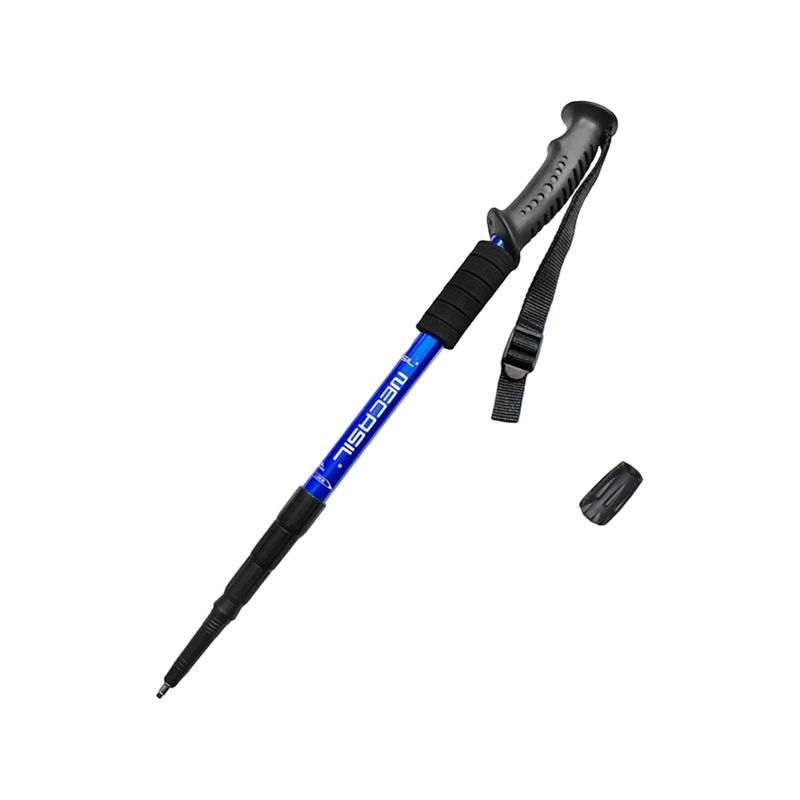
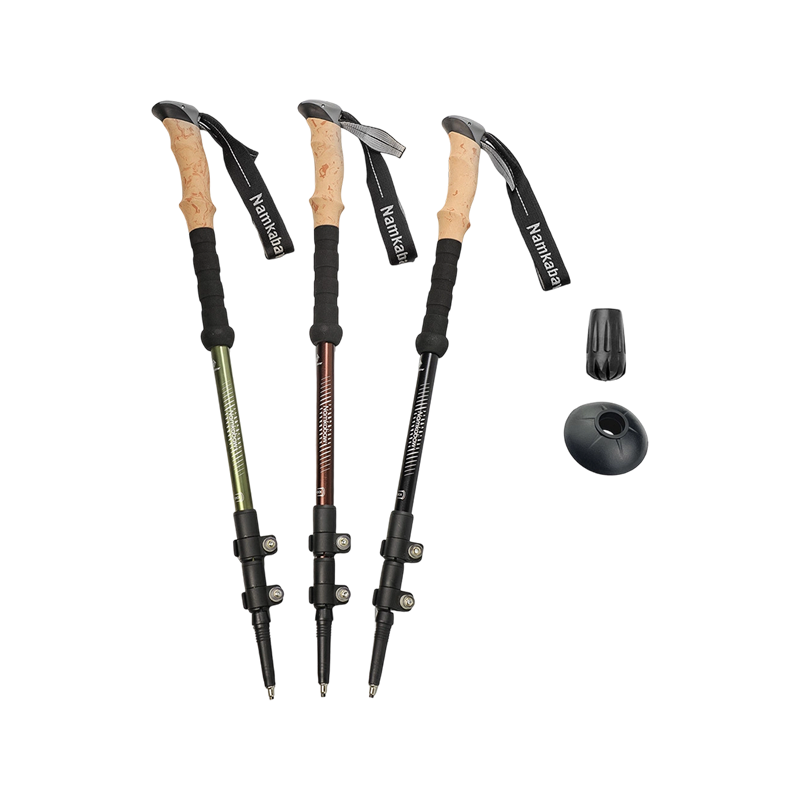
- 22 Product: Aluminum alloy three-section telescopic folding external locking trekking pole straight handle
Long-distance hiking, mountain trekking, and camping travel all place repeated stress on the body and on outdoor equipment. A trekking pole must support balance, reduce impact on the knees, adapt to changing terrain, and remain dependable after thousands of steps on stone, soil, snow, mud, and forest paths. The aluminum alloy three-section telescopic folding external locking trekking pole with straight handle is designed for these real outdoor conditions. It combines a durable aluminum alloy shaft, a 3LS external locking speed adjustment system, a compact three-section structure, and a wear-resistant tungsten steel alloy tip to provide stable support for hikers, mountaineers, campers, and outdoor gear buyers.
This trekking pole is not simply a walking accessory. It is a structural support tool for outdoor movement. When a hiker climbs a steep trail, descends a loose slope, crosses a stream, or walks for hours with a loaded backpack, the pole must handle vertical pressure, lateral force, repeated adjustment, and rough surface contact. The product’s design responds to these requirements through material selection, locking reliability, portability, and manufacturing consistency. Compared with many ordinary trekking poles that focus only on appearance or low price, this model emphasizes practical performance, long-term durability, and stable use in real terrain.
CragHaven Outdoor positions this trekking pole within a broader product philosophy: outdoor gear should be designed for weather, terrain, and time, not merely for catalogs. The company’s manufacturing approach combines outdoor scenario understanding with China’s mature production capabilities, helping global retailers, distributors, and OEM buyers obtain reliable mountaineering, hiking, and camping equipment. For buyers seeking an aluminum trekking pole supplier or an external lock trekking pole factory partner, this product represents a combination of functional design and scalable manufacturing.
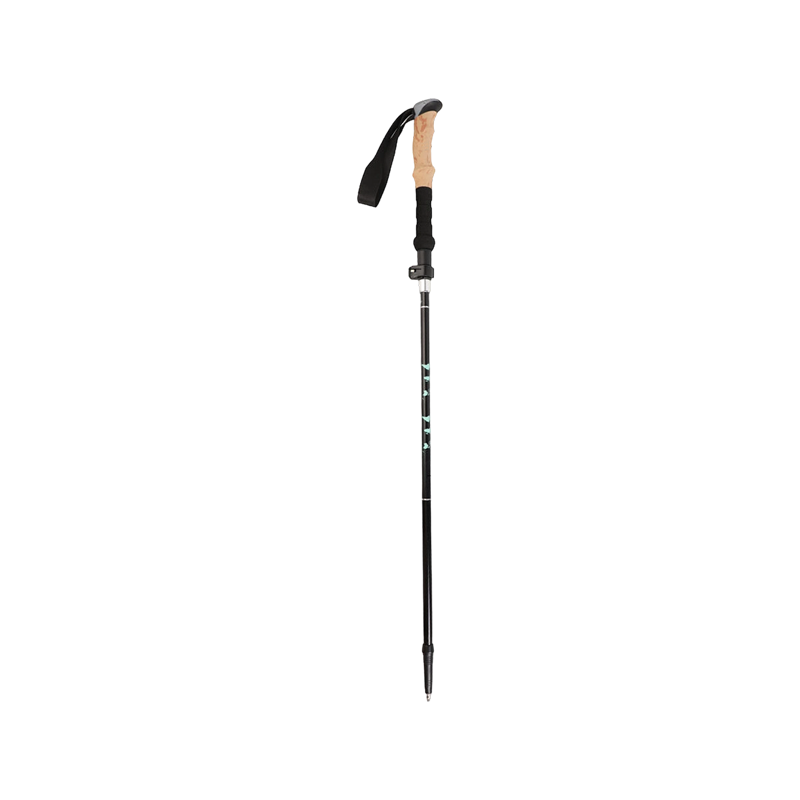
Aluminum alloy three-section telescopic folding external locking trekking pole straight handle
Product Overview: A Three-Section Aluminum Trekking Pole Built for Outdoor Stability
The aluminum alloy three-section telescopic folding external locking trekking pole features a straight handle and a compact adjustable structure. Its three-section telescopic shaft allows the pole to be shortened for transportation and extended for trail use. This design is especially useful for mountaineering and camping users who need to store poles on backpacks, inside luggage, or with other outdoor gear. Portability matters because long-distance travelers often carry tents, cookware, clothing layers, sleeping systems, and safety equipment. A trekking pole must not become a burden; it must remain compact, light enough to carry, and strong enough to perform when needed.
The shaft is made from high-strength aluminum alloy, a material widely used in trekking poles because it balances durability, impact resistance, and reasonable weight. Aluminum alloy does not only provide structural rigidity; it also tolerates repeated knocks and pressure better than many fragile low-grade alternatives. In rugged mountain environments, poles may hit rock edges, become wedged between stones, or experience sudden side loading when a user slips. A quality aluminum shaft is more forgiving in such situations than weak materials that may crack or fail suddenly.
The 3LS external locking speed adjustment system is another defining feature. External locks are preferred by many hikers because they are easy to see, quick to operate, and more convenient to adjust with gloves or cold hands. A reliable external lock allows users to change length when climbing, descending, or moving across uneven terrain. When compared with older twist-lock mechanisms, external lever locks are often easier to inspect and less likely to become frustrating during rapid trail adjustments. The one-button lock concept supports fast, secure length control and reduces downtime during movement.
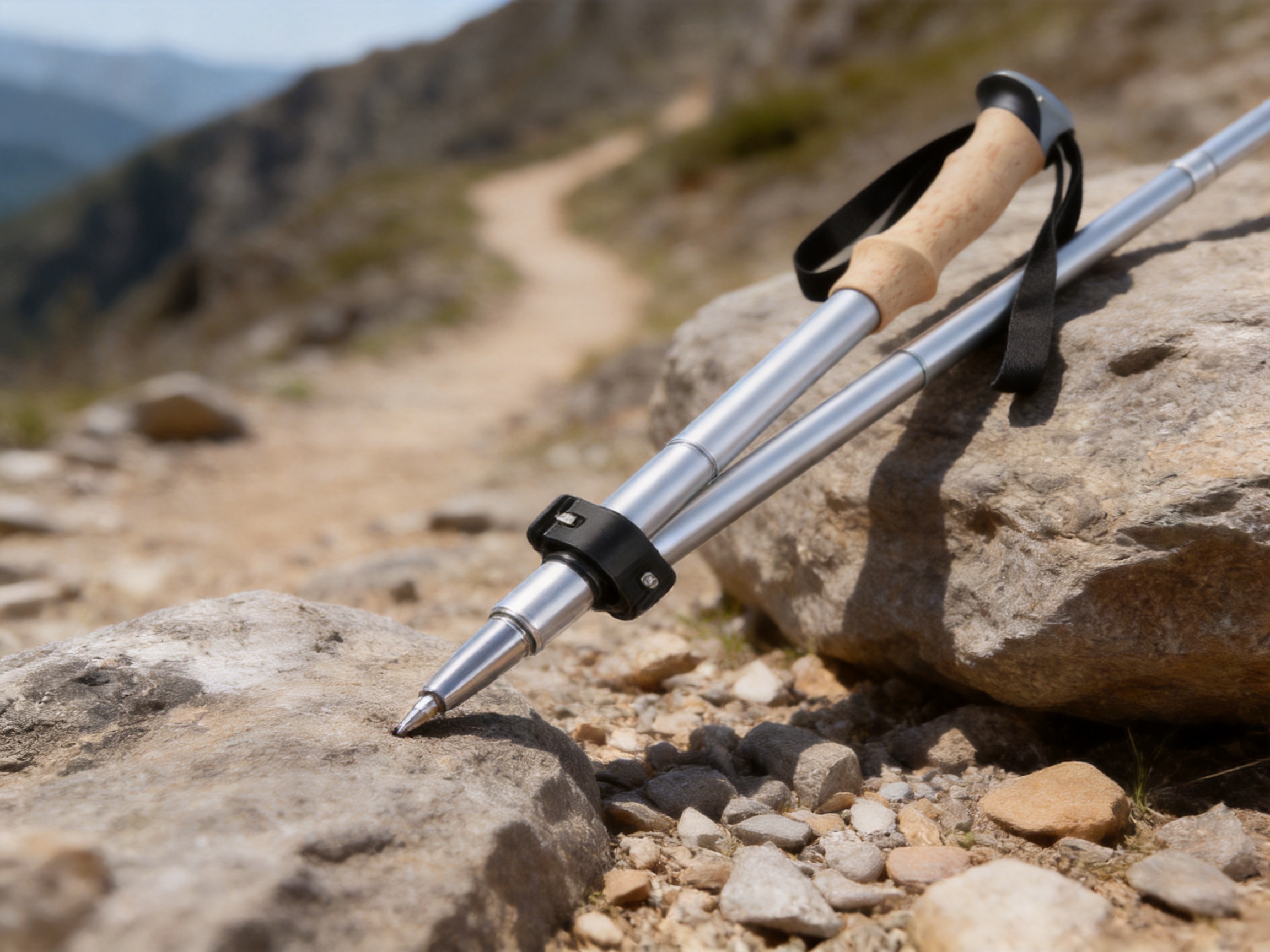
The pole also uses a wear-resistant, non-slip tungsten steel alloy tip. The tip is the point of contact between the trekking pole and the ground, so it directly affects traction and service life. On rocky surfaces, a soft or low-grade tip can wear quickly, reducing grip and making the pole less stable. Tungsten steel alloy tips provide stronger abrasion resistance and better biting performance on hard terrain. For users walking on mixed surfaces, including gravel, packed soil, mountain paths, and stone steps, this detail significantly improves the practical value of the product.
Why Aluminum Alloy Remains a Practical Choice for Demanding Trekking Poles
Outdoor gear buyers often compare aluminum trekking poles with carbon fiber trekking poles. Carbon fiber is known for light weight and vibration absorption, but aluminum alloy remains a preferred option for many demanding applications because of its impact resistance and cost-performance balance. Long-distance hiking and mountaineering do not always happen on smooth trails. They often involve sudden slips, unpredictable side pressure, heavy backpack loads, and accidental knocks against rock. In these conditions, aluminum alloy offers dependable toughness.
One of the main advantages of aluminum alloy is its ability to deform under extreme force rather than shatter abruptly. While any material can fail if overloaded, quality aluminum tends to provide visible signs of damage, allowing users to identify problems before complete failure. This characteristic is valuable in the outdoors, where equipment failure may create safety concerns. By contrast, some lightweight composite materials can be more sensitive to sharp impacts or hidden internal damage. For professional buyers, rental programs, and brands serving a wide user base, aluminum often offers greater tolerance across different user habits and environments.
Aluminum alloy also supports stable mass production. Tube forming, surface treatment, locking assembly, and quality inspection can be standardized to create consistent products across batches. This is important for global retailers and distributors, who need product consistency in strength, appearance, adjustment performance, and packaging. A trekking pole line that performs well in one sample but varies widely in production can lead to customer complaints. CragHaven Outdoor emphasizes sampling, testing, and optimization as standard procedures, helping reduce uncertainty in supply chain outcomes.
For end users, aluminum trekking poles provide a practical balance between weight and strength. A pole that is too heavy becomes tiring after hours of use, while a pole that is too fragile creates insecurity. The aluminum alloy shaft in this model is designed to remain lightweight enough for mountaineering and hiking while still delivering high-strength performance. This is why aluminum trekking poles continue to be popular among serious hikers, outdoor clubs, entry-level mountaineers, camping travelers, and distributors targeting reliable mid-to-high value equipment.
External Locking System: Fast Adjustment and Secure Support
The 3LS external locking speed adjustment system is one of the product’s most important competitive advantages. Trekking pole length is not fixed during outdoor travel. Hikers often shorten poles during uphill climbing to improve leverage and lengthen them during downhill sections to reduce knee impact and increase reach. On side slopes, users may adjust one pole shorter and the other longer. A locking system that is difficult to operate can interrupt rhythm, while an unreliable system can compromise safety.
External lever locks offer several practical advantages over traditional internal twist locks. First, they are easier to operate visually. The user can immediately see whether the lock is open or closed. Second, they are easier to adjust with gloves, wet hands, or cold fingers. Third, they are easier to clean and inspect after muddy or dusty conditions. Fourth, they generally provide a strong clamping force when properly designed and assembled. These features make external locks suitable for mountain trekking, winter travel, camping routes, and long-distance hiking.
The one-button secure locking concept reduces complexity for users. Outdoor equipment should be intuitive because hikers may need to adjust gear quickly in changing weather, low light, or difficult terrain. A good external lock should close firmly without requiring excessive force, hold the shaft without slipping, and remain stable after repeated use. Poorly designed locks may loosen, crack, or slip under load. This model addresses those concerns through an external speed adjustment system intended for secure and reliable fixation.
For distributors and OEM customers, the locking system is also a major quality differentiator. Many market complaints about trekking poles are related to slipping locks, loose adjustment, broken levers, or inconsistent clamping. A stable external locking mechanism improves customer satisfaction because users immediately notice whether a trekking pole feels secure. CragHaven Outdoor’s manufacturing approach places importance on function-first development, meaning that components such as locks are not treated as decorative accessories but as essential mechanical parts that must survive repeated outdoor use.
| Feature | External Lock Trekking Pole | Basic Twist Lock Trekking Pole | Low-Cost Fixed Pole |
|---|---|---|---|
| Adjustment Speed | Fast and convenient for changing terrain | Moderate, often requires more twisting | No adjustment or limited adjustment |
| Ease of Inspection | Lock position is visible | Internal mechanism is harder to inspect | Simple but less versatile |
| Glove-Friendly Use | Generally easier to operate | Can be difficult in cold or wet conditions | Not applicable |
| Terrain Adaptability | High, suitable for climbing and descending | Moderate to high depending on quality | Lower, limited to specific use |
| Maintenance Convenience | Easy to clean and check | May require more disassembly | Simple but less functional |
Three-Section Telescopic Design for Portability and Versatility
The three-section telescopic structure is designed for hikers who need a pole that can travel easily and adapt to different body heights and terrain requirements. A single fixed-length pole can be strong, but it is inconvenient for storage and unsuitable for varied users. A two-section pole can provide adjustment, but it may still be longer when collapsed. The three-section structure creates a practical balance between compact packing length, adjustable use, and structural stability.
For mountaineering and camping scenarios, packability matters. Users may need to attach poles to the side of a backpack during climbing sections, place them inside a vehicle during travel, or store them with other gear during air or train transportation. A three-section telescopic pole can be shortened when not in use, reducing interference with branches, rocks, public transportation spaces, or storage rooms. This makes it attractive not only to individual hikers but also to retailers selling complete outdoor travel systems.
The telescopic design also allows user-specific adjustment. Different hikers require different pole lengths depending on height, walking style, slope angle, and terrain. On flat ground, a common pole length allows the elbow to remain around a comfortable right angle. On steep ascents, shortening the pole improves pushing efficiency. On descents, extending the pole helps absorb shock and maintain control. The external locking mechanism makes these adjustments practical during actual trail use.
Compared with folding-only designs, telescopic poles are often valued for their wide adjustment range and straightforward maintenance. Folding poles can be extremely compact, but they may use internal cords or more complex link structures. This product’s telescopic construction keeps adjustment intuitive while still providing portability. For OEM and wholesale buyers, the three-section telescopic format offers broad market appeal because it suits beginners, experienced hikers, camping travelers, and general outdoor customers.
Straight Handle Design and User Control
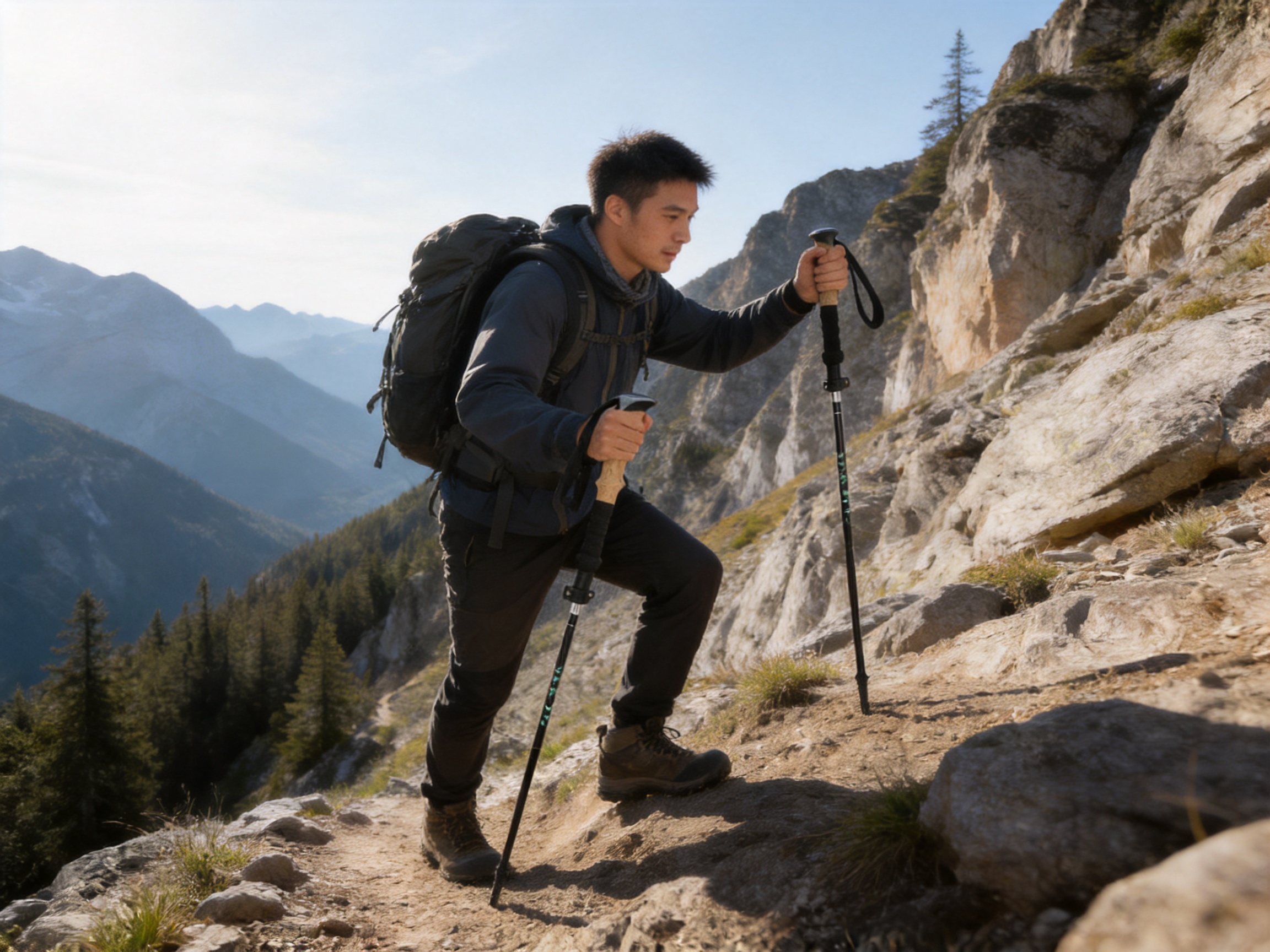
The straight handle design provides direct control and familiar handling. A trekking pole handle must support grip comfort, wrist movement, and pressure transfer. During long hikes, even small discomfort can become noticeable after thousands of repetitions. A well-designed straight handle allows the user to hold the pole naturally and position the wrist strap for support. The handle shape should not force awkward wrist angles or create pressure points that lead to fatigue.
In rugged terrain, control is more important than decorative styling. The handle must help the user plant the tip precisely between stones, beside roots, or into compact soil. A straight handle supports predictable pole placement, which improves balance when carrying a backpack or moving across uneven ground. It is especially useful for users who prefer simple, stable equipment without unnecessary complexity.
Handle material and ergonomic shaping can also affect performance in different weather conditions. Outdoor grips must remain comfortable in cold, heat, moisture, and dust. While the provided product information highlights the straight handle rather than a specific grip material, the overall design direction emphasizes practicality and outdoor reliability. CragHaven Outdoor’s product development philosophy prioritizes features that solve real usage problems, and handle comfort is one of the most direct usage factors in trekking pole design.
For competing trekking poles, handle quality is often an area where low-cost products compromise. Poor handles may feel slippery, hard, or poorly shaped. They may also deteriorate quickly under sunlight, sweat, or repeated pressure. A professional trekking pole should maintain handling confidence throughout the route. Combined with the aluminum shaft and external locking system, the straight handle contributes to a product that is easy to control, carry, and trust.
Tungsten Steel Alloy Tip for Traction and Wear Resistance
The tip of a trekking pole is a small component with major importance. Every pole plant depends on the tip contacting the ground securely. If the tip slips, the user may lose confidence or balance. If the tip wears quickly, the pole’s service life declines. This product uses a wear-resistant, non-slip tungsten steel alloy tip, providing a key advantage over trekking poles with low-grade steel or soft tips.
Tungsten steel alloy is valued for hardness and abrasion resistance. In outdoor use, the tip repeatedly contacts rock, gravel, compact soil, and trail surfaces. A hard, durable tip maintains its shape longer, helping preserve traction. This is especially important for mountain trails where a pole must bite into small surface irregularities. A rounded or worn tip may slide more easily on stone, reducing stability.
The non-slip performance of the tip also improves user confidence. When descending, hikers often place poles ahead of the body to reduce pressure on the knees. If the tip grips well, the pole can absorb some of the load and provide controlled movement. When crossing uneven rocks or muddy sections, a reliable tip helps users test surface stability before stepping. In this sense, the tip is part of a safety-support system rather than a minor accessory.
For wholesale buyers, tip durability affects after-sales satisfaction. Customers may judge trekking pole quality based on visible wear after early use. A product equipped with a tungsten steel alloy tip can better meet expectations for durability and performance. Combined with proper packaging and accessory options such as baskets or rubber protectors, this feature can support strong market positioning in hiking, camping, and mountaineering channels.
Performance Advantages Over Ordinary Competitor Products
The trekking pole market includes a wide range of products, from very basic low-cost poles to premium ultralight models. This aluminum alloy external lock trekking pole competes by delivering practical reliability rather than relying on extreme specifications or decorative features. Its advantages can be understood in four major areas: structural strength, adjustment convenience, terrain traction, and supply consistency.
First, the aluminum alloy shaft provides strong impact resistance. Many entry-level poles use low-grade materials or insufficient wall thickness, which may bend too easily or feel unstable under load. A durable aluminum shaft helps the pole maintain stiffness during backpacking and mountain walking. For users who hike on rocky paths or carry heavy equipment, this strength is more valuable than minor weight savings.
Second, the 3LS external locking system offers quick and secure adjustment. Competitor products with weak locks may slip during downhill pressure, causing sudden instability. Others may require complicated twisting, making trail adjustment inconvenient. A reliable external lock helps users adapt quickly to different slope angles and terrain changes. This is a clear practical advantage that users can feel immediately.
Third, the tungsten steel alloy tip improves wear resistance and grip. Low-cost poles may use tips that dull or wear rapidly, especially on stone trails. Once the tip loses shape, the pole becomes less stable. A wear-resistant tip extends useful performance and improves traction, supporting a better user experience.
Fourth, CragHaven Outdoor’s manufacturing strengths help distinguish the product in B2B markets. Product quality is not only about design; it is also about material control, assembly accuracy, testing, and batch consistency. Buyers need suppliers who understand outdoor usage and can transform design intent into stable production. The company’s focus on sampling, testing, optimization, and long-term partnerships supports more dependable sourcing outcomes than simple factory trading.
How the Pole Supports Long-Distance Hiking Performance
Long-distance hiking challenges the body through repetitive movement. Knees, ankles, hips, shoulders, and back all experience stress over time. Trekking poles help distribute some of that load from the lower body to the upper body. When used correctly, poles can reduce knee pressure during descents, improve rhythm on flat ground, and provide additional propulsion during climbs. This product’s stability and adjustability make it suitable for these demands.
On uphill trails, shortening the poles allows users to push down and back, helping engage the arms and shoulders. The aluminum shaft must resist bending under this repeated force. The external lock must hold the selected length firmly. If a pole slips during climbing, energy is wasted and confidence is reduced. The secure adjustment system therefore contributes directly to hiking efficiency.
On downhill sections, users often lengthen poles and plant them ahead of the body. This helps control speed and reduce impact on the knees. The tungsten steel alloy tip plays an important role here, because downhill force can cause slipping if the tip does not grip well. The pole’s overall rigidity also matters because a flexing or unstable pole feels less trustworthy when the user depends on it for braking support.
On uneven ground, poles provide additional contact points. A hiker with two poles effectively moves with four points of support, improving balance on rocks, roots, stream crossings, and loose soil. The three-section telescopic design allows users to adapt pole length to unpredictable terrain. The straight handle helps guide precise placement. These features work together to improve movement safety and comfort during long routes.
Applications in Mountain-Climbing, Camping, and Mixed Outdoor Use
This trekking pole is suitable for multiple outdoor scenarios, including mountain climbing approaches, long-distance hiking, camping travel, backpacking, and general trail walking. In mountain environments, the pole supports balance during elevation changes and helps reduce fatigue over long approaches. While technical climbing requires specialized equipment, trekking poles are widely used before and after climbing sections, especially on access trails, ridgelines, and descents.
For camping trips, trekking poles help users move while carrying heavier packs. Campers often carry tents, food, water, cooking equipment, and sleeping bags. The additional weight increases pressure on the knees and ankles. A strong aluminum trekking pole provides support when walking to campsites, gathering water, or moving around uneven outdoor areas. Its compact three-section structure also makes it easy to store when camp is established.
For hiking clubs and outdoor retailers, the product serves a broad audience. Beginners appreciate the easy adjustment and stable feel. Experienced hikers value the durability and practical construction. Travelers benefit from packability. Distributors can position the pole as a dependable aluminum trekking pole for customers who prefer rugged reliability over fragile ultralight designs.
The pole is also suitable for mixed weather use. Outdoor equipment may encounter rain, dust, mud, cold mornings, and intense sunlight. Aluminum alloy construction and visible external locks make cleaning and inspection easier after use. The tip’s wear resistance supports performance on abrasive terrain. These characteristics make the pole a practical choice for customers who need versatile equipment rather than a product limited to ideal conditions.
Manufacturing Strength: From Outdoor Scenario Understanding to Stable Production
A trekking pole’s real quality depends on much more than a material list. Manufacturing decisions determine whether the shaft sections fit smoothly, whether the lock holds securely, whether the tip is installed correctly, whether the surface treatment resists wear, and whether the final product performs consistently across batches. CragHaven Outdoor’s strength lies in connecting outdoor product understanding with manufacturing execution.
The company is based in Hangzhou, China, and operates as an outdoor brand and cross-border manufacturing partner. Its focus includes mountaineering, hiking, and camping scenarios. This matters because a supplier that understands actual outdoor use can make better decisions about product structure, material selection, and quality priorities. Rather than treating trekking poles as simple commodity items, the company approaches them as tools that must perform under weather, terrain, and time.
The development process begins with scenario-based product thinking. Designers and product teams consider how the pole will be used: repeated length adjustment, rocky impact, backpacking pressure, storage needs, and buyer requirements for global markets. This approach helps avoid unnecessary features while focusing on parts that matter most, including shaft strength, lock reliability, portability, grip control, and tip durability.
Material selection is another important strength. Aluminum alloy must be chosen for appropriate strength, processability, and weight. The locking components must provide stable clamping without premature failure. The tungsten steel alloy tip must resist abrasion. Surface treatment must support appearance and durability. By selecting materials for long-term reliability rather than short-term trends, the company supports better value for retailers and end users.
Key Manufacturing Processes Behind a Reliable Aluminum Trekking Pole
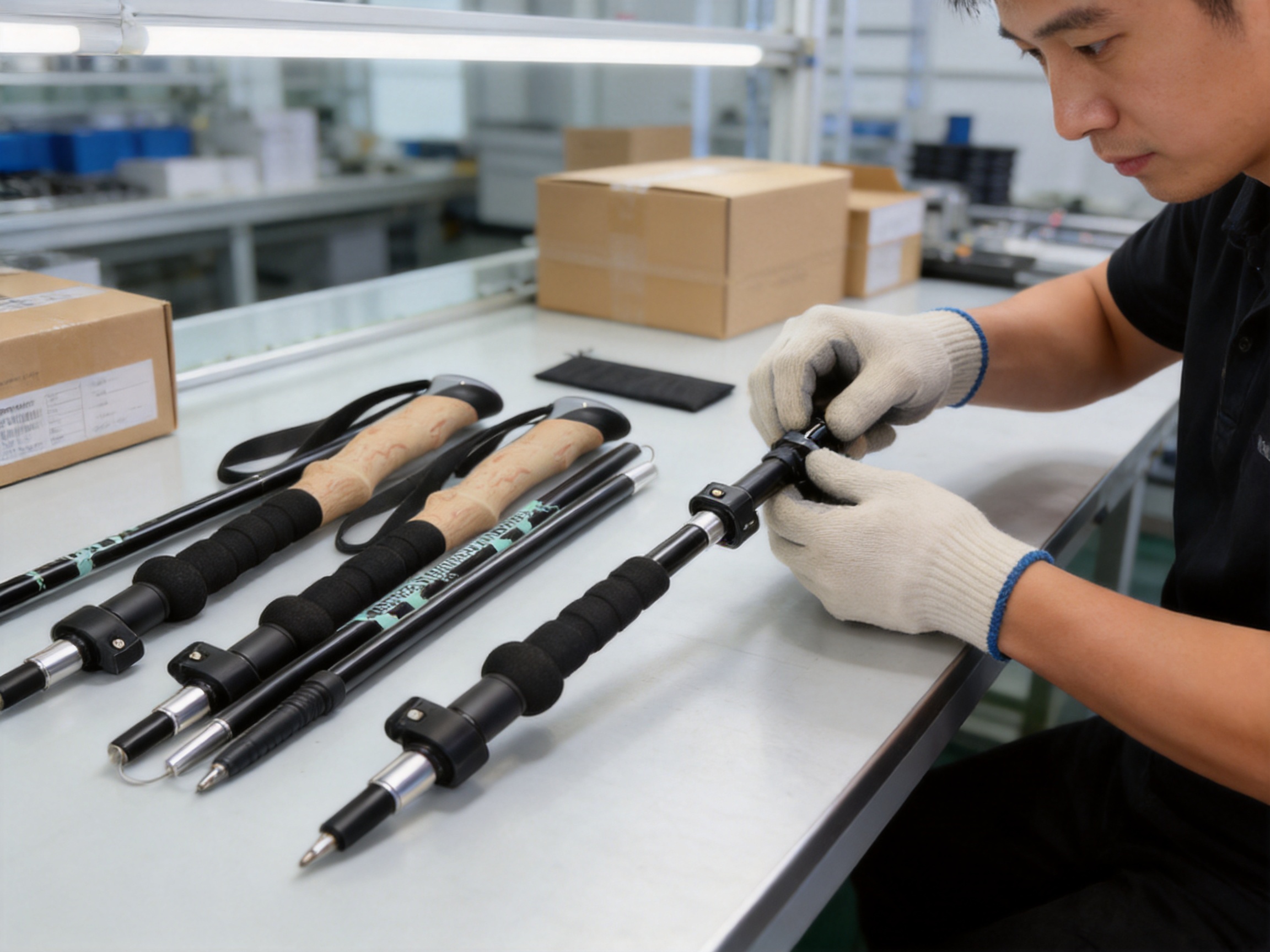
The manufacturing of a quality aluminum trekking pole typically includes tube preparation, forming, cutting, surface treatment, lock fitting, handle installation, tip assembly, inspection, and packaging. Each stage affects final performance. A small tolerance error in shaft diameter can influence telescopic movement and lock holding force. Poor surface finishing may affect corrosion resistance or appearance. Improper tip assembly may reduce durability. Therefore, process control is essential.
Tube forming and sizing are critical because the three telescopic sections must slide smoothly while maintaining stability. If the fit is too loose, the pole may rattle or feel unstable. If it is too tight, adjustment becomes difficult. Proper forming and dimensional control help achieve the correct balance. The aluminum tubes must also maintain consistent wall thickness and straightness to provide reliable strength.
Surface treatment contributes to both durability and brand presentation. Outdoor poles are exposed to moisture, dirt, abrasion, and hand contact. A controlled surface process can improve resistance to wear and oxidation while giving the pole a professional appearance. For OEM buyers, consistent surface color and finish across batches are important for retail quality perception.
Lock assembly requires precision. The external locking system must be positioned correctly and tightened to provide secure clamping without damaging the shaft. Lever movement should feel firm and controlled. The lock should hold under expected load and remain usable after repeated adjustment. Quality inspection at this stage helps prevent one of the most common trekking pole problems: length slippage during use.
Tip installation also requires attention. A tungsten steel alloy tip must be fixed securely into the lower section so it does not loosen under repeated ground impact. The angle, fit, and finishing of the tip area all influence performance. Since the tip experiences direct terrain contact, reliable assembly protects both product function and customer satisfaction.
| Manufacturing Stage | Quality Focus | Impact on User Experience |
|---|---|---|
| Aluminum Tube Selection | Strength, wall consistency, suitable alloy properties | Stable support and long service life |
| Tube Forming and Cutting | Straightness, diameter accuracy, smooth section fit | Easy adjustment and reduced rattling |
| Surface Treatment | Wear resistance, appearance consistency, oxidation resistance | Better durability and retail presentation |
| External Lock Assembly | Clamping force, lever strength, repeated operation stability | Secure length fixation during hiking |
| Handle and Strap Installation | Grip comfort, alignment, assembly strength | Improved control and reduced hand fatigue |
| Tungsten Tip Assembly | Firm installation, abrasion resistance, traction performance | Reliable grip on rock, soil, and mixed terrain |
| Final Inspection | Adjustment, appearance, load performance, packaging | Consistent product quality for global buyers |
Quality Control and Testing for Outdoor Reliability
Testing is essential because trekking poles must perform under repeated stress, not just look acceptable at the factory. CragHaven Outdoor emphasizes sampling, testing, and optimization as processes that cannot be omitted. This is especially important for external lock trekking poles because the locking system is a mechanical component that must hold under pressure and repeated use.
Quality control can include visual inspection, dimensional checks, locking force assessment, telescopic adjustment testing, tip fixation inspection, surface finish review, and packaging verification. For B2B customers, these steps help reduce returns and protect brand reputation. Outdoor products are often used far from stores or service centers, so reliability must be built into the product before shipment.
Repeated adjustment testing is particularly relevant. A trekking pole may be opened and closed many times during a single journey. The lock should not become loose after ordinary use. The telescopic sections should continue to slide smoothly. The shaft should not show abnormal deformation under normal loads. By checking these characteristics during development and production, the manufacturer improves real-world reliability.
Load-related testing is also important. Trekking poles are not designed to replace technical safety equipment, but they must support significant body pressure during hiking. Controlled testing can help verify that the shaft, locks, and tips meet expected performance. For retailers and OEM customers, documented quality expectations and consistent inspection standards create confidence when scaling orders.
Packaging inspection should not be overlooked. A well-made trekking pole can still arrive damaged if packaging is insufficient. Export-oriented manufacturing requires attention to transportation conditions, carton strength, accessory arrangement, and labeling accuracy. CragHaven Outdoor’s cross-border manufacturing experience supports global supply requirements, helping buyers receive products that are ready for distribution.
Supply Chain Advantages for Global Retailers and OEM Buyers
Outdoor gear buyers need more than a product sample. They need a supplier who can support communication, customization, production consistency, and long-term cooperation. CragHaven Outdoor aims to reduce uncertainty in the supply chain by participating in both design and manufacturing, not just factory sourcing. This distinction is important for international buyers who require stable quality and professional communication.
The company’s Western-market-oriented communication helps bridge the gap between product concept and production execution. Global retailers may need specific packaging, branding, color options, accessory kits, or compliance-related documentation. A manufacturing partner that understands retail expectations can help organize these details efficiently. This reduces misunderstanding and supports smoother product launches.
OEM customization is especially relevant for trekking poles. Buyers may request different grip materials, shaft colors, printed logos, baskets, rubber tips, packaging styles, or length ranges. A strong manufacturing partner can evaluate which changes are practical while maintaining performance. Customization should never compromise structural reliability. CragHaven Outdoor’s product-development mindset helps balance market differentiation with outdoor function.
Scalability is another advantage. China’s mature manufacturing system allows stable production when processes are properly managed. For seasonal outdoor products, timing matters. Retailers often prepare inventory before spring and summer hiking seasons or before regional camping peaks. A supplier with organized production and export experience can better support delivery schedules and reduce procurement risk.
Design Philosophy: Built for Weather, Terrain, and Time
The best outdoor products are not defined only by technical parameters. They are defined by how well they continue to work after real use. CragHaven Outdoor’s philosophy states that products should be designed for weather, terrain, and time. This perspective is highly relevant to trekking poles because their value appears through repeated contact with the environment.
Weather affects grip comfort, lock operation, and material durability. Terrain affects tip wear, shaft impact, and user stability. Time affects all components through repeated adjustment, pressure, storage, and transport. A trekking pole that looks attractive in a catalog but slips after several hikes does not deliver long-term value. A pole that performs consistently across many trips creates trust.
This product reflects that philosophy through its practical features. The aluminum alloy shaft supports impact resistance. The three-section telescopic design supports portability over many travel situations. The 3LS external locking system supports fast and reliable adjustment. The tungsten steel alloy tip supports traction and wear resistance. None of these features are purely decorative; each one addresses a real usage problem.
For distributors, this design philosophy can become a selling point. Customers increasingly recognize that outdoor products must be durable and functional. A product story based on real terrain and long-term value is stronger than one based only on low price. By offering a trekking pole with practical construction and manufacturing reliability, retailers can position it as a dependable choice for hiking and camping customers.
Buyer Considerations When Selecting Aluminum Trekking Poles
When choosing an aluminum trekking pole for retail, wholesale, or OEM programs, buyers should evaluate several factors. The first is shaft quality. Aluminum alloy should provide a balance of strength and manageable weight. Buyers should consider tube thickness, section fit, surface treatment, and overall rigidity. A pole that feels unstable in hand may create negative customer impressions even before trail use.
The second factor is locking performance. External locks should close securely, operate smoothly, and hold under load. Buyers should test adjustment repeatedly rather than judging only the first operation. Lock parts should not feel brittle or poorly aligned. Since lock failure is one of the most common customer complaints, this component deserves careful attention.
The third factor is tip quality. Tungsten steel alloy tips provide a meaningful advantage for rocky and mixed terrain. Buyers should check whether the tip is firmly installed and whether accessory options are available for different surfaces. Rubber protectors may be useful for pavement, while baskets may support mud, snow, or soft ground depending on the target market.
The fourth factor is supplier capability. A low quotation is not enough if production quality is inconsistent. Buyers should evaluate whether the supplier understands outdoor use, offers sampling and testing, supports customization, communicates professionally, and can maintain stable production. CragHaven Outdoor’s role as a cross-border manufacturing partner makes it suitable for buyers seeking long-term cooperation rather than one-time sourcing.
Market Positioning and Commercial Value
The aluminum alloy three-section telescopic external locking trekking pole is well positioned for retailers and brands that want a durable, practical, and competitively priced hiking support product. It can be marketed to outdoor beginners who need confidence, experienced hikers who need reliability, campers carrying heavier gear, and general travelers who require compact storage. Its features are easy for customers to understand because they relate directly to real use.
The aluminum alloy shaft can be promoted as strong and impact resistant. The external lock can be promoted as fast and secure. The three-section structure can be promoted as portable and adjustable. The tungsten steel alloy tip can be promoted as wear resistant and non-slip. These selling points are concrete, functional, and relevant across global outdoor markets.
Compared with premium ultralight carbon fiber poles, this product offers better ruggedness and value for many users. Compared with cheap entry-level poles, it offers stronger construction, better adjustment, and improved tip durability. This middle-to-strong performance position can be commercially attractive because it reaches a broad customer base without relying on extreme pricing or niche specialization.
For OEM buyers, the model can serve as a foundation for private label development. Branding, colors, packaging, accessories, and market-specific presentation can be customized while retaining the core performance structure. This makes the product suitable for outdoor gear chains, e-commerce retailers, camping brands, promotional outdoor programs, and specialty hiking distributors.
Maintenance and User Care for Longer Service Life
Even a durable trekking pole benefits from proper care. Users should clean dirt and sand from telescopic sections after muddy hikes, especially before collapsing the pole for storage. Fine particles can affect smooth adjustment over time. After wet use, the pole should be dried before long-term storage to help preserve components and appearance.
The external locks should be inspected periodically. Users can check whether the levers close firmly and whether the pole sections remain secure under pressure. If adjustment is possible, lock tension should be set appropriately according to the product design. Users should avoid overtightening beyond normal requirements because excessive force may shorten component life.
The tungsten steel alloy tip should also be checked. Although it is wear resistant, all ground-contact parts experience gradual wear. Users should remove mud or stones from the tip area and use rubber protectors when walking extensively on pavement or indoor surfaces. This helps protect both the tip and the walking surface.
During transportation, poles should be collapsed and secured to prevent bending or impact damage. When attached to backpacks, tips should face a safe direction to avoid injury or fabric damage. These simple maintenance habits help users receive the full value of the product’s aluminum construction, locking system, and durable tip.
Why This Trekking Pole Delivers Long-Term Value
Long-term value in outdoor equipment comes from the relationship between performance, durability, comfort, and cost. A very cheap pole that fails quickly becomes expensive through replacement and dissatisfaction. A highly specialized pole may be excellent for a narrow group but unsuitable for general customers. This aluminum alloy external lock trekking pole offers a balanced value proposition that suits broad outdoor use.
Its aluminum alloy shaft supports reliable strength in rugged terrain. Its external locking system supports efficient adjustment and secure use. Its three-section telescopic design supports portability and versatility. Its tungsten steel alloy tip supports traction and wear resistance. These features combine to create a product that can serve many hiking and camping scenarios without unnecessary complexity.
The company behind the product adds further value through manufacturing discipline and outdoor understanding. CragHaven Outdoor’s emphasis on real usage scenarios, careful material selection, sampling, testing, and optimization helps reduce the risk of inconsistent quality. For global buyers, this means the product is not only attractive as a sample but also practical as a repeatable supply item.
In an outdoor market where customers increasingly demand dependable gear, a trekking pole must prove itself through use. This model is designed to meet that expectation. It provides a strong choice for those who want an aluminum trekking pole that is portable, adjustable, rugged, and suitable for mountaineering, hiking, camping, and mixed terrain travel.
Q&A Section
What is the main advantage of this aluminum alloy trekking pole?
The main advantage is its balance of strength, portability, and adjustment reliability. The aluminum alloy shaft provides durable support, the three-section telescopic structure allows compact storage, the 3LS external locking system enables fast length adjustment, and the tungsten steel alloy tip improves traction and wear resistance.
Why choose aluminum alloy instead of carbon fiber?
Aluminum alloy is often preferred for rugged terrain because it provides excellent impact resistance and dependable durability. Carbon fiber can be lighter, but it may be more sensitive to sharp impacts. For long-distance hiking, camping, and frequent outdoor use, aluminum alloy offers a practical balance between strength, cost, and service life.
How does the external locking system improve hiking performance?
The external locking system allows users to adjust pole length quickly when terrain changes. It is easy to see, easy to operate, and convenient for use with gloves or wet hands. A secure external lock helps prevent slipping during climbing or descending, improving user confidence and movement efficiency.
Is the three-section telescopic design suitable for travel?
Yes. The three-section design allows the pole to collapse into a shorter length for backpack storage, vehicle transport, or travel packing. It also provides adjustable length for different users and different terrain conditions, making it versatile for hiking, mountaineering approaches, and camping trips.
What makes the tungsten steel alloy tip important?
The tip directly contacts the ground, so it affects grip, stability, and durability. Tungsten steel alloy provides high wear resistance and better traction on rocky or mixed terrain. This helps the pole remain useful for longer and supports safer movement on uneven surfaces.
How does this product compare with low-cost trekking poles?
Compared with many low-cost trekking poles, this model offers stronger material construction, a more practical external locking system, better portability, and a more durable tungsten steel alloy tip. These features reduce common problems such as lock slipping, unstable shaft feel, and rapid tip wear.
Can this trekking pole be used for camping as well as hiking?
Yes. Camping often involves walking with heavier loads and moving across uneven ground around campsites. The pole provides additional support and balance while remaining compact enough to store with other camping gear. It is suitable for hiking routes, camping trips, and general outdoor travel.
Why is manufacturing quality important for trekking poles?
Manufacturing quality determines whether the pole adjusts smoothly, locks securely, resists wear, and performs consistently across batches. Good materials alone are not enough. Tube accuracy, lock assembly, surface treatment, tip installation, and final inspection all influence real outdoor reliability.
What strengths does CragHaven Outdoor bring as a manufacturing partner?
CragHaven Outdoor combines outdoor scenario understanding with cross-border manufacturing capability. The company focuses on mountaineering, hiking, and camping gear, emphasizes material reliability and functional design, and supports sampling, testing, optimization, customization, and stable long-term cooperation for global markets.
Is this trekking pole suitable for OEM or private label programs?
Yes. The product’s practical structure makes it suitable for OEM and private label development. Buyers may request branding, color, packaging, accessory options, and market-specific adjustments while keeping the core advantages of aluminum alloy construction, external locking adjustment, and durable tip performance.
Conclusion
The aluminum alloy three-section telescopic folding external locking trekking pole with straight handle is designed for users and buyers who value dependable outdoor performance. It focuses on the essential qualities that matter in real hiking and camping conditions: support, durability, quick adjustment, compact storage, and reliable ground traction. The high-strength aluminum alloy shaft delivers impact resistance for demanding terrain. The 3LS external locking system allows fast and secure adjustment. The three-section telescopic structure improves portability. The tungsten steel alloy tip provides wear resistance and non-slip performance.
Beyond the product itself, CragHaven Outdoor’s manufacturing approach strengthens its commercial value. By designing for weather, terrain, and time, the company supports outdoor gear that solves practical usage problems. Its emphasis on material selection, sampling, testing, optimization, and production consistency helps global buyers reduce supply chain uncertainty. For retailers, distributors, and OEM brands seeking a reliable aluminum trekking pole and external lock trekking pole manufacturing partner, this model offers a strong combination of market appeal and functional performance.
In modern outdoor markets, successful products must do more than look good. They must remain reliable when the trail becomes steep, rocky, wet, long, and unpredictable. This trekking pole answers that demand with practical engineering, durable materials, and manufacturing discipline. It is a professional choice for mountaineering, hiking, camping, and long-distance outdoor travel.
References
Outdoor Industry Association. Outdoor Participation Trends and Consumer Equipment Use.
Mountaineering: The Freedom of the Hills. The Mountaineers Books.
American Hiking Society. Hiking Equipment and Trail Safety Guidelines.
UIAA Safety Commission. General Principles for Mountain Equipment Reliability.
Materials Science and Engineering: An Introduction. William D. Callister Jr. and David G. Rethwisch.
Backpacking and Hiking Field Manual. National Outdoor Leadership School.
Product: Aluminum alloy three-section telescopic folding external locking trekking pole straight handle


- Phone: +86-15968800379
- E-mail: [email protected]
- Address: Room 1002, Huishang Building, Gongshu District, Hangzhou City, Zhejiang Province.
Copyright © CragHaven Outdoor All Rights Reserved. Outdoor Gear Manufacturers Wholesale Mountaineering Camping Gear Suppliers
