

 English
 Deutsch
 Español
 Français

How Adjustable External-Locking Trekking Poles Improve Stability, Comfort, and Hiking Efficiency
Content
- 1 The Importance of Trekking Poles in Modern Outdoor Activities
- 2 Product Overview: A Functional Three-Section Design
- 3 How the External Locking Mechanism Creates a Competitive Advantage
- 4 Aluminum Alloy Construction for Balanced Performance
- 5 Adjustability for Uphill, Downhill, and Level Terrain
- 6 Comfort Benefits of the EVA Foam Handle
- 7 Wrist Strap Adaptability and Pole Control
- 8 Advantages Over Basic and Less Flexible Alternatives
- 9 Performance on Mountain Trails and Uneven Ground
- 10 Manufacturing Strengths Behind the Product
- 11 Quality Control Considerations for Trekking Pole Production
- 12 Sampling, Testing, and Optimization for Global Markets
- 13 Portability for Hiking, Camping, and Travel
- 14 Use in Camping and Approach Routes
- 15 Practical User Guidance and Maintenance
- 16 Why Product Integration Matters More Than Isolated Features
- 17 Commercial Value for Retailers and OEM Buyers
- 18 Design Considerations for Product Differentiation
- 19 Responsible Product Development for Long-Term Value
- 20 Recommended Positioning for Outdoor Markets
- 21 Q&A
- 21.1 What are retractable external-locking hiking poles used for?
- 21.2 How does the external locking mechanism work?
- 21.3 What is the advantage of a three-section telescopic design?
- 21.4 Are aluminum alloy trekking poles suitable for mountain hiking?
- 21.5 Why is the EVA foam handle useful during long hikes?
- 21.6 How should the wrist strap be adjusted?
- 21.7 Should the poles be shorter when walking uphill?
- 21.8 Should the poles be longer during downhill hiking?
- 21.9 How do these poles compare with fixed-length poles?
- 21.10 How do external locks compare with twist locks?
- 21.11 Can the poles be used for technical climbing?
- 21.12 How should the poles be maintained?
- 21.13 What manufacturing processes support product consistency?
- 21.14 Can the product support OEM or private-label programs?
- 21.15 Why is manufacturing experience important for trekking poles?
- 22 Conclusion
- 23 References
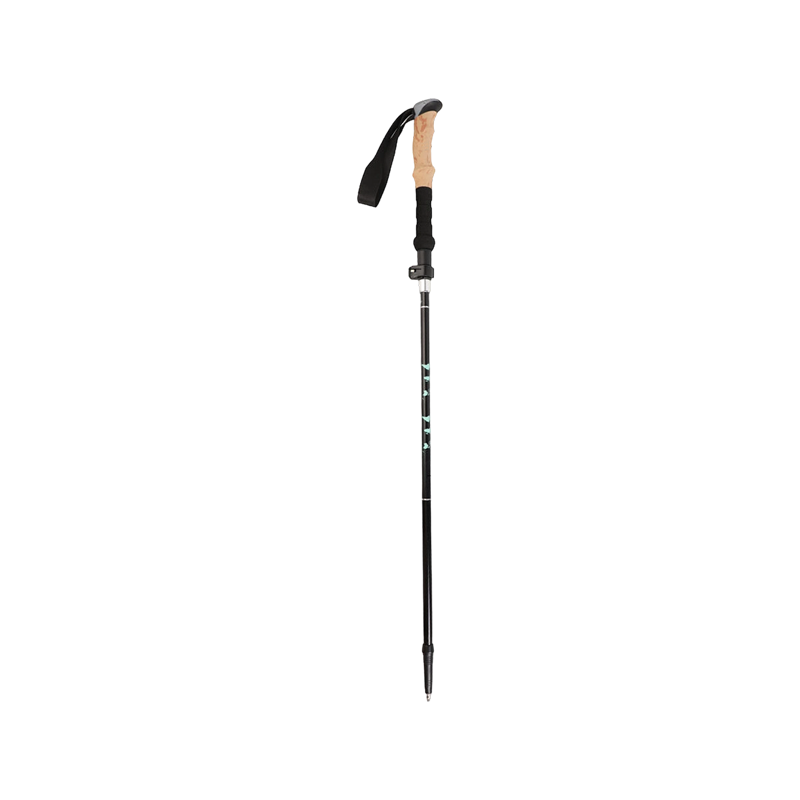
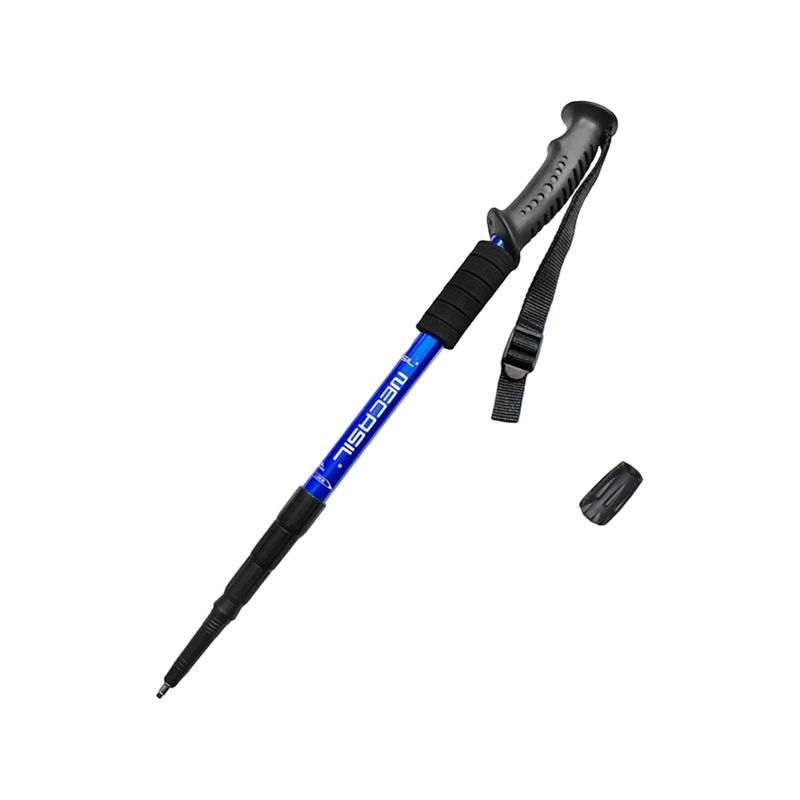
- 24 Product: Retractable external locking hiking poles, trekking poles, aluminum alloy hiking sticks
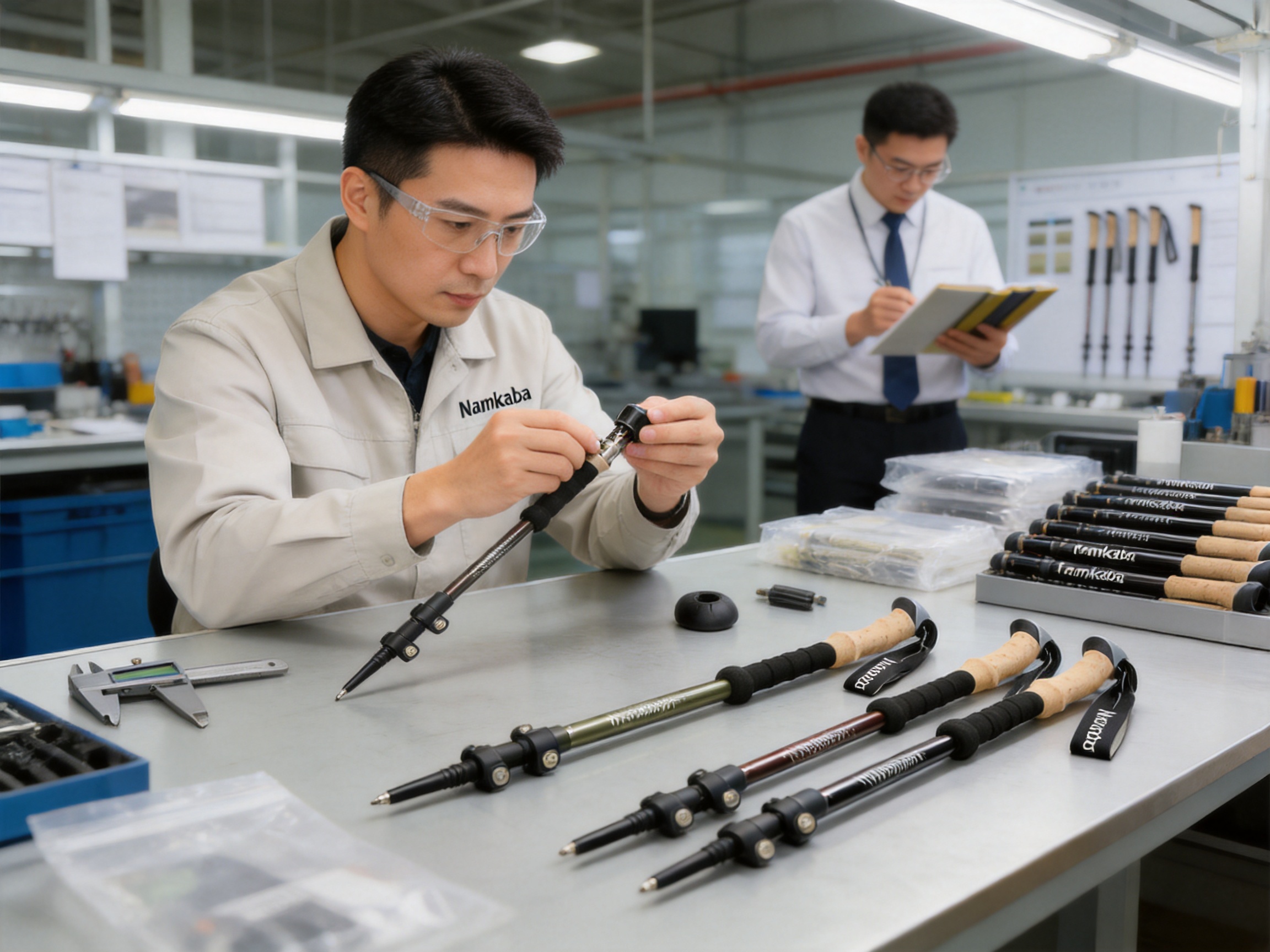
Hiking equipment has a direct influence on balance, comfort, endurance, and confidence on the trail. Among the most practical pieces of equipment for mountain walking and outdoor travel are trekking poles. A well-designed pair of poles can provide additional contact points, help users manage uneven ground, support a more natural rhythm, and make long-distance movement more comfortable. However, not every trekking pole offers the same level of reliability. Differences in locking design, shaft material, handle construction, portability, adjustment range, and manufacturing quality can significantly affect the user experience.
Retractable external-locking hiking poles combine several functions that modern hikers commonly require. Their three-section telescopic construction allows the poles to be adjusted for different terrains and user heights. The external locking system makes adjustment visible and convenient, while the aerospace-grade aluminum alloy shaft provides a practical balance of strength and weight. An EVA foam handle improves grip comfort, and the adjustable wrist strap helps users maintain a secure hold during extended activity.
These features make the poles suitable for mountain trails, forest paths, camping trips, long-distance hikes, and general outdoor travel. More importantly, the product is designed around actual outdoor conditions rather than appearance alone. Its value comes from the integration of functional components: the shaft must withstand repeated use, the locking mechanism must remain secure, the handle must remain comfortable, and the telescopic structure must be easy to carry when the poles are not in use.
The Importance of Trekking Poles in Modern Outdoor Activities
Hiking involves continuous adaptation. Trail surfaces may change from compact soil to loose gravel, wet rock, roots, steps, and steep slopes within a short distance. The body must respond to these changes while carrying clothing, water, food, and other equipment. Trekking poles provide two additional support points, allowing the hiker to use the arms as part of the movement system.
When used correctly, poles can support balance and help distribute effort across the upper and lower body. They may also assist with rhythm, especially during long walks where consistent movement is important. On uneven surfaces, a pole placed securely on the ground can provide temporary support while the user shifts weight or changes direction.
The benefit is not limited to difficult mountain routes. Trekking poles are also useful on moderate forest trails, camping approaches, travel paths, and routes with frequent elevation changes. For older hikers, new outdoor users, or people carrying heavier packs, the added points of contact can improve confidence and make terrain feel more manageable.
Fixed-length poles may perform well in a specific situation, but they lack flexibility. A pole length that feels comfortable on flat ground may be inconvenient during a steep ascent or descent. Retractable poles solve this issue by allowing users to adjust the length according to body height, terrain, walking style, and storage requirements.
Product Overview: A Functional Three-Section Design
The retractable external-locking hiking poles are built around a three-section telescopic structure. Each pole can be extended for use and shortened for transport or storage. This design is particularly valuable for hikers who move between different types of terrain or need to pack their equipment into a backpack, vehicle, or travel bag.
The three-section structure also makes it possible to create a practical adjustment range without making the pole unnecessarily bulky. When extended, the pole can provide useful support during walking. When collapsed, it becomes easier to carry between trail sections, store at a campsite, or place with other travel equipment.
The design includes the following primary elements:
- Aerospace-grade aluminum alloy shaft for lightweight strength and everyday durability.
- Three-section telescopic construction for adjustment and compact storage.
- 3LS professional external locking mechanism for visible, slip-resistant fixation.
- EVA foam handle designed to absorb sweat and improve grip comfort.
- Adjustable wrist strap that can be adapted to different hand shapes and wearing preferences.
Each feature addresses a specific outdoor requirement. The shaft supports structural performance, the lock controls length, the handle affects comfort, and the wrist strap helps maintain contact between the user and the pole. Because these parts work together, overall performance depends on both component quality and assembly precision.
| Product Element | Primary Function | Practical User Benefit |
|---|---|---|
| Aluminum alloy shaft | Provides the main load-bearing structure | Combines useful strength with manageable carrying weight |
| Three-section telescopic design | Allows the pole to extend and retract | Supports terrain adjustment and convenient transport |
| External locking mechanism | Secures the selected pole length | Makes adjustment visible and easy to operate |
| EVA foam handle | Provides a comfortable gripping surface | Helps manage moisture and reduce hand discomfort |
| Adjustable wrist strap | Supports hand positioning and pole control | Accommodates different hand sizes and preferences |
How the External Locking Mechanism Creates a Competitive Advantage
The locking mechanism is one of the most important components of any adjustable trekking pole. If the sections move unexpectedly, the pole may become uncomfortable or unreliable under pressure. An external locking design addresses this concern by placing the adjustment component on the outside of the shaft, where it can be seen and operated directly.
The 3LS professional external lock is designed to provide strong, slip-resistant fixation. Its visible structure allows users to check the locking position before applying weight. This is a practical advantage in outdoor environments, where gloves, changing weather, limited light, or uneven ground may make complicated adjustments inconvenient.
External locks are also easy to access during a hike. When terrain changes from a flat trail to an ascent, the user can stop briefly, release the mechanism, modify the pole length, and secure it again. The process does not require tools or complicated disassembly. This reduces interruptions and allows the equipment to respond quickly to actual trail conditions.
Compared with less visible internal adjustment systems, an external lock offers a clearer operational signal. The user can physically inspect whether the lever or clamp is closed and can identify when further tightening or adjustment may be needed. This visibility is especially useful for retailers and outdoor users who prioritize straightforward operation over hidden mechanisms.
Compared with basic twist-lock poles, external locking poles can offer a more intuitive adjustment experience. Twist locks depend on internal friction and may be more difficult to evaluate visually. Users must often rely on the feel of the rotation or the resistance of the shaft. An external clamp, by contrast, provides a direct mechanical interface that is easy to understand for first-time hikers.
This does not mean that every external lock is automatically superior. The quality of the lock, hinge, clamp material, shaft tolerance, and assembly process remains important. A well-designed locking system must balance secure fixation with convenient opening and closing. The advantage of this product is the combination of a professional external locking structure with a shaft and assembly system developed for practical outdoor use.
Aluminum Alloy Construction for Balanced Performance
Material selection influences weight, durability, impact resistance, cost, and long-term usability. The poles use an aerospace-grade aluminum alloy shaft, offering a practical solution for users who want dependable performance without carrying excessively heavy equipment.
Aluminum alloy is widely used in outdoor products because it offers a useful balance between structural strength and portability. It is generally more impact-tolerant than many extremely lightweight alternatives, making it suitable for users who hike on mixed terrain or require equipment for repeated use. The material also provides a solid feel in the hand, which can be reassuring when the pole is used for balance on uneven ground.
Carbon fiber poles may appeal to users who prioritize the lowest possible weight and vibration reduction. However, they can be more sensitive to certain types of impact or crushing force, depending on their construction. Steel components can provide high strength but add weight and are not generally ideal for a complete trekking pole shaft. Aluminum alloy occupies a practical middle position, making it suitable for retailers seeking a product that balances cost, durability, and broad market usability.
| Material | Typical Strength | Common Consideration | Suitable User Priority |
|---|---|---|---|
| Aluminum alloy | Strong and impact-resistant for general outdoor use | Balanced weight and durability | Versatile hiking and mountain use |
| Carbon fiber composite | Very lightweight with useful vibration-reduction characteristics | May require careful impact management | Weight-focused hikers |
| Steel | High structural strength | Heavier for extended carrying | Special structural applications |
The aluminum alloy shaft also supports the product’s positioning for global outdoor markets. It is appropriate for a wide range of users, from occasional campers to regular hikers, because it does not restrict the product to a narrow performance category. Retailers can present it as a dependable, adjustable trekking pole for practical outdoor use rather than as equipment designed only for specialist athletes.
Material quality alone does not determine performance. The alloy must be formed consistently, the sections must align correctly, and the surface must be finished in a way that supports smooth adjustment. These requirements place importance on manufacturing control and inspection, not just on the material specification printed in a product catalog.
Adjustability for Uphill, Downhill, and Level Terrain
Terrain-specific adjustment is one of the strongest reasons to choose retractable trekking poles. The correct length depends on the hiker’s height, arm position, trail gradient, footwear, backpack load, and personal technique. A three-section adjustable pole allows users to make these changes during a route.
On uphill sections, a somewhat shorter setting can help keep the hands closer to the body and support a more efficient arm position. Shortening the poles may also prevent the user from reaching too far forward when climbing. The exact setting depends on body proportions and preference, but the ability to make an adjustment is more useful than relying on a fixed length.
On downhill sections, a longer pole can provide additional reach and support. It may allow the hiker to place the tip slightly ahead of the body, helping manage the change in elevation and maintain balance. This can be especially useful on loose soil, steps, or uneven rock where the user wants an additional point of contact before shifting weight.
On level ground, a moderate setting can support a natural walking rhythm. The pole should allow the elbow to remain comfortably bent without forcing the shoulders to rise or the wrists to twist. Adjustability makes it easier for different users to find a comfortable position rather than adapting their body to a single permanent length.
The retractable design also improves transport. Hikers may not need poles on every part of a journey. A shortened pole can be stored while traveling through a visitor center, entering a vehicle, preparing food at a campsite, or walking on smooth pavement. The compact form is a practical benefit for both individual users and retailers selling to customers who travel frequently.
Basic Adjustment Guidance
Before starting a hike, users should open the external locks and set both poles to a similar length. The handle should be held with the elbow in a relaxed, bent position. After choosing a preliminary setting, each external lock should be closed firmly and checked by applying moderate hand pressure before the poles are used on the trail.
During an ascent, users may shorten the poles slightly. During a descent, they may extend them slightly. Adjustments should be made while standing in a stable position rather than while balancing on a narrow or slippery section. Users should also avoid exceeding the recommended extension markings, if such markings are present on the shaft.
Adjustment should be consistent between the two poles unless the terrain or personal technique requires otherwise. Uneven settings can affect movement rhythm and posture. When the poles are not needed, they should be fully retracted or placed in a secure carrying position so that they do not catch on branches or other equipment.
Comfort Benefits of the EVA Foam Handle
The handle is the primary contact point between the user and the pole. Even a structurally strong pole may feel unpleasant if the grip becomes slippery, hard, or tiring during extended use. The EVA foam handle is designed to provide a softer and more comfortable surface than a rigid metal or hard plastic grip.
EVA foam is commonly selected for outdoor handles because it can offer cushioning and a secure tactile feel. The material is sweat-absorbent and non-slip, helping users maintain control when the hands become warm or damp. This is valuable during steep climbs, humid weather, and long periods of continuous movement.
Grip comfort also influences technique. When a handle feels secure, users may hold it with a more relaxed hand rather than squeezing tightly. A relaxed grip can help reduce unnecessary hand and forearm fatigue. The wrist strap further supports this approach by helping keep the pole connected to the hand without requiring constant gripping force.
The handle should still be used correctly. Users should place the hand through the wrist strap from below and then grip the handle naturally, rather than relying on the strap alone. The strap can be adjusted to suit different hand shapes, gloves, and preferences. It should feel supportive without restricting circulation or movement.
For retailers, the EVA handle is an important product feature because comfort is easy for customers to understand. Technical shaft specifications may be unfamiliar to new hikers, but most users immediately recognize the value of a grip that feels comfortable, stable, and less slippery. This makes the handle a meaningful selling point for both experienced and first-time outdoor consumers.
Wrist Strap Adaptability and Pole Control
The adjustable wrist strap is a small component with an important role. During normal walking, it helps maintain the connection between the hand and the pole. It can also reduce the need to hold the grip tightly, particularly when the user is moving for several hours.
Different users have different hand sizes, glove thicknesses, and gripping habits. A fixed strap may be too loose for one person and too restrictive for another. The adjustable design allows the strap to be adapted to the user, improving comfort and control. It also makes the product easier to share among family members or groups with different users.
When properly adjusted, the strap can help guide the pole during forward and backward arm movement. It should not be tightened excessively. The goal is to support the hand, not to create pressure around the wrist. Users should inspect the strap periodically for signs of wear, loose stitching, or damage, particularly if the poles are used frequently.
The strap and handle work together with the locking system. A secure lock keeps the pole at the selected length, while the handle and strap help the user control that pole during movement. This integrated relationship demonstrates why trekking poles should be evaluated as complete products rather than as shafts with accessories added afterward.
Advantages Over Basic and Less Flexible Alternatives
The product offers several practical advantages over basic fixed-length poles and low-cost adjustable models. These advantages do not depend on exaggerated performance claims. They come from the combination of adjustability, visible locking, balanced materials, grip comfort, and portability.
Compared with Fixed-Length Poles
Fixed-length poles can be simple and reliable, but they are less adaptable. A fixed pole may be comfortable on one trail and less suitable on another. It may also be difficult to share between users of different heights. Retractable poles allow users to change the length for uphill and downhill sections, improving versatility across a complete hiking route.
Retractable poles are also easier to transport. Fixed poles may require external attachment to a backpack or may be inconvenient during travel. A three-section telescopic design can be shortened for storage, making it more suitable for customers who combine hiking with camping, road trips, or air travel.
Compared with Basic Twist-Lock Models
Twist-lock poles often rely on an internal expansion system. While such systems can be compact, the user may not be able to see the locking condition directly. An external clamp gives a clearer visual and physical indication of whether the section has been secured.
The external mechanism can also be easier to operate with limited dexterity. Hikers do not need to rotate several sections repeatedly to make an adjustment. A quick-release and closure action can save time when the terrain changes unexpectedly.
Compared with Extremely Lightweight Specialist Poles
Some specialist users prioritize the lowest possible weight above all other considerations. For general outdoor markets, however, a product must also offer durability, understandable operation, and reasonable value. The aluminum alloy shaft provides a balanced solution for users who want manageable weight without making the product excessively delicate.
This balance supports a wider range of applications. The poles can be marketed for mountain hiking, camping approaches, forest trails, travel, and everyday outdoor recreation. They are not limited to a single user group or a narrow competition-focused purpose.
| Comparison Factor | Retractable External-Locking Poles | Fixed-Length Poles | Basic Twist-Lock Poles |
|---|---|---|---|
| Length adjustment | Flexible for terrain and user height | Not available | Available, but operation may be less visible |
| Lock visibility | External mechanism is easy to inspect | Not applicable | Internal mechanism may be harder to evaluate |
| Portability | Three sections retract for storage | Longer and less convenient to pack | Usually compact, depending on design |
| Material balance | Aluminum alloy offers strength and manageable weight | Depends on construction | Depends on construction |
| Market suitability | Broad outdoor and travel applications | Users who prefer a fixed setup | Users familiar with twist adjustment |
Performance on Mountain Trails and Uneven Ground
Mountain trails create frequent changes in balance and foot placement. A hiker may need to cross loose gravel, shallow erosion channels, wet soil, roots, or irregular rock surfaces. Trekking poles do not eliminate the need for careful footwork, but they can provide additional support while the user evaluates each step.
The external locking system is particularly relevant on these routes because pole length may need to change several times during a single outing. A secure lock helps maintain the selected height when the user applies pressure. The user can also check the mechanism before entering a more demanding section.
On loose ground, pole placement should be deliberate. Users should avoid placing the tip where the surface may collapse, and they should not use the poles as a substitute for stable footing. The aluminum alloy shaft and secure lock provide useful support, but safe technique remains essential.
On wet trails, the non-slip EVA handle can help maintain a comfortable grip. The adjustable strap offers additional control when the user is wearing gloves or when the hand position changes during climbing. After use in wet or muddy conditions, the poles should be cleaned and dried to help preserve the finish and moving components.
For mountain hiking, reliability is more valuable than decorative complexity. A pole that can be adjusted quickly, held comfortably, and carried easily is more useful than a product with features that are difficult to understand or maintain. This practical orientation is central to the product’s design.
Manufacturing Strengths Behind the Product
Outdoor equipment performance begins with product development, but it depends on manufacturing execution. A trekking pole may have an appealing specification, yet fail to meet user expectations if the shaft sections are inconsistent, the lock is poorly aligned, the handle is not securely fitted, or the strap is inadequately attached.
CragHaven Outdoor approaches product development as a combination of outdoor understanding and manufacturing coordination. The company is based in Hangzhou, China, and works as an outdoor brand and cross-border manufacturing partner for global markets. Its focus includes mountaineering, hiking, and camping applications, with attention to practical use rather than catalog presentation alone.
The company’s development philosophy is based on three principles: purpose-driven design, material integrity, and engineering discipline. These principles are relevant to trekking poles because the product must function in weather, on varied terrain, and over repeated use. Every component should have a clear reason for being included and should contribute to the user’s experience.
Purpose-Driven Design
Purpose-driven design starts with the conditions in which the product will be used. Trekking poles are not developed only for photographs or packaging displays. They are handled with wet hands, stored in backpacks, adjusted on slopes, exposed to dust, and carried for long distances.
For this product, the purpose-driven approach can be seen in the external locking mechanism, compact three-section structure, sweat-absorbent handle, and adjustable strap. These features respond to common outdoor situations: changing gradients, limited storage space, hand fatigue, and the need for quick adjustment.
Such design thinking also supports product communication. Retailers can explain the product through actual use cases instead of relying solely on technical language. The poles are suitable for climbing, descending, variable trails, camping access routes, and general outdoor travel. This makes the product easier to position across different channels and customer segments.
Material Integrity
Material integrity means selecting materials according to their real performance requirements rather than short-term trends. The aluminum alloy shaft must provide a reliable structure while remaining practical to carry. The EVA handle must retain its grip characteristics during normal outdoor use. The strap must be comfortable and securely attached.
Material selection also involves consistency. A product specification has value only when production lots maintain the expected characteristics. Consistent shaft dimensions support proper adjustment. Consistent lock components support reliable closure. Consistent handle molding improves comfort and appearance. These details influence customer satisfaction and reduce avoidable quality problems.
Engineering Discipline
Engineering discipline covers sampling, testing, optimization, and production control. Before a product reaches the market, the design should be reviewed through repeated samples and practical evaluations. The goal is to identify problems that may not be visible in a drawing or early prototype.
For trekking poles, evaluation may include extension and retraction cycles, lock operation, shaft alignment, handle attachment, strap strength, surface finish, and packaging protection. Testing should consider not only ideal indoor conditions but also the situations users encounter outdoors. Dust, moisture, repeated handling, and changing temperatures can all affect the user experience.
Optimization is also an ongoing process. A lock may need a change in clamp resistance, a handle may require adjustment to its shape, or a packaging insert may need improvement to prevent movement during shipment. Engineering discipline ensures that these observations are recorded and incorporated rather than ignored.
Quality Control Considerations for Trekking Pole Production
Quality control for adjustable trekking poles should address both individual components and the assembled product. A shaft can meet its material requirement while the complete pole still performs poorly if the sections do not align or the lock is not properly fitted.
Incoming material inspection should verify the consistency of aluminum alloy tubes, EVA foam, strap materials, locking parts, and other components. Dimensional checks can help identify variations that may interfere with telescopic movement. Surface inspection can identify scratches, dents, coating defects, or other issues that may affect appearance or use.
During assembly, the locking mechanism must be positioned correctly and secured with appropriate force. The clamp should open and close smoothly while maintaining sufficient fixation when closed. The handle should be firmly attached to the shaft, and the wrist strap should be installed with secure stitching or connection points.
Finished-product inspection can include:
- Verification of extension and retraction movement.
- Inspection of external lock operation and closure.
- Checking for shaft alignment and smooth section movement.
- Assessment of handle attachment and surface comfort.
- Inspection of wrist strap adjustment and connection strength.
- Visual review of finish, labeling, and packaging condition.
- Confirmation that the supplied quantity and product configuration are correct.
These controls are important for OEM and wholesale customers. Retailers need products that perform consistently across shipments, not just a few samples. Stable manufacturing helps reduce returns, protect brand reputation, and create a more predictable supply chain.
Sampling, Testing, and Optimization for Global Markets
Global outdoor markets include different customer expectations, climates, distribution systems, and retail formats. A product intended for international supply must therefore be evaluated beyond its basic function. Packaging, instructions, product presentation, and production consistency all contribute to market readiness.
CragHaven Outdoor positions itself as more than a factory-sourcing intermediary. The company participates in design and manufacturing, using practical product knowledge to support development and communication. This approach can help international customers move from a product idea to a stable, repeatable product configuration.
Sampling provides the first opportunity to review the product in detail. Customers can assess the pole length, adjustment experience, handle feel, appearance, and packaging. Feedback from sampling can then guide revisions before larger production quantities are confirmed.
Testing helps determine whether the selected components work together as intended. A lock that operates well in isolation may need further adjustment once installed on the complete shaft. A handle that feels comfortable during a brief inspection may require additional review for long-duration use. Repeated testing helps reveal these issues.
Optimization ensures that improvements are carried through to production. This may involve refining the external clamp, adjusting the telescopic tolerances, strengthening the strap attachment, improving the packaging structure, or standardizing inspection procedures. The result is a product that is more reliable, easier to explain, and better suited to repeat orders.
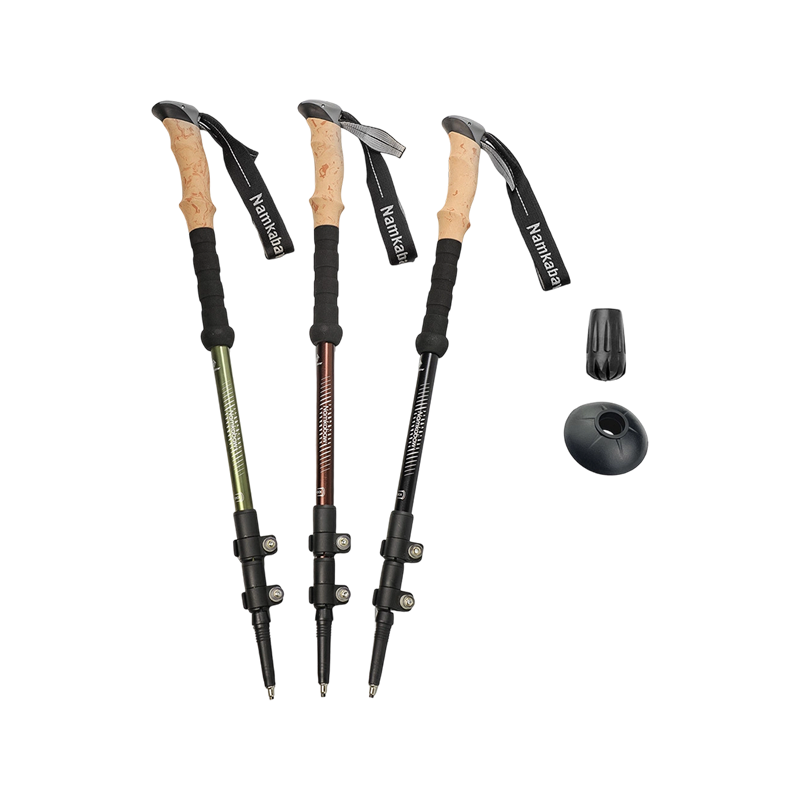
Retractable external locking hiking poles, trekking poles, aluminum alloy hiking sticks
Portability for Hiking, Camping, and Travel
Outdoor users often combine several activities in one trip. A person may drive to a trailhead, hike through a mountain route, set up a campsite, and travel home with the same equipment. Products that are useful only in one part of the trip can become inconvenient to carry.
The retractable structure helps solve this problem. When the poles are not needed, they can be shortened and stored with other equipment. This is useful when moving through crowded areas, riding in a vehicle, organizing a campsite, or packing for a multi-day trip.
Portability also matters for retailers and distributors. A compact product can be easier to package, display, warehouse, and ship. The three-section design supports a more efficient product format than long fixed-length poles, although the final packaging configuration should always be confirmed according to the order requirements.
For consumers, compact storage may increase the likelihood that the poles are carried and used regularly. Equipment that is difficult to pack may be left behind even when it could improve a hike. By making transportation simpler, the retractable design contributes to practical ownership value.
Use in Camping and Approach Routes
Trekking poles are not limited to high-altitude hiking. They are also useful on approach routes to campsites, paths near lakes, forest access trails, and uneven ground around outdoor recreation areas. Campers often carry more equipment than day hikers, making balance and energy management particularly important.
When carrying a tent, sleeping bag, cooking equipment, or food, the body’s center of gravity changes. Poles can provide additional stability while the user walks over roots, stones, or sloping ground. The adjustable length allows the poles to be adapted to a load-bearing posture and changing trail gradients.
At camp, the poles can be retracted and stored rather than left extended across a walkway. This reduces clutter and protects the equipment from accidental damage. Users should avoid placing heavy objects on the poles and should keep the locking components free from sand, mud, and debris.
The product’s broad application range makes it suitable for outdoor retailers whose customers participate in multiple activities. It can be presented as part of a hiking kit, a camping equipment collection, or a travel-oriented outdoor accessory range.
Practical User Guidance and Maintenance
Proper use helps preserve the performance of adjustable trekking poles. Before each outing, users should inspect the shaft sections, external locks, handles, and wrist straps. Any visible crack, severe dent, loose connection, or damaged strap should be addressed before the poles are used in demanding terrain.
The external lock should be closed securely without excessive force. If the mechanism feels unusually loose or tight, the user should examine the adjustment and ensure that the shaft sections are correctly positioned. The pole should not be extended beyond any indicated limit.
After hiking in wet or muddy conditions, the poles should be wiped clean and allowed to dry. Dirt inside the telescopic sections can affect movement, while moisture left on components for extended periods may reduce the product’s appearance and service life. The poles should be stored in a dry environment and protected from unnecessary impact.
Users should not use trekking poles as climbing protection, a substitute for mountaineering anchors, or a support system beyond their intended outdoor walking purpose. They are designed to assist balance and movement, not to bear the full load of a fall or replace technical climbing equipment.
Regular care is also beneficial for wholesale customers. Clear maintenance instructions can reduce misuse and help retailers provide better after-sales support. A product that is explained accurately is more likely to deliver a positive customer experience.
Why Product Integration Matters More Than Isolated Features
A trekking pole is a system of connected components. The shaft determines the primary structure, but the lock controls its usable length. The handle determines how force is transferred from the user’s hand, while the wrist strap affects control and comfort. If any one of these parts performs poorly, the overall experience can be reduced.
For this reason, product development must consider the interaction between components. The external lock should be compatible with the shaft diameter and section tolerances. The handle should be securely fitted without compromising comfort. The strap should support the handle rather than interfere with hand movement. The telescopic structure should retract smoothly without unnecessary looseness.
Integrated design also makes quality control more meaningful. Inspection should not stop after checking that individual parts look correct. The assembled product must be operated, adjusted, handled, and reviewed as a user would experience it. This approach is particularly important for outdoor products, which may be exposed to repeated motion and variable conditions.
CragHaven Outdoor’s focus on purpose, material reliability, and engineering discipline supports this integrated approach. Instead of treating the product as a collection of unrelated features, the company evaluates how the complete pole supports real hiking and camping activities.
Commercial Value for Retailers and OEM Buyers
For global retailers, outdoor products must combine customer appeal with dependable supply. A trekking pole that is easy to demonstrate, easy to explain, and suitable for several user groups can have strong commercial value. The retractable external-locking design offers a clear product story: adjustable support, visible locking, balanced aluminum construction, comfortable grip, and convenient storage.
The product can be positioned for different levels of outdoor experience. Beginners can understand the benefit of adjustable length and simple external operation. Experienced hikers may appreciate the ability to fine-tune pole height for changing terrain. Campers and travelers can recognize the value of a compact three-section design.
The product also supports OEM and private-label opportunities. A manufacturing partner with experience in outdoor applications can assist with product configuration, sampling, packaging coordination, and production communication. These services can help brands develop a trekking pole line without managing every manufacturing detail independently.
Stable communication is especially important for international buyers. Clear confirmation of materials, locking components, handle construction, packaging, inspection requirements, and order quantities can reduce misunderstandings. A professional manufacturing partner should be able to discuss both product function and production execution.
CragHaven Outdoor aims to reduce uncertainty in the supply chain by participating in design and manufacturing rather than simply listing factory options. Its Western-market-oriented communication style and focus on long-term partnerships are intended to support repeat business and stable product development.
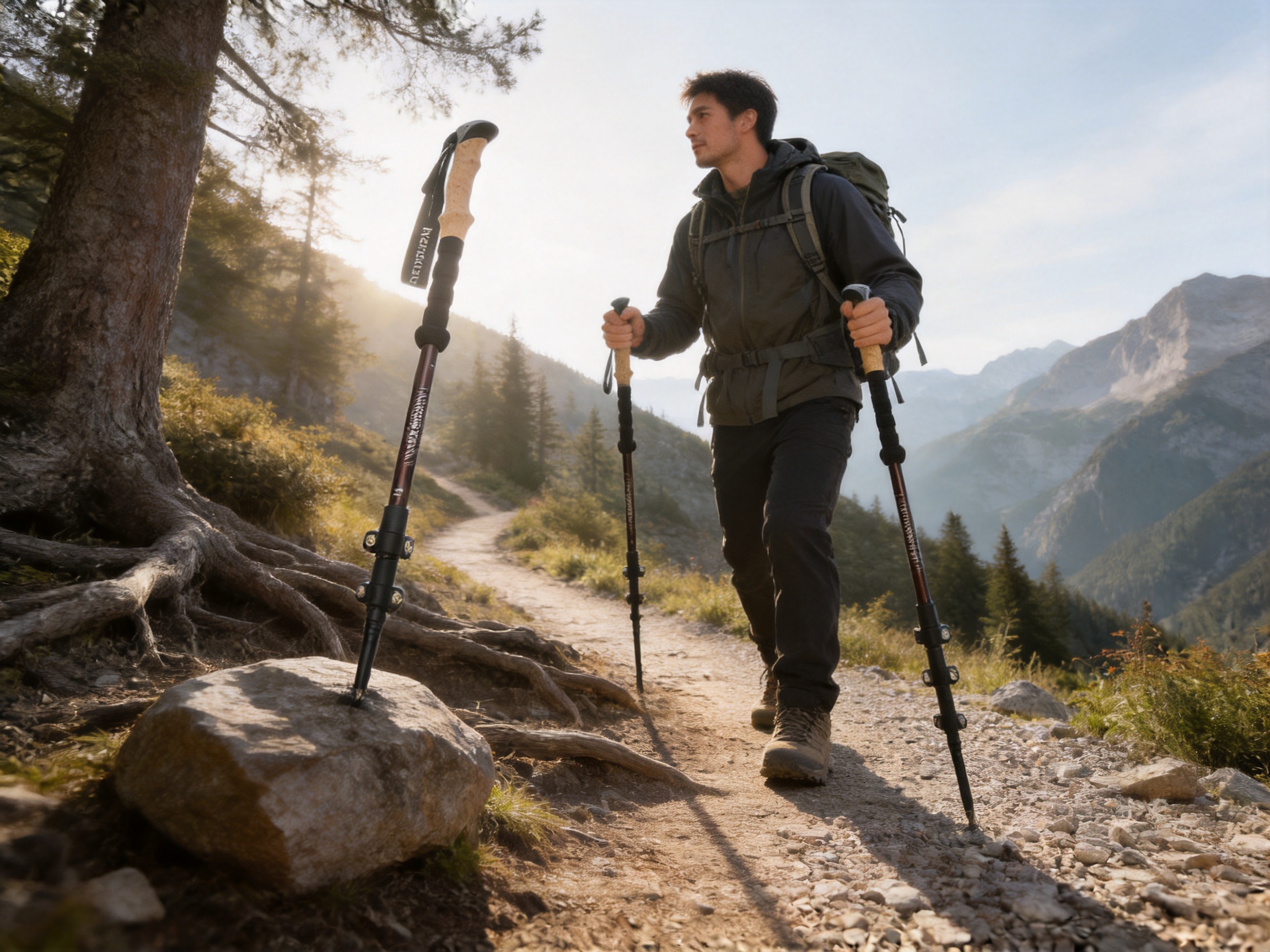
Design Considerations for Product Differentiation
Outdoor gear markets are competitive, and product differentiation should be based on meaningful user benefits. Decorative changes alone may attract attention but do not necessarily improve customer satisfaction. For trekking poles, the most valuable differences are often found in operation, comfort, reliability, portability, and material balance.
The external locking mechanism provides an immediately understandable point of differentiation. It is visible, accessible, and associated with quick adjustment. The aluminum alloy shaft communicates strength and practical durability. The EVA foam handle communicates comfort, while the adjustable wrist strap highlights user adaptability.
The three-section structure adds another layer of differentiation by connecting performance with convenience. Consumers can use the poles on the trail and then shorten them for storage. This dual purpose is valuable in a market where customers increasingly expect outdoor equipment to support travel, camping, and everyday mobility.
For private-label brands, these features can be presented through educational packaging and product content. Demonstrating how to shorten the poles, operate the external lock, adjust the length for slopes, and position the wrist strap can make the product easier to use and reduce the learning curve.
| Differentiation Area | Product Characteristic | Customer Communication Point |
|---|---|---|
| Operation | 3LS external locking system | Visible, accessible, and convenient adjustment |
| Structure | Three-section telescopic shaft | Adaptable on trails and compact during transport |
| Material | Aerospace-grade aluminum alloy | Balanced strength, durability, and carrying comfort |
| Grip | Sweat-absorbent EVA foam handle | Comfortable and secure hand contact |
| Fit | Adjustable wrist strap | Suitable for different hand shapes and preferences |
Responsible Product Development for Long-Term Value
Long-term value in outdoor equipment is created when a product remains useful, understandable, and dependable over time. This requires more than selecting popular features. It requires consideration of how the equipment will be used, maintained, transported, and reordered.
CragHaven Outdoor’s product development philosophy is based on observing real outdoor usage. The company emphasizes that products should be developed for weather, terrain, and time. This perspective encourages practical decisions about materials, component integration, and testing.
Long-term value also includes supply-chain stability. Retailers need confidence that a product can be reproduced with consistent specifications. Repeat orders should not require starting the development process from the beginning. Documented sampling, clear production standards, and ongoing communication help support consistency.
For outdoor brands, dependable manufacturing can be as important as a strong product concept. A well-designed trekking pole must be supported by accurate assembly, reliable inspection, protective packaging, and responsive coordination. These factors influence whether the product performs as expected after it reaches the customer.
Recommended Positioning for Outdoor Markets
The trekking poles can be positioned as practical, adjustable support equipment for mountain hiking, camping, forest trails, and travel. Their strongest message is not a single extreme performance claim, but the balanced combination of features that make them useful in many situations.
Suggested positioning themes include:
- Adjustable support for changing trail conditions.
- Visible external locking for straightforward operation.
- Aluminum alloy construction for balanced strength and weight.
- Comfortable EVA foam grip for extended outdoor use.
- Compact three-section design for storage and transportation.
- Adaptable wrist strap for different users and hand shapes.
- Manufacturing support based on sampling, testing, and optimization.
This positioning can serve both direct-to-consumer and business-to-business channels. For consumers, it explains how the poles improve hiking comfort and confidence. For retailers, it identifies clear features that can be demonstrated in product listings and store displays. For OEM buyers, it communicates that the product is supported by a development and manufacturing process rather than a one-time sourcing transaction.
The product is especially appropriate for customers who want reliable general-purpose outdoor equipment. It does not need to be presented as a specialist competition pole to offer value. Its broad usability is one of its strengths.
Q&A
What are retractable external-locking hiking poles used for?
They are designed to provide additional support and improve balance during hiking, mountain walking, camping approaches, forest trails, and other outdoor activities. Their adjustable length allows users to adapt the poles to different terrains and walking conditions.
How does the external locking mechanism work?
The external locking mechanism is positioned on the outside of the pole section. Users can open the lock, adjust the shaft to the desired length, and close the lock to secure the setting. The visible design makes the locking condition easier to inspect than many hidden adjustment systems.
What is the advantage of a three-section telescopic design?
A three-section structure allows the poles to be extended for use and retracted for transport. It also makes it easier to adjust the pole length for uphill, downhill, and level terrain. The compact form is convenient for backpacks, vehicles, luggage, and campsite storage.
Are aluminum alloy trekking poles suitable for mountain hiking?
Yes. Aluminum alloy offers a practical combination of strength, durability, impact resistance, and manageable weight. It is suitable for general mountain trails, uneven ground, camping routes, and repeated outdoor use.
Why is the EVA foam handle useful during long hikes?
The EVA foam handle provides a comfortable gripping surface and is designed to absorb sweat and reduce slipping. This can help users maintain control and reduce the need to grip the pole excessively tightly during extended activity.
How should the wrist strap be adjusted?
The strap should be adjusted so that it supports the hand without feeling restrictive. It should accommodate the user’s hand size, gloves, and preferred grip. Users should place the hand through the strap and hold the handle naturally rather than relying on the strap alone.
Should the poles be shorter when walking uphill?
Many hikers prefer a somewhat shorter setting for uphill sections because it can support a more comfortable arm position. The ideal length depends on body height, terrain, backpack load, and personal technique.
Should the poles be longer during downhill hiking?
A slightly longer setting can provide additional reach and support on downhill sections. Users should adjust the poles while standing securely and should avoid making changes on unstable ground.
How do these poles compare with fixed-length poles?
Retractable poles provide more flexibility because their length can be changed for different users and terrain conditions. They are also easier to store and transport. Fixed-length poles may be suitable for users who always walk in similar conditions, but they offer less adaptability.
How do external locks compare with twist locks?
External locks are visible and directly accessible, which can make adjustment and inspection more straightforward. Twist locks use an internal mechanism and may require users to rely more on rotational resistance or feel when checking whether the pole is secure.
Can the poles be used for technical climbing?
They are intended for hiking, trekking, mountain walking, camping approaches, and general outdoor support. They should not be used as climbing protection, anchors, or a substitute for technical mountaineering equipment.
How should the poles be maintained?
Users should wipe away dirt and moisture after use, allow the poles to dry, and store them in a dry place. The shaft sections, external locks, handles, and wrist straps should be inspected regularly. Excessive force, overextension, and exposure to unnecessary impact should be avoided.
What manufacturing processes support product consistency?
Product consistency is supported by material selection, sampling, testing, assembly inspection, finished-product review, and optimization. These processes help verify shaft alignment, lock operation, handle attachment, strap connection, surface finish, and packaging quality.
Can the product support OEM or private-label programs?
The product is suitable for discussion within OEM and private-label outdoor equipment programs. A manufacturing partner can coordinate product specifications, sampling, packaging requirements, quality expectations, and repeat production planning according to the buyer’s needs.
Why is manufacturing experience important for trekking poles?
Trekking poles contain several interacting components. A reliable shaft is not enough if the lock is poorly fitted or the handle and strap are not securely assembled. Manufacturing experience helps ensure that materials, tolerances, assembly, testing, and packaging work together as a complete product system.
Conclusion
Retractable external-locking hiking poles offer a balanced solution for hikers, campers, travelers, and outdoor retailers. Their three-section telescopic design provides portability and terrain adaptability. The 3LS external locking mechanism supports visible, convenient, slip-resistant adjustment. The aerospace-grade aluminum alloy shaft balances structural strength with manageable weight, while the EVA foam handle and adjustable wrist strap improve comfort and control.
The product’s competitive advantage comes from integration rather than from one isolated feature. It is easier to adjust than fixed-length equipment, more visibly operated than many internal locking systems, and broadly applicable compared with highly specialized lightweight poles. These qualities make it suitable for a wide range of outdoor customers and retail channels.
Behind the product is a manufacturing philosophy centered on purpose-driven design, material integrity, and engineering discipline. Through sampling, testing, optimization, and practical quality control, CragHaven Outdoor aims to develop equipment that responds to real weather, terrain, and usage patterns. This approach supports dependable product performance and helps global partners reduce uncertainty in sourcing and repeat production.
For hiking and camping markets seeking practical, adjustable, and reliable support equipment, these trekking poles provide a strong combination of functionality, comfort, portability, and manufacturing value.
References
International Organization for Standardization. ISO 11158: Outdoor Equipment and Product Safety Principles.
International Mountaineering and Climbing Federation. General Guidance on Trekking Equipment and Safe Mountain Travel.
American Hiking Society. Principles of Responsible Hiking, Trail Safety, and Equipment Selection.
Outdoor Industry Association. Consumer Trends in Hiking, Camping, and Outdoor Recreation Equipment.
European Committee for Standardization. Guidance on Materials, Mechanical Components, and Consumer Product Quality Control.
Manufacturer product information supplied for retractable external-locking hiking poles, aluminum alloy shaft, EVA foam handle, adjustable wrist strap, and three-section telescopic construction.
Product: Retractable external locking hiking poles, trekking poles, aluminum alloy hiking sticks


- Phone: +86-15968800379
- E-mail: [email protected]
- Address: Room 1002, Huishang Building, Gongshu District, Hangzhou City, Zhejiang Province.
Copyright © CragHaven Outdoor All Rights Reserved. Outdoor Gear Manufacturers Wholesale Mountaineering Camping Gear Suppliers
