

 English
 Deutsch
 Español
 Français

Outdoor Camping Tent Steel Stakes: A Reliable Anchoring Solution for Beaches, Grasslands, and Mountain Camps
Content
- 1 Introduction: The Small Component That Determines Tent Stability
- 2 Product Overview and Core Design
- 3 Why High-Carbon Steel Offers an Advantage
- 4 How the 25cm Length Supports Ground Stability
- 5 Design Advantages Compared with Common Competitor Products
- 6 Glow-in-the-Dark Head and Nighttime Usability
- 7 Universal Hook and Knot Compatibility
- 8 Application Scenarios
- 9 Manufacturing Process and Quality Considerations
- 10 Advantages of a Specialized Outdoor Manufacturing Partner
- 11 Correct Installation and Use
- 12 Maintenance, Storage, and Service Life
- 13 Purchasing Considerations for Brands and Distributors
- 14 Safety and Application Limitations
- 15 Q&A: Frequently Asked Questions
- 15.1 What are these 25cm outdoor camping tent steel stakes used for?
- 15.2 Why choose high-carbon steel instead of plastic?
- 15.3 Is a 25cm stake suitable for beach camping?
- 15.4 Can the stakes be used in rocky ground?
- 15.5 What is the purpose of the glow-in-the-dark head?
- 15.6 Do the stakes work with different tent lines?
- 15.7 How should the stakes be installed?
- 15.8 How should the stakes be cleaned after beach use?
- 15.9 Are these stakes suitable for lightweight backpacking?
- 15.10 Can outdoor brands request customized products?
- 15.11 What should bulk buyers evaluate in a supplier?
- 15.12 How does a specialized outdoor manufacturer add value?
- 16 Conclusion
- 17 References
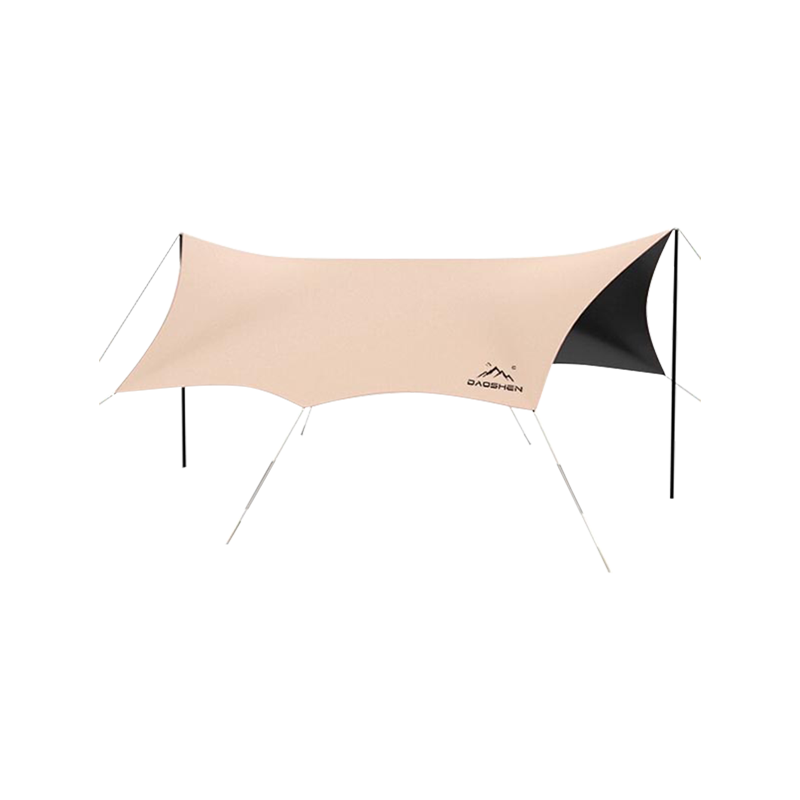
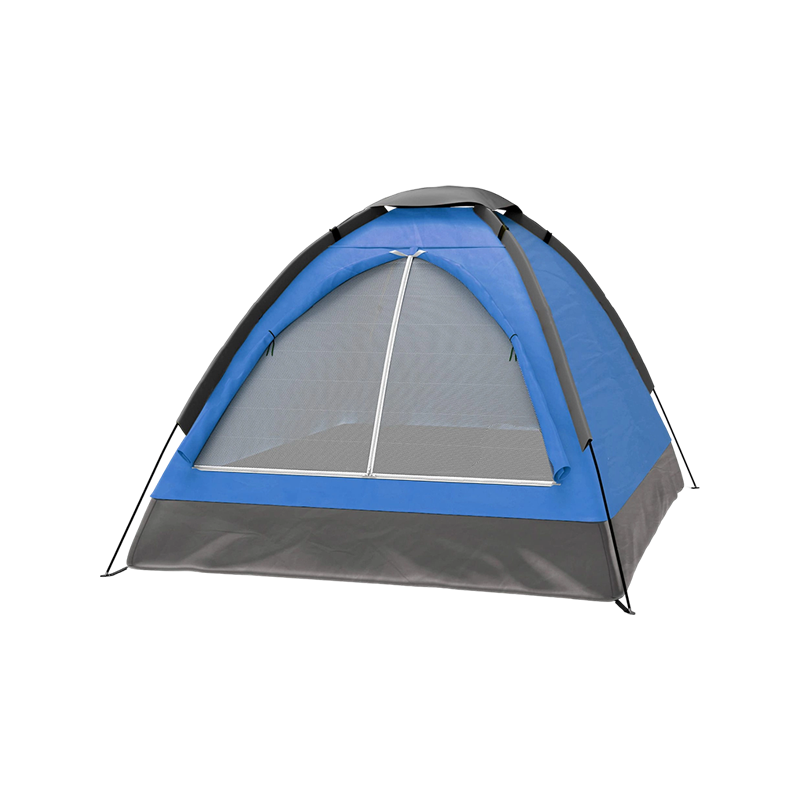
- 18 Product: Outdoor camping tent with 25cm ground stakes, beach tarpaulin, and windproof steel studs
Introduction: The Small Component That Determines Tent Stability
A tent may be made from advanced waterproof fabric, supported by a carefully engineered frame, and equipped with strong guy lines, but none of these elements can perform properly without a dependable connection to the ground. Tent stakes are the components that create this connection. They transfer tension from the tent and guy lines into the soil, helping the shelter resist wind, movement, uneven terrain, and changing weather conditions.
The Outdoor Camping Tent with 25cm Ground Stakes is designed to provide a practical anchoring solution for camping, hiking, mountaineering, beach trips, recreational travel, and other outdoor applications. Made from high-carbon steel, the stakes are hardened for improved hardness and bending resistance, then galvanized to help protect against corrosion. Their 25cm length provides deeper ground engagement than many short, lightweight pegs, while the universal hook and knot design supports compatibility with different tent tarps and guy-line arrangements.
A glow-in-the-dark head adds another practical advantage. At night, tent stakes can be difficult to see, particularly around entrances, guy lines, and walkways. A visible stake head can make campsite organization easier and may help reduce accidental contact in low-light conditions. This feature is especially useful for family camping, group camps, and users who set up or dismantle their tents before sunrise or after sunset.
The product is not intended to be a decorative accessory or a disposable component. It is developed as a reusable piece of outdoor equipment that must balance strength, grip, usability, corrosion resistance, and portability. For outdoor brands, retailers, distributors, and professional users, this balance is important because customers increasingly evaluate the performance of an entire camping system rather than focusing only on the tent fabric or poles.
This article examines the design, material advantages, application scenarios, manufacturing considerations, and purchasing value of 25cm high-carbon steel tent stakes. It also explains how a specialized outdoor manufacturing partner can help brands achieve stable quality, flexible customization, and dependable supply for different market requirements.
Outdoor camping tent with 25cm ground stakes, beach tarpaulin, and windproof steel studs
Product Overview and Core Design
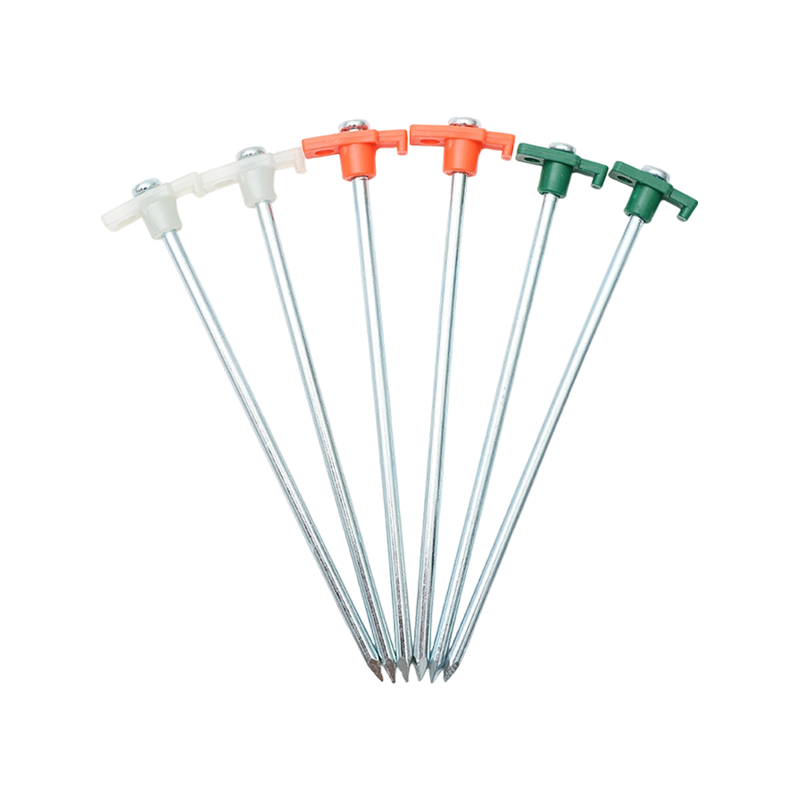
The product is a set of outdoor camping tent steel stakes intended to secure tent corners, tarps, shelters, and guy lines. Each stake has a 25cm shaft that can be driven into suitable ground to create a stable anchoring point. The shaft length is selected to provide a useful balance between holding depth and portability. It is long enough for many grass, soil, and sandy camping environments while remaining practical to carry in an outdoor equipment bag.
The main body is manufactured from high-carbon steel. Compared with many low-strength plastic pegs, high-carbon steel provides a stronger foundation for repeated impact and ground engagement. The steel structure is suitable for users who want a reusable solution rather than a lightweight peg that may crack, deform, or become unusable after limited use.
The steel is hardened to improve surface and structural performance. Hardening helps the stake withstand the forces produced during insertion and removal, although users should always select the correct installation method for the ground. A stake should not be forced into solid rock, concrete, or extremely hard mineral surfaces. In appropriate soil, hardened steel can provide better resistance to bending than ordinary soft metal or thin plastic alternatives.
Galvanization adds a protective layer to the steel surface. Camping equipment is frequently exposed to moisture, wet soil, salt-containing sand, condensation, and damp storage conditions. Galvanized protection helps reduce the risk of surface corrosion and supports a longer service life when the stakes are cleaned and dried after use.
The upper section includes a glow-in-the-dark head intended to improve visibility at night. The head also provides a practical contact point for inserting, removing, or attaching tent lines. Depending on the setup, users can connect guy lines, hooks, loops, or knots to the upper structure. This universal design allows the same stake to support several common tent and tarp configurations.
Main Product Features
25cm ground engagement: The extended length helps the stake reach deeper into suitable soil, grass, and sand than many short pegs. Greater insertion depth can improve holding performance when the ground has sufficient density.
High-carbon steel construction: The material offers a strong and reusable alternative to basic plastic pegs, especially for users who camp frequently or encounter demanding conditions.
Hardened structure: Heat-treatment and hardening processes are used to improve hardness and bending resistance, helping the stake maintain its shape during normal installation.
Galvanized surface: The protective finish helps resist corrosion caused by moisture, wet soil, and outdoor storage conditions.
Glow-in-the-dark head: The visible head improves nighttime identification around tents, tarps, and guy lines.
Universal attachment design: Hooks, loops, and knots can be used with the upper section, supporting different tent, tarp, and shelter systems.
Multi-terrain application: The product is suitable for many grassy, sandy, and ordinary soil environments, as well as selected hard-ground applications when installed with appropriate care.
Why High-Carbon Steel Offers an Advantage
Material selection is one of the most important decisions in the design of a tent stake. A peg must be thin enough to carry but strong enough to resist impact, tension, and ground pressure. It also has to tolerate repeated use and outdoor exposure. High-carbon steel is well suited to this purpose because its composition allows manufacturers to develop a harder and more durable structure through controlled processing.
Plastic tent pegs are often attractive because they are inexpensive and lightweight. They can work effectively in soft ground and for occasional recreational use. However, plastic may become brittle in cold weather, deform under heavy pressure, or break if struck at an unsuitable angle. Plastic also has limited resistance to sharp stones and repeated impact. For users who travel regularly or purchase equipment for unpredictable conditions, these limitations can increase replacement frequency.
Low-strength metal pegs may provide an improvement over plastic, but they can still bend if the shaft is too thin or if the material has not been properly treated. A bent peg may be difficult to remove, may no longer hold the guy line at the correct angle, and can become inconvenient to pack. High-carbon steel combined with hardening is intended to address this weakness by providing a stronger structural base.
Steel also performs well in repeated-use scenarios. A campsite operator, outdoor rental company, event organizer, or experienced hiker may install and remove tent stakes many times in a season. A reusable steel component can offer better long-term value than a disposable alternative, provided that the product is used within its design limits and maintained correctly.
The advantage is not simply that steel is heavier or harder. A well-designed steel stake must be engineered as a complete system. The shaft diameter, point geometry, head structure, surface finish, and production consistency all influence actual performance. If any one of these areas is neglected, the material advantage may not translate into a reliable user experience.
Strength and Bending Resistance
During installation, the stake experiences impact from a mallet or another suitable tool. After installation, it is exposed to continuous pulling force from guy lines and tent fabric. Wind does not apply a single fixed load. Instead, gusts may create repeated changes in tension, causing the stake to experience vibration and gradual movement.
A hardened high-carbon steel shaft is designed to resist this repeated stress better than many basic plastic or soft-metal products. The goal is not to make the stake indestructible. Rather, the goal is to provide a dependable level of resistance during normal outdoor use and to reduce the likelihood of bending during installation in appropriate soil.
Durability During Repeated Trips
Outdoor users often prefer equipment that can accompany them across multiple trips. Reusable stakes reduce waste and simplify preparation because the user does not need to replace a complete set after every camping season. A galvanized finish further supports repeated use by helping protect the steel surface from moisture-related deterioration.
After use, the stakes should be removed, brushed clean, and dried before being placed into storage. Sand and soil trapped around the head or shaft can retain moisture. Proper care helps preserve the galvanized finish and keeps the attachment area functioning smoothly.
How the 25cm Length Supports Ground Stability
Stake length directly affects how much material is embedded in the ground. A longer shaft generally offers more contact with surrounding soil, which can improve resistance to upward pulling and sideways movement. The 25cm length is intended to provide a useful anchoring depth for common outdoor settings without becoming excessively difficult to carry.
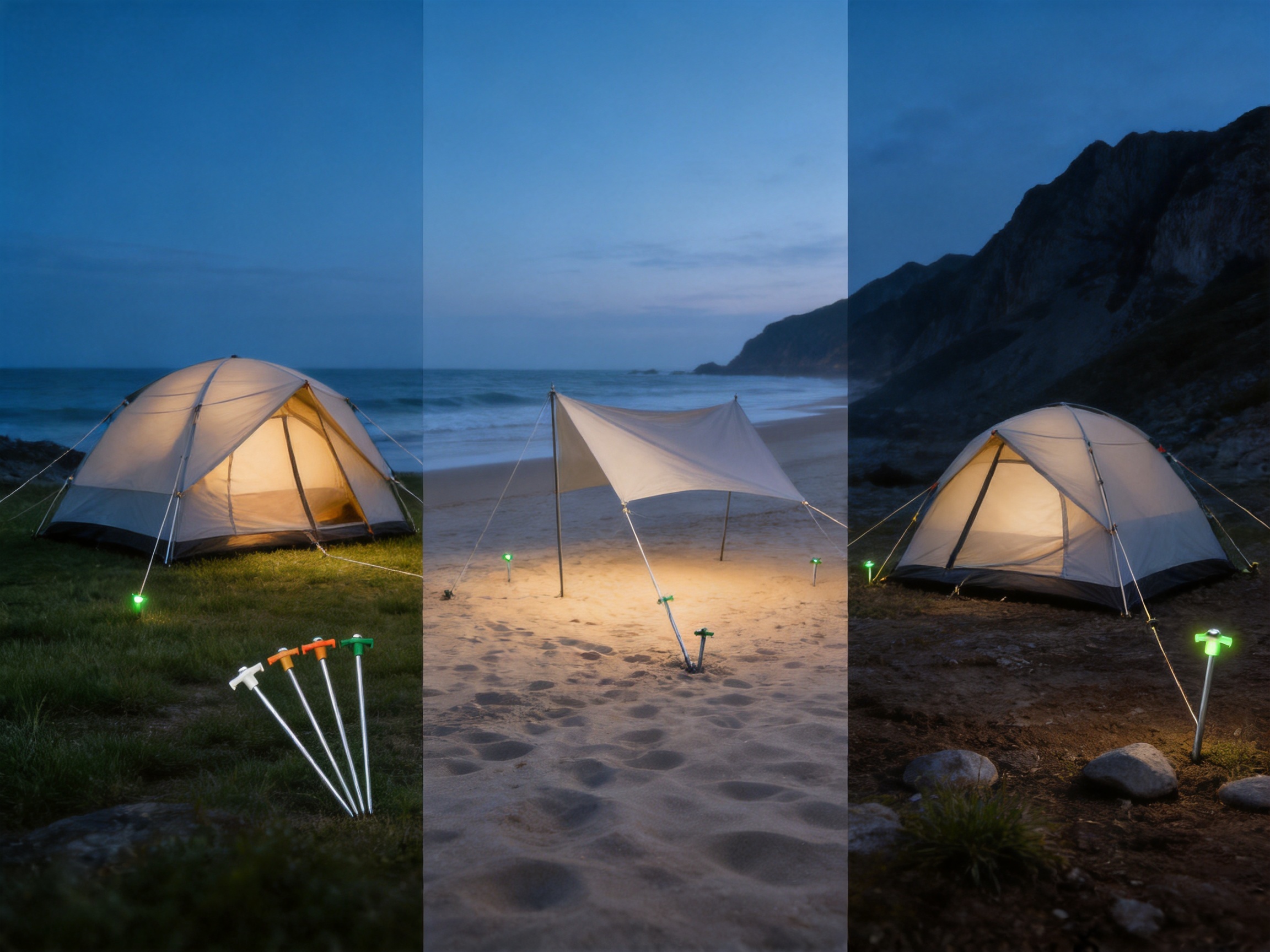
On grass and ordinary soil, the shaft can penetrate beneath the surface layer and engage denser ground. This is useful when the top layer is loose because of dry weather, foot traffic, or previous campsite use. The user should insert the stake at an appropriate angle, normally away from the tent and in line with the direction of the guy line. Correct orientation allows the ground to support the applied load more effectively.
In sand, length is especially important because sand offers less resistance than compact soil. A short peg may pull out when the guy line is tensioned or when wind repeatedly loads the tent. A 25cm stake provides additional depth, although users should understand that ordinary narrow stakes may not be sufficient for very loose or deep beach sand. In such conditions, positioning, multiple anchor points, buried anchors, or specialized sand stakes may be appropriate.
On grass, the stake can be driven through roots and compacted soil, creating a stable connection without requiring a large or complex anchor. The pointed shaft helps with insertion, while the upper head provides a connection point for the line. The combination is convenient for weekend camping, garden shelters, picnic tarps, and outdoor events.
In hard or gravelly ground, the product’s hardened steel structure may provide better resistance than plastic alternatives. However, the user should avoid striking the stake against large rocks or attempting to force it into solid stone. If the ground cannot accept the shaft, another anchor location or a suitable rock-specific anchoring method should be used.
| Ground Condition | Potential Benefit of a 25cm Steel Stake | Recommended Use Consideration |
|---|---|---|
| Grass and ordinary soil | Provides useful insertion depth and reliable guy-line attachment | Insert firmly at an angle aligned with the tension direction |
| Loose soil | Reaches deeper than many short pegs | Select denser ground where possible and use additional anchors for large shelters |
| Beach sand | Offers more depth than short stakes and supports basic tarp or tent setups | Use multiple stakes or specialized sand anchoring methods in very loose sand |
| Gravelly ground | High-carbon steel provides greater impact resistance than many plastic pegs | Avoid large rocks and do not force the stake into solid stone |
| Mountain camps | Supports general anchoring where soil is penetrable | Inspect the terrain and carry alternative anchoring options for rocky areas |
Design Advantages Compared with Common Competitor Products
Outdoor camping stakes are available in many materials and shapes. The most common alternatives include plastic pegs, thin wire stakes, short aluminum pegs, heavy-duty steel pins, and specialized sand or snow anchors. Each option has a specific use case. The advantage of this 25cm steel stake is its balanced design for users who want strength, general-purpose compatibility, and reasonable portability in one product.
Compared with Plastic Tent Pegs
Plastic pegs are often suitable for soft grass and light recreational camping. Their low price and low weight make them attractive for entry-level kits. However, they may crack under impact, deform in heat, or become brittle in cold temperatures. They can also have limited resistance to sharp gravel and repeated installation.
The high-carbon steel construction of this product provides a stronger alternative for users who need repeated-use performance. The galvanized finish also gives the steel a more durable surface for outdoor exposure. Although the steel stake may weigh more than a plastic peg, the additional strength and service life can provide better value for regular campers and professional buyers.
Compared with Short Lightweight Pegs
Lightweight pegs are popular among backpackers because every gram matters. They can be effective when used in suitable ground and with a lightweight shelter. However, shorter stakes may have reduced holding depth, especially in loose soil or sand. Their smaller dimensions may also make them harder to see and handle.
The 25cm length provides a more substantial anchoring point for general camping and tarp use. The glow-in-the-dark head improves nighttime visibility, while the steel structure supports stronger impact resistance. For long-distance hikers, the product may be selected when the user prioritizes durability and anchoring confidence over minimum pack weight.
Compared with Uncoated Steel Stakes
Uncoated steel can provide strength, but it may be more vulnerable to surface rust when exposed to damp soil, salt, or wet storage. Corrosion can affect appearance and eventually reduce the service life of a component if it is not controlled.
Galvanization adds a protective layer that helps the stake withstand normal outdoor moisture. It does not eliminate the need for maintenance, particularly in coastal environments, but it offers a meaningful advantage over bare steel for a reusable camping accessory.
Compared with Single-Purpose Anchors
Some anchors are optimized for one environment, such as deep beach sand, snow, or extremely rocky soil. These products can be highly effective in their intended conditions but may be less convenient for general camping. A buyer who travels across different regions may prefer a versatile stake that works with common grass, soil, and sand setups.
The universal upper design of this product supports tent lines, tarp loops, and hooks, making it suitable for a variety of shelter arrangements. It is not a replacement for every specialized anchor, but it can serve as a practical core component in a broader outdoor anchoring kit.
Glow-in-the-Dark Head and Nighttime Usability
Campsites change significantly after sunset. A stake that was easy to see during setup may become almost invisible at night. Guy lines can cross paths, tent entrances may be close to anchor points, and family members may walk around the shelter without noticing the hardware on the ground.
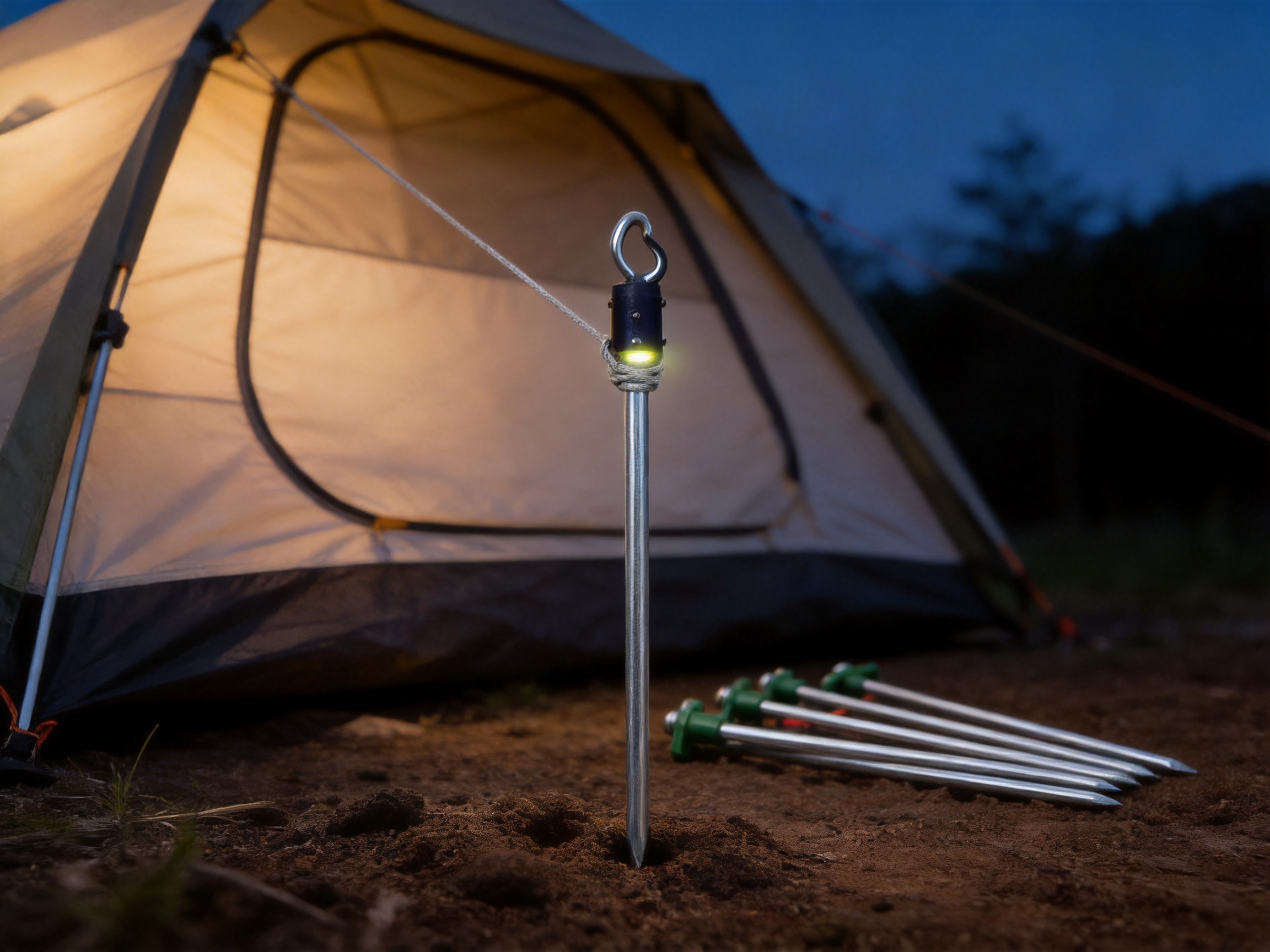
The glow-in-the-dark head helps users identify the stake location after exposure to light. This feature can make it easier to locate the end of a guy line, check whether a stake has moved, and organize the campsite during nighttime activities. It also supports quicker dismantling when the campsite must be packed before daylight.
Visibility is particularly valuable for group camping. Multiple tents and tarps may be installed close together, creating a network of lines and anchors. A recognizable stake head can help users distinguish anchoring points and reduce confusion during adjustments. For outdoor retailers, this practical feature provides a clear product benefit that can be communicated easily to consumers.
The glow feature should be understood as a visibility aid, not a substitute for campsite lighting or reflective guy lines. Users should still maintain clear walkways, place stakes carefully, and inspect the surrounding area before moving through the campsite.
Universal Hook and Knot Compatibility
Camping shelters use a wide range of attachment methods. Some guy lines have loops, some use tensioners, and others connect through hooks or knots. A stake designed around only one attachment method can limit the user’s options. The universal hook and knot design of this product is intended to accommodate common line configurations.
Users can attach a guy line to the upper section and adjust the line so that the tension is directed away from the tent. Tarps may be secured using corner loops, webbing, or lightweight hooks. This versatility makes the stakes useful beyond traditional tents. They can support awnings, rain tarps, shade shelters, windbreaks, and temporary outdoor structures when the ground conditions are appropriate.
A practical attachment area should also make removal easier. After a night of wind or rain, a stake may be firmly held by the soil. The head gives the user a clear point to grip or pull, while a suitable tool can be used carefully when additional force is required. Users should avoid pulling on a thin guy line alone because this can damage the line or create unnecessary stress on the fabric.
Application Scenarios
Family and Recreational Camping
Family campers often prioritize easy setup, durability, and visible equipment. A 25cm stake can provide a dependable anchoring option for family tents, shade tarps, and outdoor cooking shelters. The glow-in-the-dark head is useful when children or other family members move around the campsite after dark.
For larger tents, the number and arrangement of stakes are important. Users should follow the tent manufacturer’s instructions and anchor every designated point. Larger shelter surfaces catch more wind, so a strong stake alone cannot compensate for insufficient anchoring or poor guy-line placement.
Beach Camping
Beach environments combine several challenges, including loose sand, wind exposure, moisture, and salt. The 25cm shaft can provide useful depth for basic beach tent and tarp arrangements. Galvanization helps protect the steel surface from ordinary moisture, but users should rinse off sand and salt after use and dry the stakes thoroughly.
In very loose sand, a narrow stake may still pull out under high tension. Users can improve stability by choosing a location with firmer sand, inserting the stake at the correct angle, using multiple anchor points, and reducing unnecessary wind exposure. For large beach shelters or severe weather, specialized sand anchors may be more appropriate.
Hiking and Mountain Camping
Mountain and hiking environments may include grass, soil, gravel, exposed roots, and partially rocky ground. The hardened steel structure provides useful resistance when the stake must be installed in firm soil or ground containing small stones. Its 25cm length can also help when the surface layer is loose.
Mountaineers and long-distance hikers should consider the complete equipment system, including pack weight, tent size, expected wind, and terrain. A steel stake may be preferred for high-load points or storm-prone camps, while lighter alternatives may be used for secondary points when weight reduction is essential. Carrying a combination of anchoring tools can be a sensible strategy for unpredictable terrain.
RV Travel and Temporary Shelters
RV travelers often use awnings, privacy screens, tarps, and auxiliary shelters in addition to a main vehicle. These systems require ground anchors that are easy to carry and compatible with different guy lines. The universal upper design allows the stakes to support several temporary structures at campsites, parks, and outdoor events.
Outdoor Events and Commercial Use
Event organizers, equipment rental companies, and outdoor activity providers require components that can be installed and removed repeatedly. High-carbon steel, hardening, and galvanized protection support the demands of frequent handling. A consistent product specification also makes it easier for businesses to standardize their equipment kits and train staff in correct installation methods.
Manufacturing Process and Quality Considerations
A reliable tent stake is the result of multiple controlled processes rather than one material choice. Manufacturing quality influences whether every stake has a consistent length, straightness, point, head, surface finish, and attachment structure. For brands purchasing in volume, production consistency is as important as the performance of an individual sample.
Material Selection
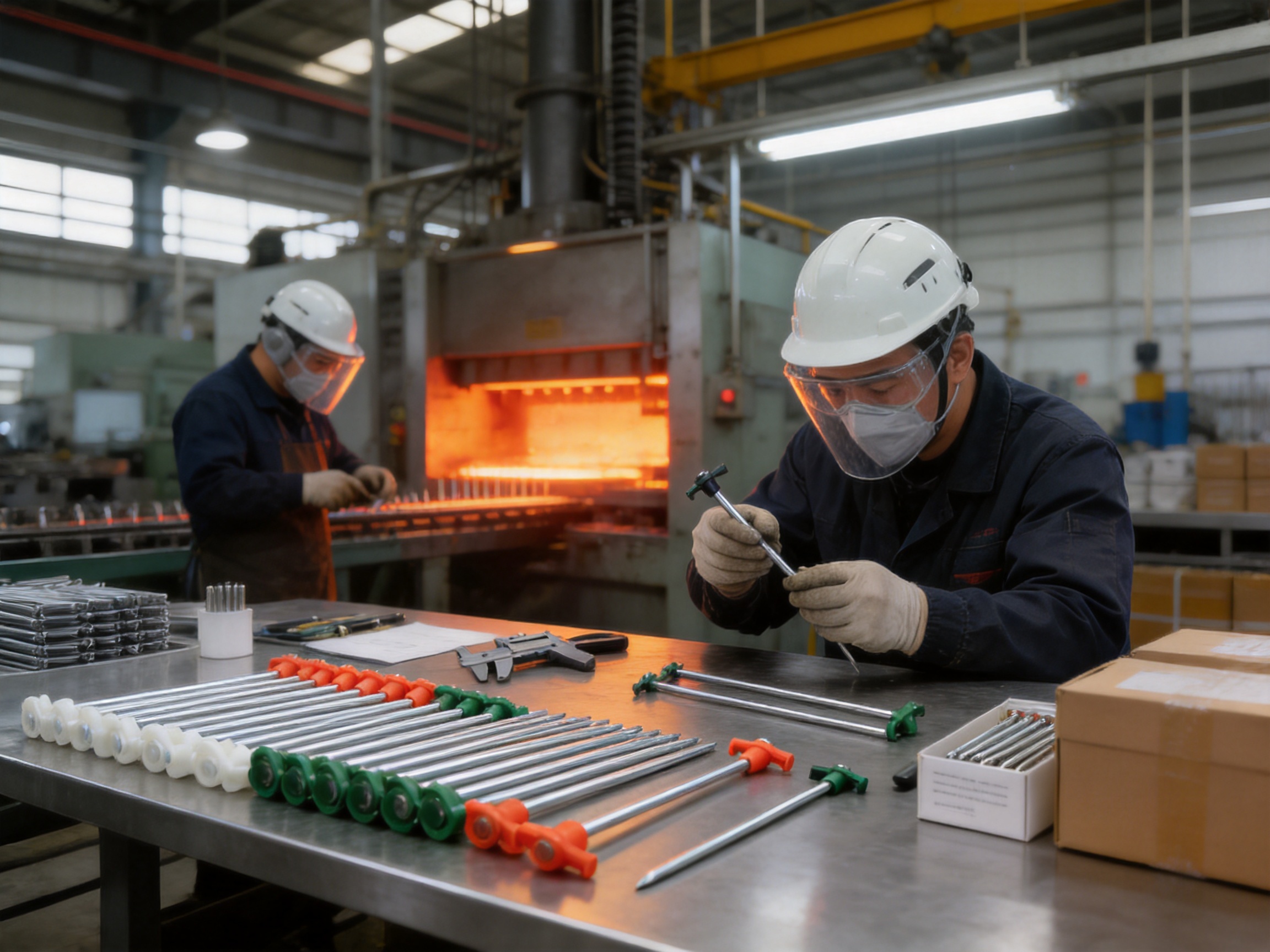
The production process begins with the selection of suitable high-carbon steel. Material quality affects hardness, strength, machinability, and the final response to heat treatment. A professional manufacturer should maintain control over incoming materials and verify that the selected steel is appropriate for the intended application.
Material documentation, supplier qualification, and batch traceability can help reduce uncertainty. These practices are especially important for OEM and private-label customers that need repeat orders to match approved samples. Consistent raw material standards support more predictable processing and finished-product performance.
Forming and Shaft Production
The steel shaft must be formed to the specified dimensions and shape. Processes may include cutting, pressing, forging, drawing, or other suitable forming methods depending on the design and production volume. The objective is to create a straight, structurally sound shaft with an effective point for insertion.
Dimensional control is necessary because variations in length or diameter can affect installation and holding behavior. The manufacturer should inspect shaft straightness, point formation, surface condition, and overall dimensions during production rather than relying only on final visual checks.
Head and Attachment Formation
The upper head is a functional part of the product. It must provide a secure connection point for hooks, loops, and knots while remaining comfortable and practical to handle. The head also contains the glow-in-the-dark feature, which must be applied or assembled consistently so that the visibility benefit is maintained across the production batch.
The connection area should be checked for sharp edges, incomplete forming, loose components, and insufficient structural support. Smooth finishing is particularly important because guy lines can be damaged by burrs or rough metal surfaces during repeated use.
Hardening and Heat Treatment
Hardening is used to improve the mechanical performance of the steel. Heat-treatment parameters must be controlled carefully because excessive hardness can create brittleness, while insufficient treatment may not provide the desired bending resistance. The appropriate process depends on the steel grade, shaft geometry, and intended use.
Professional production control may include temperature monitoring, timed processing, sample testing, and inspection after treatment. The goal is to achieve a balanced structure that can withstand normal impact while retaining sufficient toughness for outdoor use.
Galvanization and Surface Protection
After forming and treatment, the stakes can receive a galvanized finish. Surface preparation is essential. Oil, scale, dust, and other contaminants must be removed so that the protective layer adheres correctly. A uniform finish improves corrosion resistance and gives the product a consistent appearance for retail presentation.
Inspection may include visual examination, coating coverage checks, and corrosion-resistance evaluation according to the customer’s requirements. While no surface treatment can replace proper care, a controlled galvanized process provides a stronger foundation for long-term outdoor use.
Inspection, Sampling, and Optimization
Quality control should continue from initial material receipt through packaging. Production teams can use first-article inspection, in-process checks, final sampling, and packaging audits to identify deviations before shipment. Important inspection points include shaft length, straightness, head attachment, glow-head condition, surface finish, and visible defects.
Outdoor equipment should be evaluated based on actual use conditions rather than catalog appearance alone. Sampling and field-oriented testing can reveal problems that are not obvious during a factory inspection. For example, a stake may appear acceptable but prove difficult to remove, incompatible with common guy lines, or vulnerable to bending when used in ordinary compacted soil.
A manufacturing partner with experience in mountaineering, hiking, and camping products can contribute to product improvement by considering how equipment behaves in weather, terrain, and repeated-use situations. This approach helps transform a simple hardware component into a more dependable outdoor solution.
Advantages of a Specialized Outdoor Manufacturing Partner
For global retailers and outdoor brands, product quality depends on more than the factory’s ability to produce one item. Buyers also need reliable communication, stable production, flexible packaging, repeatable quality, and practical support during product development. A specialized outdoor manufacturing partner can contribute in each of these areas.
CragHaven Outdoor is based in Hangzhou, China, and focuses on mountaineering, hiking, and camping applications. Its approach is centered on designing products for real weather, terrain, and time rather than producing items only for catalog presentation. This perspective is valuable for tent stakes because the product’s performance is directly influenced by ground conditions, wind, moisture, handling, and storage.
The company’s cross-border manufacturing experience supports cooperation with camping gear brands, distributors, retailers, and corporate buyers. Customers may require a standard product, a private-label version, modified packaging, updated dimensions, or an application-specific design. A manufacturer that participates in design optimization and sampling can help identify practical improvements before mass production begins.
Stable supply chain management is another important strength. Outdoor businesses often plan seasonal launches, promotional campaigns, and regional distribution schedules months in advance. Delays in a small accessory can affect the availability of a complete camping kit. Consistent production planning, material control, and delivery coordination can help reduce these risks.
OEM and Private-Label Support
Retailers may want the product to match their brand identity through customized packaging, labels, instructions, color details, or bundled accessories. OEM support can be structured around the buyer’s sales channel and target market. For example, a retail package may emphasize ease of use and nighttime visibility, while a professional distribution package may focus on specifications, corrosion resistance, and repeated-use performance.
Private-label customers also benefit from clear product documentation. Accurate dimensions, material descriptions, care instructions, and usage limitations help reduce customer confusion and improve the credibility of the finished product. A professional supplier can assist with reviewing this information before production and shipment.
Design Optimization
Design optimization may involve changes to the stake length, shaft profile, head configuration, glow component, packaging format, or accessory combination. These changes should be evaluated against the intended application rather than made solely for appearance.
For example, a buyer focused on beach camping may request a larger contact area or a complementary sand anchor. A lightweight hiking brand may seek a reduced-weight version for selected tent points. A family camping retailer may prioritize visibility, easy removal, and a compact carrying case. A capable manufacturer can review these requirements and recommend a practical path from concept to sample.
Repeatability and Long-Term Cooperation
Outdoor brands need more than an attractive first shipment. They need later batches to maintain the same dimensions, surface finish, packaging, and functional quality. Production records, approved samples, inspection standards, and supplier communication all contribute to repeatability.
Long-term cooperation also allows the manufacturer to understand the customer’s market, customer feedback, and product roadmap. This can support continuous improvement and help the buyer develop a coherent range of camping accessories rather than isolated products.
Correct Installation and Use
Even a strong stake can fail if it is installed incorrectly. Before setup, users should inspect the ground and identify a location that is firm enough to hold the anchor. The stake should be positioned so that the guy line pulls against the embedded shaft rather than directly lifting it out of the ground.
In ordinary soil or grass, the stake should be driven deeply while leaving the upper head accessible for attachment and removal. The user should avoid placing the stake at a vertical angle when the line pulls horizontally, because an angled installation can often provide better resistance to the direction of tension.
In sand, users should avoid areas that are visibly saturated, extremely loose, or exposed to direct wave action. The stake should be inserted as deeply as practical and combined with other anchor points when supporting a tarp or larger shelter. Tension should be adjusted gradually so that the ground has time to settle around the stake.
In gravelly soil, the user should select a gap between larger stones whenever possible. If a stake meets a solid obstruction, it should not be struck repeatedly with excessive force. Repositioning the anchor is safer and helps prevent damage to the stake or tool.
A suitable mallet is preferable to a heavy metal hammer when installing stakes. The user should keep hands clear of the striking area and wear appropriate protection when working with hard ground. After installation, the tent and guy lines should be checked to confirm that the structure is evenly tensioned.
When removing the stake, loosen the guy line first. Pulling directly on a tightly loaded line may damage the tent, rope, or attachment point. Use the stake head as the primary grip point, and if necessary, apply controlled movement rather than sudden force.
Maintenance, Storage, and Service Life
Maintenance is simple but important. After each trip, remove sand, mud, grass, and other debris from the shaft and head. A dry cloth or soft brush is usually sufficient. If the stakes have been used near salt water, rinse them with clean water to reduce salt residue and allow them to dry fully before storage.
Users should inspect the stakes for bending, deep scratches, loose head components, damaged glow material, or exposed areas of corrosion. A small surface mark does not necessarily make a stake unusable, but visible structural damage should be treated seriously. Stakes that are badly bent or cracked should be replaced rather than straightened repeatedly.
Store the stakes in a dry bag or container, preferably separated from damp tent fabric. Keeping metal components in a wet storage environment can accelerate corrosion even when the surface is galvanized. A compact storage pouch also prevents the pointed ends from damaging other equipment.
With reasonable care and appropriate use, high-carbon steel stakes can provide service across many camping trips. Their actual lifespan depends on ground conditions, installation force, weather exposure, frequency of use, and maintenance practices.
Purchasing Considerations for Brands and Distributors
Bulk buyers should evaluate more than the unit price. Important considerations include material consistency, heat-treatment control, galvanized finish, dimensional accuracy, attachment compatibility, packaging quality, and delivery reliability. A low-cost product may become expensive if it produces high rates of customer complaints, replacement requests, or inconsistent retail reviews.
Buyers should request samples before confirming mass production. Samples allow the customer to assess weight, length, point design, head usability, glow visibility, packaging, and compatibility with the target tent systems. Testing should be performed in several representative ground conditions rather than on a single surface.
Packaging should protect the pointed stakes during transport and storage. It should also communicate essential information, including product dimensions, suitable applications, installation guidance, care recommendations, and safety notes. For retail sales, clear packaging can help consumers understand why a steel stake may be preferable to a basic plastic peg.
Brands should also clarify customization requirements at the development stage. These may include logo application, color, instruction cards, barcode labels, carton marks, quantity per package, and mixed-product bundles. Early confirmation reduces the risk of changes during production and helps maintain the planned delivery schedule.
| Buyer Evaluation Area | Questions to Review | Why It Matters |
|---|---|---|
| Material | Is high-carbon steel used consistently across production batches? | Material consistency influences strength and repeatability. |
| Heat treatment | Are hardening parameters controlled and documented? | Balanced hardness supports bending resistance without unnecessary brittleness. |
| Surface finish | Is the galvanized coating even and adequately protected? | Surface protection helps reduce corrosion during outdoor use. |
| Dimensions | Are the 25cm length and shaft specifications consistent? | Consistent dimensions support predictable installation and packaging. |
| Usability | Can the head accept common hooks, loops, and knots? | Compatibility broadens the product’s application range. |
| Visibility | Does the glow-in-the-dark head function consistently? | Nighttime visibility improves campsite organization and product differentiation. |
| Supply capability | Can the manufacturer support repeat orders and customized packaging? | Stable supply reduces seasonal and distribution risks. |
Safety and Application Limitations
The product is designed for outdoor anchoring in suitable penetrable ground. It should not be treated as a universal solution for concrete, solid rock, frozen ground, steep unstable slopes, or severe storm conditions. Users must assess the site, shelter size, wind exposure, and expected load before selecting an anchoring method.
Large tents, commercial marquees, and high-sided tarps may generate substantial wind loads. They may require additional stakes, thicker guy lines, specialized anchors, or professional installation. The number of stakes should follow the shelter manufacturer’s recommendations, and all anchor points should be checked after changes in weather.
Pointed metal stakes should be handled carefully and stored securely. They should be kept away from children when not in use. At the end of a camping trip, users should confirm that all stakes have been removed from the ground so that they do not create hazards for later visitors, animals, maintenance workers, or vehicles.
Glow-in-the-dark visibility can diminish over time or vary according to the amount of prior light exposure. It should supplement, not replace, reflective markings, headlamps, lanterns, and safe campsite planning.
Q&A: Frequently Asked Questions
What are these 25cm outdoor camping tent steel stakes used for?
They are used to anchor tents, tarps, guy lines, awnings, and temporary outdoor shelters to suitable ground. They are appropriate for camping, hiking, mountaineering, beach trips, RV travel, outdoor events, and general recreational use.
Why choose high-carbon steel instead of plastic?
High-carbon steel generally offers greater strength, impact resistance, and durability than ordinary plastic. It is suitable for repeated use and can perform more reliably in firm soil, gravelly ground, and windy camping areas. Plastic pegs may still be useful where minimum weight and light-duty performance are the primary concerns.
Is a 25cm stake suitable for beach camping?
It can be suitable for basic beach camping and tarp setups, particularly where the sand has adequate density. Very loose or deep sand may require multiple stakes, specialized sand anchors, buried anchors, or another method that provides a larger contact area.
Can the stakes be used in rocky ground?
They may be used in penetrable ground containing small stones, and the hardened steel construction can provide better resistance than many plastic pegs. They should not be forced into solid rock or concrete. Users should reposition the stake or use a rock-specific anchoring method when penetration is not possible.
What is the purpose of the glow-in-the-dark head?
The glow-in-the-dark head helps users locate the stake and nearby guy lines in low-light conditions. It can make nighttime campsite movement, inspection, and dismantling more convenient. It is a visibility aid and should be used together with appropriate campsite lighting and reflective equipment.
Do the stakes work with different tent lines?
Yes. The universal upper design is intended to accommodate common hooks, loops, and knots used with tent guy lines, tarp corners, and shelter attachments. Users should ensure that the line is securely connected and tensioned in the correct direction.
How should the stakes be installed?
Choose firm, penetrable ground and position the stake so that it resists the direction of line tension. Drive it in carefully with a suitable mallet, leaving the head accessible. Do not use excessive force against solid obstructions, and check the entire tent system after installation.
How should the stakes be cleaned after beach use?
Rinse off sand and salt with clean water, wipe the stakes, and allow them to dry completely before storage. This practice helps protect the galvanized surface and reduces the chance of corrosion caused by trapped moisture and salt residue.
Are these stakes suitable for lightweight backpacking?
They can be used by hikers who prioritize strength and repeated-use durability, but they may weigh more than specialized ultralight aluminum or titanium pegs. Backpackers should compare the stake weight with the shelter type, expected weather, and importance of stronger anchoring.
Can outdoor brands request customized products?
Yes. Customization may include packaging, labeling, dimensions, colors, logo presentation, instructions, quantities, and bundled accessories. Product development should begin with a review of the target market, intended terrain, shelter type, and required performance.
What should bulk buyers evaluate in a supplier?
Bulk buyers should review material control, production experience, heat treatment, galvanization, inspection procedures, sampling capability, packaging, communication, production capacity, and delivery stability. A reliable supplier should be able to support both initial development and repeat orders.
How does a specialized outdoor manufacturer add value?
A specialized manufacturer understands that outdoor products must operate in real weather and terrain. In addition to producing the item, the supplier can help optimize design, evaluate samples, control materials, develop packaging, and coordinate repeatable production for international customers.
Conclusion
The Outdoor Camping Tent with 25cm Ground Stakes is designed to solve a basic but important problem: keeping tents, tarps, and shelters securely connected to the ground. Its high-carbon steel construction, hardened structure, galvanized finish, 25cm length, glow-in-the-dark head, and universal attachment design combine to create a practical anchoring accessory for a broad range of outdoor users.
Compared with ordinary plastic pegs, the product offers improved strength and repeated-use potential. Compared with short or uncoated stakes, it provides greater insertion depth, better surface protection, and enhanced visibility. Compared with highly specialized anchors, it offers a more versatile solution for common camping environments including grass, ordinary soil, and selected beach applications.
Its performance depends on correct installation and appropriate terrain selection. No tent stake can replace careful campsite assessment, sufficient guy lines, or a complete shelter anchoring plan. However, a well-manufactured steel stake can reduce one of the common weaknesses in outdoor equipment systems: the use of small, low-quality components that fail when conditions become more demanding.
For retailers, outdoor brands, distributors, and professional buyers, the product also represents an opportunity to improve the practical quality of a camping equipment range. With controlled high-carbon steel material, hardening, galvanization, inspection, sampling, and flexible OEM support, a specialized manufacturing partner can help transform a simple accessory into a dependable, market-ready product.
CragHaven Outdoor provides outdoor brand and cross-border manufacturing support from Hangzhou, China, with a focus on mountaineering, hiking, and camping applications. Its manufacturing approach emphasizes real-world use, long-term value, stable supply, and product development based on weather, terrain, and repeated outdoor experience. For customers seeking reliable camping accessories and scalable product solutions, these capabilities can support a more consistent and competitive outdoor gear offering.
References
1. General principles of tent anchoring, guy-line tension, and campsite stability in outdoor shelter setup.
2. General engineering considerations for carbon steel selection, hardening, and bending resistance in small outdoor hardware.
3. General corrosion-protection practices for galvanized steel products used in damp and outdoor environments.
4. Outdoor equipment design principles concerning portability, durability, terrain compatibility, and repeated-use performance.
5. Product specifications and manufacturing information supplied for the 25cm Outdoor Camping Tent Steel Stakes.
6. Company information supplied for CragHaven Outdoor, including its outdoor product development, manufacturing, OEM, and cross-border supply capabilities.
Product: Outdoor camping tent with 25cm ground stakes, beach tarpaulin, and windproof steel studs



- Phone: +86-15968800379
- E-mail: [email protected]
- Address: Room 1002, Huishang Building, Gongshu District, Hangzhou City, Zhejiang Province.
Copyright © CragHaven Outdoor All Rights Reserved. Outdoor Gear Manufacturers Wholesale Mountaineering Camping Gear Suppliers
