

 English
 Deutsch
 Español
 Français
Large-Capacity Nylon Professional Mountaineering Backpack for Multi-Day Terrain
Content
- 1 Product Overview and Intended Use
- 2 Why Large Capacity Matters in Mountain and Camping Scenarios
- 3 Material System: Nylon Exterior and Oxford Cloth Interior
- 4 Weather Protection and the Independent Rain Cover
- 5 External Attachment and Trekking Pole Securing System
- 6 Ergonomic Double-Shoulder Carrying System
- 7 Competitive Advantages in Practical Outdoor Use
- 8 Manufacturing Philosophy Behind the Product
- 9 Advanced Production Processes and Quality Control
- 10 Design for Weather, Terrain, and Time
- 11 Supply Chain Strength and Cross-Border Manufacturing Value
- 12 Use Scenarios: From Trailhead to Camp
- 13 Packing Strategy for Best Performance
- 14 Business Value for Retailers, Distributors, and Outdoor Brands
- 15
Q&A Section
- 15.1 What type of user is this backpack best suited for?
- 15.2 Why is the combination of nylon and Oxford cloth important?
- 15.3 Does the backpack protect gear from rain?
- 15.4 How does the trekking pole securing system help?
- 15.5 What makes this backpack different from ordinary large travel bags?
- 15.6 Why is ergonomic carrying important for a large-capacity backpack?
- 15.7 How does CragHaven Outdoor support product quality?
- 15.8 Is this backpack suitable for wholesale or private label programs?
- 16 Conclusion
- 17 References
- 18 Product: Large-capacity nylon professional mountaineering backpack, multi-functional sports double-shoulder mountaineering backpack
Modern mountaineering demands equipment that does more than carry supplies from one point to another. A backpack must protect clothing, food, tools, emergency items, navigation equipment, and shelter components through changing weather, uneven terrain, repeated abrasion, and long hours of movement. The large-capacity nylon professional mountaineering backpack presented here is designed for that reality. Built with a high-strength water-repellent nylon exterior, a durable Oxford cloth inner lining, an independent rain cover, a spacious main compartment, trekking pole fixing points, abundant external attachment locations, and an ergonomic double-shoulder carrying system, it serves hikers, climbers, campers, and outdoor professionals who need dependable load organization across multi-day journeys.
This article examines the product from the perspective of real outdoor use. It explains why a large-capacity backpack remains central to mountaineering and camping systems, how the material structure improves reliability, how the storage layout supports expedition-style packing, and why the carrying system matters during long-distance travel. It also highlights the manufacturing strengths behind the product, including scenario-based design thinking, sampling, testing, optimization, material selection discipline, and scalable production capabilities. For buyers, distributors, outdoor retailers, and professional users, the backpack is not merely a container; it is a mobile support platform for wilderness travel.
Product Overview and Intended Use
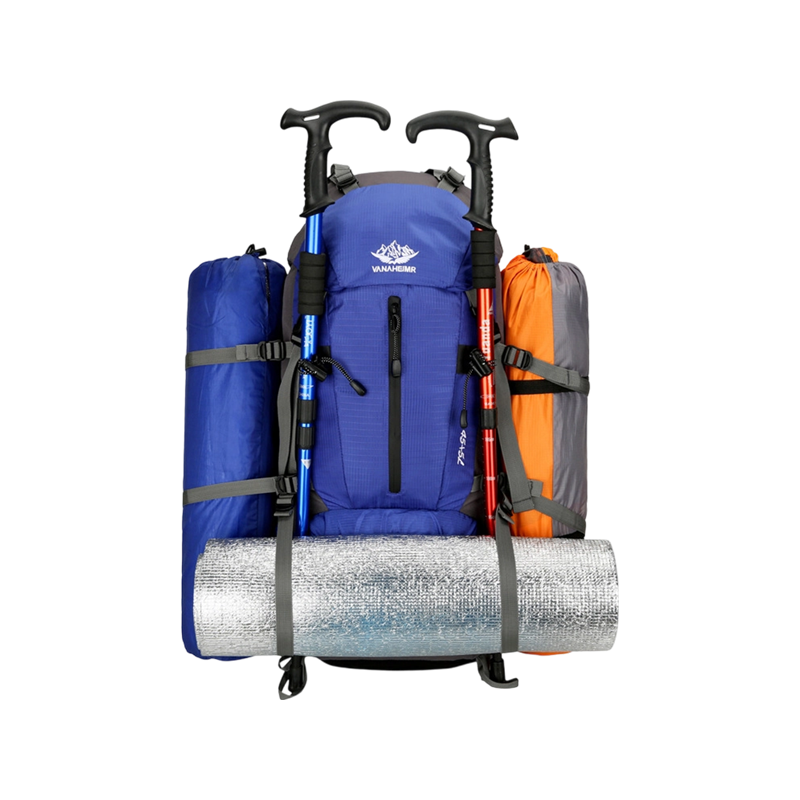
The backpack belongs to the mountaineering backpack category and is engineered for large-capacity outdoor use. Its design concept is clear: provide enough space for multi-day hiking or camping equipment while maintaining protection, load stability, and practical external organization. In mountaineering and extended trekking, users often need to carry layered clothing, food, water systems, cookware, sleeping accessories, first-aid equipment, ropes or auxiliary tools, rain gear, and personal electronics. A small urban-style daypack cannot manage those demands effectively. This model answers the need for volume, resilience, and purpose-built field functionality.
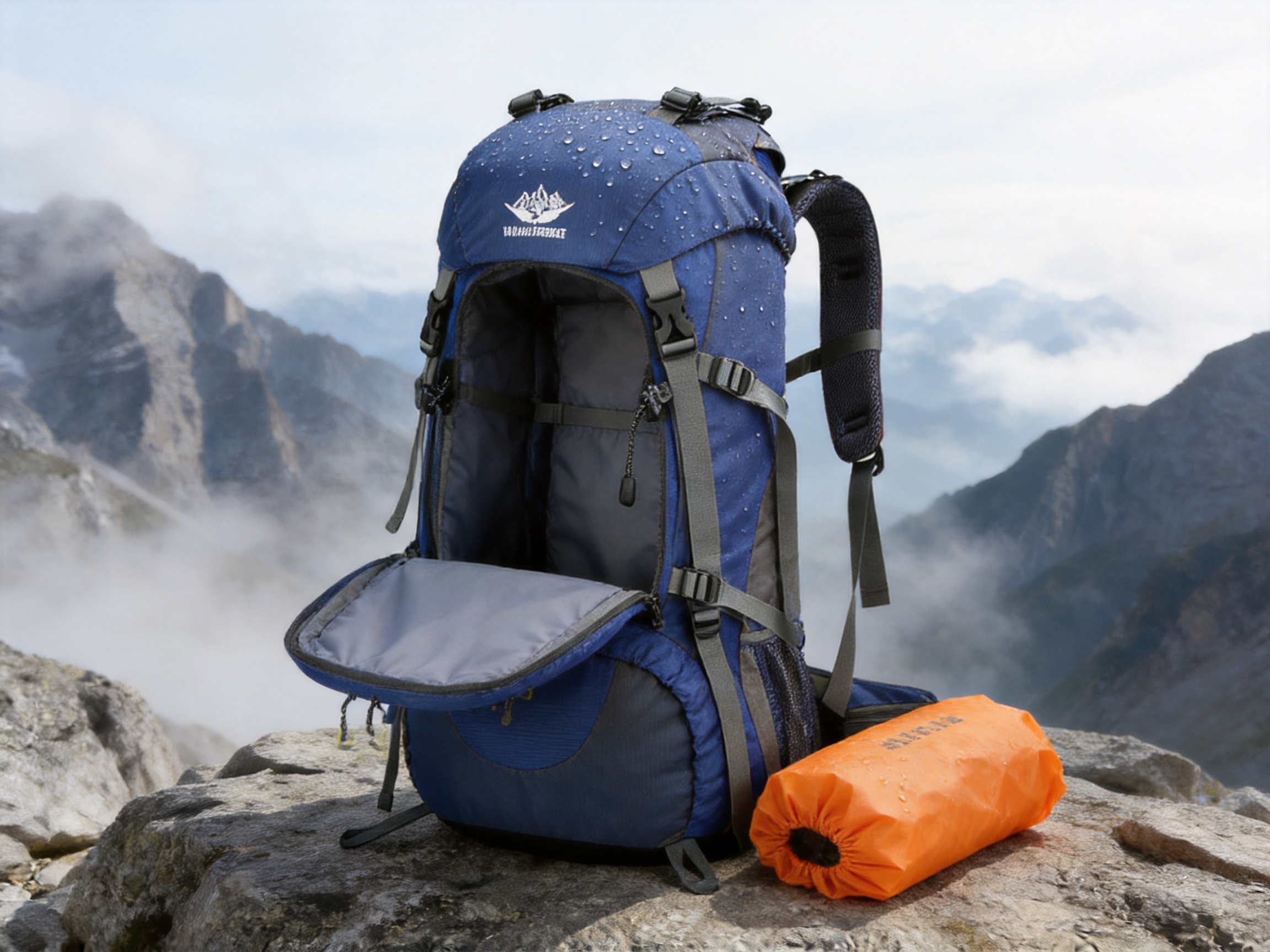
The outer layer uses high-strength water-repellent nylon. Nylon is widely valued in outdoor equipment because it offers strong tensile performance, good abrasion resistance, and a favorable strength-to-weight ratio. For a mountaineering backpack, the exterior fabric faces direct exposure to stone, tree branches, soil, snow, rain, and repeated loading. A stronger shell helps reduce premature wear and gives users confidence when the pack is placed on rough ground, brushed against rock, or strapped tightly with external gear. The water-repellent treatment adds another layer of defense by helping moisture bead off the surface during light rain or humid conditions.
Inside the pack, durable Oxford cloth provides secondary protection. This dual-material approach is one of the product’s practical advantages. Many low-cost backpacks rely only on a single shell fabric and a simplified interior. When the outer layer becomes damp, abraded, or stressed, the contents are more vulnerable. By combining nylon outside with Oxford cloth inside, the backpack creates a more secure environment for gear. The inner lining also helps resist friction from cookware, packed tools, containers, and sharp-edged accessories that might otherwise damage the bag from within.
The independent rain cover is another critical feature. While water-repellent nylon helps in light moisture, prolonged rain, wind-driven precipitation, or wet mountain vegetation can challenge any fabric. A separate rain cover provides broader coverage and can be deployed quickly when weather turns. This improves the backpack’s usefulness in unpredictable environments, especially during spring and autumn hikes, alpine approaches, forest camping, and routes where users cannot immediately find shelter. The combination of water-repellent fabric plus an independent rain cover is more versatile than relying on fabric treatment alone.
The backpack also includes side-mounted trekking pole securing functionality. Trekking poles are common in mountaineering and long-distance hiking because they reduce lower-body strain, improve balance, and support movement on descents. However, users do not always need poles in their hands. During scrambling, climbing sections, campsite tasks, or travel through dense vegetation, poles must be attached securely to the pack. A dedicated fixing system helps prevent them from swinging, falling, or interfering with movement. This is a strong advantage over general-purpose travel bags that lack proper outdoor tool accommodation.
Why Large Capacity Matters in Mountain and Camping Scenarios
Large capacity is not simply about carrying more. In professional outdoor use, capacity is about carrying the correct gear in an organized and accessible way. Multi-day routes require equipment for changing temperatures, unexpected weather, overnight rest, hydration, nutrition, and emergency response. If a backpack is too small, users are forced to hang too many items outside, compress soft goods excessively, or leave important equipment behind. Each of those compromises can reduce safety and comfort.
A large main compartment allows users to pack sleeping gear, insulated clothing, food supplies, and camping accessories more efficiently. It also supports internal weight management. Heavier items can be placed closer to the back and centered vertically, while lighter items can fill outer or upper zones. This packing method reduces sway, improves balance, and helps the user maintain posture on uneven terrain. A backpack with inadequate capacity often forces gear into awkward positions, creating an unstable load that becomes exhausting over long distances.
Large capacity also supports modular travel. Outdoor users often divide gear into systems: sleep system, cooking system, clothing system, hydration system, emergency system, and navigation system. A spacious main compartment and external attachment points allow these systems to be arranged logically. For example, spare clothing can remain protected inside, while trekking poles, sleeping pads, or rainwear can be fixed externally. This separation reduces the need to unpack the entire bag for one item and helps maintain order during camp setup or rapid weather changes.
Compared with smaller hiking backpacks or casual double-shoulder bags, this product is better suited to demanding outdoor movement. Its volume supports trips where users must carry not only personal items but also group equipment or backup layers. Outdoor retailers and distributors can position it as a practical solution for beginners upgrading from daypacks, experienced hikers planning longer routes, and camping users who need one backpack for transportation and field organization.
The product’s large-capacity orientation also supports cross-season value. In summer, users may carry lighter sleeping equipment but need extra hydration, sun protection, and campsite tools. In colder months, insulation layers and thicker sleeping gear take more space. A large backpack remains useful across conditions because it can be compressed or filled depending on trip requirements. This adaptability is important for customers who prefer durable long-term equipment instead of buying separate packs for every season.
Material System: Nylon Exterior and Oxford Cloth Interior
The material pairing is a core advantage of the backpack. High-strength nylon on the exterior provides the first line of defense. During outdoor use, a backpack is constantly exposed to mechanical stress. Shoulder straps pull under load, seams experience tension, side panels scrape against natural surfaces, and the bottom may contact rock, mud, or wood platforms. Nylon’s toughness makes it suitable for these stresses. It can withstand repeated folding and movement while remaining lighter than many heavy canvas alternatives.
Water-repellent nylon contributes to weather readiness. In real field conditions, moisture rarely appears only as heavy rain. It may arrive as morning condensation, damp grass, mist, snow contact, wet tent floors, or splashes during stream crossings. A water-repellent surface helps reduce fabric saturation and keeps the pack from becoming unnecessarily heavy. When fabric absorbs too much water, not only can gear become damp, but the backpack itself may gain weight, increasing fatigue. Water repellency improves efficiency and comfort.
The Oxford cloth inner lining is equally valuable. Outdoor gear often has hard points, buckles, metal accessories, stove components, food packaging corners, and compressed equipment that rubs against the inside of the pack. A simple unlined bag may degrade from internal abrasion even if the outside looks intact. Oxford cloth helps create a durable internal structure that protects against friction and contributes to the bag’s overall lifespan. It also gives the interior a more finished, practical feel for packing and unpacking.
This dual-layer protection gives the backpack a competitive distinction. Many market alternatives emphasize appearance or low weight but reduce inner reinforcement. Others may use strong outer fabric but neglect water management. This product combines surface resistance, internal durability, and rain cover backup. That layered approach reflects a more realistic understanding of outdoor risk: gear is threatened not only by rain, but also by abrasion, pressure, repeated movement, and poor organization.
Material selection also affects brand and distributor reliability. A backpack that performs consistently reduces returns, complaints, and customer dissatisfaction. When the exterior fabric, lining, and rain protection are considered together, the product becomes more suitable for markets that value dependable outdoor equipment. It is not designed as a short-life promotional item; it is positioned as functional equipment for repeated use.
Weather Protection and the Independent Rain Cover
Weather is one of the main uncertainties in mountaineering and camping. Clear conditions at the trailhead can change into rain, fog, hail, or snow at higher elevations. Even when forecasts are accurate, terrain can trap moisture and create localized wet environments. Because the backpack carries essential supplies, weather protection must be treated as a functional priority.
The independent rain cover helps users respond quickly to rain. Unlike fixed coatings alone, a rain cover forms a removable barrier around the pack body. It can be stored when not needed and deployed when conditions worsen. This reduces direct exposure of the pack fabric and helps protect zippers, seams, and external attachment zones. While no backpack should be treated as a fully submersible dry bag unless specifically designed for that purpose, a rain cover greatly improves practical rain resistance during hiking and camping.
The value of a rain cover becomes especially clear on multi-day trips. If a backpack becomes soaked on the first day, internal gear may remain damp for the rest of the journey. Wet clothing reduces warmth, wet sleeping equipment reduces rest quality, and wet food packaging can cause inconvenience. By preventing prolonged saturation, the rain cover helps preserve the functionality of the entire gear system.
Compared with competitors that require users to purchase a rain cover separately, including one as part of the backpack system improves convenience and perceived value. It also ensures that the cover is appropriately matched to the pack size and shape. A mismatched aftermarket cover may slip, flap in wind, or leave areas exposed. An integrated product concept gives users a more complete outdoor solution.
The rain cover also supports retail differentiation. Customers browsing backpack options often compare visible features quickly. A large-capacity pack with water-repellent nylon and an independent rain cover communicates readiness for real terrain. For wholesale buyers, this can improve product appeal because weather protection is easy to explain and directly connected to user concerns.
External Attachment and Trekking Pole Securing System
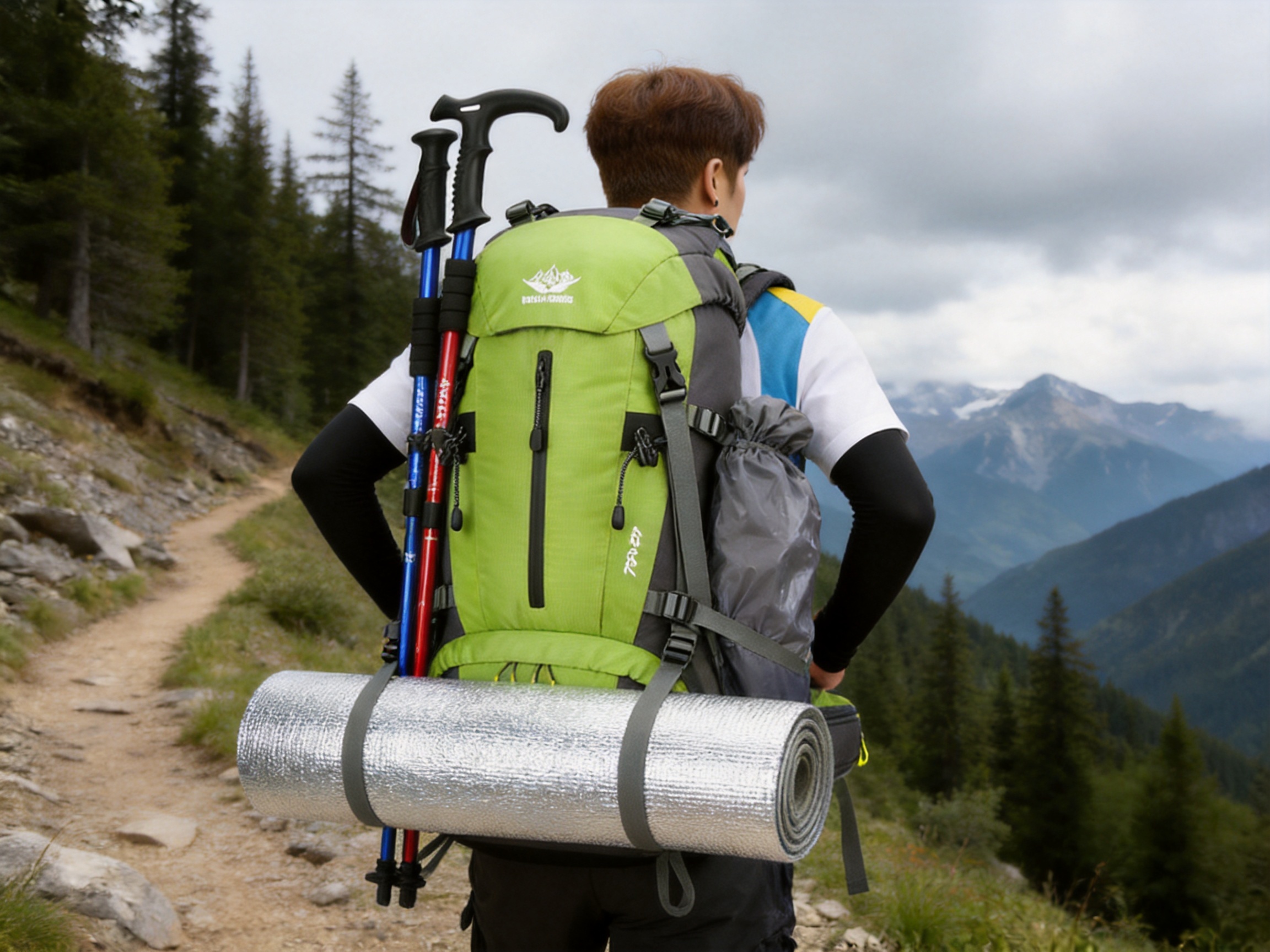
External attachment capability is essential for a professional mountaineering backpack. Outdoor trips involve items that should not always be packed inside the main compartment. Wet rainwear, trekking poles, sleeping pads, helmets, ropes, small tools, bottles, or campsite accessories may need to be secured outside for accessibility, drying, or space management. A backpack without sufficient attachment points forces users into improvised solutions, such as tying items with loose cord or overloading side pockets. These methods can be unsafe and inconvenient.
This backpack includes abundant external attachment points, giving users more flexibility. Attachment points allow the pack to adapt to different trip types. A hiker on a forest route may use them for poles and a sleeping pad. A camper may attach a ground mat or compact cookware. A mountaineering user may secure tools or auxiliary equipment depending on the activity. The backpack becomes a configurable platform instead of a fixed container.
The side trekking pole securing system is especially practical. Poles must be held firmly so they do not bounce or swing during movement. Poor pole attachment can create noise, affect balance, catch on branches, or injure nearby users on crowded trails. A professional securing system keeps poles aligned with the pack and reduces interference. This improves safety and comfort, particularly during technical sections or when hands must be free.
External attachment points also improve packing discipline. Items that may become wet or dirty can remain outside, protecting clean clothing and sleeping gear inside the pack. Frequently needed items can be placed where they are easier to access. Users do not have to unpack the main compartment every time they stop. This is important during bad weather, when opening the main compartment repeatedly increases moisture exposure.
In comparison with casual outdoor backpacks, the stronger external organization makes this product more field-ready. Many casual bags have decorative straps that look rugged but do not support serious use. This backpack’s attachment concept is tied to actual mountaineering needs. The result is better adaptability and more value for users who carry varied gear across different environments.
Ergonomic Double-Shoulder Carrying System
Capacity alone is not enough. A large backpack must carry weight comfortably, or its size becomes a disadvantage. The ergonomic carrying system is therefore one of the most important elements of the product. During long hikes, load pressure affects the shoulders, back, hips, knees, and overall endurance. A poorly designed backpack can create pain within the first hour, while a well-designed system helps distribute weight and stabilize movement.
The backpack uses a double-shoulder mountaineering structure designed for extended wear. The goal is to keep the load close to the body and reduce unnecessary sway. When a pack shifts side to side, the user must constantly compensate with muscles and joints. Over time, this increases fatigue and may affect balance on steep or uneven ground. A stable carrying system helps the backpack move with the user rather than against the user.
Ergonomic design also supports posture. Outdoor users often climb, descend, step over obstacles, and adjust pace frequently. If the pack pulls backward or sits too low, the user may lean forward excessively, increasing strain. A properly designed carrying system encourages a more natural load position. This improves comfort and can contribute to safer movement over long distances.
Shoulder comfort is particularly important for multi-day loads. Padding, strap geometry, and adjustment options all influence how pressure is transferred. While the exact fit varies by user body type, a professional mountaineering backpack must provide enough structure to handle gear weight without feeling like a simple school bag. This product’s ergonomic concept makes it better suited for outdoor buyers who expect functional load support.
Compared with lower-end backpacks that emphasize only capacity, this model balances storage and carrying comfort. Some competitors advertise large volume but use weak straps or flat back panels, making the pack uncomfortable when full. A large-capacity product must be judged by how it performs under load, not only by how much it can contain. The ergonomic carrying system helps turn volume into usable capacity.
Competitive Advantages in Practical Outdoor Use
The backpack’s competitive advantages can be understood through the lens of real use rather than catalog claims. First, it offers a layered protection system: water-repellent nylon outside, Oxford cloth inside, and an independent rain cover for harsher conditions. This gives users multiple defenses against moisture and wear. Many entry-level products rely on one fabric and limited weather preparation. This model provides a more complete protection strategy.
Second, it supports multi-day packing. A large main compartment allows users to carry essential gear without excessive external clutter. The ability to organize more equipment inside the pack improves balance and reduces the risk of losing items. External attachment points remain available for items that are better carried outside, rather than becoming the only solution for insufficient internal space.
Third, it integrates professional outdoor details, including trekking pole securing and multiple attachment options. These details show that the backpack is designed for mountain and camping scenarios, not merely styled to look outdoorsy. Functional details matter because they solve small problems that become major frustrations on the trail.
Fourth, the backpack is built around long-term value. Outdoor users increasingly recognize that the cheapest gear is not always the most economical. A backpack that wears out quickly, lacks rain protection, or causes discomfort may need replacement or create trip problems. By emphasizing durable materials, protective structure, and carrying ergonomics, the product offers better long-term utility.
Fifth, the product benefits from a manufacturer with outdoor-specific design awareness and cross-border market understanding. CragHaven Outdoor focuses on mountaineering, hiking, and camping scenarios, and its development philosophy begins with weather, terrain, and time. This is different from suppliers that design products mainly for catalogs or quick visual appeal. Scenario-based development produces features that make sense in actual use.
| Feature Area | This Backpack | Typical Lower-End Competitor | User Benefit |
|---|---|---|---|
| Exterior Material | High-strength water-repellent nylon | Basic polyester or thin nylon without strong weather focus | Better abrasion resistance and improved moisture defense |
| Interior Protection | Durable Oxford cloth lining | Minimal lining or single-layer construction | Improved resistance to internal friction and gear wear |
| Weather System | Independent rain cover included | Rain cover often absent or sold separately | More complete readiness for changing conditions |
| Storage Capacity | Large main compartment for multi-day use | Limited volume or poor internal organization | Supports extended trips and better packing discipline |
| External Carry | Abundant attachment points and trekking pole securing | Decorative or limited straps | More flexible gear configuration |
| Carrying System | Ergonomic double-shoulder mountaineering design | Simple shoulder straps with limited support | Greater comfort and stability under load |
Manufacturing Philosophy Behind the Product
A strong outdoor backpack is not created by fabric choice alone. It requires a manufacturing philosophy that connects design, material selection, sampling, testing, and production consistency. CragHaven Outdoor positions itself as an outdoor brand and cross-border manufacturing partner based in Hangzhou, China. Its focus on mountaineering, hiking, and camping scenarios gives it a clear direction: products must solve real-world usage problems.
The company’s development principles are especially relevant to this backpack. It does not treat products as catalog fillers, but as tools for weather, terrain, and time. That means every feature should answer a practical outdoor question. Why use water-repellent nylon? Because weather exposure and abrasion are constant. Why add Oxford cloth inside? Because gear can damage a pack from within. Why include a rain cover? Because mountain weather changes rapidly. Why provide external attachment points? Because not all equipment belongs inside the main compartment. Why emphasize ergonomic carrying? Because comfort and load stability determine whether capacity is truly useful.
This practical philosophy reduces unnecessary design. Outdoor equipment can easily become overloaded with features that look impressive but add little value. A disciplined development process prioritizes what users actually need. For distributors and retailers, this improves product communication. Sales teams can explain features in terms of use cases rather than vague marketing language.
CragHaven Outdoor also emphasizes durability, reliability, and long-term use rather than short-term trends. This matters in backpack manufacturing because trends can encourage cosmetic changes while weakening function. Bright colors, complex shapes, or excessive decorative straps may attract attention, but they do not guarantee performance. A long-term value approach keeps attention on materials, stitching, structure, comfort, and repeatable quality.
The company’s role as both design participant and manufacturing partner further strengthens the product. It is not only sourcing generic factory goods; it participates in design and manufacturing decisions. This integrated approach can reduce misunderstandings between concept and production. When the team understands outdoor usage and manufacturing constraints, the final product is more likely to be practical, scalable, and consistent.
Advanced Production Processes and Quality Control
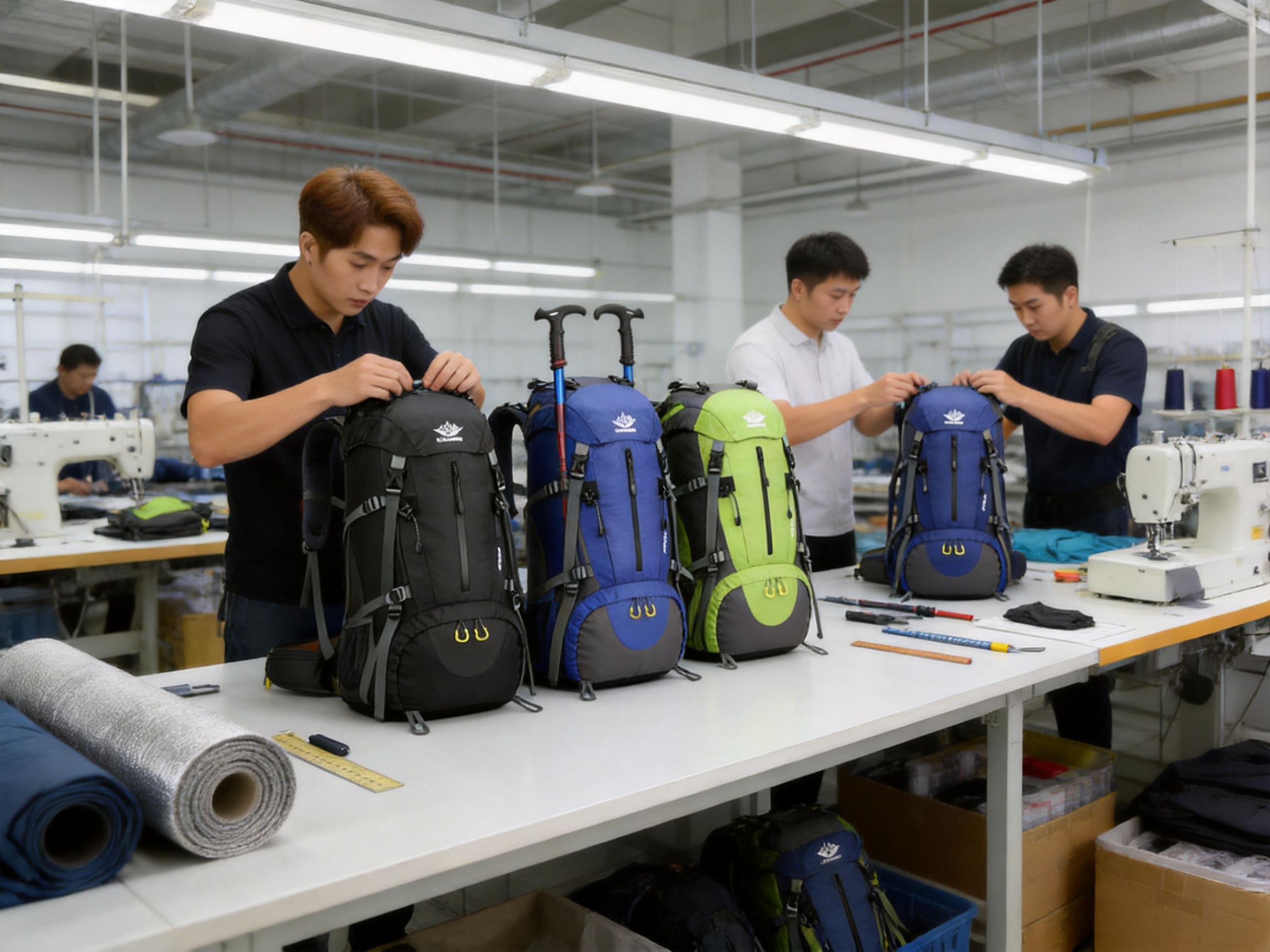
Manufacturing a mountaineering backpack requires multiple coordinated processes. The production team must manage fabric selection, material inspection, pattern development, cutting accuracy, reinforcement planning, sewing quality, hardware integration, lining assembly, rain cover compatibility, and final inspection. Each stage affects the final user experience. Even strong fabric can fail if stitching is weak, and a good carrying design can underperform if dimensions are inconsistent.
Material evaluation comes first. High-strength nylon must meet expectations for hand feel, strength, water-repellent performance, and visual consistency. Oxford cloth lining must be durable enough for internal use while remaining suitable for efficient assembly. Hardware such as buckles, adjustment parts, and attachment components must match the backpack’s load requirements. A responsible manufacturing process checks these elements before large-scale production begins.
Pattern development translates design intent into manufacturable components. A mountaineering backpack is not a simple rectangular bag. It includes curved panels, straps, reinforcements, compartments, side securing structures, and back-carrying elements. Accurate pattern design helps ensure that the assembled pack has the correct shape, volume, and load behavior. If panels are poorly proportioned, the backpack may look distorted or carry awkwardly when full.
Cutting accuracy is another key step. Fabric pieces must be cut consistently so that seams align and dimensions remain stable across production batches. In large orders, small errors can multiply. Efficient manufacturing systems in China support scalable cutting and assembly, but quality still depends on disciplined process control. CragHaven Outdoor’s focus on stable, replicable, and scalable products aligns with the need for repeatable production quality.
Sewing and reinforcement are central to backpack durability. Stress points such as shoulder strap connections, side attachment points, bottom panels, and load-bearing seams require careful stitching. Reinforcement decisions must match use scenarios. A backpack intended for mountaineering and camping cannot rely on the same construction logic as a lightweight city bag. Strong seams and proper stitch density help prevent failures under loaded conditions.
Sampling, testing, and optimization are standard processes that cannot be omitted in the company’s development approach. This is important because the first sample is rarely perfect. A sample may reveal that a strap angle needs adjustment, a pocket location is inconvenient, an attachment point requires reinforcement, or a rain cover fit needs refinement. Testing allows the product to improve before mass production. Optimization reduces risk for buyers and end users.
Final inspection completes the process. A backpack must be checked for stitching defects, material flaws, hardware function, lining integrity, rain cover inclusion, visual cleanliness, and packing accuracy. For cross-border customers, consistent inspection supports supply chain stability. It helps ensure that products arriving in overseas markets match expectations and reduce after-sales issues.
Design for Weather, Terrain, and Time
The company’s design principle of weather, terrain, and time is a useful framework for understanding this backpack. Weather refers to rain, humidity, temperature shifts, and environmental exposure. The backpack addresses weather through water-repellent nylon, Oxford cloth protection, and the independent rain cover. These elements reduce the risk of moisture-related problems and support outdoor reliability.
Terrain refers to the physical environments where the backpack is used: rocky paths, forest trails, alpine slopes, campsites, gravel roads, and uneven ground. Terrain creates abrasion, impact, dirt, and balance challenges. The high-strength nylon exterior, durable lining, external attachment points, and ergonomic carrying structure all respond to terrain. They help the pack survive contact with rough environments while maintaining load stability.
Time refers to long hours of carrying, repeated trips, seasonal use, and product lifespan. Outdoor gear should not be judged only in a showroom. A backpack must remain useful after being packed, lifted, adjusted, placed on the ground, exposed to weather, cleaned, stored, and used again. The emphasis on durable materials and manufacturing consistency supports long-term value.
This framework also prevents overdesign. If a feature does not help with weather, terrain, or time, it should be questioned. This is a mature approach to outdoor product development. Users do not need unnecessary complexity; they need dependable solutions. The backpack’s major features are easy to justify because each one connects directly to outdoor conditions.
For wholesale buyers, this design logic can strengthen market positioning. Instead of presenting the backpack as just another large pack, it can be introduced as a weather-aware, terrain-ready, long-use mountaineering solution. This language reflects genuine product structure and helps differentiate it from fashion-oriented outdoor bags.
Supply Chain Strength and Cross-Border Manufacturing Value
CragHaven Outdoor is based in Hangzhou, Zhejiang Province, within one of China’s most mature commercial and manufacturing regions. This location supports access to supply chain resources, textile expertise, logistics channels, and production coordination. For international buyers, a strong manufacturing partner can reduce uncertainty in sourcing, communication, sampling, and delivery.
The company’s cross-border orientation is important. Outdoor markets in North America, Europe, and other global regions often expect clear communication, functional product descriptions, stable quality, and professional development support. A supplier that understands Western-market expectations can help buyers avoid mismatches between product concept and market demand. This is especially valuable in outdoor gear, where users are more demanding and product failures can damage reputation.
The company also emphasizes long-term, stable, and sustainable partnerships. In manufacturing, stability matters as much as price. Buyers need consistent materials, predictable production quality, responsive communication, and the ability to refine products over time. A backpack line may begin with one model and later expand into related capacities, colors, material upgrades, or market-specific versions. A stable partner can support that development.
Because CragHaven Outdoor participates in both design and manufacturing, it can help customers move from idea to production more efficiently. Many sourcing models separate design from factory execution, creating gaps. If a design is not manufacturable, costs rise or quality suffers. If a factory does not understand outdoor use, it may make decisions that weaken performance. An integrated partner helps align function, cost, production feasibility, and market value.
The company’s philosophy of transforming design intent into stable, replicable, and scalable products is particularly relevant for this backpack. A single impressive sample is not enough for commercial success. Retailers and distributors need repeated production batches that meet the same expectations. Scalable process control helps ensure that the backpack’s material structure, rain protection, attachment points, and carrying design remain consistent.
Use Scenarios: From Trailhead to Camp
The backpack is suitable for a wide range of outdoor scenarios. On a multi-day hiking route, the large main compartment can hold clothing layers, food, a compact sleeping system, and personal essentials. External attachment points can secure trekking poles, rainwear, or campsite accessories. The rain cover can be deployed during sudden showers, while the ergonomic carrying system supports long hours of movement.
For mountaineering approaches, the backpack helps manage technical and non-technical gear. Users may need to carry poles on the side while keeping hands free for scrambling or balance. External attachment options make it easier to adapt the pack to different terrain sections. The durable exterior helps resist abrasion when moving through rocky or wooded environments.
For camping, the backpack functions as both transport and organization. Campers often need to carry cooking items, spare clothing, ground accessories, personal care items, and weather protection. The spacious compartment reduces the need for multiple bags. The inner Oxford cloth lining helps protect the pack from internal friction caused by cookware or packed accessories.
For travel to outdoor destinations, the backpack’s double-shoulder design and large capacity support movement through stations, trailheads, rural roads, and campsites. While it is designed for outdoor use, its organization and durability can also benefit adventure travel. Users who combine transportation with hiking need a bag that can handle both packing volume and field conditions.
For outdoor retailers, these varied scenarios broaden the product’s market potential. It can be sold to hikers, campers, trekking groups, beginner mountaineers, outdoor clubs, and travel users who want a rugged large-capacity backpack. The product story is easy to adapt to different customer groups because its features are practical rather than overly specialized.
Packing Strategy for Best Performance
To gain the most value from a large-capacity mountaineering backpack, users should pack strategically. Heavy items should generally be placed close to the back and near the center of the pack. This helps maintain balance and reduces the feeling of being pulled backward. Medium-weight items can be placed around the core load, while lightweight items such as clothing can fill outer spaces.
Frequently needed items should remain accessible. Rainwear, snacks, first-aid items, water-related accessories, and navigation tools should not be buried under sleeping gear. External attachment points can be used for items that are safe to carry outside and do not interfere with movement. Trekking poles should be secured in the dedicated side system when not in use.
Moisture management is also important. Even with water-repellent fabric and a rain cover, users should consider packing sensitive items such as electronics, down sleeping gear, and documents in additional waterproof pouches or dry bags during extreme conditions. A backpack is part of a broader weather protection system. The included rain cover improves defense, but smart packing further reduces risk.
Users should avoid overloading external attachment points with loose or swinging objects. A stable pack is safer and more comfortable. Items attached outside should be compressed, aligned, and tightened. Poorly attached gear can catch on branches or affect balance. The backpack provides attachment flexibility, but good technique remains essential.
After each trip, users should clean dirt from the exterior, dry the backpack before storage, inspect straps and seams, and fold the rain cover only after it is dry. Proper maintenance extends product life and preserves performance. This is especially important for outdoor gear exposed to moisture, mud, sweat, and abrasion.
Business Value for Retailers, Distributors, and Outdoor Brands
Beyond individual users, the backpack has strong business relevance. Retailers need products that customers can understand quickly and trust after purchase. This model offers clear selling points: large capacity, durable nylon exterior, Oxford cloth lining, independent rain cover, trekking pole securing, abundant external attachment points, and ergonomic carrying. Each feature connects to a recognizable outdoor need.
Distributors benefit from products with broad market applicability. The backpack can serve multiple segments instead of a narrow niche. It is suitable for hiking, camping, mountaineering approaches, and adventure travel. This helps simplify inventory planning because one model can address several customer groups. Its practical feature set can also support both online and offline sales presentations.
Outdoor brands seeking manufacturing partners can benefit from CragHaven Outdoor’s scenario-based development process. A partner that understands terrain, weather, and user behavior can assist with product refinement. This is especially useful for private label or customized outdoor gear programs where buyers need more than basic factory execution.
Stable production also supports brand reputation. If a backpack line sells well, customers expect the next batch to match the first. Inconsistent fabric, weak stitching, missing accessories, or poor packing can damage trust. The company’s emphasis on sampling, testing, optimization, and scalable manufacturing addresses this concern. Long-term reliability is not only a user benefit; it is a business advantage.
The backpack can also help brands compete in value-focused outdoor markets. It does not rely on extreme technical claims that may limit audience size. Instead, it offers practical durability and usable features at a professional level. This positioning is attractive for customers who want dependable gear without unnecessary complexity.
Q&A Section
What type of user is this backpack best suited for?
This backpack is best suited for hikers, campers, trekking users, and mountaineering participants who need large storage capacity, weather protection, and practical external gear attachment. It is especially useful for multi-day trips or outdoor activities where users must carry clothing, food, tools, shelter accessories, and trekking poles.
Why is the combination of nylon and Oxford cloth important?
The high-strength water-repellent nylon exterior helps resist abrasion and moisture exposure, while the Oxford cloth inner lining improves durability inside the pack. This combination provides double protection, reducing damage from both external terrain contact and internal gear friction.
Does the backpack protect gear from rain?
The backpack uses water-repellent nylon and includes an independent rain cover. Together, these features improve protection during rain and damp conditions. For extremely sensitive items or severe weather, users should still use additional waterproof pouches as part of a complete outdoor packing system.
How does the trekking pole securing system help?
The side trekking pole securing system allows users to attach poles when they are not needed in hand. This is useful during scrambling, campsite work, transportation, or sections where hands must remain free. It also prevents poles from swinging loosely or interfering with movement.
What makes this backpack different from ordinary large travel bags?
Ordinary travel bags may offer volume, but they often lack weather protection, outdoor attachment systems, durable inner lining, and ergonomic mountaineering carry structure. This backpack is designed specifically for outdoor terrain, changing weather, and long carrying periods.
Why is ergonomic carrying important for a large-capacity backpack?
Large capacity becomes useful only when the load can be carried comfortably. An ergonomic double-shoulder carrying system helps improve stability, reduce sway, and support better posture during long-distance movement. This reduces fatigue and makes multi-day travel more manageable.
How does CragHaven Outdoor support product quality?
CragHaven Outdoor follows a development approach based on real outdoor usage scenarios. The company emphasizes durable material selection, sampling, testing, optimization, and stable manufacturing. Its focus on mountaineering, hiking, and camping helps ensure that product features serve practical field needs.
Is this backpack suitable for wholesale or private label programs?
Yes. The backpack has clear market appeal and practical features that are easy to communicate. CragHaven Outdoor’s role as a cross-border manufacturing partner supports buyers who need stable production, professional communication, and scalable outdoor gear development.
Conclusion
The large-capacity nylon professional mountaineering backpack is a practical response to the demands of hiking, camping, trekking, and mountain travel. Its value comes from the integration of durable materials, layered weather protection, spacious storage, trekking pole securing, abundant external attachment points, and ergonomic carrying. These features work together to solve real outdoor problems rather than simply creating a rugged appearance.
Compared with many ordinary competitors, the backpack offers stronger functional completeness. It does not rely only on large volume; it makes that volume usable through better protection, organization, and carrying comfort. The high-strength water-repellent nylon exterior resists environmental stress, the Oxford cloth lining protects from internal wear, and the independent rain cover improves readiness for sudden weather changes. External attachment options increase adaptability, while the professional carrying system supports long hours on the move.
The manufacturing background further strengthens the product’s market value. CragHaven Outdoor’s philosophy of designing for weather, terrain, and time aligns closely with what outdoor users actually need. Its emphasis on sampling, testing, optimization, durable material selection, and scalable production helps reduce uncertainty for buyers and improve confidence for end users. In an outdoor market crowded with products that look similar, this backpack stands out by connecting every major feature to practical use.
For individual adventurers, it is a dependable gear-carrying solution for extended routes and changing conditions. For retailers and distributors, it is a clear and credible product with strong selling points. For brands seeking manufacturing support, it demonstrates the value of a partner that understands both outdoor scenarios and production realities. A mountaineering backpack must earn trust through use, and this product is built around the conditions where that trust matters most.
References
1. Twight, Mark. Extreme Alpinism: Climbing Light, Fast, and High. Mountaineers Books.
2. Clyde Soles. The Outdoor Knots Book and related outdoor equipment field guidance. Mountaineers Books.
3. National Outdoor Leadership School. NOLS Wilderness Guide: The Classic Handbook. Stackpole Books.
4. Graydon, Don, and Kurt Hanson. Mountaineering: The Freedom of the Hills. Mountaineers Books.
5. McManners, Hugh. The Complete Wilderness Training Book. DK Publishing.
6. Textile Institute. Technical Textile Materials and Outdoor Performance Fabrics. Textile Institute Publications.
Product: Large-capacity nylon professional mountaineering backpack, multi-functional sports double-shoulder mountaineering backpack


- Phone: +86-15968800379
- E-mail: [email protected]
- Address: Room 1002, Huishang Building, Gongshu District, Hangzhou City, Zhejiang Province.
Copyright © CragHaven Outdoor All Rights Reserved. Outdoor Gear Manufacturers Wholesale Mountaineering Camping Gear Suppliers
