

 English
 Deutsch
 Español
 Français


How Retractable External-Locking Hiking Poles Improve Stability, Comfort, and Outdoor Performance
Content
- 1 The Importance of Proper Trekking Poles in Outdoor Activities
- 2 Product Overview: A Three-Section External-Locking Design
- 3 How the External Locking Mechanism Creates a Competitive Advantage
- 4 Aerospace-Grade Aluminum Alloy for Lightweight Strength
- 5 Three-Section Telescopic Portability for Travel and Storage
- 6 Ergonomic EVA Foam Handles for Extended Comfort
- 7 Adjustable Wrist Straps and Better Pole Control
- 8 Adjusting Pole Length for Different Terrains
- 9 Advantages Over Fixed-Length Hiking Sticks
- 10 Advantages Over Low-Quality Adjustable Poles
- 11 Engineering and Manufacturing Approach
- 12 Quality Control Considerations for Trekking Poles
- 13 How the Product Supports Hiking Efficiency
- 14 Suitability for Retailers, Outdoor Brands, and OEM Programs
- 15 Recommended User Practices
- 16 Environmental and Long-Term Value Considerations
- 17 Q&A
- 17.1 What are retractable external-locking hiking poles designed for?
- 17.2 What is the main advantage of an external locking mechanism?
- 17.3 How does the 3LS locking system improve usability?
- 17.4 Why is aerospace-grade aluminum alloy used for the shaft?
- 17.5 Are these poles suitable for beginners?
- 17.6 Can experienced hikers use these poles on mountain trails?
- 17.7 How should the poles be adjusted for uphill hiking?
- 17.8 How should the poles be adjusted for downhill hiking?
- 17.9 What does the EVA foam handle contribute?
- 17.10 Why is the wrist strap adjustable?
- 17.11 Are retractable poles easier to transport than fixed-length sticks?
- 17.12 What should buyers evaluate when comparing trekking poles?
- 17.13 How can retailers position this product?
- 17.14 What manufacturing capabilities are important for this type of product?
- 17.15 How should users maintain the external locks?
- 18 Conclusion
- 19 References
- 20 Product: Retractable external locking hiking poles, trekking poles, aluminum alloy hiking sticks
For hikers, trekkers, mountaineers, and outdoor equipment buyers, trekking poles are much more than simple walking accessories. A well-designed pair of hiking poles can provide additional points of contact, improve balance on uneven ground, support more efficient movement, and reduce the physical strain associated with steep ascents and descents. However, not every trekking pole delivers the same level of reliability. The locking mechanism, shaft material, handle construction, adjustment range, portability, and manufacturing quality all influence the way a pole performs in real outdoor conditions.
Retractable external-locking hiking poles offer a practical solution for users who need dependable support across changing environments. Their three-section telescopic construction allows compact storage and convenient transportation, while the external locking mechanism makes length adjustment fast and visible. The aerospace-grade aluminum alloy shaft provides a useful balance between low weight and structural strength. At the contact points with the user, an EVA foam handle and adjustable wrist strap improve comfort, grip security, and control during extended use.
This combination gives retractable external-locking hiking poles several advantages over basic fixed-length walking sticks, poorly constructed twist-lock models, and low-quality adjustable poles. They are suitable for mountain trails, forest paths, camping trips, long-distance hikes, travel, and general outdoor recreation. More importantly, they can be developed and manufactured according to real usage conditions rather than being designed only for appearance or catalog presentation.
The Importance of Proper Trekking Poles in Outdoor Activities
Hiking places continuous demands on the human body. On a level trail, the legs carry most of the load, while on a steep slope, the knees, ankles, hips, and lower back must respond to changes in elevation and surface stability. Loose gravel, wet soil, roots, rocks, and irregular steps can make each movement less predictable. When a hiker carries a backpack or other outdoor equipment, the demands become even greater.
Trekking poles provide extra support points that help the user maintain a more stable relationship with the ground. Instead of relying only on two feet, the hiker can coordinate both arms and poles with the legs. This creates a more balanced walking rhythm and can help the user respond more effectively to unstable terrain. Poles do not eliminate the need for careful foot placement, but they can improve confidence and control when used correctly.
In uphill sections, poles can assist with rhythm and posture. The user may shorten the poles slightly so that the arms remain in a comfortable position while pushing upward. During downhill movement, extending the poles can provide additional reach and support, helping the hiker manage changes in elevation with greater control. On flat trails, a moderate setting can support a natural stride without forcing the shoulders or wrists into an uncomfortable position.
The value of a trekking pole depends on its ability to remain reliable when pressure is applied. If a pole slips unexpectedly, collapses, or becomes difficult to adjust, it can interrupt movement and reduce user confidence. For this reason, the locking system is one of the most important functional components of an adjustable hiking pole. A secure external lock, combined with a strong shaft and comfortable handle, creates a more dependable support system for outdoor use.
Product Overview: A Three-Section External-Locking Design
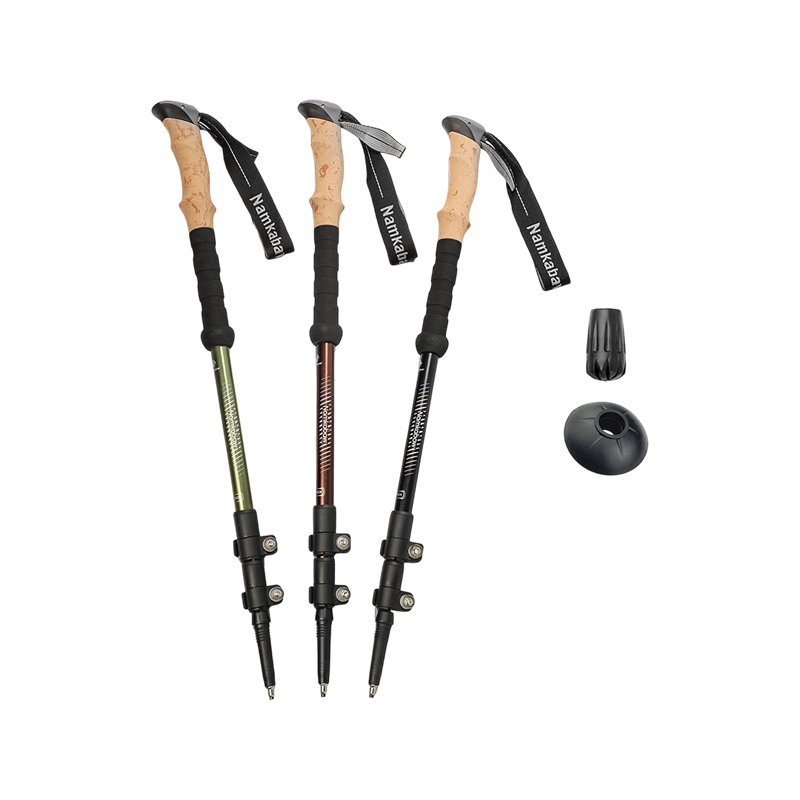
The retractable external-locking hiking pole is built around a three-section telescopic structure. Each shaft section can slide into the next section, allowing the user to adjust the overall length according to body height, terrain, and personal preference. When collapsed, the pole occupies less space and is easier to place in a backpack, vehicle, storage cabinet, or travel bag.
The three-section format provides a practical balance between adjustability and structural simplicity. A pole with too many sections may require more operations and may introduce additional connection points. A fixed-length pole, by contrast, offers little flexibility for different users or terrain. The three-section design delivers sufficient adjustment capability while keeping the construction easy to understand and convenient to operate.
The external locking mechanism is positioned outside the shaft sections. This visible arrangement allows users to see the locking components during adjustment. Instead of relying on an internal mechanism that is difficult to inspect, the external design provides a more direct method for opening, tightening, and securing the pole. When hiking conditions change, users can make adjustments without disassembling the pole or performing complicated operations.
The product uses a 3LS professional external lock mechanism designed to provide strong, slip-resistant fixation. The locking structure is especially important when the pole is used on steep, uneven, or loose surfaces. A secure lock helps maintain the selected length when downward or lateral pressure is applied. It also gives the user a clear point of inspection before the pole is placed under load.
The shaft is made from aerospace-grade aluminum alloy. This material choice is intended to balance strength, weight, durability, and impact resistance. Hiking poles must be light enough for repeated carrying but strong enough to handle everyday outdoor pressure. Aluminum alloy is widely used in outdoor equipment because it offers practical structural performance without the excessive weight associated with many steel constructions.
The EVA foam handle is designed to absorb sweat and improve grip comfort. During long hikes, the hands may become damp because of perspiration, humidity, rain, or changing weather conditions. A suitable foam grip can help reduce slipping and make the handle more comfortable to hold over extended periods. The adjustable wrist strap further supports control by adapting to different hand shapes and helping distribute pressure around the wrist.
These features work together rather than functioning as isolated specifications. The shaft provides the main load-bearing structure, the external lock holds the selected length, the handle creates a comfortable contact surface, and the strap helps maintain control. The result is a trekking pole designed for practical use across multiple outdoor scenarios.
Retractable external locking hiking poles, trekking poles, aluminum alloy hiking sticks
How the External Locking Mechanism Creates a Competitive Advantage
Adjustable trekking poles generally use one of two common approaches: external locking systems or internal twist-lock systems. Both designs can be useful when properly engineered, but they offer different operating experiences. An external lock is visible and accessible, while a twist-lock mechanism is usually located inside the pole sections and depends on internal expansion or compression.
Visibility is one of the clearest advantages of the external locking format. Users can immediately identify the components that control each section. This makes it easier to check whether the lock is open, partially engaged, or fully secured. In outdoor environments where conditions change quickly, direct visual confirmation can reduce uncertainty before a pole is used for support.
External locking systems can also be adjusted quickly. A hiker may need shorter poles for an uphill section, longer poles for a descent, or a compact setting while crossing a narrow trail. With an external lever or clamp-style component, the user can release the section, make the desired adjustment, and secure it again with a relatively simple movement. This minimizes interruptions and allows the pole to adapt to changing terrain.
Another advantage is maintenance accessibility. Because the locking components are externally positioned, users can more easily inspect them for dirt, moisture, wear, or improper alignment. A visible system can be cleaned and checked without requiring specialized tools or extensive disassembly. This is valuable for people who use trekking poles repeatedly in muddy, dusty, wet, or sandy environments.
Compared with inexpensive twist-lock poles, an external-locking model can provide a more intuitive operating process. Twist locks may be difficult to determine by feel, especially when the internal mechanism is not correctly tightened. Users may be unsure whether the pole has reached the appropriate level of security. With an external system, the locking action and position are more apparent.
The 3LS external locking structure is designed to provide a strong, slip-resistant lock. This is important because pole length must remain stable when the user presses downward or transfers part of the body’s weight through the pole. A lock that gradually slips can cause an unexpected change in hand position and reduce balance. A stable lock helps maintain consistent support throughout a step sequence.
The external mechanism also supports more efficient product inspection during manufacturing. Technicians can examine the position, closure, alignment, and engagement of the lock as part of sampling and testing procedures. This makes the structure easier to evaluate during product development compared with components that are hidden inside the shaft. Visible functional parts can be measured, adjusted, and verified more directly.
| Feature | External-Locking Hiking Pole | Basic Fixed-Length Stick | Low-Quality Twist-Lock Pole |
|---|---|---|---|
| Length adjustment | Quick adjustment across multiple settings | Not adjustable | Adjustable but may require repeated twisting |
| Lock visibility | Components are visible and easy to inspect | Not applicable | Internal mechanism is less visible |
| Terrain adaptability | Suitable for uphill, downhill, and flat sections | Limited to one length | Depends on internal lock condition |
| Maintenance access | External parts are easier to check and clean | Simple but not adjustable | Internal parts may be difficult to inspect |
| Travel convenience | Three-section collapsible structure | Usually takes more storage space | Often collapsible |
The external lock does not replace the need for correct use. Users should always confirm that each section is securely fixed before placing significant pressure on the pole. Nevertheless, the accessible design provides a practical advantage by making correct operation easier to understand and verify.
Aerospace-Grade Aluminum Alloy for Lightweight Strength
Material selection has a direct influence on the performance of trekking poles. A shaft must be sufficiently strong for outdoor support while remaining light enough to carry over long distances. Excessive weight increases arm fatigue and adds unnecessary load to a backpack. Insufficient strength, on the other hand, can reduce confidence and shorten product life.
The aluminum alloy shaft used in these hiking poles is selected for its balanced performance. Aluminum alloy generally offers a favorable combination of structural strength, impact resistance, and manageable weight. It is lighter than many steel alternatives and is widely recognized as a practical material for outdoor equipment subjected to repeated use.
The term aerospace-grade describes a material standard associated with demanding strength-to-weight requirements. In a trekking pole, the practical purpose is to create a shaft that feels light during movement but remains dependable when exposed to ordinary outdoor forces. The shaft should support the locking components and handle without becoming unnecessarily bulky.
Lightweight construction is particularly beneficial during long-distance hiking. A user may lift and plant each pole thousands of times during a full-day route. Even a small reduction in the weight of each pole can contribute to a more comfortable overall experience. Lower carried weight also helps users maintain a more natural arm swing and reduces fatigue in the shoulders and forearms.
Aluminum alloy is also suitable for users who need equipment that can withstand repeated transportation. Trekking poles are frequently placed in vehicles, checked with luggage, stored in backpacks, or moved between different outdoor locations. The shaft must tolerate ordinary handling while retaining its shape and connection with the locking system.
Material strength alone does not determine product quality. The shaft must be correctly formed, joined, finished, and matched with the lock, handle, and tip assembly. A strong material can still perform poorly if manufacturing tolerances are inconsistent. For this reason, material selection must be supported by disciplined production processes and inspection procedures.
One competitive advantage of the aluminum alloy construction is its suitability for a broad customer base. Beginners may appreciate the manageable weight and straightforward operation, while experienced hikers may value the dependable structure for more demanding routes. Retailers and outdoor brands can also position the product across several categories, including trekking, hiking, camping, travel, and general outdoor walking.
Compared with heavier metal walking sticks, the aluminum alloy shaft can provide a more comfortable experience for extended use. Compared with more delicate lightweight alternatives, it offers a practical focus on durability and repeated outdoor application. The choice is therefore appropriate for users who want a reliable balance rather than a product optimized only for the lowest possible weight.
Three-Section Telescopic Portability for Travel and Storage
Outdoor equipment must perform not only on the trail but also before and after the activity. Hikers may need to transport poles by car, bus, train, airplane, or backpack. A long, fixed-length pole can be inconvenient in confined spaces and may require special handling. A retractable design improves portability by reducing the length when the poles are not in use.
The three-section telescopic construction allows the poles to collapse into a more compact form. This makes them easier to store at home, place inside a travel bag, or attach to a backpack. During camping trips, compact storage can help users organize their equipment more efficiently and protect the poles from unnecessary contact with other gear.
Portability is also useful when hiking conditions change. A user may carry the poles collapsed while walking through a crowded area, boarding transportation, or crossing a section where hands are needed for another task. When support becomes necessary, the poles can be extended and adjusted again. This flexibility makes the equipment suitable for mixed itineraries that combine travel, sightseeing, camping, and trail use.
The telescopic structure also supports inventory and distribution efficiency for outdoor retailers and brands. Products that occupy less space can be easier to package, store, display, and ship. For a manufacturing partner serving international markets, practical product dimensions can contribute to more efficient logistics and easier handling across the supply chain.
However, compactness should not come at the cost of structural reliability. A telescopic pole contains multiple sections and connection points, so each part must be produced with suitable dimensional consistency. The sections must slide smoothly without excessive looseness, and the external locks must engage correctly across the adjustment range. The balance between portability and stability is therefore a central design consideration.
The three-section format is an effective compromise. It provides useful adjustability and compact storage while avoiding an unnecessarily complex multi-section architecture. For most hiking and camping scenarios, this structure offers enough flexibility without making operation difficult for the user.
Ergonomic EVA Foam Handles for Extended Comfort
The handle is the primary contact point between the user and the trekking pole. Even a strong shaft and reliable lock can be uncomfortable if the handle is poorly shaped or made from an unsuitable material. During a long hike, the hands repeatedly grip, release, and reposition the poles. Heat, sweat, rain, and pressure can all affect comfort and control.
The EVA foam handle is designed to provide a soft yet supportive grip. EVA foam is commonly used in outdoor equipment because it can offer cushioning while remaining lightweight. It creates a more comfortable contact surface than a hard, unpadded shaft and can help reduce the sensation of pressure in the palm during extended use.
The sweat-absorbent quality of the handle is useful during warm-weather hiking or strenuous climbing. When the hand becomes damp, a smooth hard surface may feel slippery. A textured or absorbent foam surface can help the user maintain more consistent contact. This supports better pole control and reduces the need to grip excessively tightly.
Grip comfort can have an important effect on overall fatigue. If a handle causes pressure points or requires constant squeezing, the hands and forearms may become tired before the legs. A comfortable handle encourages a more relaxed grip. The user can allow the wrist strap and hand position to share some of the control responsibility instead of relying entirely on finger strength.
The handle is also relevant to seasonal use. In cooler conditions, foam can feel more comfortable than exposed metal. In warmer conditions, its absorbent surface can help manage moisture. This broadens the product’s suitability across different climates and outdoor activities.
Adjustable Wrist Straps and Better Pole Control
The wrist strap is a small component, but it plays an important role in how the pole is used. A correctly adjusted strap can help the user maintain contact with the pole while reducing the need to hold the handle tightly. It may also support a more efficient transfer of force during pushing movements.
Because users have different hand sizes and may wear gloves of varying thickness, the strap must be adjustable. The strap on these hiking poles adapts to different hand shapes, allowing users to find a position that feels secure without being restrictive. Proper adjustment helps keep the hand aligned with the handle during normal walking and climbing motions.
A wrist strap should not be treated as a substitute for a secure grip or correct technique. It is a support feature that helps maintain control. Users should be able to release or loosen the pole when necessary, particularly in situations where a pole could become caught between rocks, branches, or other obstacles.
For long-distance use, the adjustable strap can help distribute pressure across the wrist rather than concentrating it in the fingers. This may reduce hand fatigue and make repeated pole planting more comfortable. The combination of the strap and EVA foam handle gives the user multiple contact and control benefits without adding unnecessary weight.
Adjusting Pole Length for Different Terrains
One of the most important advantages of retractable poles is terrain-specific adjustment. A single length is unlikely to be ideal for every section of a route. Body height, slope angle, footwear, backpack load, and personal walking style all influence the preferred setting.
Uphill Hiking
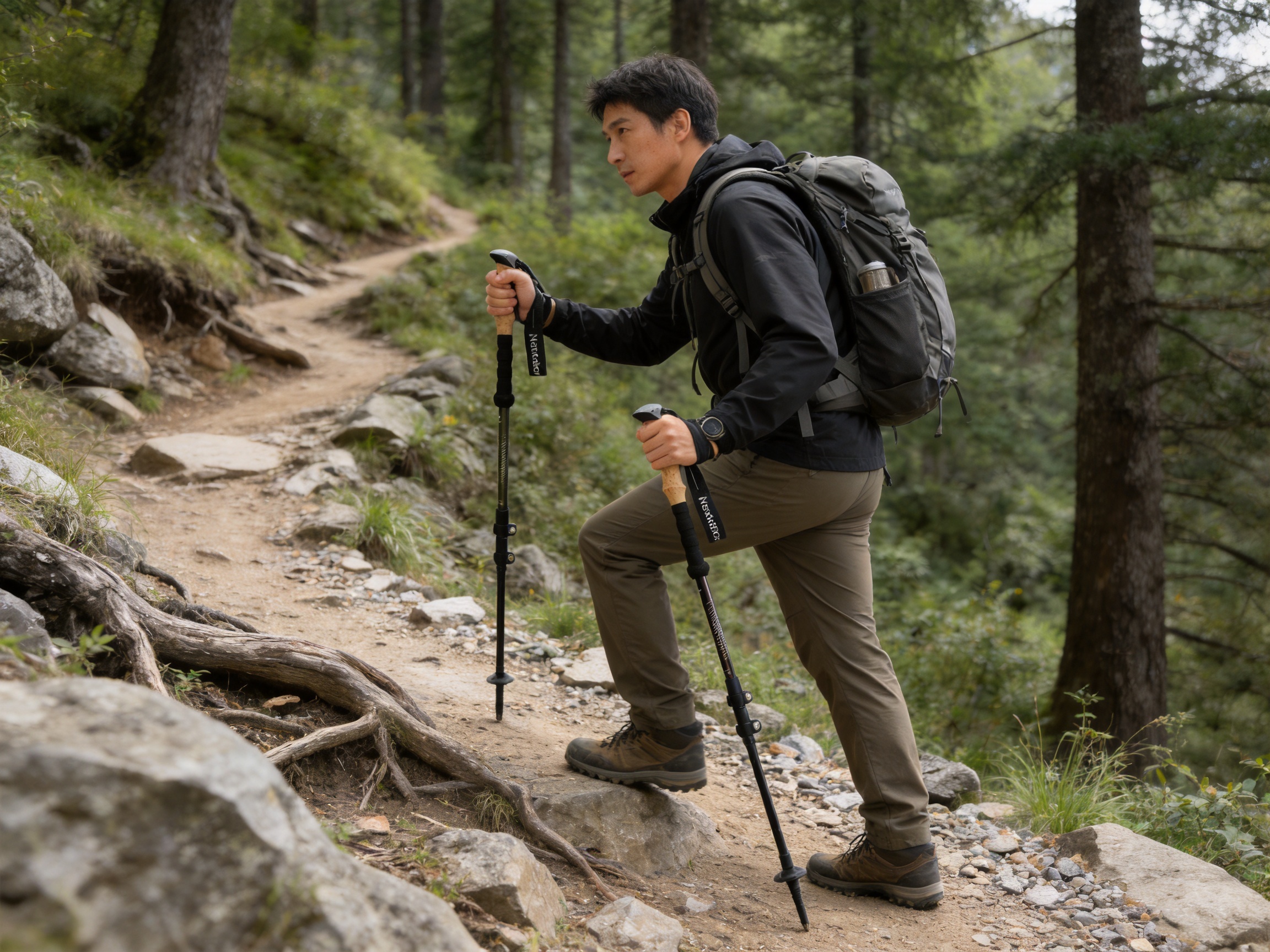
During uphill movement, shorter poles can help maintain a comfortable arm angle. A shorter setting may allow the user to plant the pole closer to the body and push more effectively while climbing. It can also help keep the shoulders from rising excessively as the slope becomes steeper.
Users should make gradual adjustments rather than shortening the poles too much. The goal is to support a natural movement pattern, not to force the hands into an unusually high or low position. The external locking mechanism makes it practical to make this change before entering a steeper section.
Downhill Hiking
Downhill movement often places additional stress on the knees and requires careful balance. Extending the poles can provide a longer reach and create additional support before each step. The user can place the pole slightly ahead of the body and use it to help manage the change in elevation.
Longer poles can also support a more controlled rhythm on uneven descents. However, the poles should not be extended beyond the safe operating range. Each section must remain properly engaged in the external lock, and users should avoid relying on a pole as a substitute for stable footing.
Flat Trails
On flat trails, a moderate length that allows the elbows to remain comfortably bent is generally suitable. The user can focus on a natural alternating rhythm between the arms and legs. The poles may help improve walking consistency, particularly during long-distance routes where maintaining an even pace is important.
Rocky and Uneven Ground
Rocky surfaces require frequent changes in balance and foot placement. Adjustable poles allow the user to respond to variations in terrain without carrying separate equipment for each type of trail. The external lock provides a convenient way to maintain the selected length when the user needs dependable support across irregular surfaces.
Camping and General Outdoor Use
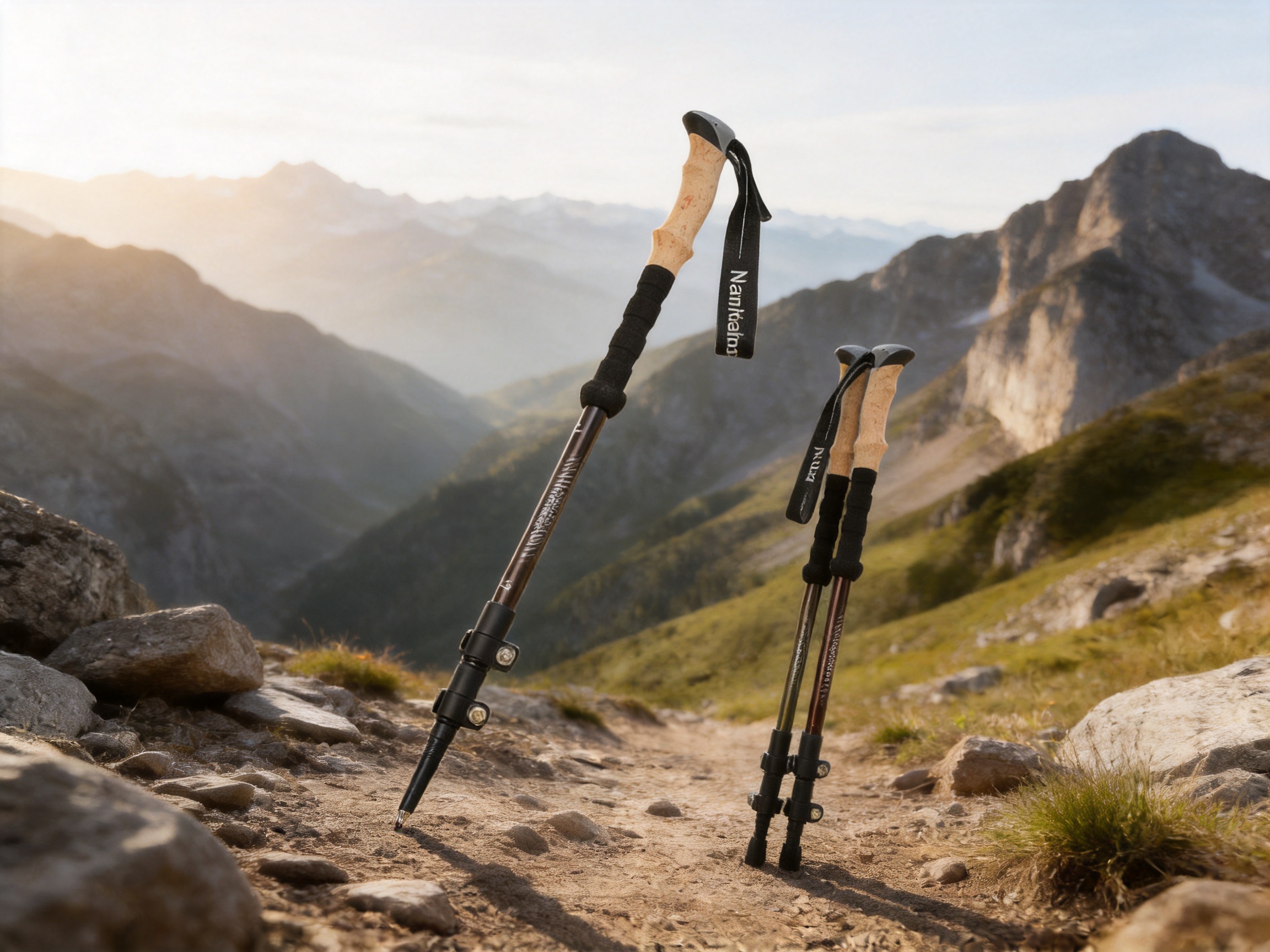
Although designed primarily for hiking and trekking, the poles can also be useful around campsites, on access paths, during nature walks, and on outdoor trips that involve changing ground conditions. Their collapsible design makes them easy to carry between different activities. Users should always select the appropriate pole setting and use the poles within their intended function.
| Terrain or Activity | Suggested Adjustment Approach | Main Performance Objective |
|---|---|---|
| Steep uphill section | Shorten the poles moderately | Support climbing rhythm and arm positioning |
| Steep downhill section | Extend the poles moderately | Provide additional reach and balance support |
| Flat trail | Use a comfortable medium setting | Maintain natural walking rhythm |
| Rocky or uneven ground | Adjust according to slope and step height | Improve stability and terrain adaptability |
| Transport or storage | Collapse all sections | Reduce volume and improve portability |
Advantages Over Fixed-Length Hiking Sticks
Fixed-length hiking sticks can be strong and simple, but they do not accommodate different users or changing terrain. A person may prefer one length for climbing and another for descending. A family may share equipment among users of different heights. A traveler may need to shorten the poles for storage. The retractable design addresses these requirements without requiring multiple pairs of poles.
Adjustability also supports better posture. When a pole is too long or too short, the user may compensate by raising the shoulders, bending the back, or reaching too far forward. A suitable length encourages more balanced arm movement and can make the walking pattern feel more natural.
Fixed poles may also be difficult to transport. Their length can make them inconvenient in vehicles, luggage, or small tents. The three-section telescopic construction provides a clear portability advantage for users who combine hiking with travel or camping.
For retailers and equipment buyers, adjustable poles can appeal to a broader market. The same product can serve beginners, experienced hikers, different body heights, and multiple outdoor scenarios. This versatility can be more commercially valuable than a product designed for only one specific user profile.
Advantages Over Low-Quality Adjustable Poles
Not all retractable poles offer the same level of performance. Low-quality products may use weak clamps, inconsistent shaft sections, uncomfortable handles, or straps that cannot be adjusted properly. They may appear similar in photographs but perform differently when used repeatedly in real outdoor environments.
The 3LS external locking mechanism is a key differentiator because reliable length retention is central to user confidence. A lock should engage consistently and resist unwanted movement during normal use. The external format also allows the user to inspect the mechanism more easily than a hidden internal design.
The aerospace-grade aluminum alloy shaft provides another distinction. A product that is too heavy can become tiring, while one that is too fragile may not deliver dependable support. The selected alloy construction is intended to balance these requirements for general mountain, hiking, and camping applications.
Handle and strap quality further separate a practical trekking pole from a basic budget product. The EVA foam handle is designed for sweat absorption and non-slip comfort, while the adjustable wrist strap accommodates different hand shapes. These features improve the experience during repeated and extended use.
Manufacturing consistency is equally important. A pole may have good materials and a reasonable design, but inconsistent production can lead to variations in fit, locking force, surface finish, or telescopic movement. Professional sampling, testing, and optimization help reduce these risks and support more stable product performance.
Engineering and Manufacturing Approach
Product performance begins with design, but it is confirmed through manufacturing. A trekking pole must be developed around the way it will be used in real environments. This means considering weather, terrain, impact, repeated adjustment, transportation, hand comfort, and long-term handling.
The manufacturing approach behind this product follows a purpose-driven process. The design is not based only on adding specifications to a catalog. Instead, each major feature is connected to a practical usage problem. The external lock addresses fast adjustment and visible security. The aluminum alloy shaft addresses the balance between strength and weight. The EVA handle addresses grip comfort and moisture. The three-section structure addresses portability and terrain adaptability.
Material integrity is another important principle. Materials are selected according to durability, reliability, and intended application rather than temporary trends. The shaft, lock, handle, strap, and other components must function together as a complete system. A material that performs well in isolation may not be suitable if it creates compatibility problems with adjacent parts.
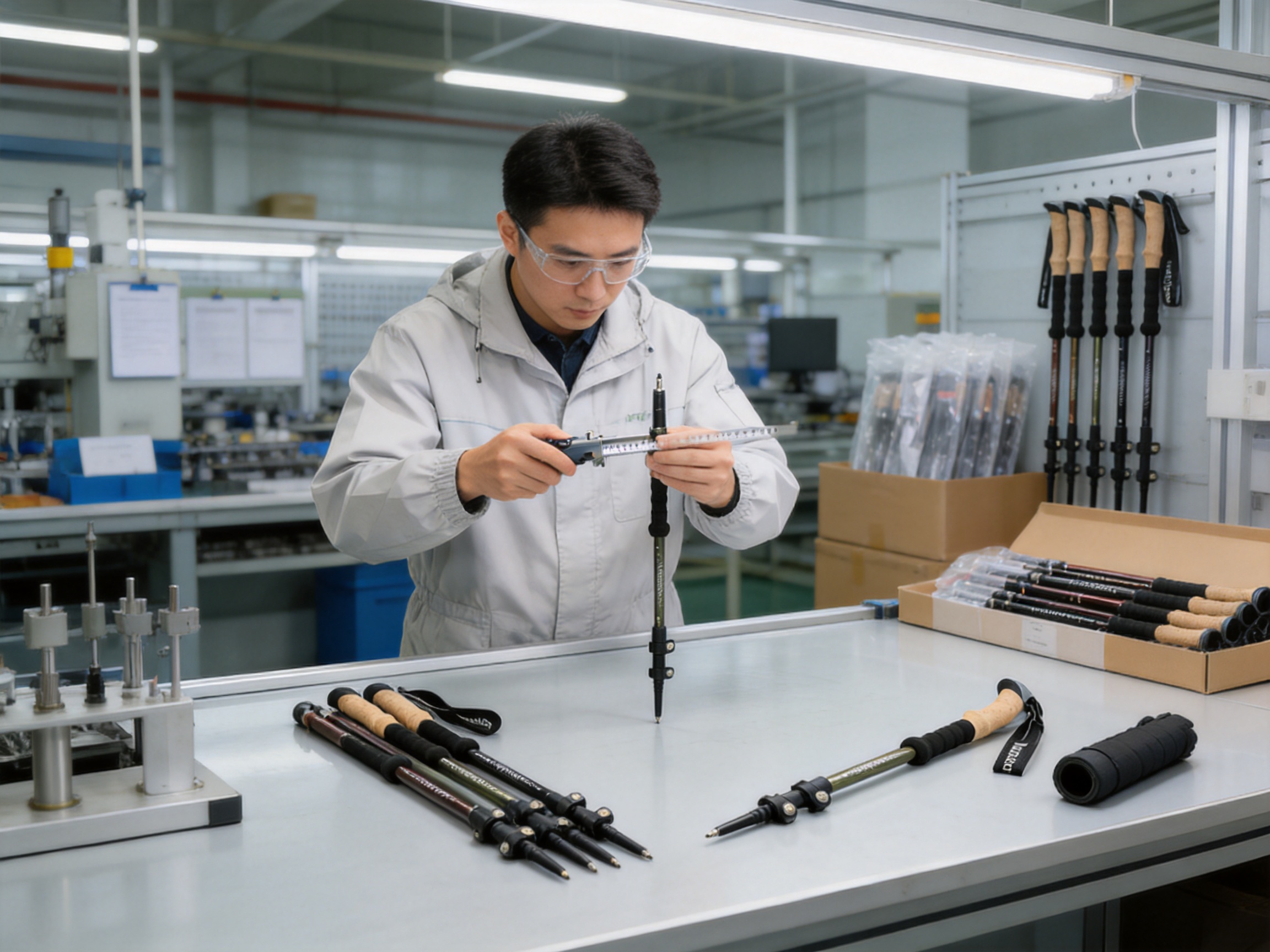
Engineering discipline is applied through sampling, testing, and optimization. Sampling allows the design team to examine actual production pieces rather than relying only on drawings or theoretical calculations. Testing helps identify issues related to adjustment, locking, handling, and repeated use. Optimization then improves the design or production method before larger-scale supply.
For the shaft and telescopic sections, manufacturing consistency is essential. The sections must have suitable dimensions so they can extend and retract smoothly. Excessive clearance may create unwanted movement, while insufficient clearance may make adjustment difficult. Surface treatment and finishing also need to support smooth operation and resistance to ordinary outdoor handling.
The locking mechanism requires careful assembly and functional verification. Its position must align correctly with the shaft sections, and the closure must produce sufficient holding force. During inspection, manufacturers can evaluate whether the lock opens and closes correctly, whether the adjustment is smooth, and whether the selected length remains stable under appropriate test conditions.
Handle installation must also be consistent. A handle that is loose, misaligned, or poorly attached can affect user confidence and comfort. The foam surface should remain properly fitted to the shaft and should not interfere with the wrist strap or the user’s hand position.
Packaging and final inspection are part of the manufacturing process as well. Hiking poles may be transported across long distances before reaching the final user. Protecting the telescopic sections, locking components, and handle during handling helps preserve the product’s condition. Final inspection can identify visible defects, assembly problems, missing components, and packaging errors before shipment.
This manufacturing approach is particularly valuable for retailers and outdoor brands seeking stable supply. A reliable partner should contribute more than factory sourcing. The partner should understand product function, communicate clearly, participate in design decisions, and support repeatable production. These capabilities help reduce uncertainty in the supply chain and improve the likelihood of consistent product performance across different batches.
Quality Control Considerations for Trekking Poles
Quality control for adjustable hiking poles should cover both individual components and the assembled product. The shaft material, lock, handle, strap, and telescopic operation each require attention. A product can fail to meet user expectations if any one of these areas is neglected.
Visual inspection is the first step. Inspectors can check the surface of the aluminum alloy sections for obvious scratches, deformation, uneven finishing, or other visible issues. The external locks should be correctly positioned and free from damage. Handles and straps should be securely attached and presented consistently.
Dimensional checks help confirm that components are produced within the intended tolerances. The telescopic sections need to fit together correctly, and the overall collapsed and extended configurations should match the product design. Consistent dimensions support smooth adjustment and reduce variation between units.
Functional testing examines how the product behaves during operation. The sections should extend and retract without unreasonable resistance. The external lock should open, close, and hold the section as intended. The handle should remain secure during normal gripping and movement. The wrist strap should provide an adjustable range suitable for different users.
Repeated-operation testing can provide information about durability. Because users may adjust their poles frequently, the locking system and telescopic sections should be evaluated after repeated opening, closing, extending, and collapsing. Such testing helps identify wear patterns and possible weaknesses before products are delivered to customers.
Testing should reflect realistic use without making unsupported claims about extreme performance. The purpose is to understand how the product performs under intended outdoor conditions and to ensure that the finished equipment meets practical expectations. Clear specifications and responsible communication are important parts of a trustworthy manufacturing program.
How the Product Supports Hiking Efficiency
Trekking poles can influence hiking efficiency in several ways. They help coordinate the upper and lower body, provide additional support on uncertain ground, and encourage a more consistent rhythm. The benefits are most noticeable when the poles are adjusted correctly and used with appropriate technique.
On a long trail, regular arm movement can help maintain pace. The user can alternate the poles with the opposite leg or use both poles together depending on the terrain. This distributes some movement across the upper body and may make the overall walking pattern feel more balanced.
On uneven ground, the poles provide information as well as support. By planting a pole before shifting weight, the user can gain a better sense of surface firmness and elevation. This may help with route selection and step timing, especially when crossing loose gravel, shallow obstacles, or irregular trail sections.
During descents, the poles can help the user manage forward movement and maintain a more controlled posture. They should not be used to absorb all body weight, but they can provide additional contact and reduce the feeling of instability. The ability to extend the pole length makes it easier to position the tips farther ahead when appropriate.
During climbs, poles can support a steady tempo. The user can plant the poles securely and coordinate arm movement with each step. A shorter setting may keep the handles within a comfortable reach and help reduce unnecessary shoulder movement.
These benefits depend on correct technique. Users should maintain awareness of the trail, avoid planting poles where they can become trapped, and inspect the locks regularly. Trekking poles are supportive equipment, not a replacement for safe footwear, careful route planning, or appropriate physical preparation.
Suitability for Retailers, Outdoor Brands, and OEM Programs
The product is suitable for companies that serve the hiking, camping, mountaineering, travel, and outdoor recreation markets. Its combination of adjustable length, aluminum alloy construction, external locking operation, and comfortable contact features gives it broad category relevance.
For retailers, the product can be presented as an accessible and practical trekking accessory. Beginners can understand the purpose of the external locks and adjustable sections, while experienced users can evaluate the material and construction advantages. Its compact design also makes it appropriate for stores and online channels where transportation and storage efficiency matter.
For outdoor brands, the product can serve as a foundation for OEM or private-label development. The basic structure may be adapted through packaging, color, branding, accessory selection, or other market-specific requirements, subject to technical and production feasibility. A manufacturing partner with product development experience can help transform a general concept into a stable, repeatable item.
For distributors, the product’s multi-scenario application may simplify market positioning. It can be promoted for day hikes, mountain trails, camping trips, long-distance walking, travel, and general outdoor use. This flexibility reduces dependence on a single narrow customer group.
A professional supply relationship should include communication about target users, expected order volumes, packaging requirements, quality standards, and regional preferences. Clear communication at the beginning of development helps avoid misunderstandings later in sampling and mass production.
The manufacturing partner’s role is especially important when buyers need more than a catalog product. A capable partner can participate in design, review materials, coordinate sampling, evaluate functional issues, and support production optimization. This approach helps brands build a product that reflects actual market needs instead of simply reproducing a generic item.
Recommended User Practices
Before each hike, users should inspect the shafts, locks, handles, straps, and tips. The external locks should be closed correctly, and the selected length should remain stable when light pressure is applied. If a component appears damaged or unusually loose, the pole should not be used until the issue is resolved.
Length adjustments should be made before entering a demanding section whenever possible. Users should avoid making complicated changes while standing on unstable ground. Each section should remain within its intended adjustment range, and the pole should not be extended beyond the visible or stated limit.
The handles should be held with a relaxed but controlled grip. The wrist straps can be adjusted so that the hands remain supported without being compressed. Users should avoid wrapping the straps so tightly that they restrict circulation or make it difficult to release the pole.
After use, the poles should be wiped clean and allowed to dry if they have been exposed to rain, mud, or moisture. Dirt around external locking components can interfere with operation. Storing the poles in a clean, dry condition can help preserve the materials and reduce unnecessary wear.
When transporting the poles, users should collapse the sections and place them where the locks and tips are protected from excessive impact. Proper storage helps maintain the telescopic function and reduces the risk of damage caused by pressure from heavier equipment.
Environmental and Long-Term Value Considerations
Durable outdoor equipment can provide value over repeated seasons when it is correctly used and maintained. A product designed for long-term use may reduce the need for frequent replacement and can support more responsible consumption. Aluminum alloy construction, a serviceable external locking design, and replaceable or inspectable components can all contribute to practical product longevity, depending on maintenance and usage conditions.
Long-term value also includes reliability. A product that performs consistently across different hikes can reduce uncertainty for users and retailers. Stable manufacturing, careful sampling, and quality inspection help create this reliability from the beginning.
For supply chain partners, responsible manufacturing means considering the entire product lifecycle. Material selection, production consistency, packaging efficiency, and communication about proper use all influence the total value of the product. Outdoor equipment should be developed with respect for the environments where it will be used and the customers who depend on it.
Q&A
What are retractable external-locking hiking poles designed for?
They are designed to provide additional support, balance, and walking control during hiking, trekking, mountaineering, camping, and other outdoor activities. Their adjustable length allows users to adapt the poles to different terrain and body positions.
What is the main advantage of an external locking mechanism?
The external mechanism is visible, accessible, and convenient to adjust. Users can more easily check whether the lock is engaged and can change the pole length quickly when moving between uphill, downhill, and flat sections.
How does the 3LS locking system improve usability?
The 3LS external lock is designed to provide strong, slip-resistant fixation. It helps hold the selected pole length during normal outdoor use and offers an accessible structure for inspection and adjustment.
Why is aerospace-grade aluminum alloy used for the shaft?
It offers a practical balance between strength, impact resistance, and weight. The shaft can remain manageable for long-distance carrying while providing a dependable structure for hiking and trekking applications.
Are these poles suitable for beginners?
Yes. The external locking system is straightforward to understand, and the adjustable structure allows beginners to find a comfortable length. Users should read any supplied instructions and check that the locks are secure before applying pressure.
Can experienced hikers use these poles on mountain trails?
They are suitable for general mountain trails and uneven outdoor terrain when used within their intended conditions. The adjustable design, aluminum alloy shaft, external locks, EVA handle, and wrist strap support practical use across changing environments.
How should the poles be adjusted for uphill hiking?
A moderately shorter setting is generally useful for uphill sections because it can keep the arms in a comfortable position and support a climbing rhythm. The exact adjustment depends on the user’s height, slope angle, and personal technique.
How should the poles be adjusted for downhill hiking?
A moderately longer setting can provide additional reach and support during descent. Users should ensure that every section remains securely locked and should not extend the poles beyond the safe adjustment range.
What does the EVA foam handle contribute?
The EVA foam handle provides a cushioned contact surface designed to absorb sweat and improve grip comfort. It can help reduce hand fatigue during extended hiking and support more consistent control in warm or damp conditions.
Why is the wrist strap adjustable?
Users have different hand sizes, and some may wear gloves. An adjustable wrist strap allows the pole to fit different hand shapes and helps distribute control more comfortably during repeated movement.
Are retractable poles easier to transport than fixed-length sticks?
Yes. The three-section telescopic structure allows the poles to collapse into a more compact form. This is useful for backpacks, vehicles, travel bags, home storage, and camping equipment organization.
What should buyers evaluate when comparing trekking poles?
Buyers should consider the locking mechanism, shaft material, adjustment range, collapsed size, handle comfort, wrist strap design, manufacturing consistency, and intended usage conditions. Product reliability depends on the relationship between all of these elements.
How can retailers position this product?
Retailers can position it for hiking, trekking, mountain trails, camping, travel, and general outdoor recreation. Its adjustable structure and practical materials make it suitable for both entry-level users and more experienced outdoor customers.
What manufacturing capabilities are important for this type of product?
Important capabilities include material selection, shaft forming, lock assembly, dimensional control, functional testing, repeated-operation testing, sampling, packaging, and production optimization. These processes help create consistent products rather than relying only on appearance.
How should users maintain the external locks?
Users should keep the locks reasonably clean and dry, inspect them before use, and remove dirt or debris that may interfere with closure. Any damaged or unusually loose component should be checked before the poles are used again.
Conclusion
Retractable external-locking hiking poles provide a practical combination of stability, adjustability, portability, and comfort. The three-section telescopic structure makes them convenient for transport and storage, while the 3LS external locking mechanism supports fast adjustment and visible fixation. The aerospace-grade aluminum alloy shaft balances lightweight handling with dependable structural performance. An EVA foam handle and adjustable wrist strap improve comfort and control during extended outdoor activities.
These features give the product clear advantages over fixed-length sticks and low-quality adjustable poles. More importantly, they demonstrate how product performance depends on the interaction between design, materials, manufacturing precision, and real-world usage requirements. A reliable trekking pole is not defined by a single specification. It is created through the coordinated development of the shaft, lock, handle, strap, telescopic structure, and quality control process.
For outdoor brands, retailers, distributors, and OEM buyers, the product offers broad market relevance across hiking, mountaineering, camping, travel, and general outdoor recreation. A manufacturing approach based on purpose-driven design, material integrity, sampling, testing, and optimization can help reduce supply chain uncertainty and support long-term product value.
For users, the most important benefits are straightforward: convenient adjustment, secure locking, manageable weight, comfortable handling, and easy transport. When correctly adjusted and responsibly used, retractable external-locking hiking poles can become dependable equipment for exploring trails, climbing slopes, crossing uneven ground, and enjoying the outdoors with greater confidence.
References
1. American Hiking Society. Principles of Safe and Responsible Hiking Equipment Use.
2. International Organization for Standardization. General Guidelines for Product Quality, Dimensional Consistency, and Manufacturing Control.
3. Outdoor Industry Association. Consumer Trends in Hiking, Trekking, and Camping Equipment.
4. Engineering Materials Handbook. Aluminum Alloys and Lightweight Structural Applications.
5. Human Factors in Outdoor Equipment Design. Principles of Grip Comfort, Wrist Support, and Adjustable Product Ergonomics.
6. Mountaineering and Trekking Equipment Development Guidelines. Considerations for Terrain Adaptability, Portability, and Long-Term Product Reliability.
Product: Retractable external locking hiking poles, trekking poles, aluminum alloy hiking sticks


- Phone: +86-15968800379
- E-mail: [email protected]
- Address: Room 1002, Huishang Building, Gongshu District, Hangzhou City, Zhejiang Province.
Copyright © CragHaven Outdoor All Rights Reserved. Outdoor Gear Manufacturers Wholesale Mountaineering Camping Gear Suppliers
