

 English
 Deutsch
 Español
 Français

Ultralight Internal-Lock Aluminum Trekking Poles for Stable, Comfortable Hiking
Content
- 1 Product Overview
- 2 Why Trekking Pole Construction Matters
- 3 Internal Locking System
- 4 Aluminum Alloy Shaft Advantages
- 5 Shock Absorption and Walking Comfort
- 6 Ergonomic Straight Handle and Telescopic Strap
- 7 Telescopic Adjustment for Different Terrain
- 8 Performance Advantages over Basic Competitor Models
- 9 Suitable Outdoor Applications
- 10 Manufacturing Approach and Product Development
- 11 Sampling, Testing, and Optimization
- 12 Quality and Supply-Chain Strengths
- 13 Retail and Wholesale Positioning
- 14 Care and Maintenance
- 15 Safe Use Guidelines
- 16 How to Choose Between This Product and Other Trekking Poles
- 17 Frequently Asked Questions
- 17.1 What is an internal-lock trekking pole?
- 17.2 Is an internal lock better than an external clamp?
- 17.3 How does the spring shock absorption system help?
- 17.4 Is the aluminum alloy shaft suitable for long-distance hiking?
- 17.5 How should the pole length be adjusted?
- 17.6 Can different people use the same trekking pole?
- 17.7 Is the product suitable for camping trips?
- 17.8 Can the product be customized for private-label orders?
- 17.9 What should be checked before using the pole?
- 17.10 What makes this product different from a simple hiking pole?
- 18 Conclusion
- 19 References
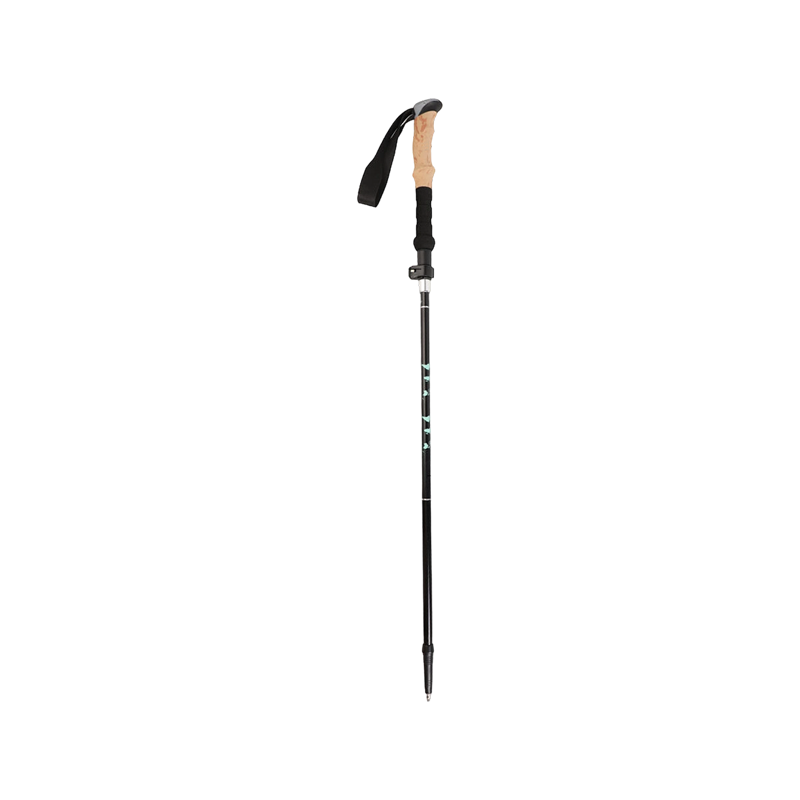
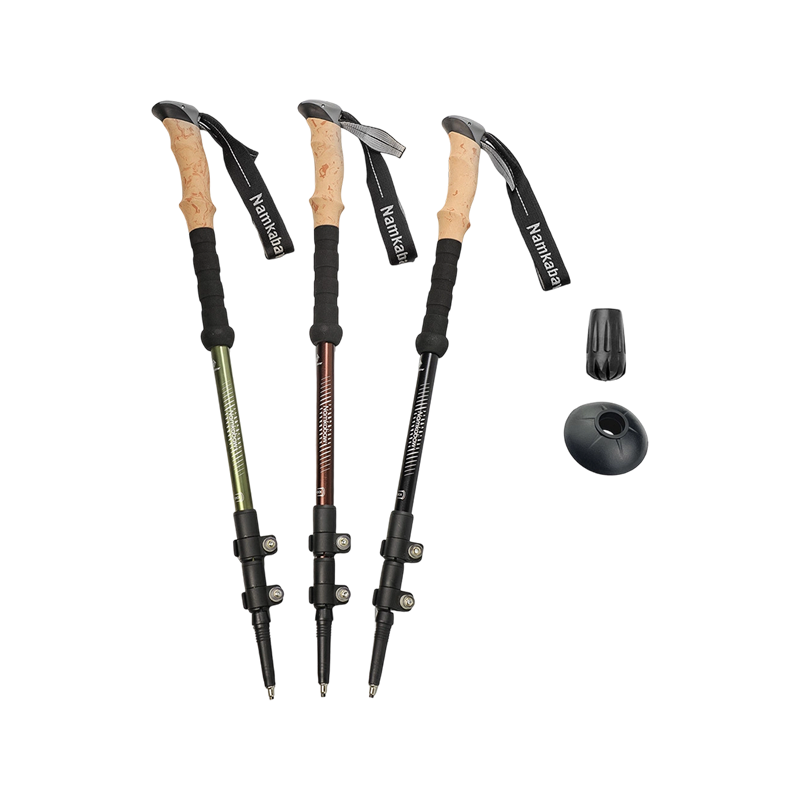
- 20 Product: Ultralight, internally locking aluminum alloy straight handle trekking pole with telescopic strap and shock absorption.
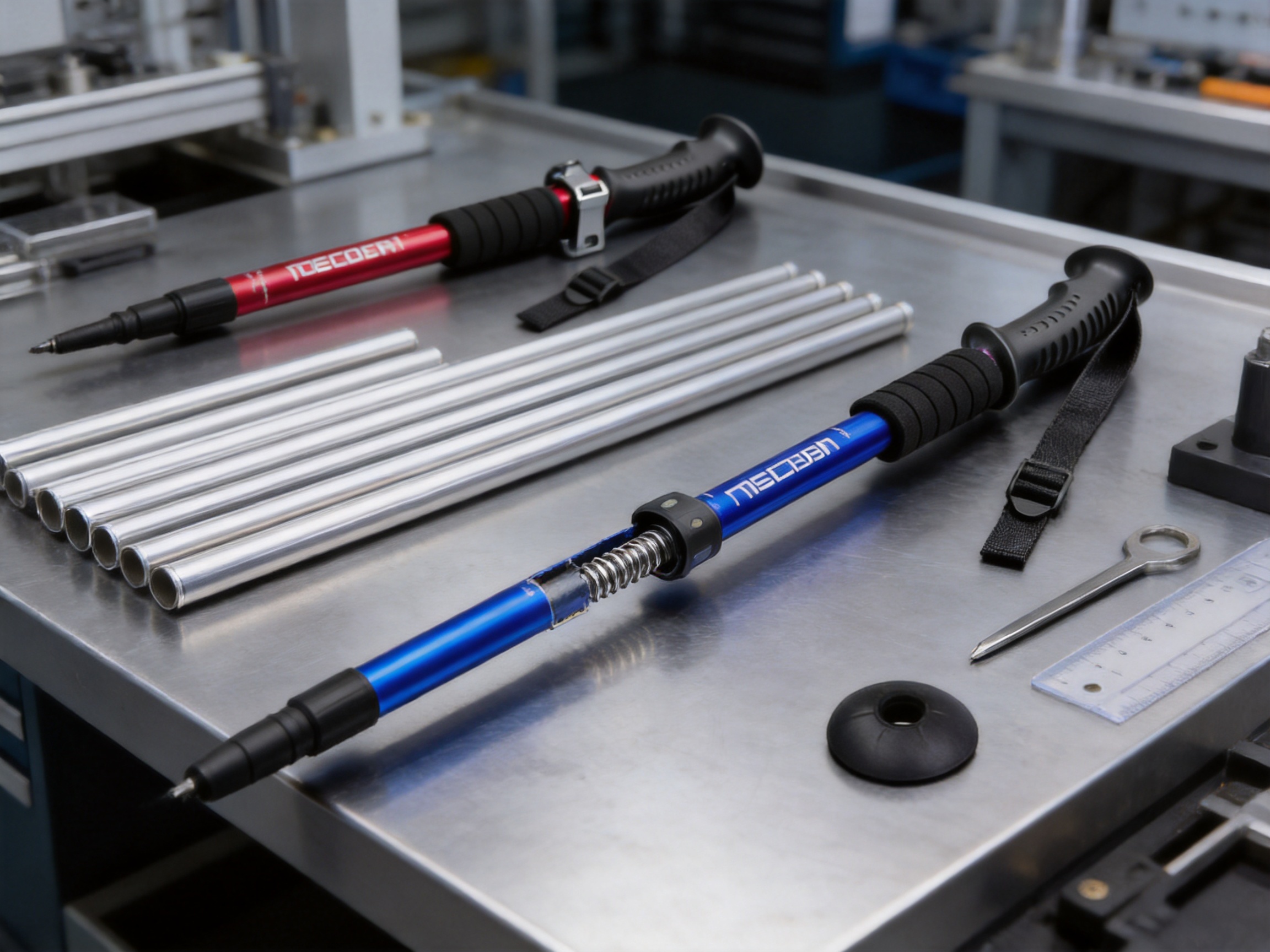
Ultralight Internal-Lock Aluminum Trekking Poles for Stable, Comfortable Hiking
Trekking poles are among the most practical pieces of equipment for hiking, backpacking, mountaineering, and camping. They help users maintain balance on uneven ground, improve rhythm during long walks, reduce strain on the lower body, and move with greater confidence across changing terrain. However, not every trekking pole provides the same combination of stability, portability, comfort, and adjustment reliability. The construction of the shaft, the type of locking system, the quality of the handle, and the behavior of the shock absorption mechanism all influence the experience of using a pole outdoors.
The ultralight, internally locking aluminum alloy trekking pole described in this article is designed around these practical requirements. It combines an aerospace-grade aluminum alloy body, an internal expansion locking structure, a built-in spring shock absorption system, an ergonomic non-slip straight handle, and an adjustable telescopic strap. Together, these features create a trekking pole intended for long-distance hikes, daily walking, backpacking, camping trips, and general mountain use.
Rather than focusing on a single specification, the product is developed as a complete support system for outdoor movement. Its internal lock keeps the exterior streamlined, while the telescopic structure allows the pole to be adjusted for different users and terrain conditions. The shock absorption mechanism helps moderate impact transmitted through the pole, and the handle and strap are shaped to support a more natural grip during extended use.
This article examines the product’s design, functional advantages, comparison with competing trekking pole structures, manufacturing considerations, applicable outdoor scenarios, maintenance requirements, and purchasing factors for distributors, retailers, and outdoor users.
Product Overview
The pole is a lightweight, straight-handle trekking pole made from aluminum alloy. Its telescopic structure allows the user to extend or shorten the shaft according to body height, walking conditions, and personal preference. The internal locking mechanism is positioned inside the shaft rather than outside it. When the sections are rotated, an internal expansion component presses against the inside of the pole tube and secures the adjusted length.
A built-in spring shock absorption system is incorporated into the pole body. When the pole contacts the ground, the spring provides controlled movement that can help reduce the harshness of repeated impact. This feature is particularly relevant when walking on hard trails, descending slopes, or carrying equipment over long distances. Shock absorption does not replace correct technique or appropriate footwear, but it can contribute to a more comfortable overall walking experience.
The aluminum alloy shaft provides a practical balance between weight, strength, and cost. Compared with heavier steel structures, aluminum is easier to carry over long distances. Compared with some lightweight composite materials, aluminum can provide a familiar combination of rigidity, resilience, and manufacturing consistency. The material also supports a broad range of surface finishes and product configurations for different markets.
The handle is designed with an ergonomic, non-slip surface to improve grip comfort and control. A straight handle design offers a simple and versatile shape suitable for general hiking and trekking. The attached telescopic strap gives the user an additional contact point, helping maintain control without requiring a continuously tight grip.
The product identification code for this model is WFDS262002. It is positioned within the trekking pole category for mountain-climbing, hiking, backpacking, and camping applications.
Why Trekking Pole Construction Matters
A trekking pole must perform under repeated loading. Every step can transfer force through the handle, shaft, locking mechanism, and tip. On flat trails, the loading pattern may be relatively moderate. On steep descents, loose ground, wet surfaces, or rocky terrain, the pole may experience abrupt changes in direction and pressure.
For this reason, a trekking pole should not be evaluated only by its advertised weight or appearance. The connection between the telescopic sections must remain dependable. The grip must be comfortable enough for repeated use. The strap must support control without causing excessive pressure on the wrist. The shaft must resist ordinary bending and handling stresses. The tip and lower section must maintain contact with the ground across different surfaces.
Design decisions also affect the product’s commercial value. Outdoor retailers and distributors need products that are easy to explain, simple to use, and suitable for multiple customer groups. A trekking pole that combines lightweight construction with a recognizable internal locking system can serve both experienced hikers and users purchasing their first adjustable pole.
The product’s central advantage is its balanced structure. It is not designed solely as a racing-oriented pole, a technical mountaineering tool, or a decorative camping accessory. Instead, it is developed for practical support across daily hiking, long-distance trekking, backpacking, and recreational mountain activities.
Internal Locking System
The internal locking structure is one of the defining features of this trekking pole. Unlike an external clamp, which is placed visibly on the outside of the shaft, an internal lock operates within the pole tube. Rotating the sections causes the internal expansion mechanism to press outward against the inside wall of the shaft. This friction-based connection holds the selected length in place.
One major benefit of this design is the clean exterior. Because the locking components are integrated into the shaft, there are fewer external parts that can catch on clothing, vegetation, backpack straps, or other equipment. This streamlined structure is useful when moving through narrow trails, forest paths, or crowded storage areas.
The internal lock also supports a compact visual appearance. Many users prefer the smooth profile of a twist-lock pole because it appears less mechanical and has fewer visible levers. For brands and retailers, the simplified exterior can make the product easier to position as a lightweight, integrated outdoor tool.
Another advantage is that the lock is protected within the shaft. External clamps are exposed to accidental knocks, dirt, and contact with other objects. An internal system reduces the number of external components exposed during ordinary carrying and use. It still requires proper inspection and cleaning, but its protected arrangement can support a neat and durable product structure.
Internal locking systems do require the user to rotate the sections correctly. They are generally not as immediately fast to adjust as lever-operated external locks. However, for users who set their pole length before beginning a hike and make only occasional adjustments, the internal mechanism provides a practical balance between portability and reliable everyday use.
Internal Lock Compared with External Lock
An external locking trekking pole uses a visible clamp. The user opens the lever, slides the shaft to the desired length, and closes the clamp. This operation is quick and easy to observe. External locks are especially useful when hikers frequently change pole length while moving between steep ascents, descents, and level ground.
The internal lock uses a twisting adjustment. It may take more time to rotate than opening a clamp, but it creates a smoother outer profile and can reduce the number of exposed parts. This makes the internal design attractive to users who prioritize compactness, clean appearance, and reduced interference with clothing or pack equipment.
| Comparison Factor | Internal-Lock Trekking Pole | External-Lock Trekking Pole |
|---|---|---|
| Locking location | Inside the shaft | Outside the shaft |
| Adjustment method | Twist sections to tighten or release | Open and close a lever clamp |
| Exterior profile | Smooth and streamlined | Visible mechanical clamp |
| Adjustment speed | Moderate; requires rotation | Fast; direct clamp operation |
| Portability | Lightweight and compact in appearance | May have a slightly larger external structure |
| Inspection | Internal components require careful checking | Lock condition is easy to see |
| Typical preference | Long-distance hiking and lightweight travel | Frequent adjustment on variable terrain |
Neither locking system is automatically superior in every environment. The most suitable choice depends on how the user hikes. The internal design is a strong option for those who value a smooth, compact, lightweight trekking pole. The external design may be preferable for users who need rapid length changes and direct visual confirmation of the clamp position.
For a general-purpose outdoor product, the internal lock offers a clear competitive position. It can appeal to backpackers, travelers, recreational hikers, and consumers who want a less bulky pole without giving up adjustable length.
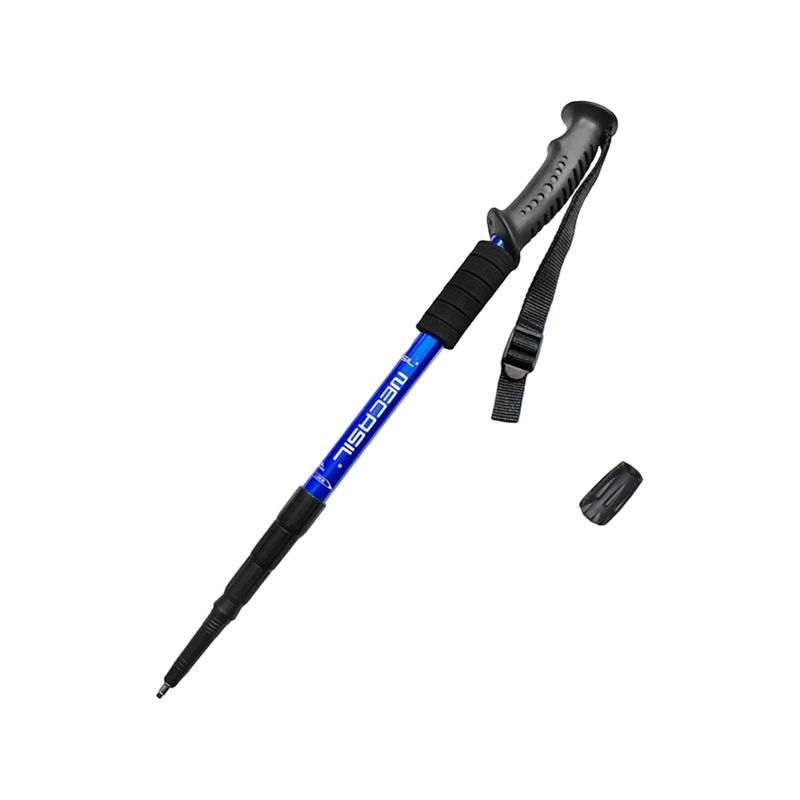
Ultralight, internally locking aluminum alloy straight handle trekking pole with telescopic strap and shock absorption.
Aluminum Alloy Shaft Advantages
The pole shaft uses aerospace-grade aluminum alloy as its primary structural material. In outdoor equipment, aluminum is widely valued because it provides a dependable relationship between strength, weight, manufacturability, and price. These characteristics make it suitable for products that must be carried for hours and repeatedly exposed to outdoor handling.
A well-designed aluminum shaft can provide sufficient rigidity for normal hiking support while remaining easier to carry than heavier metal alternatives. It is also compatible with telescopic construction because aluminum tubes can be manufactured in multiple sections with controlled dimensions. Consistent tube sizing is important for smooth extension, accurate fit, and dependable performance of the internal locking mechanism.
Aluminum alloy is also practical for international product supply. It can be processed through established forming, cutting, surface treatment, and assembly methods. This supports stable production and makes it possible to develop different colors, finishes, handle configurations, packaging formats, and private-label requirements for different customers.
The term “aerospace-grade” describes the intended material positioning and the high-performance image associated with the alloy selection. In commercial communication, responsible product evaluation should still focus on the complete assembly rather than the shaft material alone. The locking insert, handle connection, spring, strap, tip, and quality-control process all contribute to real-world performance.
Balance Between Light Weight and Support
Reducing weight is important for long-distance hiking. Every additional gram must be carried over the full route, and equipment that feels acceptable on a short walk may become tiring after several hours. A lightweight aluminum trekking pole can reduce carrying burden while still providing a stable contact point on the ground.
At the same time, an ultralight product must be used within its intended application. Trekking poles are designed to assist balance and rhythm; they are not climbing anchors, fall-arrest systems, or substitutes for technical mountaineering equipment. The user should avoid applying sudden bodyweight loads beyond the product’s design purpose.
The product’s value comes from balance rather than an extreme specification. It offers a practical aluminum structure, telescopic adjustment, internal locking, and shock absorption in one accessible format. This combination is suitable for outdoor customers who want a lighter alternative to basic heavy-duty poles but do not necessarily require a specialized competition or expedition model.
Shock Absorption and Walking Comfort
Repeated impact is a common source of discomfort during hiking. When a pole tip contacts a hard surface, the resulting force can travel through the shaft and handle into the user’s hand and arm. A built-in spring shock absorption system introduces controlled movement into this transfer path. The purpose is to moderate the sharpness of impact and create a smoother sensation during repeated pole plants.
The shock absorption system is especially relevant on firm trails, paved sections, compacted soil, rocky paths, and downhill routes. Descending can place additional stress on the knees because the body must control forward and downward movement. A trekking pole can help distribute part of the user’s effort through the arms and shoulders, while the spring system may make repeated contact feel less abrupt.
The product description identifies the shock absorption system as a feature that effectively reduces impact on the knee joint. Users should understand this as support for comfort and load management rather than a medical guarantee. Correct pole height, appropriate walking posture, suitable footwear, and controlled movement remain important.
How to Use the Shock Absorption Function Correctly
The user should adjust the pole to an appropriate length before walking. On level ground, the elbow is commonly kept at a comfortable angle with the forearm approximately parallel to the ground. On an ascent, a slightly shorter setting may be convenient. On a descent, a slightly longer setting can help the user maintain support without leaning excessively forward.
The telescopic strap should be adjusted so that the hand can enter and exit easily while remaining supported. The user should place the hand through the strap from below and maintain a relaxed grip around the handle. Excessive squeezing defeats part of the comfort benefit and can cause fatigue in the fingers and forearm.
The shock absorption mechanism should not be forced, blocked, or modified. Users should avoid disassembling the spring assembly in the field. If unusual looseness, noise, or resistance appears, the pole should be inspected and serviced according to the supplier’s guidance.
Ergonomic Straight Handle and Telescopic Strap
The handle is the primary contact point between the user and the pole. During a long hike, a poorly shaped grip can create hot spots, pressure points, or hand fatigue. This product uses an ergonomic straight handle with a non-slip surface to support stable contact and comfortable control.
A straight handle is versatile because it allows the user to hold the pole at different positions. The main grip can be used during normal walking, while the upper or lower portion may be held temporarily when adjusting to a slope or changing hand position. This flexibility is useful for users who walk for extended periods and naturally vary their grip.
The non-slip surface helps reduce unwanted movement when the hands become damp from perspiration or light rain. Grip security is important not only for comfort but also for maintaining consistent pole placement. A stable grip allows the user to guide the pole more accurately without continuously tightening the hand.
The telescopic strap adds another layer of control. It can support the wrist and palm during ordinary use, allowing the hand to remain relaxed while the pole is still connected to the user. The strap is also useful when the user briefly loosens the grip to adjust clothing, drink water, or change hand position.
Strap adjustment should be performed before the hike begins. A strap that is too loose may provide little support, while one that is too tight can restrict circulation or cause pressure. The correct setting should allow the user to slide the hand through naturally and maintain a relaxed hold.
Telescopic Adjustment for Different Terrain
A fixed-length pole can provide a simple and rigid structure, but an adjustable pole is more adaptable for travel and changing terrain. The telescopic construction of this model allows the user to select a suitable working length and reduce the overall size when carrying or storing the product.
On level ground, users generally select a height that allows comfortable arm movement without lifting the shoulders. During an ascent, shortening the pole can help maintain a natural arm swing and keep the hands closer to the body. During a descent, extending the pole can provide a longer point of contact and assist with balance.
Adjustment is also useful when the pole is shared among family members or outdoor groups. Different users can set the length according to their own height and walking style. For retailers, this makes an adjustable model easier to position as a multi-user product than a fixed-length alternative.
The internal lock should always be tightened sufficiently before use. The sections should be aligned, and the user should confirm that the shaft does not slide under ordinary hand pressure. Adjustment should be made on stable ground rather than while walking on a steep or exposed section of trail.
Performance Advantages over Basic Competitor Models
Basic trekking poles often provide only a simple shaft and handle. They may be suitable for occasional use, but they can lack the comfort and adjustment features expected by frequent hikers. The present product provides several advantages over a basic entry-level structure.
First, the internal locking system creates a cleaner profile than an exposed clamp. This can improve handling around vegetation and reduce the chance of snagging on pack components. It also gives the pole a more integrated appearance that may be attractive in retail presentation.
Second, the aluminum alloy shaft combines practical durability with low carrying weight. A heavier pole may feel stable but can become tiring during long-distance use. A very light pole made from an unsuitable material may not provide the desired confidence. The aluminum design occupies a useful middle position for general trekking and hiking.
Third, the built-in spring shock absorption system adds a comfort feature that is not always present in basic poles. It is intended to moderate repeated impact and support more comfortable movement, especially on firm ground and downhill sections.
Fourth, the ergonomic non-slip handle and telescopic strap improve the user interface. A pole is used through the hands, so comfort and control have a direct effect on the overall experience. These features help the product compete not only on shaft material but also on functional completeness.
Fifth, the telescopic construction supports easier transportation and storage. The pole can be shortened when placed in luggage, stored at home, or carried between trail sections. This is particularly valuable for travelers who need equipment that fits into a broader camping or backpacking system.
| Feature | Basic Entry-Level Pole | Ultralight Internal-Lock Aluminum Pole | User Benefit |
|---|---|---|---|
| Shaft material | May use heavier or less refined construction | Aluminum alloy body | Balanced weight and structural support |
| Locking system | Simple adjustment mechanism | Internal expansion lock | Streamlined exterior and compact appearance |
| Shock control | May have no absorption function | Built-in spring shock absorption | More comfortable repeated pole contact |
| Handle | Basic molded grip | Ergonomic non-slip straight handle | Improved grip comfort and control |
| Strap | Fixed or basic strap | Telescopic adjustable strap | Better wrist support and hand positioning |
| Use range | Occasional short walks | Daily hiking, trekking, backpacking, and camping | Broader application across outdoor activities |
Compared with an external-lock competitor, the product’s primary advantage is not necessarily faster adjustment. External clamps remain highly convenient when users frequently change length. Instead, the internal-lock model competes through a smoother exterior, reduced exposed hardware, compact visual design, and a lightweight integrated structure.
This balanced positioning allows distributors to offer the product to customers who value portability and comfort but still want the security of an adjustable aluminum trekking pole.
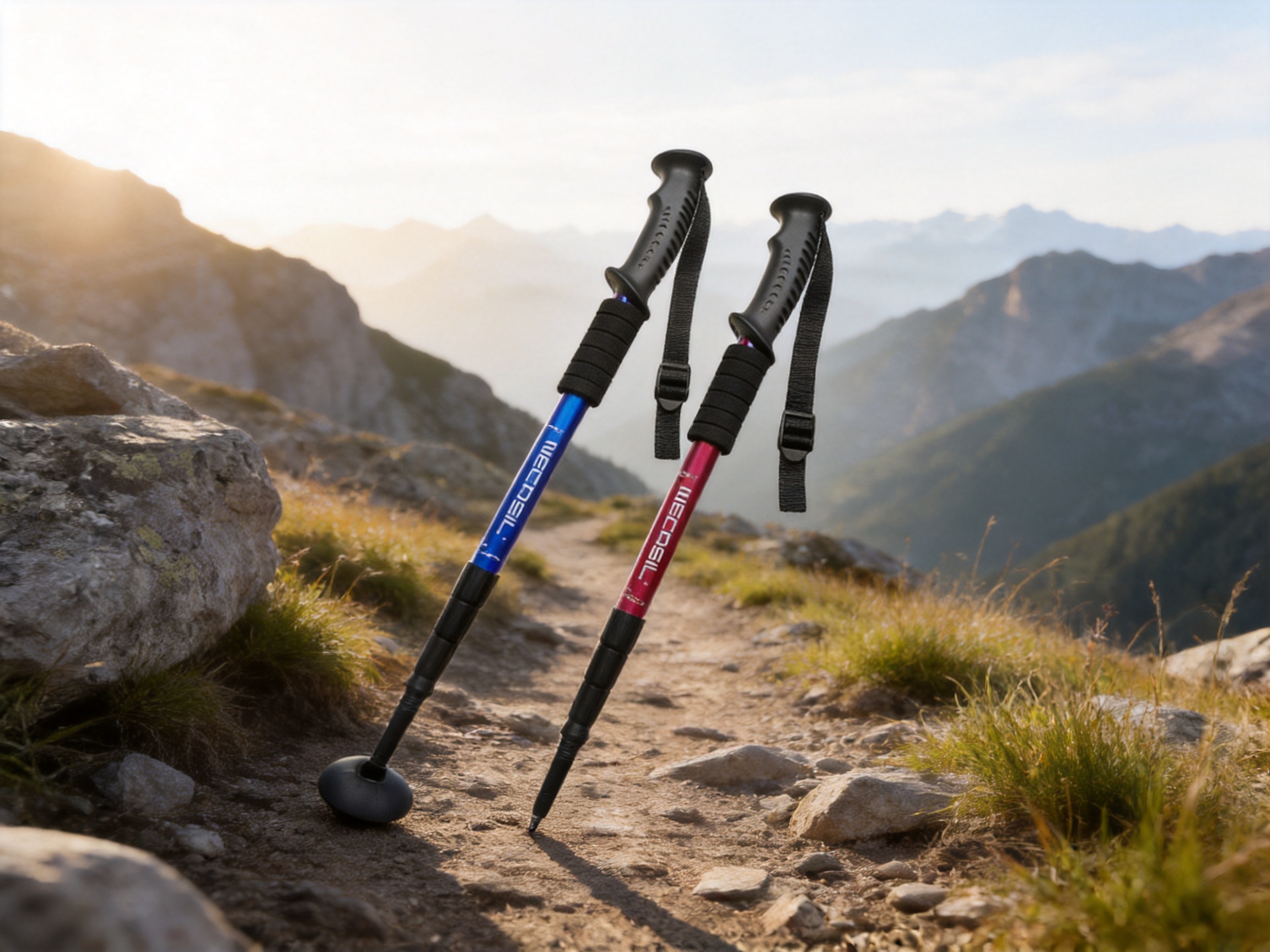
Suitable Outdoor Applications
Long-Distance Hiking
Long-distance hiking places continuous demands on the body and equipment. The user may walk for several hours across changing ground while carrying food, water, clothing, and other supplies. A lightweight pole helps reduce the burden of carrying equipment, while the shock absorption system and ergonomic handle support comfort over time.
The internal lock is appropriate for hikers who normally set their pole length at the beginning of a route and make only occasional changes. The smooth exterior is also convenient when the pole is attached to or removed from a backpack during breaks.
Backpacking
Backpackers usually pay close attention to both packed size and carrying weight. An adjustable trekking pole can be shortened during transport and extended when needed. The internally integrated lock avoids the bulky appearance of some clamp-based designs and supports a simple equipment setup.
Because backpacking routes can include hard-packed trails, gravel, forest paths, and moderate slopes, a general-purpose aluminum pole is a practical option. Users should select appropriate tips or accessories when available and should inspect the lower section after prolonged use on abrasive surfaces.
Mountain Hiking
Mountain trails often involve steep changes in elevation. The pole can be shortened for uphill movement and extended for descents, allowing the user to adapt the support point to the terrain. The spring shock absorption system may also improve comfort during repeated contact on firm or rocky sections.
For technical climbing, scrambling, glacier travel, or terrain requiring specialized safety equipment, this trekking pole should be treated as a balance and walking aid rather than a protection device. It is most suitable for hiking and trekking applications within its intended design range.
Camping and Travel
Camping users may value a pole that is easy to transport, store, and share. The telescopic structure helps reduce storage length, while the aluminum body provides a dependable and familiar material platform. The streamlined internal-lock structure is convenient when the pole is packed with tents, sleeping equipment, cooking systems, or other gear.
For travel retailers, the product can be marketed as a practical accessory for outdoor holidays, nature walks, camping weekends, and sightseeing routes with uneven ground. Its general-purpose design makes it suitable for customers who do not want to purchase a highly specialized trekking system.
Daily Walking and Fitness
Trekking poles are also used for regular walking, fitness routines, and recreational outdoor activity. The ergonomic handle and strap can make the product comfortable for repeated use, while the adjustable length allows different family members to share it.
For daily users, the internal locking system provides a clean and uncomplicated appearance. The pole can be adjusted before a walk and stored easily afterward. The aluminum construction also supports practical durability for routine handling.
Manufacturing Approach and Product Development
Product performance depends on more than the final assembly. Reliable trekking poles require coordinated control of material selection, tube dimensions, locking components, spring behavior, handle attachment, strap installation, surface treatment, and packaging. CragHaven Outdoor approaches product development through a manufacturing-driven process that connects outdoor use requirements with production capability.
The company is based in Hangzhou, China, and operates as an outdoor brand and cross-border manufacturing partner. Its focus includes mountaineering, hiking, and camping scenarios. This positioning allows product decisions to be considered from both the user’s perspective and the supply-chain perspective.
The development philosophy emphasizes actual weather, terrain, and time rather than catalog appearance alone. This means that a feature is expected to solve a practical usage problem. For this trekking pole, the internal lock addresses compactness and a clean exterior, the spring addresses repeated impact, the aluminum alloy addresses weight and support, and the handle and strap address long-duration comfort.
Material Selection
Material selection begins with the intended use. Aluminum alloy is chosen for the shaft because it can provide low weight, structural support, and stable production. The internal locking components must be compatible with the inside diameter and surface of the tube. The spring must provide controlled resistance without creating an uncomfortable or unpredictable movement.
The handle material and surface texture are selected to support grip comfort and non-slip performance. Strap materials must be flexible enough for adjustment while remaining suitable for repeated handling. Lower pole components require wear-resistant materials because they experience contact with soil, stone, and other abrasive surfaces.
Material compatibility is particularly important in a telescopic product. Sections must move smoothly during adjustment but remain secure after locking. Excessive clearance can create wobble, while insufficient clearance can make extension difficult. Manufacturing control helps maintain the required relationship between these parts.
Tube Processing and Dimensional Control
The aluminum shaft is produced through controlled tube processing. Cutting accuracy, section length, straightness, and surface condition all affect the final user experience. If the sections are not properly aligned, the lock may not engage consistently, and the pole may feel rough during extension.
Dimensional control is also important for packaging and product consistency. Retail customers expect poles from the same product line to feel similar when adjusted. Stable dimensions support repeatable assembly, reduce variation between batches, and make quality inspection more efficient.
Before assembly, tube sections can be checked for visible damage, deformation, burrs, and surface defects. Components that do not meet the required condition should be separated rather than passed into later production stages.
Internal Lock Assembly
The internal locking mechanism is assembled inside the telescopic shaft. Correct positioning of the expansion component is essential. The lock must engage firmly when tightened and release smoothly when the user rotates the sections in the opposite direction.
Assembly workers or production equipment must ensure that the internal component is installed at the intended depth and orientation. The locking contact surfaces should remain clean during assembly. Contamination, incorrect positioning, or inconsistent tightening can influence adjustment behavior.
Functional inspection should include extension and contraction checks, lock engagement, resistance to ordinary sliding, and evaluation of the connection between sections. These inspections are especially important because the mechanism is not fully visible during normal use.
Spring Shock Absorption Assembly
The shock absorption system must be assembled so that the spring can move within its intended range. The mechanism should not be excessively loose, and it should not be restricted by misaligned components. Controlled assembly supports a consistent feel from one product to another.
Quality checks may include compression and release observation, abnormal noise inspection, and confirmation that the spring returns appropriately after normal movement. The exact testing method depends on the production configuration and customer requirements, but the principle remains the same: the shock absorption function should be evaluated as part of the complete pole rather than as an isolated component.
Handle, Strap, and Final Assembly
The handle must be securely connected to the upper shaft. The connection should be checked for looseness, misalignment, and surface defects. The non-slip grip should have a consistent finish so that the product feels uniform in the hand.
The telescopic strap is installed and checked for stitching, attachment strength, adjustment movement, and comfort. A strap that is not correctly installed can reduce user confidence even if the shaft and lock perform properly.
Final assembly brings together the shaft, locking system, spring, handle, strap, and lower components. The complete product is then inspected for appearance, adjustment, function, and packaging readiness. This integrated approach helps reduce the risk that a component passes individual inspection but performs poorly when combined with the rest of the pole.
Sampling, Testing, and Optimization
CragHaven Outdoor describes sampling, testing, and optimization as standard parts of development. This approach is important because outdoor equipment must function across real usage conditions rather than only in a controlled showroom environment.
During sampling, the product team can assess how the pole feels in the hand, how quickly it adjusts, how the internal lock responds, and how the spring behaves during repeated contact. Feedback from samples may lead to changes in handle shape, strap length, shaft fit, lock resistance, spring behavior, surface treatment, or packaging.
Testing should reflect the product’s intended scenarios. A trekking pole may be evaluated through repeated extension and retraction, ordinary loading, grip handling, strap movement, and contact with representative ground surfaces. Visual inspection is also important because scratches, burrs, uneven finishes, or assembly marks can affect customer perception.
Optimization is not limited to the first prototype. A product may require several rounds of adjustment before the relationship between comfort, durability, production efficiency, and cost is suitable for the target market. Manufacturing-driven design helps identify whether a proposed feature can be produced consistently at the required scale.
For wholesale customers, this process provides an important supply-chain advantage. A product that has been considered through sampling and repeatable production methods is easier to manage than a design based only on appearance or unverified specifications.
Quality and Supply-Chain Strengths
Outdoor gear buyers often face uncertainty regarding material consistency, delivery stability, product variation, and communication. CragHaven Outdoor positions itself as a partner intended to reduce these uncertainties through participation in both design and manufacturing.
China’s mature outdoor manufacturing ecosystem provides access to established resources for aluminum processing, injection-molded components, textile straps, packaging, surface treatment, and assembly. Coordinating these resources can support efficient production and make it possible to adapt products for different markets.
The company’s stated approach emphasizes stable, replicable, and scalable products. For this trekking pole, that means maintaining consistency in the shaft sections, internal lock, handle connection, spring assembly, and final appearance. Consistency is essential when products are sold through retail channels because customers expect the next purchase to perform like the first.
CragHaven also focuses on long-term partnerships rather than one-time factory sourcing. This can be valuable for importers and outdoor brands that require repeat orders, packaging coordination, private-label development, and ongoing product improvement. Clear communication about use scenarios, target pricing, packaging, and market expectations allows the manufacturing process to be aligned with the customer’s commercial needs.
The company can support OEM-oriented cooperation for outdoor gear buyers seeking a custom configuration. Potential areas for discussion may include handle colors, surface finishes, branding treatment, packaging design, strap details, accessory selection, and order quantities. Any customization should be confirmed through samples and production review before mass manufacturing.
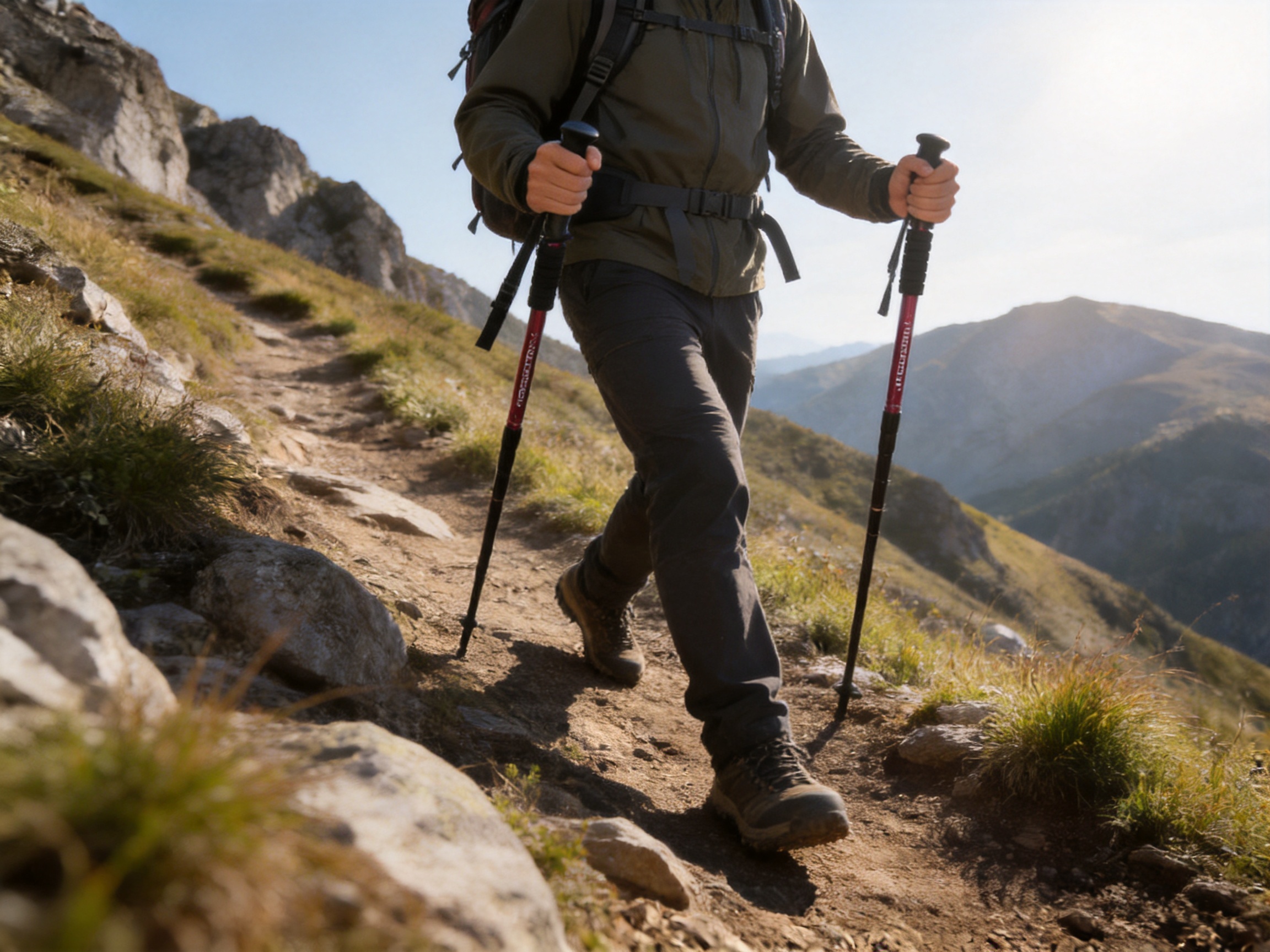
Retail and Wholesale Positioning
This trekking pole can be positioned in several ways depending on the customer segment. For general outdoor retailers, it can be presented as an ultralight adjustable aluminum pole with shock absorption and a clean internal locking structure. For camping stores, it can be grouped with compact travel and hiking accessories. For online sellers, the combination of recognizable features provides clear content for product pages and comparison guides.
The product is also suitable for private-label programs. The internal lock, aluminum alloy shaft, ergonomic handle, and telescopic strap create a complete platform that can be adapted to a retailer’s visual identity. Buyers can discuss packaging, color, logo application, and market-specific presentation while preserving the core functional structure.
Product education should be accurate and balanced. Retail descriptions should explain that the internal lock uses a twisting adjustment and that external-lock poles may adjust faster. This transparency helps customers choose according to their habits and reduces the risk of mismatched expectations.
The product’s most persuasive selling points are its combination of features rather than a single exaggerated claim. It offers portability through its telescopic aluminum body, a smooth exterior through internal locking, improved comfort through spring shock absorption, and hand control through its ergonomic grip and adjustable strap.
| Target Customer | Important Requirement | Relevant Product Feature |
|---|---|---|
| Long-distance hiker | Low carrying burden and comfort | Lightweight aluminum body and shock absorption |
| Backpacker | Compact and easy-to-carry equipment | Telescopic structure and streamlined internal lock |
| Daily walker | Simple operation and comfortable grip | Ergonomic handle and adjustable strap |
| Camping traveler | Versatile outdoor accessory | Adjustable length and practical aluminum construction |
| Outdoor retailer | Clear product differentiation | Combination of internal lock, shock absorption, and comfort features |
| Private-label buyer | Stable manufacturing and customization potential | Manufacturing-driven development and OEM cooperation |
Care and Maintenance
Correct maintenance helps preserve the performance of an adjustable trekking pole. After use, especially in wet, muddy, sandy, or salty environments, the pole should be wiped clean. Dirt should not be allowed to accumulate around the joints or inside the shaft.
The sections should be separated or extended according to the supplier’s care instructions so that moisture can evaporate. Storing a damp pole in a closed bag may encourage corrosion, odor, or deterioration of certain components. The pole should be completely dry before long-term storage.
The internal lock should be checked periodically. Users should look for unusual slipping, difficulty tightening, excessive looseness, or irregular movement during adjustment. If the pole cannot maintain its selected length, it should not be used until the mechanism has been inspected.
The spring system should be checked for abnormal noise, sticking, or inconsistent movement. Users should not apply random lubricants or attempt to alter the spring tension unless specifically instructed by the manufacturer. Unapproved modifications may affect the lock, shaft, or shock absorption function.
The handle should be cleaned with a suitable cloth and mild cleaning method. Strong solvents may damage the grip surface. The strap should be examined for fraying, loose stitching, or damage around the attachment point.
Tips and lower components experience the most direct contact with the ground. They should be checked after use on rock, concrete, or abrasive trails. Worn components should be replaced when appropriate. Users should also avoid striking the pole against hard objects or using it as a lever.
Safe Use Guidelines
Before each hike, users should inspect the full pole from handle to tip. The telescopic sections should be correctly aligned, the internal lock should be tightened, the spring should move normally, and the strap should be securely attached.
The pole should be adjusted on stable ground. Users should not attempt to change the length while standing in an unstable position or crossing difficult terrain. Both poles, when used as a pair, should be set to compatible lengths unless a specific terrain condition requires otherwise.
Trekking poles are intended to provide balance and walking support. They should not be used as climbing protection, load-bearing anchors, tent supports, or fall-arrest equipment unless a separate product has been specifically designed and approved for that purpose.
On steep terrain, users should maintain awareness of the ground ahead. A pole tip can slip on smooth rock, ice, wet roots, or loose gravel. Appropriate technique, careful foot placement, and suitable accessories remain necessary.
People with existing joint, wrist, or balance concerns should select equipment appropriate to their condition and consult a qualified professional when necessary. Shock absorption can support comfort, but it is not a substitute for medical advice or physical preparation.
How to Choose Between This Product and Other Trekking Poles
Buyers should begin by considering the main activity. For general hiking, backpacking, and camping, the internal-lock aluminum model provides a broad combination of features. It is particularly suitable for users who value a clean design and do not need to change the length every few minutes.
For technical users who frequently adjust pole length on steep terrain, an external clamp may be more convenient. The visible lever allows rapid operation and makes it easier to confirm whether the lock is closed. This does not make the external system universally stronger; it simply gives it a different operational advantage.
Weight is another important consideration. An ultralight pole is easier to carry, but buyers should also consider durability, grip comfort, and locking reliability. A pole that is slightly heavier but more comfortable and dependable may be preferable for long-term use.
Storage size matters for travelers and backpackers. A telescopic or folding structure can be easier to pack than a fixed-length pole. The product described here uses telescopic adjustment and is intended to offer compact handling while retaining the support of an aluminum shaft.
Comfort features should not be overlooked. The handle, strap, and shock absorption system have a direct influence on how the pole feels after repeated use. Customers who hike regularly may notice these features more than occasional users who only evaluate the pole during a brief test.
Frequently Asked Questions
What is an internal-lock trekking pole?
An internal-lock trekking pole uses an expansion mechanism inside the shaft to secure the telescopic sections. The user rotates the sections to tighten or release the lock. Because the locking components are integrated inside the tube, the pole has a smooth and streamlined outer profile.
Is an internal lock better than an external clamp?
The better option depends on the user’s priorities. An internal lock is attractive for lightweight hiking, compact carrying, and a clean exterior. An external clamp is generally faster to operate and easier to inspect visually. Both systems can provide reliable support when correctly designed, assembled, adjusted, and maintained.
How does the spring shock absorption system help?
The built-in spring allows controlled movement when the pole contacts the ground. This can reduce the sharpness of repeated impact transmitted through the pole and may improve comfort during long walks, hard-surface sections, and descents. It should be viewed as a comfort-support feature rather than a medical device.
Is the aluminum alloy shaft suitable for long-distance hiking?
Yes. Aluminum alloy is widely used in trekking poles because it offers a practical balance of low weight, strength, durability, and manufacturing consistency. This model is designed for long-distance hiking, backpacking, daily walking, and general mountain activities within its intended use conditions.
How should the pole length be adjusted?
On level ground, the pole should be set at a comfortable height that allows natural arm movement. A shorter setting may be useful for climbing, while a longer setting can help during descents. The user should rotate the sections to release or tighten the internal lock and confirm that the pole is secure before walking.
Can different people use the same trekking pole?
Yes. The telescopic structure allows the length to be adjusted for different users. Each person should set the pole to a suitable height and check the locking mechanism before use. The strap should also be adjusted to fit the individual hand and wrist.
Is the product suitable for camping trips?
Yes. Its compact telescopic structure, aluminum body, and practical support features make it suitable for camping travel, nature walks, and outdoor recreation. It can be carried with other camping equipment and stored when not in use.
Can the product be customized for private-label orders?
Customization may be discussed for suitable OEM projects. Potential areas can include branding, colors, finishes, packaging, strap details, and other configuration requirements. Final options, minimum quantities, samples, and production standards should be confirmed with the manufacturer before ordering.
What should be checked before using the pole?
Users should inspect the shaft sections, internal lock, spring mechanism, handle, strap, and tip. The pole should be adjusted and tested on stable ground. If the shaft slips, the spring behaves abnormally, or any component is damaged, the pole should not be used until it has been checked.
What makes this product different from a simple hiking pole?
This product combines several comfort and usability features in one structure: an aluminum alloy shaft, internal locking mechanism, telescopic adjustment, built-in spring shock absorption, ergonomic non-slip handle, and adjustable strap. The combination gives it a broader performance profile than a basic pole with only a shaft and standard grip.
Conclusion
The ultralight internally locking aluminum alloy trekking pole is designed to provide practical support across hiking, backpacking, camping, mountain walking, and daily outdoor use. Its main strengths come from the integration of several features rather than from one isolated component.
The internal locking system creates a smooth and compact exterior while securing adjustable shaft sections through an internal expansion mechanism. The aluminum alloy body balances portability with dependable structural support. The spring shock absorption system is intended to moderate repeated impact, while the ergonomic non-slip straight handle and telescopic strap improve comfort and control during extended use.
Compared with basic trekking poles, the product offers a more complete user experience. Compared with external-lock models, it emphasizes streamlined construction, portability, and reduced exposed hardware rather than the fastest possible adjustment. This makes it a strong option for users who set their pole length before hiking and value a clean, lightweight design.
From a manufacturing perspective, the product benefits from a development approach centered on real outdoor scenarios, material compatibility, sampling, testing, optimization, and repeatable production. CragHaven Outdoor combines product development with China’s mature outdoor manufacturing ecosystem, supporting OEM and cross-border supply opportunities for retailers, distributors, and outdoor brands.
For customers seeking an adjustable trekking pole that combines comfort, portability, aluminum construction, internal locking, and shock absorption, this model provides a balanced solution for everyday outdoor movement and long-distance adventure.
References
1. CragHaven Outdoor. Product Development and Manufacturing Information for Trekking Poles.
2. CragHaven Outdoor. WFDS262002 Internal-Lock Aluminum Alloy Trekking Pole Product Materials.
3. Outdoor Equipment Design Principles. Trekking Pole Shaft Construction, Grip Ergonomics, and Adjustment Systems.
4. Hiking Equipment Selection Guide. Comparison of Internal Expansion Locks and External Lever Clamps.
5. General Outdoor Safety Practices. Trekking Pole Adjustment, Inspection, and Terrain-Specific Use.
6. Material Selection in Outdoor Products. Aluminum Alloy Applications in Lightweight Hiking Equipment.
Product: Ultralight, internally locking aluminum alloy straight handle trekking pole with telescopic strap and shock absorption.


- Phone: +86-15968800379
- E-mail: [email protected]
- Address: Room 1002, Huishang Building, Gongshu District, Hangzhou City, Zhejiang Province.
Copyright © CragHaven Outdoor All Rights Reserved. Outdoor Gear Manufacturers Wholesale Mountaineering Camping Gear Suppliers
