

 English
 Deutsch
 Español
 Français
Large-Capacity Nylon Professional Mountaineering Backpack for Multi-Day Expeditions
Content
- 1 Designed for Real Mountain Use, Not Just Product Catalogs
- 2 Material System: High-Strength Nylon with Oxford Cloth Lining
- 3 Weather Protection for Uncertain Conditions
- 4 Large Capacity Without Losing Functional Control
- 5 Ergonomic Carrying System for Long-Distance Comfort
- 6 Professional Details That Improve Field Efficiency
- 7 Manufacturing Philosophy Behind the Product
- 8 Advanced Production Strengths and Supply Chain Reliability
- 9 Comparison with Typical Competitor Backpacks
- 10 Use Scenarios and Target Users
- 11 How the Backpack Supports Multi-Day Packing
- 12 Durability as a Long-Term Value Proposition
- 13 Why Manufacturing Process Matters in Backpack Quality
- 14 Product Positioning for Global Outdoor Markets
- 15 Care and Maintenance Recommendations
- 16 Business Value for Importers, Retailers, and Outdoor Brands
- 17 Quality Built from Outdoor Understanding
- 18 Q&A Section
- 18.1 What is the main purpose of this backpack?
- 18.2 What materials are used in the backpack?
- 18.3 Is the backpack waterproof?
- 18.4 How does it compare with ordinary large-capacity backpacks?
- 18.5 Why is the independent rain cover important?
- 18.6 Can the backpack be used for camping?
- 18.7 What manufacturing strengths support this product?
- 18.8 Who should consider sourcing this backpack?
- 19 Conclusion
- 20 References
- 21 Product: Large-capacity nylon professional mountaineering backpack, multi-functional sports double-shoulder mountaineering backpack
For mountaineers, trekkers, and long-distance campers, a backpack is not simply a storage container. It is the moving base camp that carries shelter, food, insulation, tools, emergency equipment, and personal essentials across rough terrain and unstable weather. A professional expedition backpack must therefore balance capacity, weather resistance, structural reliability, comfort, and practical organization. The large-capacity nylon professional mountaineering backpack described here is designed for exactly that purpose: multi-day hiking, alpine approaches, camping travel, and outdoor missions where ordinary daypacks are not enough.
This backpack belongs to the mountaineering backpack category and is built with a high-strength, water-repellent nylon outer layer, a durable Oxford cloth inner lining, an independent rain cover, a spacious main compartment, side trekking pole securing systems, multiple external attachment points, and an ergonomic carrying structure. These design choices are not decorative features; they solve real field problems. Gear must remain dry, loads must remain stable, external tools must be easy to attach, and shoulder pressure must be controlled during long hours on trails, rock paths, forest routes, and mountain ridges.
In competitive outdoor markets, many backpacks appear similar at first glance. They may share a large silhouette, multiple straps, and aggressive outdoor styling. However, real performance depends on materials, sewing quality, load distribution, weather protection, and functional layout. This model is positioned as a professional, practical, and durable option for users and distributors who value long-term performance over short-term visual appeal. It is also supported by the product development and manufacturing capabilities of CragHaven Outdoor, a Hangzhou-based outdoor gear manufacturer focused on mountaineering, hiking, and camping scenarios for global markets.
Designed for Real Mountain Use, Not Just Product Catalogs
A major strength of this backpack is that it is developed around actual outdoor use. Multi-day mountain travel places very different demands on equipment compared with city commuting or casual travel. A climber or trekker may need to carry a sleeping bag, rainwear, spare layers, cooking equipment, hydration supplies, trekking poles, navigation tools, repair items, and emergency protection. These items are varied in shape, weight, and accessibility requirements. A good pack must therefore allow both large-volume storage and flexible external organization.
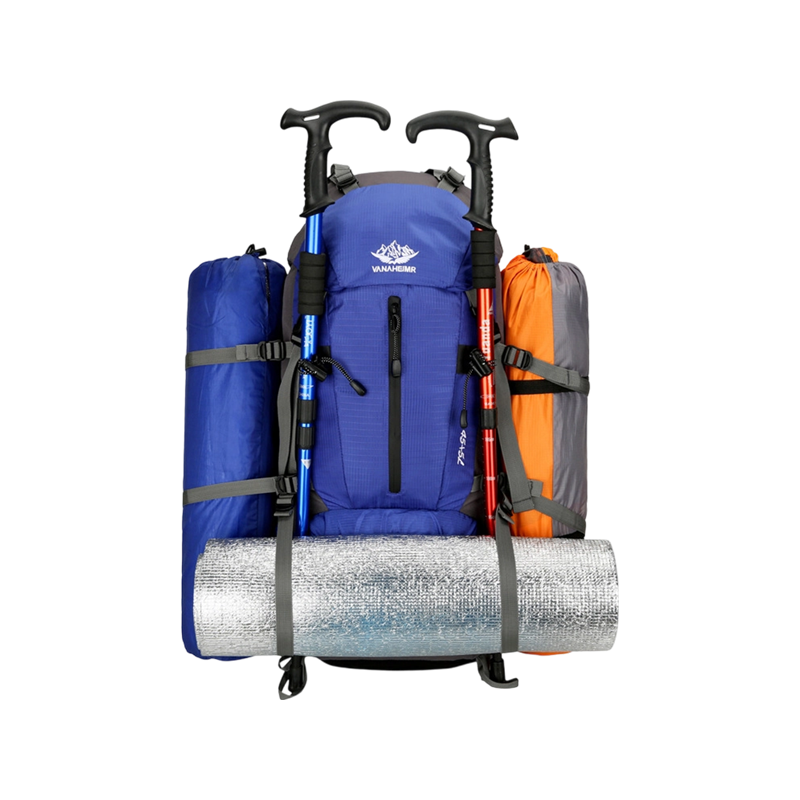
The large main compartment provides the base capacity required for multi-day hikes and camping trips. Rather than limiting the user to short outings, the pack supports extended travel where volume matters. The main compartment can accommodate bulky equipment, while exterior attachment points help manage items that should remain outside the pack, such as damp rain gear, trekking poles, foam pads, rope accessories, or lightweight tools. This flexibility gives the backpack an advantage over simpler competitor models that rely only on one large chamber and offer limited external carrying options.
The side trekking pole securing system is particularly important for mountaineering and long-distance hiking. Trekking poles may be essential on steep ascents, descents, snowfield approaches, river crossings, and unstable ground, but they also need to be stowed safely when hands must be free. Without secure side retention, poles can shift, fall, scratch other gear, or create imbalance. A dedicated system keeps them controlled and accessible. For outdoor users, this small feature can make a large difference in efficiency and safety.
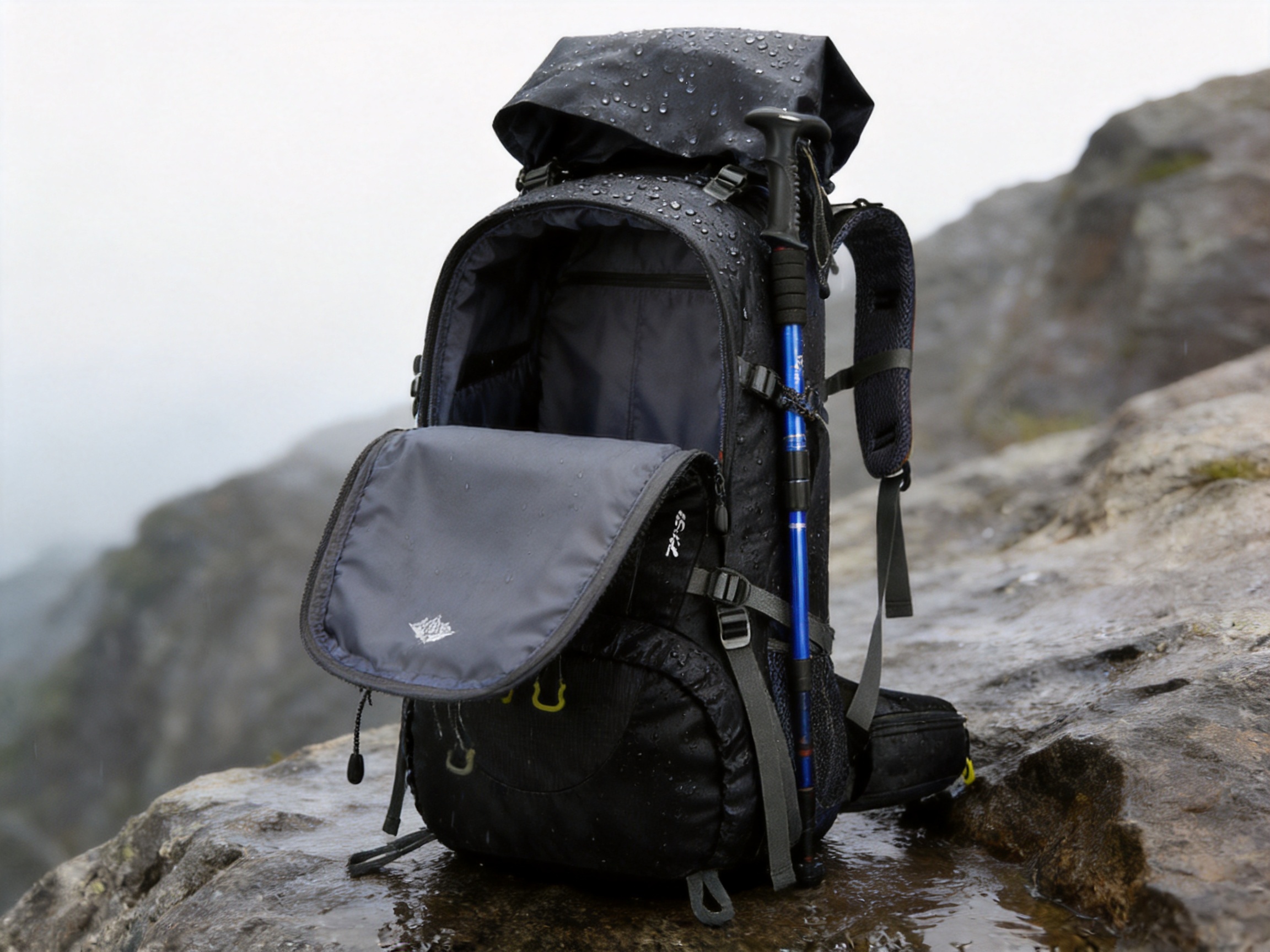
Another practical advantage is the independent rain cover. Water-repellent fabric is valuable, but no backpack fabric should be expected to replace full rain protection during sustained downpours. An integrated or independent rain cover gives the user an additional layer of weather defense when the pack is exposed to heavy rain, wet vegetation, or storm conditions. This is especially useful during long routes where there is no immediate shelter and where dry clothing and sleeping equipment are critical to comfort and safety.
Material System: High-Strength Nylon with Oxford Cloth Lining
The outer layer of the backpack is made of high-strength, water-repellent nylon. Nylon is widely valued in outdoor gear because it offers a strong balance between abrasion resistance, tensile strength, flexibility, and manageable weight. In mountain environments, backpacks are frequently exposed to rock surfaces, tree branches, snow edges, muddy ground, transport handling, and repeated loading cycles. A weak outer fabric may begin to fray, tear, or lose structure quickly. High-strength nylon helps the pack withstand these conditions and supports longer service life.
The water-repellent treatment adds protection against light rain, snow contact, mist, and splashes. While the rain cover provides the most complete defense in harsh weather, the water-repellent nylon outer layer helps reduce water absorption during normal use. This keeps the pack lighter in damp conditions and helps protect internal contents during brief exposure. Compared with lower-grade polyester shells often found in entry-level competitor packs, this nylon-based construction provides a more performance-oriented material foundation.
Inside the pack, durable Oxford cloth serves as the lining. The purpose of the lining is often underestimated, but it plays an essential role in day-to-day durability. Internal items such as cookware, tool handles, tent hardware, food containers, and gear edges can rub against the inside of the pack. A weak lining may fail even when the outer shell remains intact. Oxford cloth improves inner abrasion resistance and provides an additional protective layer. The combination of nylon outside and Oxford cloth inside creates a double-protection material system.
This dual-layer approach is one of the backpack’s clearest advantages over many simplified competitor designs. Some budget backpacks focus only on outer appearance while using thin inner materials that wear quickly under heavy loads. In contrast, this pack is designed with both external and internal stress in mind. The outer fabric faces weather and terrain, while the inner lining faces equipment friction and repeated packing. Together, they support reliability during extended use.
Weather Protection for Uncertain Conditions
Mountain weather is rarely predictable. A morning may begin with clear skies and end with rain, fog, wind, or cold mist. On long routes, a backpack must be prepared for changing conditions without requiring complicated adjustments. This model addresses weather uncertainty through three layers of protection: water-repellent nylon, durable inner lining, and an independent rain cover.
The water-repellent nylon shell helps shed surface moisture and reduces the speed at which water penetrates the outer layer. The Oxford lining provides a second barrier and adds structure. When conditions become extreme, the rain cover can be deployed to cover the backpack more completely. This layered approach is more practical than relying on a single material feature. It recognizes that real outdoor weather is variable and that protection should be redundant rather than minimal.
Competitor backpacks sometimes advertise water resistance but omit a rain cover or provide only limited fabric protection. This can be acceptable for short walks but risky for multi-day outdoor travel. Wet gear can reduce comfort, increase pack weight, damage electronics, and compromise insulation. For campers, a wet sleeping system can turn a routine trip into a serious problem. By including independent rain protection, this backpack offers more confidence for users traveling through wet forests, mountain passes, rainy campsites, and unpredictable shoulder-season conditions.
Weather protection also has business value for distributors and retailers. Customers who buy outdoor gear for serious use expect products to perform when conditions worsen. A backpack that helps protect gear can reduce dissatisfaction, returns, and negative reviews. For buyers sourcing outdoor products for global markets, robust weather-oriented design is not just a feature; it is a competitive positioning point.
Large Capacity Without Losing Functional Control
Large capacity is valuable only when it remains manageable. A pack that simply offers volume but lacks organization can become inefficient and uncomfortable. Users may waste time searching for essential items, overload the wrong areas, or create unstable weight distribution. This mountaineering backpack is built around a large main compartment supported by external systems that improve functional control.
The main compartment is intended for larger items needed during multi-day hikes and camping trips. This may include clothing layers, sleeping equipment, food bags, compact cooking gear, and personal supplies. Because multi-day loads are often dense and irregular, the compartment must be strong enough to handle repeated packing and compression. The durable outer and inner materials support this purpose.
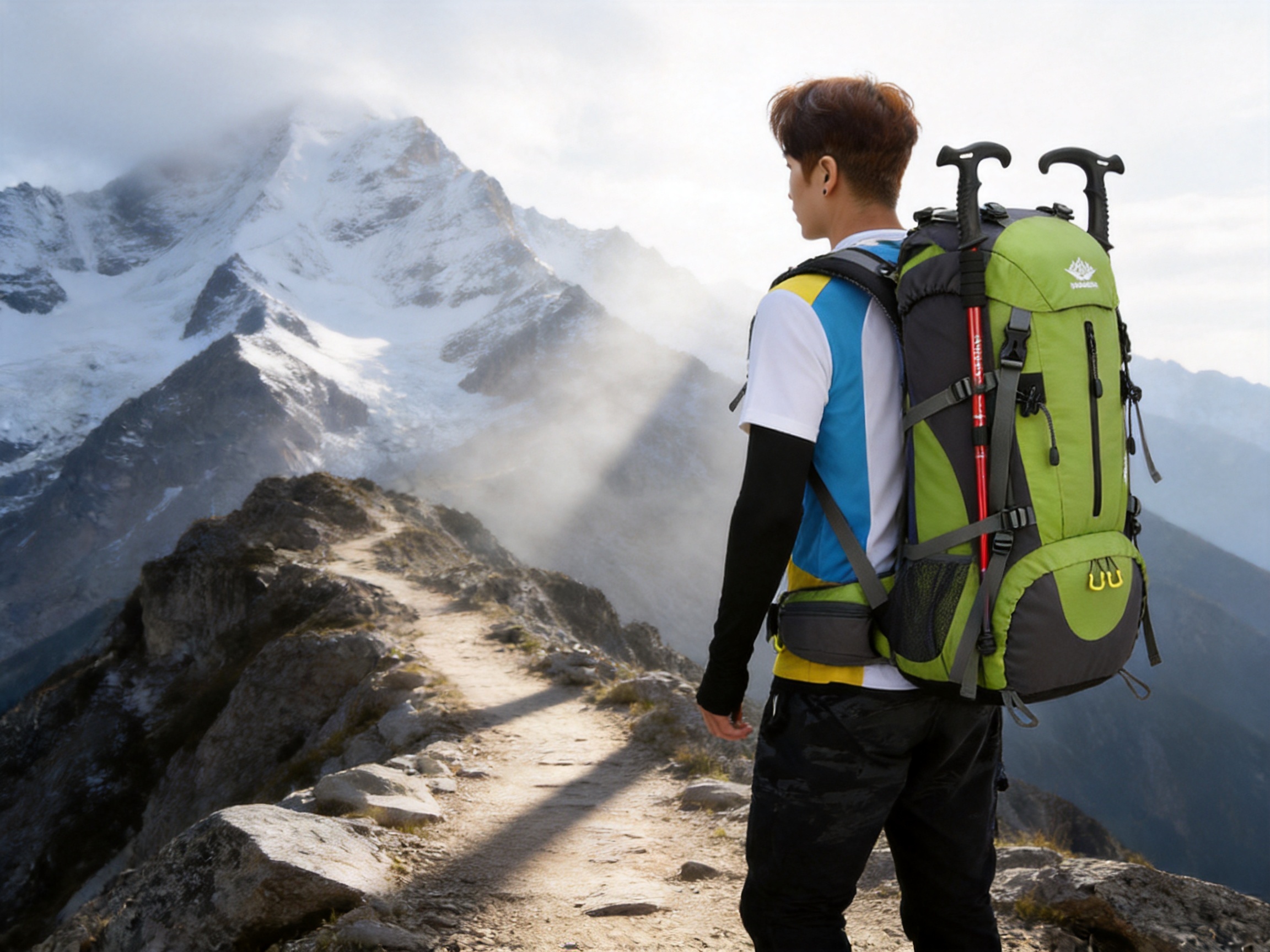
External attachment points expand usability. Outdoor users often carry items that do not fit neatly inside a pack or that should remain outside due to moisture, shape, or accessibility. For example, trekking poles, rain shells, ground mats, light tools, or tent accessories may be attached externally. Abundant attachment points allow users to adapt the pack to different activities and packing styles. This versatility gives the product an advantage over more basic competitor packs with fixed layouts and fewer exterior options.
For mountaineering and camping, flexibility is especially important because no two trips are exactly the same. A summer hiking route, a rainy forest camp, a high-altitude approach, and a long-distance trekking itinerary all require different packing decisions. A multifunctional backpack should support these changes without forcing the user into one rigid organization method. This product’s combination of large internal space and external expandability makes it suitable for varied outdoor scenarios.
Ergonomic Carrying System for Long-Distance Comfort
Comfort is one of the most decisive factors in backpack performance. Even a strong, spacious pack becomes a liability if it causes shoulder pain, poor balance, or rapid fatigue. This model uses an ergonomically designed carrying system to improve load handling during long hours of movement. The purpose of ergonomic design is to help the pack follow the body more naturally, distribute weight more effectively, and reduce unnecessary pressure points.
In outdoor use, a backpack is constantly moving with the user. It shifts during climbs, descents, turns, steps over rocks, and changes in body angle. A poorly designed carrying system can swing, pull backward, or concentrate weight on the shoulders. Over several hours, this may lead to fatigue, soreness, and reduced stability. An ergonomic structure improves the relationship between pack and body, helping users maintain better posture and more controlled movement.
The double-shoulder mountaineering design is important because it allows load distribution across both shoulders and the back. For heavy loads, the shoulder system must be stable and comfortable. While the specific shoulder strap details are not listed in the product data, the overall ergonomic carrying concept indicates that comfort and load management were considered as core requirements. This differentiates the backpack from low-cost large bags that may offer capacity but lack professional carrying design.
For business buyers, ergonomic performance can influence customer satisfaction strongly. Users may forgive minor aesthetic limitations, but they rarely continue using a backpack that hurts during real trips. Comfort becomes a repeat-purchase driver. A backpack that carries well is more likely to be recommended by hikers, guides, campers, and outdoor communities.
Professional Details That Improve Field Efficiency
Small details often determine whether outdoor gear feels professional or ordinary. This backpack includes several practical features that improve field efficiency. The trekking pole securing system allows poles to be carried securely when not in use. The external attachment points allow modular packing. The independent rain cover provides fast weather response. The large main compartment supports multi-day planning. The nylon and Oxford material system supports durability inside and outside.
These features work together rather than standing alone. A backpack with only durable fabric but poor organization still feels incomplete. A backpack with many straps but weak materials may fail under stress. A large pack without weather protection can expose critical gear to moisture. This model combines capacity, durability, protection, and usability into a balanced platform for mountain travel.
The advantage over competitors is not based on a single exaggerated claim. Instead, it comes from practical integration. Many competing products emphasize one visible selling point, such as size or sporty appearance. This backpack emphasizes the combination of field-relevant features. That makes it better suited to users who actually carry gear through difficult environments.
Manufacturing Philosophy Behind the Product
The product is supported by the manufacturing philosophy of CragHaven Outdoor, an outdoor brand and cross-border manufacturing partner based in Hangzhou, China. The company focuses on mountaineering, hiking, and camping scenarios, with the goal of delivering functional, reliable, and long-term value outdoor gear for global markets. Its approach is rooted in the belief that outdoor products should be designed for weather, terrain, and time rather than merely for catalog display.
This philosophy matters because the outdoor industry is full of products that look capable but are not built around actual use. A pack may photograph well, but real performance depends on material choice, stitch consistency, load-bearing construction, and feature placement. CragHaven Outdoor emphasizes that every feature should solve a real-world usage problem. In this backpack, that principle can be seen in the weather protection system, trekking pole attachment, external expansion points, and ergonomic carrying structure.
The company also emphasizes material selection for durability, reliability, and long-term use rather than short-term trends. This is reflected in the use of high-strength nylon and Oxford cloth. Instead of relying only on surface styling, the material system addresses repeated outdoor stress. For global buyers, this approach supports product consistency and practical customer value.
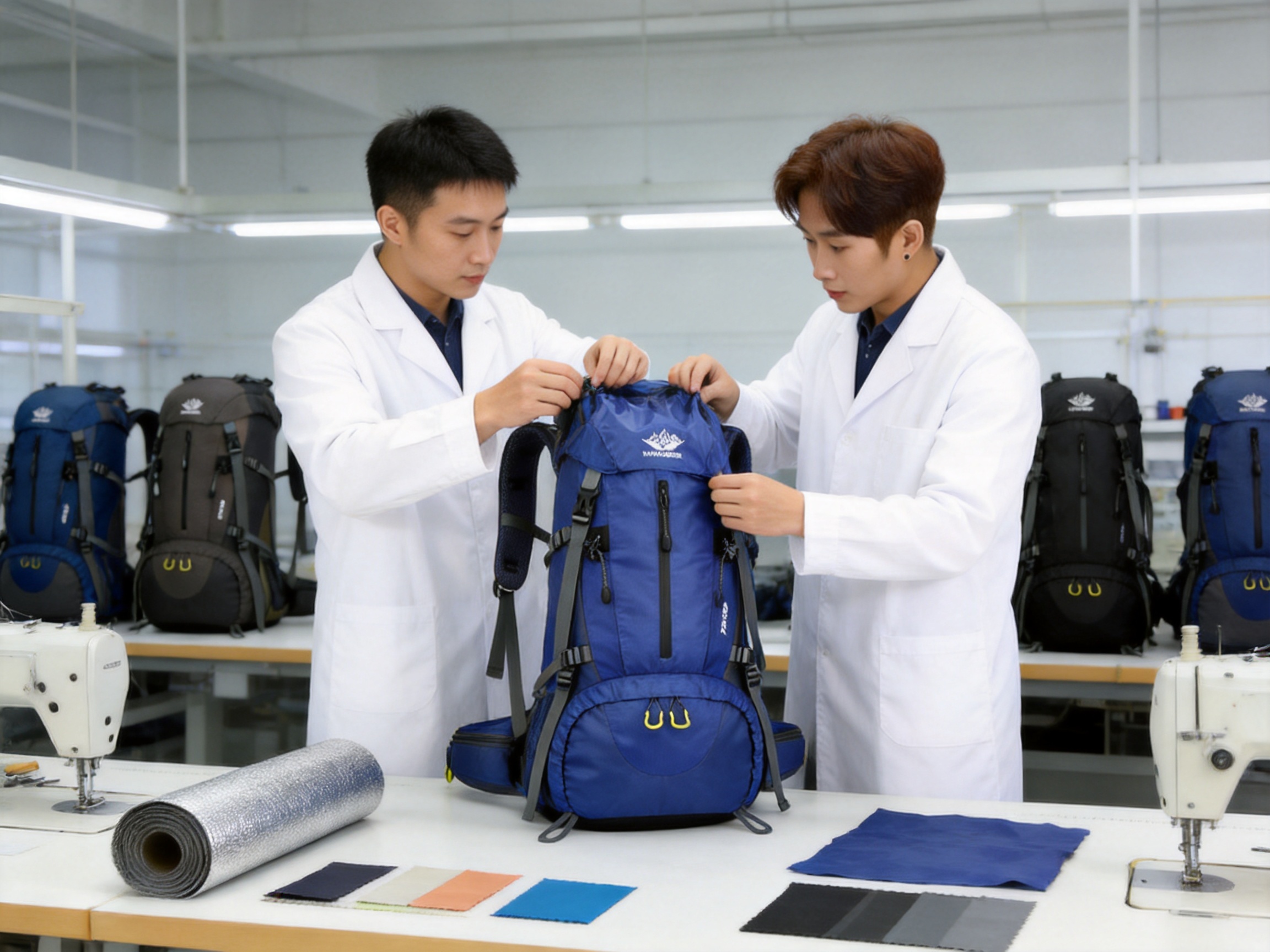
Sampling, testing, and optimization are described as standard processes that cannot be omitted. This is an important manufacturing strength. Outdoor gear often requires refinement after prototypes are produced. Strap placement, compartment proportions, rain cover compatibility, fabric behavior, and comfort characteristics may all require adjustment. A company that builds sampling and optimization into its workflow is better positioned to deliver stable products at scale.
Advanced Production Strengths and Supply Chain Reliability
CragHaven Outdoor aims to reduce uncertainty in the supply chain. This is a significant advantage for international buyers, retailers, importers, and outdoor brands seeking reliable manufacturing partners. Outdoor gear sourcing can be challenging because products must satisfy functional expectations, material requirements, cost targets, packaging needs, and delivery schedules. A supplier that understands both outdoor usage and manufacturing execution can reduce communication gaps and product risk.
The company participates in both design and manufacturing rather than acting only as a factory sourcing channel. This gives it a stronger ability to translate field requirements into production details. For a mountaineering backpack, that translation includes selecting appropriate fabrics, choosing lining materials, ensuring attachment points are practical, planning rain protection, and considering how the carrying system will perform under load. A purely trading-oriented supplier may not provide the same depth of product understanding.
Hangzhou and the broader Chinese manufacturing ecosystem provide mature production infrastructure for textile, bag, and outdoor equipment categories. CragHaven Outdoor uses this manufacturing environment to transform design intent into stable, repeatable, and scalable products. This combination of practical outdoor understanding and efficient manufacturing capability is one of the company’s core strengths.
For global markets, communication style is also important. The company positions itself as Western-market-oriented in its communication. This can help buyers clarify specifications, understand product positioning, refine features, and manage expectations. In cross-border manufacturing, clear communication is not a minor service detail; it is essential for avoiding mistakes in materials, colors, packaging, labeling, and performance requirements.
Comparison with Typical Competitor Backpacks
The following comparison summarizes how this professional mountaineering backpack stands against common competitor models in the same general category. The table is based on the provided product features and typical market differences between professional outdoor packs and basic large-capacity bags.
| Evaluation Area | This Mountaineering Backpack | Typical Basic Competitor Backpack | Practical Advantage |
|---|---|---|---|
| Outer Material | High-strength, water-repellent nylon | Often standard polyester or lower-grade synthetic fabric | Better balance of durability, weather resistance, and mountain suitability |
| Inner Protection | Durable Oxford cloth lining | May use thin lining or simplified internal fabric | Improved resistance to internal abrasion from gear |
| Weather Defense | Water-repellent shell plus independent rain cover | May rely only on surface water resistance | More reliable protection in rain, wet vegetation, and storm conditions |
| Capacity | Large main compartment for multi-day hikes | May offer volume but limited practical organization | Better suited to camping, trekking, and longer routes |
| External Carrying | Abundant external attachment points | Often fewer attachment options | More flexible packing for tools, poles, rain gear, and accessories |
| Trekking Pole Storage | Professional side securing system | May lack dedicated pole retention | Safer, cleaner, and more convenient pole management |
| Carrying Comfort | Ergonomic carrying system | May prioritize size over fit and comfort | Reduced fatigue and improved stability during long movement |
| Manufacturing Support | Backed by design, sampling, testing, and optimization processes | May be sourced mainly for appearance or low price | More consistent product reliability for serious outdoor markets |
The table shows that the product’s competitive edge comes from integration. The backpack does not depend on one feature alone. It combines durable materials, weather readiness, large capacity, modular external storage, pole management, ergonomic support, and professional manufacturing discipline. This combination is what separates a true mountaineering backpack from a generic large sports bag.
Use Scenarios and Target Users
This backpack is suitable for a wide range of outdoor users. Multi-day hikers can use the large main compartment for clothing, food, and shelter equipment. Campers can benefit from the external attachment points for mats, rain gear, and accessories. Mountaineers and alpine approach users can use the trekking pole securing system and weather protection features. Outdoor travelers can use the large capacity and durable construction for rugged travel routes where ordinary luggage is not practical.
The backpack is also suitable for outdoor clubs, retail product lines, e-commerce sellers, expedition equipment distributors, and private-label outdoor programs. Its feature set addresses common customer expectations in global outdoor markets: durability, weather resistance, carrying comfort, and practical organization. Because the product is not limited to a narrow niche, it can serve multiple sales channels and outdoor scenarios.
For beginners moving beyond casual day hiking, the backpack offers a step up in capacity and structure. For experienced users, its value lies in practical details and material reliability. For retailers, it can be positioned as a professional large-capacity pack for mountain hiking and camping. For distributors, it provides a product with clear feature explanations and strong merchandising potential.
How the Backpack Supports Multi-Day Packing
On a multi-day route, packing strategy becomes essential. Heavier items should generally remain close to the back and centered to improve balance. Frequently used items should be placed where they can be reached quickly. Wet or dirty equipment may need to be separated or attached externally. The structure of this backpack supports these practical packing needs.
The main compartment can carry the core load, including clothing, compact sleeping gear, food, and camping essentials. External attachment points allow users to keep bulky or irregular items outside the main storage area when needed. Trekking poles can be secured to the sides when not in use, preventing them from interfering with internal packing. The rain cover can be deployed when conditions change, protecting the overall load without requiring a complete repack.
This adaptability is particularly useful in mountain travel because conditions change throughout the day. A user may begin with poles in hand, later attach them during a scramble, then retrieve them for a descent. Rain gear may be packed externally after use. A wet cover or ground sheet may need separation from dry clothes. The backpack’s feature layout supports these transitions.
Compared with simpler competitors, the product gives users more control over how they organize their equipment. That control saves time, reduces frustration, and improves safety. In outdoor environments, efficiency is not just convenience; it helps users conserve energy and respond more effectively to weather or terrain changes.
Durability as a Long-Term Value Proposition
Durability is one of the strongest value arguments for this backpack. Outdoor users often judge products not by first impressions but by how they perform after repeated trips. A backpack may look attractive when new, but its real quality becomes visible after it has been loaded heavily, dragged through transport, exposed to rain, placed on rough ground, and opened repeatedly in camp.
The high-strength nylon outer layer supports resistance to abrasion and tearing. The Oxford cloth lining helps protect against internal wear. The rain cover helps reduce moisture stress. The external attachment system allows users to manage equipment without forcing everything into the main compartment, which may reduce internal strain. The ergonomic carrying system supports more stable load movement, which can also reduce stress on materials during travel.
For customers, durability means fewer replacements and better trust in the product. For sellers, durability can mean stronger reviews, fewer complaints, and better brand reputation. For manufacturers, durability reflects disciplined material selection and construction decisions. This backpack’s material and feature system is aligned with long-term value rather than disposable consumption.
Why Manufacturing Process Matters in Backpack Quality
Backpack quality is not created by fabric alone. Manufacturing process determines whether good materials become a dependable product. Cutting accuracy, sewing consistency, reinforcement placement, strap assembly, compartment alignment, and inspection all influence final performance. A professional mountaineering backpack must be produced with attention to both visible and hidden details.
CragHaven Outdoor’s stated process includes design involvement, sampling, testing, and optimization. This is important because every backpack design must pass through practical evaluation before stable production. A prototype may reveal that a strap angle needs adjustment, an attachment point needs reinforcement, or a compartment proportion needs improvement. Optimization helps correct these issues before larger production runs.
Advanced manufacturing strength also includes the ability to repeat results. For global buyers, a good sample is not enough if mass production cannot match it. Stable, replicable manufacturing is essential. The company’s use of China’s mature and efficient manufacturing system supports scalable production while maintaining product intent. This is especially valuable for buyers who need consistent inventory and predictable quality.
In competitive sourcing, low price alone is not a complete advantage. If a backpack fails in use, the cost of returns, customer dissatisfaction, and damaged reputation may exceed initial savings. A manufacturing partner that understands outdoor function can help buyers avoid these hidden costs. This product benefits from that function-first approach.
Product Positioning for Global Outdoor Markets
The global outdoor market includes many user segments, from casual weekend hikers to serious expedition planners. This backpack is best positioned for users who need more than a simple travel bag but still want a practical, versatile, and durable mountaineering solution. Its key messages are large capacity, water-repellent nylon construction, Oxford lining, rain cover protection, trekking pole securing, external expansion, and ergonomic comfort.
For e-commerce listings, the product can be presented as a professional large-capacity mountaineering backpack for hiking, camping, trekking, and outdoor sports. For retail stores, it can be displayed as a multi-day backpack with weather protection and functional carrying details. For private-label programs, it can serve as a strong base model that reflects outdoor credibility and manufacturing reliability.
The product’s story is also easy to explain. It is built for real conditions: rain, terrain, time, load, and repeated use. That message aligns with the company’s broader philosophy. Instead of relying on exaggerated claims, the backpack can be marketed through clear functional benefits that users understand immediately.
Care and Maintenance Recommendations
Proper care will help extend the service life of the backpack. After each outdoor trip, users should remove dirt, leaves, sand, and moisture from the pack. If the backpack becomes wet, it should be dried naturally in a ventilated area before storage. Long-term storage in a damp environment should be avoided because moisture can affect fabrics, coatings, and odor control.
Users should avoid unnecessary exposure to sharp objects inside the main compartment. Although the Oxford lining is durable, tools, cookware edges, and metal hardware should be packed carefully. Heavy items should be placed thoughtfully to maintain balance and reduce strain on seams. External attachment points should be used within reasonable limits and should not be overloaded with excessive swinging weight.
The rain cover should be dried after use before being stored. If dirt accumulates on the nylon shell, gentle cleaning with mild water and a soft cloth is preferable to harsh detergents. Proper care supports the backpack’s long-term performance and helps preserve its water-repellent function.
Business Value for Importers, Retailers, and Outdoor Brands
For importers and retailers, the backpack offers a strong mix of product features and supply-side reliability. The feature set is easy to communicate to customers, while the company behind it provides design and manufacturing participation rather than simple sourcing. This combination can reduce product development uncertainty and improve market readiness.
The backpack’s practical benefits support multiple sales arguments. Customers looking for comfort can focus on the ergonomic carrying system. Customers concerned about weather can focus on the water-repellent nylon and rain cover. Customers planning longer trips can focus on the large capacity. Customers carrying trekking poles or external gear can focus on the securing systems and attachment points. This creates broad merchandising flexibility.
CragHaven Outdoor’s background as a cross-border manufacturing partner also matters. The company understands the need for professional communication, stable production, and long-term cooperation. For buyers serving Western markets, this can help align product expectations, quality standards, and market positioning. A good product combined with reliable supplier cooperation is more valuable than either element alone.
Quality Built from Outdoor Understanding
One of the most important ideas behind this backpack is that excellent outdoor products are not built on a pile of parameters alone. Specifications matter, but the deeper value comes from understanding environment, usage patterns, and time. A backpack may list many features, but those features must work together in real conditions. This product reflects that approach through its material system, weather protection, load capacity, pole management, external flexibility, and ergonomic design.
The company’s development philosophy begins with real outdoor usage experience. From initial design concepts to repeated sampling and testing, the goal is to transform practical field needs into stable products. This is a strong foundation for manufacturing because it prevents design from becoming disconnected from use. When a backpack is created for actual mountain scenarios, it is more likely to meet the expectations of serious users.
The result is a product that offers both immediate appeal and long-term value. It looks suitable for mountain use, but more importantly, its construction and feature set support that appearance. It is large enough for multi-day travel, protected enough for uncertain weather, organized enough for varied gear, and supported by manufacturing processes focused on reliability.
Q&A Section
What is the main purpose of this backpack?
The backpack is designed for mountaineering, hiking, camping, trekking, and multi-day outdoor travel. Its large main compartment, external attachment points, trekking pole securing system, rain cover, and ergonomic carrying structure make it suitable for carrying outdoor gear across demanding terrain and changing weather.
What materials are used in the backpack?
The outer layer is made of high-strength, water-repellent nylon, while the inner lining is made of durable Oxford cloth. This combination provides double protection: the nylon shell helps resist outdoor abrasion and moisture, while the Oxford lining helps protect against internal gear friction.
Is the backpack waterproof?
The backpack uses water-repellent nylon and includes an independent rain cover for stronger weather protection. It is designed to resist rain and moisture more effectively than ordinary fabric packs, especially when the rain cover is used. As with most outdoor backpacks, users should still pack sensitive items in waterproof bags for maximum protection during severe or prolonged rain.
How does it compare with ordinary large-capacity backpacks?
Ordinary large-capacity backpacks may provide storage space but often lack professional outdoor details. This model adds a trekking pole securing system, abundant external attachment points, an Oxford cloth lining, a water-repellent nylon shell, a rain cover, and an ergonomic carrying system. These features make it more suitable for mountain and camping use.
Why is the independent rain cover important?
Weather in mountain environments can change quickly. The rain cover provides an additional protective layer during heavy rain, wet forest routes, storm conditions, or exposed trails. It helps protect the pack contents and reduces the risk of wet clothing, sleeping gear, and personal items.
Can the backpack be used for camping?
Yes. The large capacity and external attachment options make it suitable for camping trips. Users can carry clothing, food, shelter equipment, cooking items, and accessories. External points can help manage bulky or damp gear that may not fit conveniently inside the main compartment.
What manufacturing strengths support this product?
The backpack is supported by CragHaven Outdoor’s product development approach, which includes real-use design thinking, material selection for durability, sampling, testing, optimization, and scalable manufacturing. The company participates in both design and manufacturing, helping reduce uncertainty for global buyers.
Who should consider sourcing this backpack?
Importers, retailers, e-commerce sellers, outdoor brands, camping equipment distributors, and private-label buyers can consider this backpack. It offers clear product advantages, practical outdoor features, and supplier support from a manufacturing partner focused on mountaineering, hiking, and camping gear.
Conclusion
The large-capacity nylon professional mountaineering backpack is built for outdoor users who need strength, space, weather protection, and practical field organization. Its high-strength water-repellent nylon shell, Oxford cloth lining, independent rain cover, spacious main compartment, trekking pole securing system, external attachment points, and ergonomic carrying structure create a balanced solution for multi-day mountain and camping use.
Its advantages over competitors are rooted in practical integration rather than superficial styling. It is not merely a large bag; it is a functional carrying system designed for weather, terrain, load, and time. The double-material protection improves durability, the rain cover improves confidence in changing weather, the external systems improve flexibility, and the ergonomic structure improves comfort during long-distance movement.
Behind the product is CragHaven Outdoor’s manufacturing and development strength. Based in Hangzhou, China, the company focuses on real outdoor scenarios, durable material choices, sampling, testing, optimization, and long-term supply chain reliability. For global buyers, this means the backpack is not only a marketable product but also a practical result of function-first design and scalable manufacturing capability.
For hikers, campers, mountaineers, retailers, and outdoor brands seeking dependable gear, this backpack offers a strong combination of performance, value, and professional production support. It is designed not for display alone, but for the trail, the mountain, the campsite, the weather, and repeated use over time.
References
Graydon, D., and Hanson, K. Mountaineering: The Freedom of the Hills. The Mountaineers Books.
Long, S. Hillwalking: The Official Handbook of the Mountain Training Walking Schemes. Mountain Training UK.
Fasulo, D. Self-Rescue: How to Rock Climb Series. Falcon Guides.
O’Bannon, A. Backpacker Magazine’s Complete Guide to Outdoor Gear Maintenance and Repair. Falcon Guides.
National Outdoor Leadership School. NOLS Wilderness Guide. Stackpole Books.
Twight, M., and Martin, J. Extreme Alpinism: Climbing Light, Fast, and High. The Mountaineers Books.
Product: Large-capacity nylon professional mountaineering backpack, multi-functional sports double-shoulder mountaineering backpack


- Phone: +86-15968800379
- E-mail: [email protected]
- Address: Room 1002, Huishang Building, Gongshu District, Hangzhou City, Zhejiang Province.
Copyright © CragHaven Outdoor All Rights Reserved. Outdoor Gear Manufacturers Wholesale Mountaineering Camping Gear Suppliers
