

 English
 Deutsch
 Español
 Français
Large-Capacity Nylon Mountaineering Backpack for Multi-Day Outdoor Use
Content
- 1 Product Overview: A Professional Backpack Built for Real Outdoor Conditions
- 2 Why Large Capacity Matters in Mountaineering and Camping
- 3 Material Advantage: High-Strength Nylon Outer Layer
- 4 Inner Protection: Oxford Cloth Lining for Internal Durability
- 5 Weather Readiness: Independent Rain Cover for Extreme Conditions
- 6 Ergonomic Carrying System: Comfort Under Load
- 7 Trekking Pole Securing System: Practical Trail Adaptability
- 8 External Attachment Points: Expanding Gear Management Options
- 9 Competitive Advantages Over Ordinary Outdoor Backpacks
- 10 Manufacturing Philosophy: Designed for Weather, Terrain, and Time
- 11 Advanced Manufacturing Strengths and Process Control
- 12 Quality-Oriented Material and Construction Decisions
- 13 Practical Use Scenarios
- 14 Feature and Benefit Summary
- 15 Value for Retailers, Distributors, and Private-Label Buyers
- 16 How the Backpack Supports Safer and More Efficient Packing
- 17 Design Balance: Strength, Capacity, Weather Protection, and Comfort
- 18 Durability as Long-Term Value
- 19 Why Scenario-Based Development Matters
- 20 Q&A Section
- 20.1 What type of user is this backpack best suited for?
- 20.2 How does the nylon outer layer benefit outdoor users?
- 20.3 Why is the Oxford cloth lining important?
- 20.4 Does the backpack provide rain protection?
- 20.5 What makes this backpack different from ordinary sports backpacks?
- 20.6 Can trekking poles be attached to the backpack?
- 20.7 Why are external attachment points useful?
- 20.8 How does the ergonomic carrying system improve the experience?
- 20.9 What manufacturing strengths support the product?
- 20.10 Is this backpack suitable for business buyers?
- 21 Conclusion: A Functional Backpack for Serious Outdoor Value
- 22 References
- 23 Product: Large-capacity nylon professional mountaineering backpack, multi-functional sports double-shoulder mountaineering backpack
For serious hikers, mountain travelers, camping enthusiasts, and outdoor professionals, a backpack is more than a storage container. It is a mobile gear system that must remain stable, durable, weather-ready, and comfortable across changing terrain. The Large-Capacity Nylon Professional Mountaineering Backpack is designed around that reality. Built with a high-strength water-repellent nylon outer layer, a durable Oxford cloth inner lining, an independent rain cover, a spacious main compartment, trekking pole securing points, external attachment options, and an ergonomic carrying system, it is intended for demanding outdoor use where ordinary daypacks are not enough.
This article examines the product from practical, manufacturing, and competitive perspectives. It explains how the backpack supports multi-day hikes, mountaineering trips, camping routes, and rugged travel scenarios. It also highlights the strengths of CragHaven Outdoor as a manufacturing partner: material-focused development, repeated sampling, scenario-based optimization, stable production logic, and a supply-chain approach designed for long-term value rather than short-term catalog trends.
Product Overview: A Professional Backpack Built for Real Outdoor Conditions
The Large-Capacity Nylon Professional Mountaineering Backpack is positioned in the mountaineering backpack category, with a design language focused on long-distance load carrying, adaptable gear organization, and resistance to outdoor weather. Unlike casual backpacks or lightweight urban sports bags, this model is built for users who may carry clothing layers, food, hydration supplies, sleeping equipment, camping accessories, rain gear, navigation tools, and trekking poles over several days.
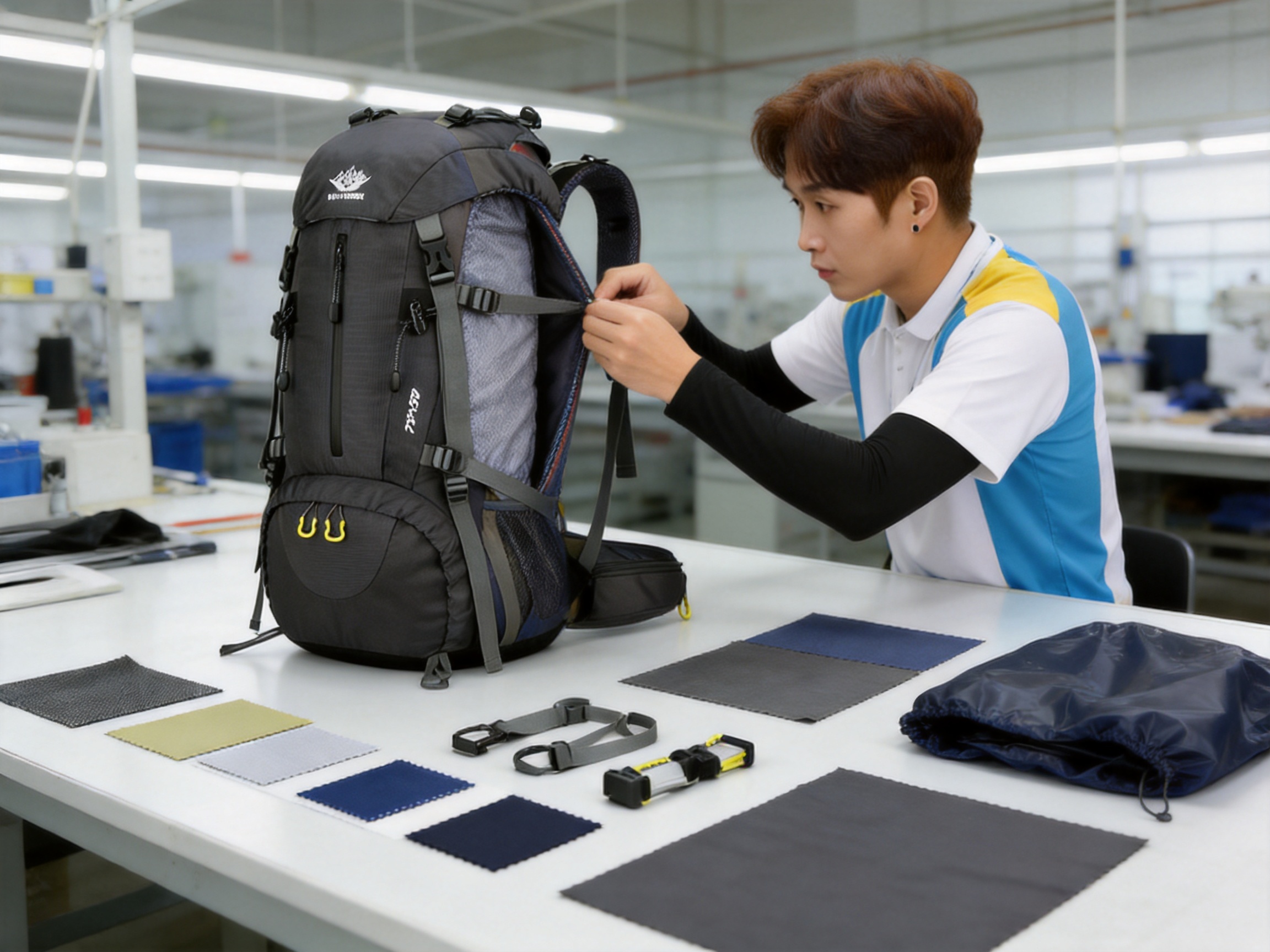
The core material system combines a high-strength nylon shell with an Oxford cloth lining. This dual-layer structure is important because outdoor backpacks face both external and internal stress. Externally, the backpack may rub against rocks, tree branches, vehicle storage compartments, ground surfaces, and rough campsite terrain. Internally, equipment with hard corners, cookware, tools, stakes, or metal accessories may create abrasion from the inside. A backpack that only looks strong from the outside can still fail if the lining is weak. By using a water-repellent nylon exterior and a durable Oxford cloth inner layer, the product offers practical double protection for typical mountaineering and camping loads.
The backpack also includes an independent rain cover, which is a major advantage for unpredictable mountain weather. Water-repellent fabric helps reduce moisture penetration during light rain or wet trail contact, but prolonged rainfall, wind-driven moisture, or storm conditions require a separate weather barrier. The independent rain cover adds an extra level of protection when the environment becomes more severe. This makes the backpack suitable for users who cannot rely on perfect forecasts and need gear protection during changing conditions.
Large-capacity storage is another major feature. Multi-day hiking and mountaineering require more than minimal packing. Even experienced users who travel efficiently still need enough volume for insulation layers, spare socks, gloves, food supplies, cooking equipment, basic safety tools, shelter accessories, and other essentials. The main compartment is designed to support this kind of load planning. A large central compartment also allows users to pack bulkier items more easily, improving flexibility compared with small segmented bags that restrict packing options.
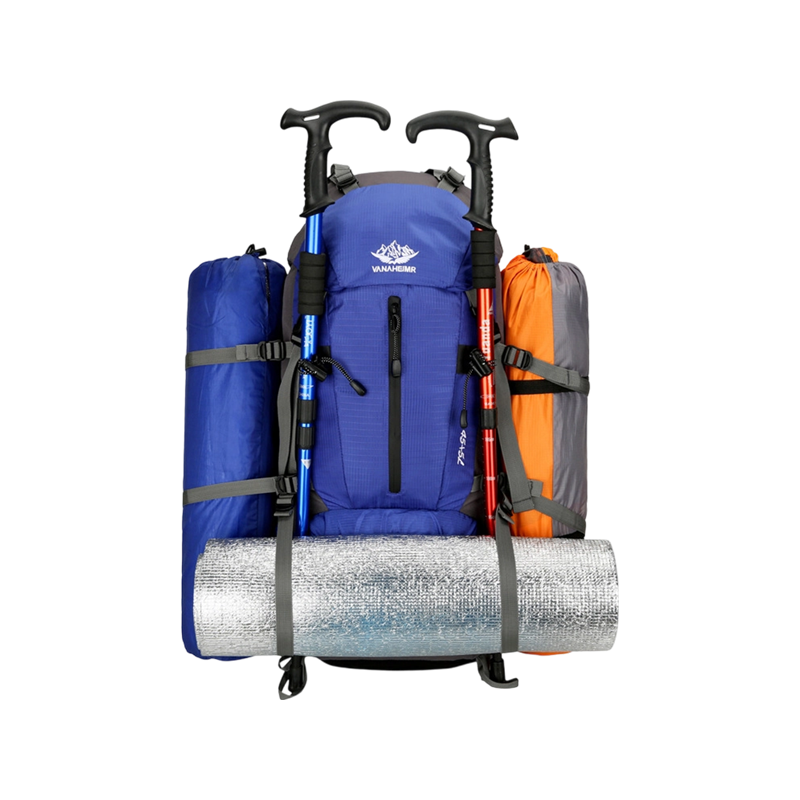
In addition, the backpack includes a professional trekking pole securing system on the sides. This is a practical outdoor feature that directly reflects real trail use. Trekking poles are frequently used on steep ascents, long descents, loose gravel, muddy surfaces, and snow-covered trails. However, users may need to store them when climbing, traveling through brush, entering vehicles, handling camp tasks, or moving through areas where poles are inconvenient. A dedicated securing system keeps poles accessible and stable instead of forcing users to improvise with loose straps or internal storage.
Why Large Capacity Matters in Mountaineering and Camping
Capacity is not simply about carrying more items. In mountaineering and camping, capacity affects safety, comfort, packing efficiency, and adaptability. A backpack that is too small forces users to attach too many items externally, which can create imbalance, snagging, noise, and exposure to rain or dirt. A backpack with more usable internal volume allows critical gear to be packed securely and protected from the environment.
For multi-day hikes, users typically need a combination of soft goods, hard goods, consumables, and emergency items. Soft goods may include thermal layers, base layers, rainwear, hats, gloves, sleeping accessories, or extra clothing. Hard goods may include cooking pots, fuel canisters, repair tools, lighting equipment, and water filtration devices. Consumables include food, snacks, and sometimes large water loads. Emergency items may include a first-aid kit, fire starter, headlamp, compass, rescue blanket, communication device, or compact shelter support. A large main compartment helps organize these categories without forcing critical equipment to be left behind.
Another advantage of capacity is seasonal flexibility. In warm weather, users may pack lighter, but in cold weather or high-altitude conditions, insulation needs increase significantly. A backpack suitable only for summer day hikes may become useless when temperatures drop or route duration increases. The large-capacity design of this mountaineering backpack gives it broader application across different seasons and terrain types.
Capacity also affects group use. In many outdoor teams, one user may need to carry shared equipment such as shelter components, a cooking system, group food, medical supplies, or technical accessories. A professional large backpack allows load sharing to be handled more efficiently. This is especially useful for guides, experienced hikers, expedition organizers, outdoor clubs, and camping groups that require practical equipment distribution.
Compared with many competitor backpacks that focus heavily on appearance, compactness, or fashion styling, this backpack prioritizes functional volume. The design is not limited to light urban travel or single-day use. Instead, it addresses the reality that outdoor users often need a stable platform for substantial loads. This gives the product stronger value for retailers, distributors, and outdoor equipment buyers looking for practical gear rather than seasonal novelty products.
Material Advantage: High-Strength Nylon Outer Layer
The outer layer of a mountaineering backpack must handle repeated abuse. Nylon is widely used in outdoor equipment because it offers a strong balance of strength, flexibility, abrasion resistance, and manageable weight. In this product, the high-strength nylon shell is selected to support outdoor durability while remaining suitable for active use. It is not just a cosmetic surface; it is the first protective layer against weather, impact, friction, and trail wear.
Water repellency is especially important. In the field, backpacks are frequently exposed to dew, light rain, wet grass, snow contact, dripping tent surfaces, muddy ground, and damp transport environments. A water-repellent outer shell helps moisture bead and run off rather than immediately soaking into the fabric. This improves user confidence and reduces the risk of damp contents during routine outdoor exposure.
High-strength nylon also supports structural reliability. A large-capacity backpack must resist tearing at stress points, especially when loaded with heavy gear. Shoulder strap connections, side panels, compression zones, external attachment areas, and base sections often experience concentrated stress. A stronger shell material helps the backpack maintain integrity under dynamic movement, where loads shift with each step, climb, or descent.
Competitor products in the low-cost market may use thinner fabric with a similar visual appearance. At first glance, these bags can look comparable, but differences emerge after repeated use. Thin materials can wrinkle, deform, fray, or tear around high-stress points. Lower-grade fabric may also lose its water-repellent performance faster. By focusing on durable nylon rather than purely appearance-oriented materials, this backpack is positioned for longer service life and more reliable outdoor use.
The choice of material also reflects CragHaven Outdoor’s design philosophy: products should be developed for weather, terrain, and time. This means material selection is not based only on marketing terms or trend-driven specifications. It is based on how the backpack will be dragged, carried, packed, unpacked, compressed, rained on, leaned against rocks, placed on campsite ground, and used repeatedly over long periods.
Inner Protection: Oxford Cloth Lining for Internal Durability
While many customers focus on outer fabric, experienced product developers understand that the lining is equally important. The inner lining of this backpack uses durable Oxford cloth, creating an additional protective layer between packed contents and the outer shell. This structure is valuable because outdoor equipment often causes internal abrasion. Cookware, tools, tent accessories, buckles, poles, and containers may rub against the inside of a bag during movement.
Oxford cloth is known for its woven strength and practical durability. As an inner lining, it helps protect the backpack from hidden wear that may not be visible during early use but can reduce long-term reliability. This is particularly important in large-capacity backpacks because users often pack heavier and more varied equipment than they would in a daypack.
The combination of nylon and Oxford cloth creates a double-protection concept. The outer nylon resists external moisture and abrasion, while the Oxford lining reinforces the internal storage environment. This layered approach gives the backpack a competitive advantage over simpler designs that rely on a single layer of fabric or a weak lining to reduce cost.
From a user perspective, a stronger lining also improves confidence when packing. Users do not want to worry constantly about whether a stove, tool, or hard container will damage the inside of the bag. While careful packing is always recommended, a durable lining makes the backpack more forgiving in real conditions. This is important because outdoor use is rarely perfect. Packing may be done quickly in rain, wind, darkness, or cold temperatures.
For business buyers, the lining choice matters because product returns and customer complaints often result from durability failures after repeated use. A backpack that survives longer in real outdoor scenarios supports better brand reputation, stronger repeat purchases, and reduced after-sales issues. CragHaven Outdoor’s focus on long-term value makes this internal material strategy especially relevant for global markets.
Weather Readiness: Independent Rain Cover for Extreme Conditions
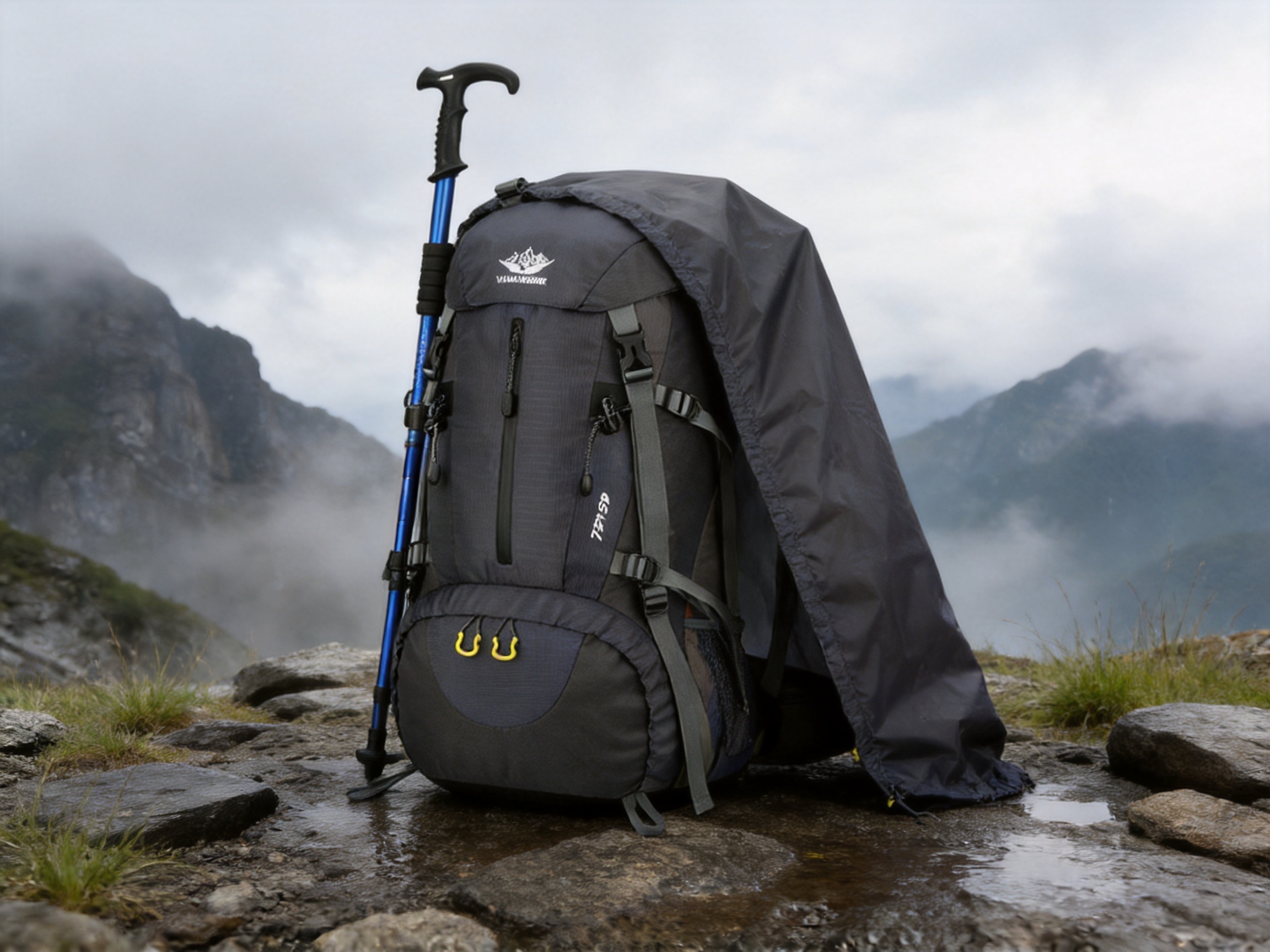
Mountain weather changes quickly. A clear morning can become an afternoon storm. Wind can push rain sideways. Mist can soak fabric over time. Campsites near lakes, rivers, or high elevations often experience heavy condensation. In these conditions, a water-repellent shell is helpful but may not be enough by itself. The independent rain cover included with this backpack gives users an additional defense layer when weather becomes more severe.
A separate rain cover improves protection in several ways. First, it reduces direct water contact with the backpack body. Second, it helps shield zippers, seams, and fabric panels from prolonged rainfall. Third, it protects externally attached items from some moisture exposure, depending on how they are secured. Fourth, it allows users to respond quickly when rain begins without repacking the entire bag.
This is a clear advantage over competitor backpacks that sell rain covers separately or omit them entirely. When a rain cover is not included, users may delay purchasing one or rely on improvised solutions such as plastic bags, ponchos, or pack liners. These methods can help, but they may not fit securely and may become inconvenient during movement. An integrated or dedicated independent cover is more practical for actual field use.
The rain cover also increases the backpack’s suitability for multi-day routes. During a short hike, users can sometimes wait out a storm or return quickly. During a longer journey, they may have no choice but to continue through bad weather. A professional backpack must support those decisions by protecting essential gear. Dry clothing, insulation, food, and sleeping items can affect comfort and safety. Keeping gear dry is therefore not a luxury feature; it is a functional requirement.
From a manufacturing standpoint, including a rain cover demonstrates that the product is designed as a complete outdoor system rather than a basic shell with straps. It reflects scenario-based thinking: the backpack is expected to encounter rain, and the solution is provided as part of the product. This aligns with CragHaven Outdoor’s principle that every feature should solve real-world usage problems.
Ergonomic Carrying System: Comfort Under Load
A large-capacity backpack must do more than hold equipment. It must carry weight in a way that supports the body during long movement. Poor load distribution can create shoulder pain, neck tension, lower back fatigue, unstable balance, and inefficient walking. The ergonomic carrying system of this backpack is therefore a central performance feature.
An effective carrying system typically works by distributing weight across the shoulders, back, and hips while keeping the load close enough to the body to maintain control. Although users should always pack properly, the backpack structure can make a major difference. A well-designed back panel, shoulder strap shape, adjustment system, and stabilizing structure help reduce pressure points and improve movement efficiency.
Ergonomics are especially important when terrain changes. On flat ground, a poorly balanced backpack may feel merely uncomfortable. On steep trails, rocky paths, muddy slopes, or narrow ridges, poor balance can become a safety issue. A backpack that shifts excessively or pulls backward can affect footing. A stable carrying system helps users maintain better posture and confidence.
Compared with many competitor bags that emphasize maximum volume without sufficient support, this product approaches capacity and comfort as a combined system. Large storage is only useful if the user can carry it. A backpack that holds a lot but becomes painful after one hour is not truly functional. The ergonomic design helps turn capacity into practical field performance.
For distributors and outdoor retailers, comfort-focused design is important because customers often judge backpacks after real use, not just in-store inspection. If a bag looks large and strong but causes discomfort, repeat purchase potential declines. CragHaven Outdoor’s attention to real-world use patterns supports products that satisfy users beyond the initial purchase moment.
Trekking Pole Securing System: Practical Trail Adaptability
Trekking poles are essential tools for many hikers and mountaineers. They reduce knee strain during descents, improve stability on uneven ground, help test terrain, and support rhythm during long-distance walking. However, there are times when poles need to be stored quickly. Climbers may need hands free. Travelers may enter crowded transport. Campers may need to handle equipment. Trail sections may require scrambling or gripping rocks. In these moments, a reliable pole securing system becomes valuable.
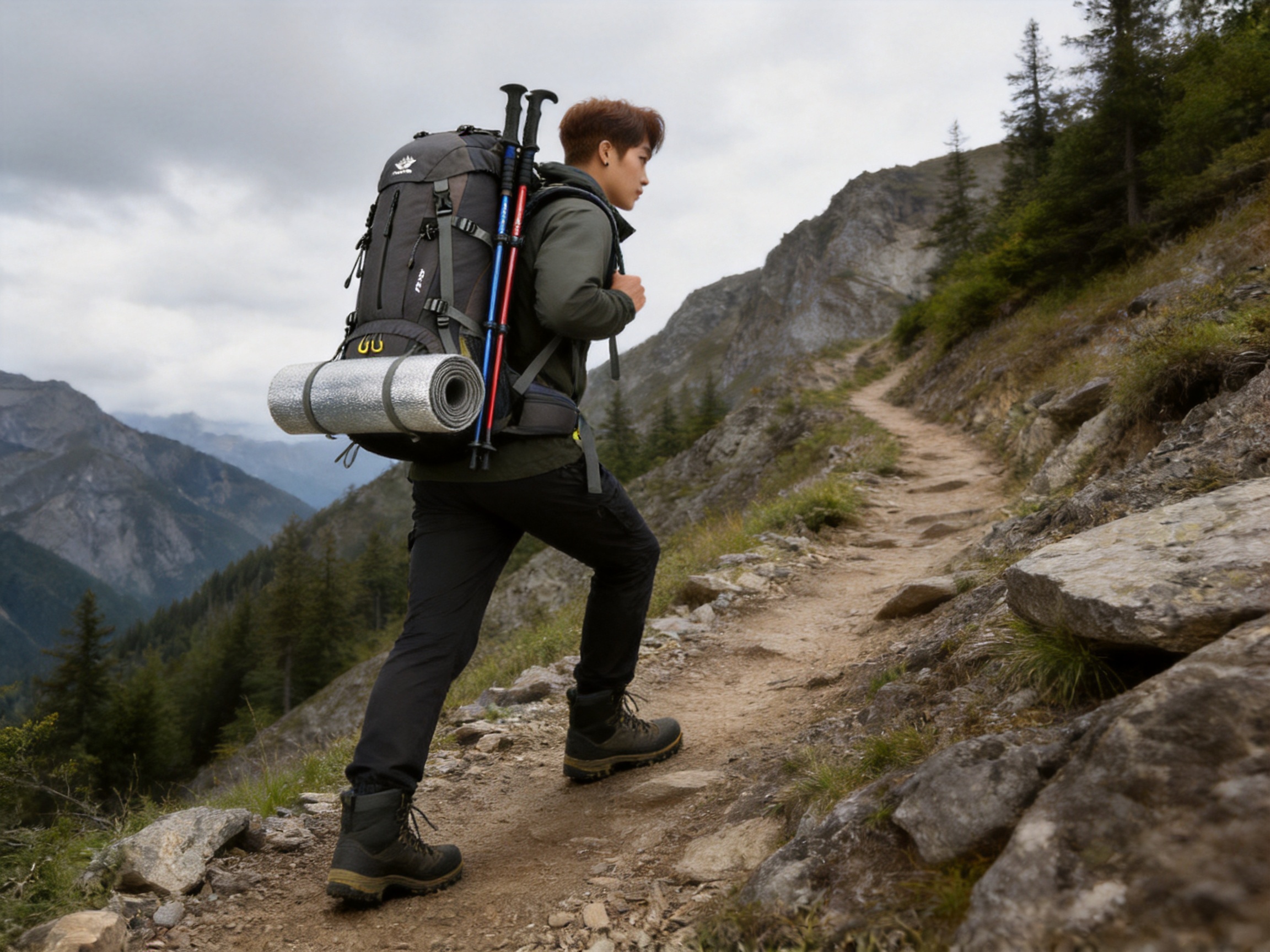
This backpack includes professional trekking pole securing points on the sides. Side storage is practical because it keeps poles accessible without occupying the main compartment. It also prevents dirty or wet poles from contacting clothing, sleeping gear, or food inside the bag. Properly secured poles are less likely to swing, fall, or snag compared with improvised attachment methods.
External pole storage also supports better packing organization. Users can reserve internal space for items that must remain dry and protected, while rugged tools remain outside. This is part of a larger outdoor design principle: not every item belongs in the main compartment. A professional backpack should provide multiple ways to manage different gear categories.
Many lower-end backpacks provide generic side pockets or straps but do not secure poles effectively. Poles may slide, bounce, or interfere with walking. A dedicated securing approach improves reliability and reflects attention to real trail behavior. This detail gives the product an advantage for experienced users who evaluate backpacks based on field practicality rather than only volume or appearance.
External Attachment Points: Expanding Gear Management Options
Outdoor trips often require equipment that is bulky, wet, dirty, or frequently used. External attachment points help users manage these items without compromising the organization of the main compartment. This backpack includes abundant external attachment options, allowing users to secure gear such as sleeping pads, lightweight tools, jackets, water bottles, helmets, rope accessories, camp items, or other suitable outdoor equipment depending on the route and packing style.
External attachment points add flexibility. For example, a user may want to keep a rain jacket accessible during unstable weather, attach a foam sleeping pad outside the pack, separate muddy gear from clean clothing, or secure items that do not fit easily inside the main compartment. The ability to customize load placement is especially useful on multi-day trips where packing needs change over time.
However, external storage must be balanced carefully. Too many loose items can create instability. A good backpack provides attachment points that allow gear to be secured closely and firmly. This helps maintain a stable load profile. The design of this backpack supports versatile attachment while maintaining a professional mountaineering function.
Competitor products sometimes limit external gear management to decorative loops or minimal straps that do not perform well under load. Others overload the exterior with unnecessary details that add complexity without practical value. This backpack aims for useful external attachment capacity, making it suitable for users who need adaptable storage rather than purely visual outdoor styling.
From a product development standpoint, attachment points are not minor details. They influence how people interact with the backpack throughout a journey. A well-placed strap or loop can save time, reduce frustration, and improve trail efficiency. CragHaven Outdoor’s usage-based development approach supports this kind of practical feature planning.
Competitive Advantages Over Ordinary Outdoor Backpacks
The outdoor backpack market includes a wide range of products, from low-cost casual bags to technical expedition packs. Many products look similar in online listings, but performance differences become clear in actual use. The Large-Capacity Nylon Professional Mountaineering Backpack stands out because it combines durable materials, weather protection, large storage, pole management, external attachment capacity, and ergonomic support in one integrated product.
One major advantage is the dual-material protection system. Some competitor backpacks use a single outer fabric and minimal lining. Others rely on visually rugged patterns without strong internal reinforcement. This backpack’s nylon outer shell and Oxford cloth lining create stronger protection from both outside and inside. For users carrying mixed outdoor equipment, this matters greatly.
Another advantage is the included independent rain cover. In many competitor products, rain protection is treated as optional. That can reduce the advertised price but shifts the burden to the user. Including the rain cover makes the backpack more complete and more suitable for unpredictable conditions. It also adds value for retail customers who appreciate ready-to-use outdoor equipment.
The large main compartment is also a competitive strength. Some backpacks divide storage into too many small zones, which can reduce usable volume for bulky gear. Others provide large volume but poor structure. This model balances generous main storage with external organization and carrying support, making it practical for multi-day packing.
The trekking pole securing system gives the product an advantage among users who actively hike or climb rather than simply commute with an outdoor-style bag. This feature targets real mountain behavior and helps differentiate the backpack from generic sports backpacks.
Ergonomics further strengthen the product’s position. Large capacity alone is not enough. If a competitor backpack lacks a supportive carrying system, users may experience discomfort during longer trips. The ergonomic design of this backpack supports extended movement and helps users manage heavier loads more effectively.
The final competitive advantage comes from CragHaven Outdoor’s development and manufacturing philosophy. The company does not treat products as catalog items assembled only for visual appeal. It emphasizes weather, terrain, time, material durability, sampling, testing, and optimization. This approach supports stable quality and makes the backpack more attractive to business buyers seeking dependable supply rather than inconsistent one-time sourcing.
Manufacturing Philosophy: Designed for Weather, Terrain, and Time
CragHaven Outdoor is based in Hangzhou, China, and focuses on mountaineering, hiking, and camping scenarios. Its development philosophy is built around a practical statement: products should not be designed for catalogs, but for weather, terrain, and time. This philosophy is important because outdoor gear must perform after the first impression has passed. A backpack must survive repeated packing, lifting, carrying, rain exposure, trail abrasion, compression, storage, and transport.
Designing for weather means considering moisture, rain, humidity, condensation, temperature changes, mud, and wind-driven exposure. In this backpack, that thinking is visible in the water-repellent nylon outer layer and independent rain cover. These features are not decorative; they directly respond to environmental uncertainty.
Designing for terrain means understanding abrasion, load movement, balance, external gear contact, and the need for trekking pole management. Mountain trails create constant friction between user, equipment, and environment. The backpack’s durable shell, Oxford lining, external attachment points, and pole securing system reflect this terrain-aware logic.
Designing for time means prioritizing durability and long-term use. Many outdoor products perform acceptably during early use but degrade quickly after repeated trips. CragHaven Outdoor emphasizes materials and construction decisions that support long-term value. Sampling, testing, and optimization are treated as standard processes rather than optional steps.
This philosophy is particularly valuable for global buyers. In cross-border manufacturing, one of the main risks is inconsistency between product concept, sample quality, and mass production output. A manufacturer with scenario-based development knowledge can reduce misunderstanding and improve the chance that the final product performs as intended. CragHaven Outdoor positions itself not merely as a factory source but as a partner that understands outdoor usage.
Advanced Manufacturing Strengths and Process Control
Advanced manufacturing in outdoor gear is not only about machines. It is about connecting design intent, material selection, sampling, quality control, production repeatability, and real-world function. CragHaven Outdoor’s strength lies in combining China’s mature manufacturing system with outdoor product understanding. This allows the company to transform design ideas into stable, replicable, and scalable products.
The process begins with scenario analysis. Instead of designing a backpack only around a target size or a visual trend, the company considers how the product will be used. Will it carry multi-day loads? Will it face rain? Will users attach trekking poles? Will the interior experience abrasion? Will the carrying system remain comfortable during long movement? These questions guide early decisions.
Material selection follows. The high-strength water-repellent nylon outer layer and Oxford cloth lining are selected because they address specific performance needs. CragHaven Outdoor’s principle is to choose materials for durability, reliability, and long-term use rather than short-term trends. This reduces the risk of products that look attractive but fail under outdoor stress.
Sampling is another key process. A sample is not only a sales model; it is a test object. Through sampling, developers can evaluate structure, capacity, attachment placement, carrying comfort, stitching performance, lining compatibility, rain cover integration, and overall usability. Problems identified in sampling can be corrected before larger production begins.
Testing and optimization are also essential. Outdoor products require repeated refinement because small details can affect user experience. Strap position, pocket access, attachment tension, fabric behavior, and load balance may all require adjustment. CragHaven Outdoor treats testing and optimization as standard processes that cannot be omitted. This approach improves product maturity and reduces risk for customers.
Production repeatability is critical for business buyers. A strong sample is not enough if mass production varies significantly. By working within China’s mature and efficient manufacturing ecosystem, CragHaven Outdoor can support scalable production while maintaining attention to functional requirements. This matters for importers, private-label brands, wholesalers, and retailers who need stable batches and predictable quality.
Quality-Oriented Material and Construction Decisions
Material quality and construction quality must work together. Strong fabric can fail if stitching is weak, and good stitching cannot compensate for unsuitable materials. In a large-capacity mountaineering backpack, stress points require special attention because the user may carry heavy gear over long distances. Shoulder strap connections, side attachment zones, bottom panels, and compression areas must be designed with load behavior in mind.
The product’s combination of nylon and Oxford cloth supports both external and internal durability. Water repellency improves protection during wet conditions, while the rain cover extends weather resistance during heavy exposure. External attachment points provide flexibility, while the ergonomic system supports load comfort. These features must be integrated carefully so that one function does not weaken another.
For example, external attachment points should be positioned where they can support gear without tearing fabric or disturbing balance. Trekking pole securing systems must hold poles securely without interfering with walking motion. The rain cover must be accessible enough to use quickly. The large main compartment must provide practical storage without creating an unstable shape. The carrying system must support load transfer without excessive pressure.
These details show why manufacturing experience matters. A backpack is a system of interacting parts. A small change in strap angle, fabric thickness, seam placement, or panel shape can affect performance. CragHaven Outdoor’s emphasis on repeated sampling and optimization helps ensure that these interactions are addressed before production scale-up.
Practical Use Scenarios
This backpack is suitable for a wide range of outdoor scenarios, especially those involving extended carrying and variable conditions. In multi-day hiking, it provides space for clothing, shelter accessories, food, water systems, rain protection, and safety equipment. The rain cover helps protect the load during changing weather, while the ergonomic system supports longer movement.
In mountaineering approaches, users can benefit from the trekking pole securing system and external attachment points. Poles can be stored when hands are needed, and external gear can be arranged according to route demands. The durable outer shell helps resist contact with rough terrain, while the inner lining protects against equipment abrasion.
For camping trips, the large main compartment is useful for bulkier items. Campers often carry sleeping accessories, cooking equipment, extra layers, and personal items. External attachment points can help manage items that are too large, wet, or frequently accessed. The water-repellent shell and rain cover provide confidence when the backpack is placed near tents, under trees, or on damp ground.
For outdoor travel and overland movement, the backpack offers flexible packing and durable construction. Users who travel through mixed environments, such as buses, trailheads, campsites, hostels, and mountain villages, need gear that can handle both transport abuse and outdoor exposure. A strong nylon shell and Oxford lining support this type of use.
For outdoor clubs, training groups, and guided trips, the backpack can serve as reliable group equipment. Its feature set addresses common needs without excessive complexity. Large capacity, weather protection, external attachment options, and carrying comfort make it practical for users with different skill levels.
Feature and Benefit Summary
| Product Feature | Practical Benefit | Competitive Advantage |
|---|---|---|
| High-strength water-repellent nylon outer layer | Helps resist abrasion, light moisture, and outdoor wear | Stronger long-term value than thin fashion-oriented fabrics |
| Durable Oxford cloth inner lining | Protects the interior from gear abrasion and repeated packing stress | Improves durability compared with single-layer or weak-lined backpacks |
| Independent rain cover | Adds protection during heavy rain and unpredictable weather | More complete than competitor models that require separate purchase |
| Large main compartment | Supports multi-day hiking, camping loads, clothing, food, and equipment | More useful for serious outdoor trips than compact casual packs |
| Trekking pole securing system | Keeps poles accessible and stable when not in use | Targets real trail behavior better than generic side straps |
| External attachment points | Allows flexible storage for bulky, wet, or frequently used gear | Improves adaptability for different routes and seasons |
| Ergonomic carrying system | Improves comfort and load control over long distances | Balances capacity with practical carrying performance |
| Scenario-based manufacturing development | Connects design, materials, sampling, testing, and production | Reduces sourcing uncertainty for global buyers |
Value for Retailers, Distributors, and Private-Label Buyers
For business buyers, the value of a backpack is measured not only by unit cost but also by customer satisfaction, repeatability, market positioning, and after-sales risk. A low-cost backpack that creates frequent complaints can become expensive in the long run. A reliable product with clear functional advantages can support stronger brand trust and better market performance.
This Large-Capacity Nylon Professional Mountaineering Backpack offers a strong selling proposition because its features are easy to explain and directly relevant to users. Retail staff, online product pages, distributors, and brand owners can communicate the benefits clearly: durable nylon exterior, Oxford cloth lining, independent rain cover, large capacity, trekking pole securing system, external attachment points, and ergonomic carrying support.
The product also fits multiple market segments. It can appeal to hikers planning multi-day trips, campers needing practical storage, outdoor travelers seeking a rugged bag, and mountaineering users who require pole management and weather readiness. This broad relevance helps buyers reduce inventory complexity because one product can serve several outdoor scenarios.
CragHaven Outdoor’s manufacturing role adds further value. The company understands outdoor products and participates in design and manufacturing rather than only factory sourcing. It communicates in a professional, Western-market-oriented way, which is important for cross-border cooperation. Clear communication reduces errors, improves expectations, and supports efficient project development.
Long-term partnership is another advantage. CragHaven Outdoor prioritizes stable and sustainable relationships. This matters because outdoor product lines often require seasonal planning, repeat orders, packaging adjustments, quality consistency, and possible feature refinements. A supplier focused on long-term cooperation can help buyers develop stronger product programs rather than constantly restarting with new factories.
How the Backpack Supports Safer and More Efficient Packing
Effective packing is a key part of outdoor safety. A backpack with a large main compartment and external attachment points allows users to separate gear by weight, access frequency, and weather sensitivity. Heavy items can be placed closer to the back to improve balance. Soft items can fill gaps. Rain-sensitive items can remain protected inside, while wet or rugged items can be attached outside when appropriate.
The Oxford cloth lining helps protect the inside when mixed equipment is packed. The nylon outer shell helps defend against external abrasion. The rain cover can be deployed when conditions worsen. Trekking poles can be secured externally when not in use. These features work together to support better organization and quicker transitions on the trail.
For example, when approaching a steep section where poles are no longer useful, the user can secure them on the sides and keep hands free. When rain begins, the rain cover can be used without unpacking. When arriving at camp, external attachment points can help separate wet gear from dry contents. These small efficiencies matter during long trips because they reduce fatigue and decision pressure.
In comparison, a basic backpack may force users to make compromises: poles carried by hand, wet jackets stuffed inside, rain cover purchased separately, hard equipment rubbing against weak lining, or heavy loads carried with poor support. The professional design of this backpack reduces those compromises and improves overall outdoor workflow.
Design Balance: Strength, Capacity, Weather Protection, and Comfort
The best outdoor backpack is not the one with the most features on paper. It is the one that balances the right features for actual use. Too much structure can add unnecessary weight. Too little structure can reduce comfort. Too many pockets can limit bulk storage. Too few attachment points can reduce flexibility. Excessively technical features may confuse casual users, while overly simple designs may fail experienced users.
This backpack achieves balance by focusing on core mountaineering and camping needs. Its large compartment provides storage flexibility. Its material system supports durability. Its rain cover improves weather protection. Its trekking pole system addresses trail equipment management. Its external attachment points support adaptable packing. Its ergonomic system helps carry the load.
This balance is also commercially valuable. Products that are too specialized may appeal only to a narrow segment. Products that are too generic may lack differentiation. This backpack sits in a practical middle ground: professional enough for serious outdoor use, but understandable enough for broad market acceptance.
CragHaven Outdoor’s design philosophy supports this balance. By starting from usage scenarios rather than catalog appearance, the company can prioritize features that matter. The goal is not to overload the backpack with unnecessary claims, but to make each included feature solve a practical problem.
Durability as Long-Term Value
Durability is one of the most important measures of outdoor gear quality. A backpack may be carried for hundreds of kilometers, exposed to rain, compressed during transport, placed on rough ground, and loaded repeatedly with heavy equipment. If it fails during a trip, the consequences can be inconvenient or even serious. Long-term durability therefore creates both user value and business value.
The nylon exterior contributes to durability by resisting external wear. The Oxford cloth lining contributes by protecting against internal abrasion. The rain cover reduces weather-related stress. The ergonomic system helps stabilize the load, which may also reduce unnecessary strain on certain parts of the backpack. External attachment points provide proper gear placement, reducing the need for improvised methods that may damage fabric or straps.
Durability also supports sustainability in a practical sense. A backpack that lasts longer reduces the need for frequent replacement. This aligns with the idea of long-term value rather than short-term trends. CragHaven Outdoor’s product development approach reflects this by focusing on reliable materials and testing rather than purely visual novelty.
For global buyers, durable products can improve customer reviews, reduce return rates, and strengthen brand credibility. In outdoor markets, trust is built through repeated successful use. Customers remember gear that performs during difficult trips. They also remember gear that fails. A durable backpack helps businesses build the right kind of reputation.
Why Scenario-Based Development Matters
Scenario-based development means designing from actual use conditions rather than from isolated specifications. A specification sheet can list capacity, material, color, and size, but it does not automatically guarantee field performance. Outdoor gear must be understood through scenarios: packing before dawn, walking in rain, climbing steep ground, storing poles, accessing gear at camp, carrying loads when tired, and protecting equipment during unexpected weather.
This backpack reflects scenario-based development in multiple ways. The rain cover responds to sudden storms. The large compartment responds to multi-day load needs. The trekking pole securing system responds to changing trail sections. The external attachment points respond to varied gear types. The ergonomic carrying system responds to long-distance fatigue. The material pairing responds to external and internal abrasion.
CragHaven Outdoor’s company philosophy emphasizes that excellent outdoor products are not built on a pile of parameters but on deep understanding of environment, usage patterns, and the test of time. This perspective is important for buyers who want products that perform beyond marketing images. It also supports better product differentiation because features are connected to real user problems.
Q&A Section
What type of user is this backpack best suited for?
This backpack is best suited for hikers, campers, mountaineering users, outdoor travelers, and group activity participants who need large-capacity storage, durable materials, weather readiness, and comfortable load carrying. It is especially useful for multi-day trips and routes where trekking poles, external attachments, and rain protection are important.
How does the nylon outer layer benefit outdoor users?
The high-strength nylon outer layer helps resist abrasion, outdoor friction, and routine trail wear. Its water-repellent property helps reduce moisture absorption during light rain, wet vegetation contact, and damp conditions. This makes it more suitable for mountain and camping environments than ordinary casual backpack fabrics.
Why is the Oxford cloth lining important?
The Oxford cloth lining adds internal durability. Outdoor users often carry hard or rough equipment such as cookware, tools, poles, containers, and camp accessories. A stronger lining helps protect the inside of the backpack from abrasion caused by repeated packing and movement.
Does the backpack provide rain protection?
Yes. The backpack uses a water-repellent nylon outer layer and includes an independent rain cover. The outer material helps during light moisture exposure, while the rain cover adds protection during heavier or prolonged rain.
What makes this backpack different from ordinary sports backpacks?
Ordinary sports backpacks often focus on light use, appearance, or short trips. This backpack is designed for professional outdoor scenarios with large-capacity storage, double material protection, rain cover support, trekking pole securing points, external attachment options, and an ergonomic carrying system.
Can trekking poles be attached to the backpack?
Yes. The backpack includes a professional trekking pole securing system on the sides. This allows users to store poles when they need their hands free or when poles are not required for a section of the route.
Why are external attachment points useful?
External attachment points allow users to carry bulky, wet, dirty, or frequently used items outside the main compartment. This improves packing flexibility and helps users adapt to different terrain, weather, and trip duration.
How does the ergonomic carrying system improve the experience?
The ergonomic carrying system helps distribute weight more comfortably and supports better load stability during long movement. This is especially important when carrying heavy gear over uneven mountain terrain.
What manufacturing strengths support the product?
CragHaven Outdoor supports the product through scenario-based design, durable material selection, sampling, testing, optimization, and scalable manufacturing within China’s mature production system. The company focuses on long-term reliability and stable supply rather than short-term catalog trends.
Is this backpack suitable for business buyers?
Yes. Retailers, distributors, private-label brands, and outdoor equipment buyers can benefit from the backpack’s clear feature set, broad outdoor application, durable construction concept, and the manufacturer’s focus on communication, repeatability, and long-term partnership.
Conclusion: A Functional Backpack for Serious Outdoor Value
The Large-Capacity Nylon Professional Mountaineering Backpack is designed for users who need dependable performance in real outdoor environments. Its high-strength water-repellent nylon outer layer, durable Oxford cloth lining, independent rain cover, spacious main compartment, trekking pole securing system, abundant external attachment points, and ergonomic carrying system create a well-rounded product for mountaineering, hiking, camping, and rugged travel.
Its advantages over many competitor products come from practical integration. It does not rely on appearance alone. It offers double material protection, built-in weather readiness, real trail equipment management, adaptable external storage, and load-carrying comfort. These features respond directly to the challenges outdoor users face during multi-day movement and variable conditions.
The product also reflects the manufacturing strengths of CragHaven Outdoor. The company’s approach is based on weather, terrain, and time; material durability; sampling; testing; optimization; and long-term supply-chain stability. For global buyers, this reduces uncertainty and supports more reliable product development. For end users, it means a backpack built with practical outdoor experience in mind.
In a market filled with backpacks that may look similar online, real value comes from the details that survive repeated use. This model offers those details in a balanced, functional, and commercially meaningful way. It is a strong choice for buyers seeking a professional mountaineering backpack that supports serious outdoor activity while delivering durable long-term value.
References
Ryan, L. Outdoor Gear Design Principles: Materials, Load Systems, and Field Durability. Mountain Equipment Studies Press.
Hampton, C. Backpacking Systems and Trail Load Management. Alpine Fieldcraft Publications.
Miller, A. Textile Performance in Outdoor Equipment: Nylon, Oxford Cloth, and Weather Protection. Technical Fabric Review.
Thompson, J. Ergonomics for Hiking and Mountaineering Packs. Journal of Applied Outdoor Product Design.
Wang, S. Manufacturing Quality Control for Functional Outdoor Gear. International Production and Sourcing Review.
Product: Large-capacity nylon professional mountaineering backpack, multi-functional sports double-shoulder mountaineering backpack



- Phone: +86-15968800379
- E-mail: [email protected]
- Address: Room 1002, Huishang Building, Gongshu District, Hangzhou City, Zhejiang Province.
Copyright © CragHaven Outdoor All Rights Reserved. Outdoor Gear Manufacturers Wholesale Mountaineering Camping Gear Suppliers
