

 English
 Deutsch
 Español
 Français


Outdoor Thickened Quick-Setup Beach Tent: A Practical Guide to Fast Deployment, Reliable Protection, and Scalable Manufacturing
Content
- 1 Understanding the Outdoor Thickened Quick-Setup Tent
- 2 Why Fast Deployment Matters in Outdoor Use
- 3 Hydraulic Spring Frame Engineering
- 4 Double-Layer Construction for Sun and Rain Protection
- 5 Ventilation, Mesh Density, and Insect Protection
- 6 Capacity, Footprint, and Real-World Comfort
- 7 Advantages Over Conventional Pole-and-Sleeve Tents
- 8 CragHaven Outdoor’s Product Development Philosophy
- 9 Manufacturing Strengths and Quality Control
- 10 OEM and Customization Support
- 11 Packaging, Storage, and After-Sales Considerations
- 12 Responsible Use in Sun, Rain, and Wind
- 13 Cleaning and Maintenance Recommendations
- 14 Why This Product Is Suitable for Global Retailers
- 15 Product Selection Checklist for Buyers
- 16 Frequently Asked Questions
- 16.1 What makes this tent different from a standard beach shade?
- 16.2 How quickly can the tent be opened?
- 16.3 Is the tent suitable for beginners?
- 16.4 Can two people sleep inside?
- 16.5 Does the double-layer construction make the tent completely waterproof?
- 16.6 How does the mesh help with ventilation?
- 16.7 Is the tent suitable for strong wind?
- 16.8 How should the tent be cleaned after beach use?
- 16.9 Can the product be customized for a private-label brand?
- 16.10 What should commercial buyers evaluate before ordering?
- 17 Conclusion
- 18 References
- 19 Product: Outdoor thickened tent, quick-setup beach tent, camping sun protection tent.
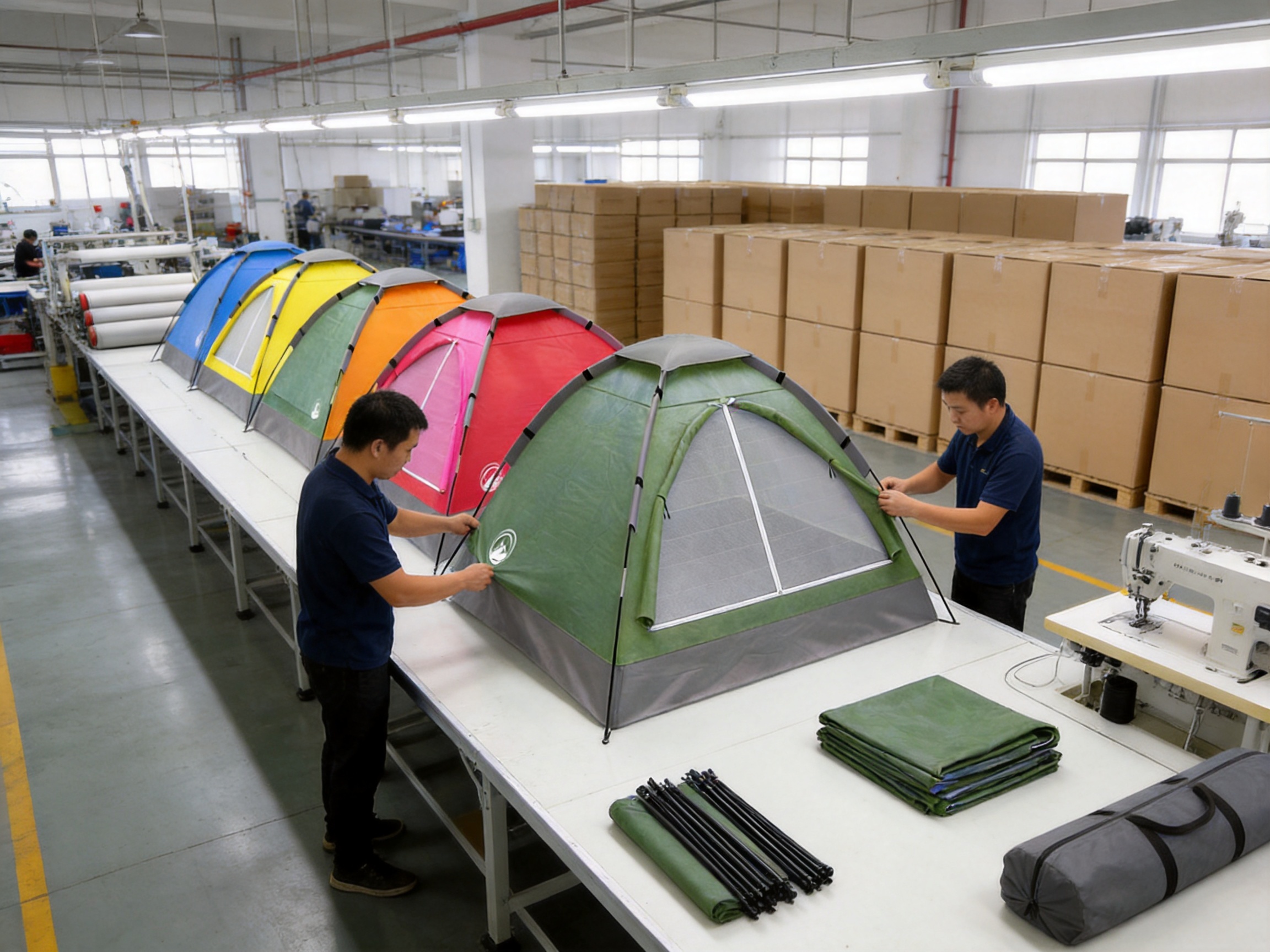
Outdoor recreation continues to expand across beaches, campsites, parks, festivals, family travel destinations, and casual weekend locations. As participation increases, consumers and retailers are looking for shelters that are easier to use than traditional tents while still providing meaningful protection from sunlight, rain, wind-blown sand, insects, and repeated outdoor wear. The outdoor thickened quick-setup beach tent is designed to meet this demand by combining fast deployment, double-layer protection, breathable mesh, and a compact folding structure.
Unlike conventional tents that rely on several separate poles and a time-consuming assembly process, this type of shelter uses a hydraulic spring frame that opens rapidly after the retaining system is released. The structure forms its basic shape in approximately two to three seconds, allowing users to create shade or temporary shelter with minimal technical knowledge. This makes the product especially suitable for novice campers, families with children, beach visitors, event operators, and retailers seeking a practical pop-up shelter for broad consumer markets.
The product is developed and supplied by CragHaven Outdoor, a Hangzhou-based outdoor brand and cross-border manufacturing partner focused on mountaineering, hiking, camping, and related outdoor equipment. Its approach combines scenario-based design, material selection, sampling, testing, manufacturing coordination, and long-term supply-chain support. Rather than treating the tent as a simple seasonal commodity, the company evaluates how the shelter performs under sunlight, rain, sand, repeated folding, ventilation requirements, and everyday handling.
Understanding the Outdoor Thickened Quick-Setup Tent
An outdoor thickened quick-setup tent is a portable shelter designed to provide rapid protection in outdoor environments. Its main characteristics include a spring-assisted frame, a double-layered fabric construction, breathable mosquito-resistant mesh, and a floor area suitable for two people under typical sleeping conditions. It can also be used as a beach shade shelter, changing space, rest area, or short-term camping enclosure.
The tent’s quick-opening structure removes one of the most common frustrations associated with conventional camping products: complicated setup. Traditional pole-and-sleeve tents may require users to identify pole sections, connect them correctly, thread them through fabric channels, attach multiple clips, and tension the rainfly. For experienced campers, this process may be manageable. For beginners, older users, families, and casual beach visitors, however, it can create unnecessary difficulty.
The hydraulic spring system addresses this problem by storing the frame in a folded position and releasing it into a pre-engineered dome shape. The user still needs to position the tent properly, secure it according to the intended conditions, and fold it correctly after use, but the primary structural deployment takes only a few seconds. This improves convenience while reducing the likelihood of incorrect assembly.
The product is not limited to one type of user. Beach visitors can use it as a sun shelter during daytime activities. Campers can use it as a compact sleeping shelter for two people. Families may use it as a private resting space for children. Outdoor event teams can deploy multiple units in locations where speed and consistency are important. Retailers can position it as an accessible entry-level shelter for customers who may not be ready for a more technical camping tent.
Why Fast Deployment Matters in Outdoor Use
Speed is valuable in outdoor environments because conditions can change quickly. A family arriving at a beach may need immediate shade for children, food, luggage, or personal belongings. Hikers may reach a campsite late in the day and prefer to avoid a complicated setup in fading light. At a festival, market, sporting event, or temporary outdoor worksite, staff may need to establish multiple shelters efficiently.
A quick-opening frame helps reduce the time between arrival and actual use. The user does not need to spread several pole sections across the ground or search for the correct sleeve path. Once the retaining strap is released, the pre-tensioned frame expands into its designed configuration. The fabric follows the frame and creates a recognizable dome-like shelter.
This convenience offers a practical advantage over many low-cost traditional tents. A product can be inexpensive at the point of purchase but still create dissatisfaction if it is difficult to assemble. Consumers increasingly evaluate outdoor products according to the total user experience, including setup time, folding difficulty, storage, ventilation, cleaning, and reliability. A fast-deployment tent directly addresses one of the first and most important interactions between the customer and the product.
Quick deployment is also valuable for commercial users. Beach rental businesses, event organizers, outdoor education providers, and promotional teams may need to assemble and pack away shelters repeatedly. Every minute saved per unit can produce a meaningful improvement in labor efficiency when multiple tents are involved. For these customers, frame durability and correct folding procedures are particularly important because the mechanism may experience significantly more cycles than a family tent used only a few times each year.
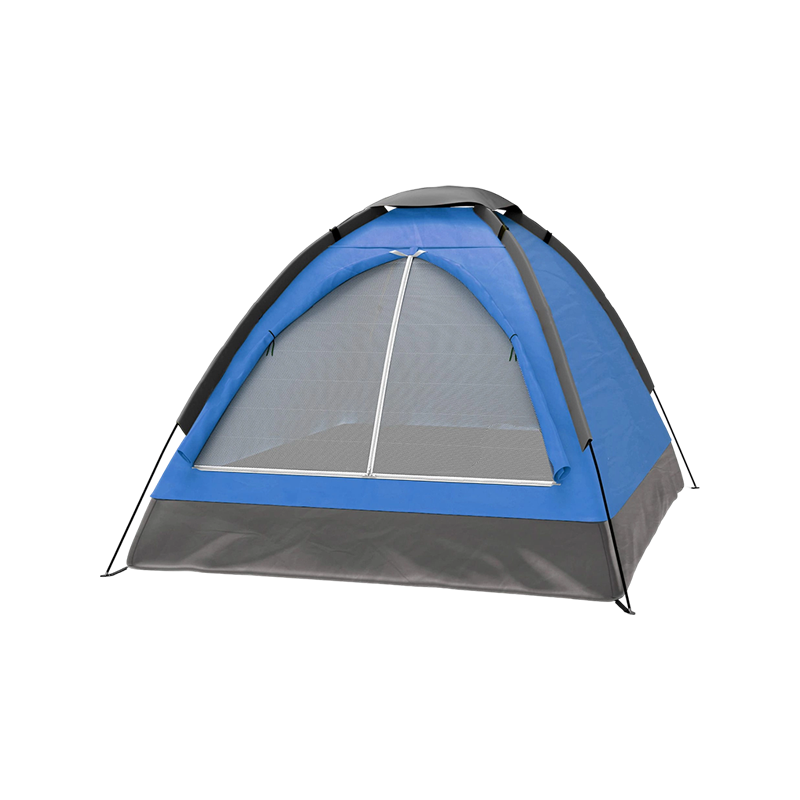
Outdoor thickened tent, quick-setup beach tent, camping sun protection tent.
Hydraulic Spring Frame Engineering
The hydraulic spring frame is the central structural feature of the tent. In practical terms, the frame uses pre-tensioned spring steel ribs that can be held in a compact position during transportation and then released to form the shelter. The frame is designed to use stored mechanical energy for deployment rather than requiring the user to build the structure manually from separate components.
The performance of a spring-loaded frame depends on several factors. Spring gauge, steel quality, rib geometry, bend radius, connection points, fabric tension, and locking arrangements all influence the overall user experience. If the material is too thin, the frame may lose its ability to hold the intended shape after repeated opening and closing. If the bend radius is too tight, the metal may experience higher stress during each cycle. If the fabric is cut incorrectly, it can place excessive tension on certain frame sections.
For this reason, a reliable quick-setup tent cannot be developed by selecting a spring mechanism in isolation. Frame engineering and textile pattern design must be coordinated. The ribs need to create sufficient volume without placing excessive pressure on seams or corners. The fabric must follow the frame smoothly while retaining enough tension to avoid sagging. The folding method must also be considered during the early design stage rather than added as an afterthought.
Spring Gauge and Repeated-Cycle Performance
Lower-grade pop-up products may use spring steel that is adequate for occasional deployment but less suitable for frequent commercial use. Repeated bending and twisting can gradually affect the spring’s ability to return to its original shape. A thicker spring gauge, an appropriate heat treatment, and a wider bend radius can help reduce fatigue and extend useful service life.
Manufacturing quality also matters at the points where ribs connect, cross, or transfer force. If joints are poorly aligned, the frame may deploy unevenly or place excess pressure on one side of the tent. Consistent forming, controlled assembly, and inspection of key connection areas help improve repeatability from one unit to the next.
CragHaven Outdoor approaches frame selection with the intended usage scenario in mind. A tent intended for occasional recreational use may have different optimization priorities from a shelter used by a beach vendor or event operator. The company’s product development process considers not only how quickly a tent opens but also how it is transported, stored, cleaned, folded, and deployed over time.
Safe Operation and Folding Considerations
Quick-opening products should be used according to the supplier’s folding and storage instructions. The frame should not be forced into an arbitrary shape, and the retaining strap should be checked before transport. Users should keep fingers, loose clothing, and other objects away from moving frame sections during deployment. The tent should also be anchored appropriately when exposed to wind.
Folding a spring-frame tent is not always a simple reversal of the opening action. The user generally needs to bring the frame into a controlled twist-and-fold motion so that the ribs overlap correctly and the fabric remains inside the folded structure. Providing clear instructions is therefore an important part of product quality. A well-designed shelter should be supported by understandable packaging information, visual folding guidance, and consistent production of the frame geometry.
Double-Layer Construction for Sun and Rain Protection
The tent uses a double-layer structure to improve comfort and protection compared with a single-layer shade shelter. The outer layer helps block direct sunlight and resist exposure to the outdoor environment. The inner layer contributes to coverage, privacy, and the creation of an air gap between fabric surfaces.
This air gap is important because it slows the direct transfer of heat from the sun-exposed outer surface to the interior. The effect is similar in principle to the insulating space used in other layered protective systems. Although a fabric tent cannot eliminate heat in direct sunlight, a properly designed double-layer structure can create a more comfortable interior than a thin single-layer canopy with no separation between the user and the sun-facing material.
Rain protection depends on more than fabric thickness alone. Denier count, yarn construction, coating type, coating application, seam design, seam treatment, floor construction, and panel overlap all contribute to performance. A heavy fabric with an inadequate coating may still leak under sustained rain. Conversely, a moderately weighted fabric with a suitable polyurethane coating and carefully treated seams can provide effective protection while keeping the tent manageable to transport.
Fabric Weight, Denier, and Abrasion Resistance
Denier is commonly used to describe the fineness or weight of synthetic fibers. In general, a higher denier fabric may offer improved resistance to abrasion and puncture, which is valuable in beach environments where sand, shells, stones, and rough ground can place stress on the material. However, fabric selection must balance durability against total weight, foldability, breathability, and manufacturing cost.
A thickened outdoor tent should not be evaluated solely by a single fabric specification. The full material system is more important than one isolated number. The company’s manufacturing approach considers the relationship between fabric weight, coating performance, seam construction, pattern shape, frame tension, and the expected application. This helps avoid a common problem in low-cost product development: using a heavy material that appears durable but performs poorly at seams or connection points.
Coatings and Seam Protection
A polyurethane coating can improve water resistance and help protect the fabric from moisture penetration. The coating must be applied consistently, since variation across a panel may lead to uneven performance. Seams require special attention because needle holes and overlapping fabric layers can create potential pathways for water.
Depending on the intended product configuration, seam treatment may include carefully designed seam allowances, binding, protective overlays, or seam taping. Floor edges also need to be considered because they are exposed to wet ground, sand, and repeated contact during setup. A raised floor edge can help reduce the entry of water, sand, and insects while also improving the practical cleanliness of the sleeping area.
| Construction Factor | Primary Function | Importance in Outdoor Use |
|---|---|---|
| Higher-denier fabric | Improves resistance to abrasion and puncture | Useful on sandy, rough, or frequently handled ground |
| Polyurethane coating | Supports water resistance | Helps the shelter perform during light or sustained rain |
| Double-layer structure | Creates separation between the outer shell and interior | Helps reduce direct heat transfer and improves coverage |
| Protected seams | Reduces leakage risk at stitched joins | Important during wet weather and repeated folding |
| Raised floor edge | Limits entry of sand, splash water, and insects | Improves comfort at beaches and low-lying campsites |
Ventilation, Mesh Density, and Insect Protection
Comfort inside a compact shelter depends greatly on airflow. Without sufficient ventilation, body heat and moisture can accumulate rapidly, especially when the tent is occupied by two people or placed under direct sunlight. Condensation may also form when warm interior air meets cooler fabric surfaces. Mesh panels help address this issue by allowing air to pass through while limiting the entry of mosquitoes and other insects.
Mesh design involves a balance between protection and airflow. A very fine weave can block smaller insects, including sand flies and no-see-ums, but it may restrict airflow if the panel area is too small. A more open weave can provide greater ventilation but may not provide the same level of insect protection. The appropriate solution depends on panel size, placement, mesh construction, and the intended environment.
The tent’s ventilation strategy uses multiple mesh areas rather than relying on one small opening. When openings are located on opposite or different sides of the shelter, air can move through the interior more effectively. This cross-ventilation principle is useful even when wind conditions are limited because differences in temperature and pressure encourage air exchange.
Ventilation panels must be integrated with the outer shell so that they do not compromise rain protection. Overlapping fabric, suitable panel orientation, covered openings, and controlled seam construction can help maintain a balance between airflow and weather resistance. These details are part of the pattern and manufacturing process rather than merely decorative features added to the finished product.
Why Cross-Ventilation Is Better Than a Single Small Opening
A single vent may release some warm air, but it provides limited circulation if there is no corresponding intake path. Multiple openings create a more practical airflow route. Air entering from one side can move through the interior and exit through another panel, carrying away heat and humidity.
Large mesh panels can improve the result, but their dimensions must be coordinated with frame tension and fabric stability. If a mesh opening is too large or poorly reinforced, the surrounding fabric may distort during folding. If it is too small, the airflow benefit may be negligible. CragHaven Outdoor pays attention to panel layout, mesh integration, and floor-edge construction during development and sampling.
Ground-Level Protection
The lower edge of a beach tent is exposed to more than insects. Sand can enter through small gaps, splash water can reach the floor during rain, and loose fabric can lift when the wind moves across the ground. A raised or sealed floor edge helps create a more controlled boundary between the inside and outside.
This feature is especially useful for families with children, users resting on the floor, and campers who store sleeping bags or personal items inside the shelter. It also makes cleaning easier because fewer particles are drawn into the interior during normal use. While no portable shelter can eliminate all sand or moisture under every condition, thoughtful floor construction can substantially improve daily usability.
Capacity, Footprint, and Real-World Comfort
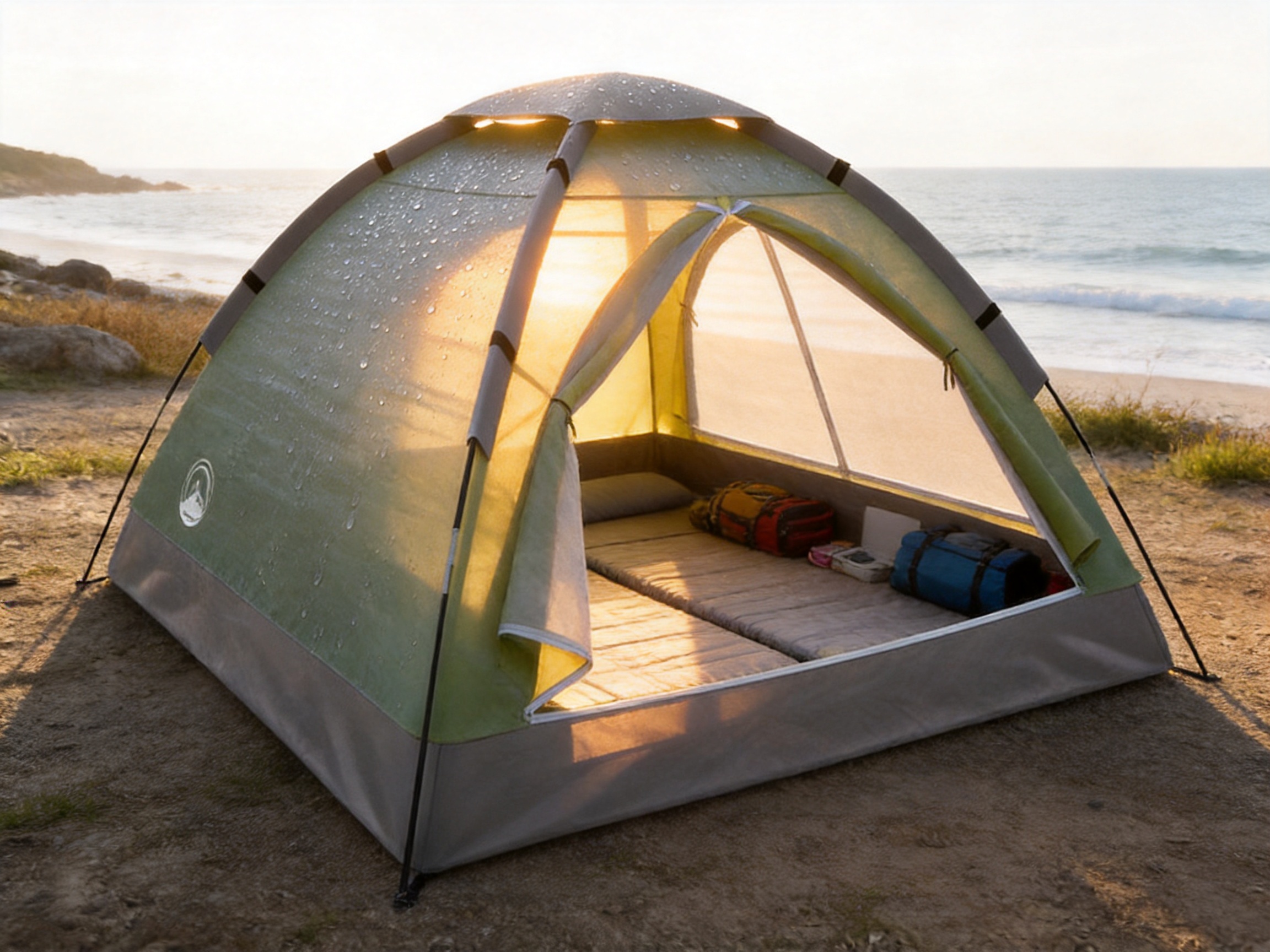
The tent is designed to accommodate two people for sleeping under suitable conditions. However, capacity labels should be understood in practical rather than purely numerical terms. A two-person rating generally assumes sleeping pads and personal gear arranged efficiently, with limited unused space. Users who bring large bags, coolers, shoes, beach equipment, or children’s accessories may experience a different level of comfort.
For daytime beach use, the same floor area may serve more people because occupants may sit upright, keep chairs outside, or use the shelter only for shade and short periods of rest. Overnight camping places greater demands on floor space because sleeping bags, mats, clothing, and other gear occupy nearly the entire base.
Peak height also affects comfort. Two shelters can have similar floor dimensions but feel very different if one provides more headroom or a more efficient wall angle. Dome structures are stable and effective at distributing frame loads, but the sloping sides reduce usable space near the edges. When comparing models, buyers should review floor length, floor width, peak height, door placement, and storage requirements rather than relying only on a general capacity statement.
Beach Use
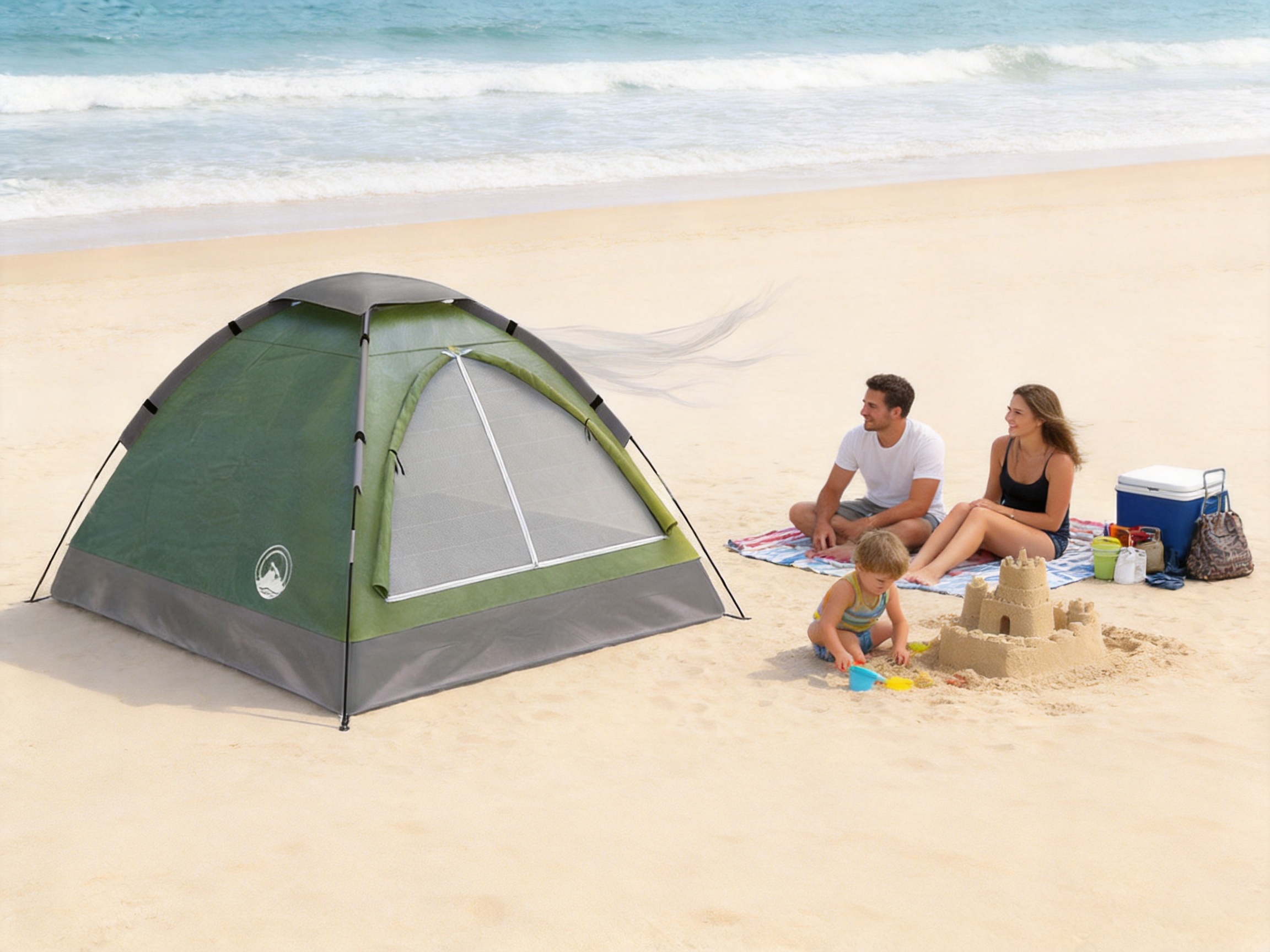
For beach applications, the shelter’s primary roles are shade, privacy, wind reduction, insect protection, and a clean resting area. The double-layer construction can help reduce direct solar exposure, while the mesh supports airflow. The pop-up mechanism allows users to establish shelter quickly after arriving, which is particularly convenient when carrying children, coolers, towels, and other equipment.
Beach users should still anchor the shelter properly. Lightweight pop-up structures can be moved by sudden gusts if they are not secured with suitable sand stakes, weights, or other approved methods. The tent should not be left unattended in changing weather, and it should be cleaned and dried after use to reduce the effects of salt, moisture, and sand.
Camping Use
For casual camping, the tent provides an accessible alternative to more complex shelters. A novice user can achieve a functional structure quickly without learning a complicated pole system. The inner space can accommodate two sleepers, while the mesh supports ventilation and reduces insect entry.
Campers should select a level location free from sharp stones, branches, and standing water. A footprint or groundsheet may provide additional protection beneath the tent, although it should not extend beyond the floor in a way that collects rainwater. After use, the tent should be shaken or brushed carefully, dried completely, and stored in a cool, dry location.
Events and Commercial Applications
Retailers and commercial operators may find this product suitable for beach rental fleets, outdoor promotional activities, family recreation businesses, and event support. The fast deployment time can reduce setup labor, while the compact folded format supports transportation and storage.
Commercial use places greater emphasis on frame cycle life, folding instructions, cleaning procedures, replacement parts, packaging durability, and quality consistency. A manufacturing partner that understands these requirements can help buyers develop a more dependable product program than a simple one-time sourcing arrangement.
Advantages Over Conventional Pole-and-Sleeve Tents
The most visible advantage of a quick-setup spring tent is deployment speed. Traditional tents require several assembly steps, and an inexperienced user may need assistance. The spring frame allows the basic structure to form almost immediately.
The second advantage is user accessibility. A product that can be opened with fewer actions is easier for first-time campers, families, older consumers, and casual beach visitors. This broadens the potential customer base for retailers and reduces the number of customer complaints related to setup confusion.
The third advantage is consistency. When the frame is pre-engineered to open into a set configuration, users are less likely to create an uneven structure through incorrect pole placement. Consistent geometry can also support more predictable fabric tension and appearance across different units.
The fourth advantage is functional integration. The tent combines rapid deployment with double-layer coverage, mesh ventilation, and a compact sleeping area. Some low-cost shade shelters offer easy opening but lack meaningful rain protection or insect control. Some traditional tents provide stronger overnight features but require more time and skill to assemble. This product aims to occupy the practical middle ground between convenience and protective performance.
| Comparison Area | Quick-Setup Thickened Tent | Basic Single-Layer Shade Shelter | Traditional Pole-and-Sleeve Tent |
|---|---|---|---|
| Initial deployment | Rapid spring-assisted opening | Usually fast, depending on frame type | Requires pole assembly and fabric attachment |
| Sun protection | Supported by double-layer construction | Often limited to one coated layer | Depends on fabric and rainfly configuration |
| Insect protection | Mesh panels designed for ventilation and insect resistance | May be limited or absent | Usually available but may require more assembly |
| Rain performance | Supported by coated fabric and protected seams | Varies widely by material and design | Can be strong when fully assembled |
| Ease of use | Suitable for novice users | Generally simple | May require more experience |
| Repeated commercial deployment | Requires suitable spring durability and folding discipline | Depends on frame quality | Requires more labor per setup |
CragHaven Outdoor’s Product Development Philosophy
CragHaven Outdoor is an outdoor brand and manufacturing partner based in Hangzhou, China. The company focuses on mountaineering, hiking, camping, and related outdoor scenarios. Its product development philosophy is based on the belief that outdoor equipment should be designed for actual weather, terrain, usage patterns, and time rather than for catalog appearance alone.
This philosophy is particularly relevant to tent development. A shelter may look attractive in a studio photograph but perform poorly if it is difficult to fold, overheats in direct sun, leaks at the seams, or allows sand to enter through the floor edge. CragHaven therefore considers the complete experience, from the first opening action through transport, setup, use, cleaning, folding, and storage.
The company emphasizes three basic principles. First, each feature should solve a real-world problem. The hydraulic spring frame addresses setup difficulty. The double-layer structure addresses solar exposure and weather protection. Mesh panels address airflow and insects. The raised floor edge addresses sand and ground-level entry.
Second, materials are selected for durability, reliability, and long-term use rather than short-term trends. Fabric weight, coating behavior, mesh density, spring gauge, seam construction, and packaging all contribute to product performance. Third, sampling, testing, and optimization are treated as standard processes rather than optional steps.
Manufacturing Strengths and Quality Control
Reliable outdoor equipment depends on controlled execution. The design must be translated accurately into patterns, cut components, stitched panels, assembled frames, and finished units. Small inconsistencies can affect the appearance, deployment action, seam strength, or overall durability of the tent.
Material Inspection
Material inspection begins before cutting and assembly. Fabric rolls should be checked for visible defects, coating consistency, color variation, width accuracy, and hand feel. Mesh should be reviewed for uniformity and damage. Spring steel components should be checked for shape, surface condition, and dimensional consistency.
Material control helps reduce production variation and supports more stable product performance. It also allows the manufacturing team to identify problems before they become more expensive to correct in finished goods. For international customers, documented material specifications can help align the product with brand requirements and market expectations.
Pattern Development and Cutting
Pattern development determines how the shelter’s fabric panels fit over the frame. The pattern must account for seam allowances, mesh openings, floor geometry, door operation, fabric stretch, and the intended folded configuration. Poor pattern alignment can create wrinkles, loose areas, or excessive tension.
Accurate cutting is equally important. Inconsistent panel dimensions may lead to an uneven dome or make assembly more difficult. Organized cutting procedures, marking systems, and production checks help ensure that components remain traceable and compatible throughout the manufacturing process.
Sewing and Seam Construction
Sewing quality affects both appearance and performance. Critical seams should have appropriate stitch density, seam allowance, reinforcement, and thread selection. High-stress areas around frame pockets, corners, doors, and floor edges may require additional reinforcement.
Mesh panels need to be joined securely without creating sharp edges or weak points. Door closures and attachment points should operate smoothly while maintaining the intended barrier against insects and weather. A well-organized sewing process helps produce a clean finish and reduces the risk of premature seam failure.
Frame Assembly and Functional Testing
Frame assembly should verify that spring ribs, joints, retaining straps, and fabric attachments work together correctly. Each unit should be opened and checked for deployment behavior, symmetry, fabric tension, and visible damage. Functional testing can identify problems that may not be obvious during separate component inspection.
Testing should also include folding and re-opening. A tent that opens correctly once may still present difficulties if the folding sequence causes fabric bunching or frame misalignment. Repeated operational checks help the manufacturing team refine both the product and the instructions supplied to the customer.
OEM and Customization Support
CragHaven Outdoor supports OEM and custom outdoor product development for global retailers and outdoor brands. Customization may include fabric colors, printed branding, packaging artwork, labels, carrying bags, accessory combinations, instruction materials, and selected structural details.
Customization should be approached carefully because every change can influence cost, lead time, performance, or production complexity. For example, a different fabric may alter the folding volume. A new color may require a different coating or dyeing process. A larger logo may require changes to panel positioning. A modified door design may affect mesh coverage, seam placement, and frame tension.
The company’s role as a manufacturing partner includes communicating these relationships clearly. Rather than accepting every specification without review, an experienced supplier can identify potential conflicts early and suggest practical alternatives. This reduces late-stage revisions and helps maintain a stable path from sample approval to mass production.
Private Label and Retail Programs
Retailers may require a consistent product identity across multiple markets. Private-label support can include custom packaging, barcode areas, care instructions, multilingual documentation, carton markings, and brand-specific presentation. The goal is to deliver a finished product that fits the retailer’s sales channel rather than a generic item requiring extensive local modification.
Product presentation should still reflect actual performance. Clear communication about capacity, weather use, anchoring, ventilation, folding, and care helps set appropriate customer expectations. Honest product information can reduce returns and improve long-term consumer confidence.
Sampling and Revision
Sampling is a critical stage because it allows the design team and buyer to evaluate the physical product before larger production quantities are committed. A sample should be reviewed not only for color and appearance but also for opening speed, frame action, mesh airflow, floor design, seam quality, carrying size, and ease of folding.
Revision may involve several rounds. A pattern may need to be adjusted to improve interior space. A seam may need reinforcement. A mesh panel may require a larger area to balance airflow. A spring gauge may need to be reconsidered for the intended cycle frequency. This iterative process reflects the company’s emphasis on testing and optimization.
Packaging, Storage, and After-Sales Considerations
A quick-setup tent must remain protected during transportation from the factory to the warehouse, retailer, and end customer. Packaging should prevent unnecessary abrasion, moisture exposure, and pressure on the folded frame. The carrying bag should be appropriately sized so that users can return the tent to storage without forcing the components into an unsuitable shape.
Storage instructions should recommend a dry and ventilated location away from prolonged direct sunlight. The tent should be fully dry before long-term storage. Sand and dirt should be removed carefully because abrasive particles can increase wear during folding. If the product becomes wet, it should be opened and dried as soon as practical.
After-sales support is another area where an experienced manufacturing partner can provide value. Clear instructions, spare components where appropriate, packaging support, and responsive communication can reduce the burden on retailers. For commercial customers, guidance on inspection intervals and folding procedures can help extend the service life of frequently used units.
Responsible Use in Sun, Rain, and Wind
The tent provides useful protection from sun and light to moderate outdoor weather when used appropriately, but it should not be treated as an all-season mountaineering shelter or a substitute for a heavy-duty storm tent. Users should evaluate local weather conditions before deployment and avoid using the product in severe wind, thunderstorms, flooding, or other hazardous conditions.
Sun protection is improved when the tent is positioned correctly and ventilation openings are used as intended. Users should avoid blocking all mesh panels with personal belongings because this can reduce airflow. In hot conditions, the shelter should be placed where it can receive natural air movement while remaining securely anchored.
During rain, the fabric and seam construction help reduce moisture entry, but performance depends on setup, fabric condition, exposure duration, and weather intensity. The shelter should be pitched on ground that does not collect water, and users should avoid placing heavy objects against wet walls or obstructing drainage around the floor.
Wind requires special attention. The lightweight and rapidly deployable design makes the tent convenient, but any portable shelter can be displaced if it is not anchored. Appropriate sand stakes, weights, or approved tie-down methods should be used according to the ground conditions. The tent should never be left unattended when strong winds are expected.
Cleaning and Maintenance Recommendations
Routine care can improve the useful life of the tent. After beach use, sand should be removed before folding. Users can open the tent, shake it gently, and brush remaining particles from seams and floor edges. Excessive force should be avoided because aggressive brushing may damage coatings or mesh.
For ordinary dirt, a soft cloth and clean water are generally preferable to harsh chemical cleaners. Strong solvents, abrasive detergents, and unapproved treatments may affect the fabric coating, mesh, seam tape, or color. If the tent becomes wet, it should be opened fully and allowed to dry before being placed in its carrying bag.
The frame should be inspected for unusual bends, loose components, or damage. Retaining straps should remain functional because they control the folded frame during transport. If a structural part appears damaged, the tent should not be forced open or used in demanding conditions until it has been assessed.
Why This Product Is Suitable for Global Retailers
Global retailers need outdoor products that are understandable, practical, and suitable for a broad customer base. The quick-setup tent has a clear consumer benefit that can be explained simply: it opens rapidly, provides shade and shelter, supports ventilation, and accommodates two people for suitable camping use.
The product also supports multiple sales occasions. It can be marketed for beach holidays, family camping, weekend travel, outdoor recreation, festivals, picnic areas, and seasonal leisure. This versatility can help retailers reduce dependence on a single use case while maintaining a coherent outdoor product category.
From a supply perspective, the product is suitable for OEM development because its core structure can be adapted through selected fabric, color, packaging, and branding options. CragHaven Outdoor’s experience in outdoor gear manufacturing enables buyers to discuss not only the finished appearance but also material selection, construction, testing, and production scalability.
The company’s location in Hangzhou provides access to China’s mature manufacturing ecosystem while its cross-border orientation supports communication with international customers. CragHaven aims to reduce supply-chain uncertainty by participating in design and manufacturing decisions instead of acting only as a basic sourcing intermediary.
Product Selection Checklist for Buyers
Buyers evaluating a quick-setup beach or camping tent should review the complete product system. The frame should open smoothly and hold its shape without unusual resistance. The fabric should be appropriate for the target market and usage conditions. Mesh panels should provide a practical balance between insect protection and airflow.
Capacity claims should be supported by realistic floor dimensions and peak height. The product description should distinguish between daytime shade capacity and overnight sleeping capacity. Packaging should explain setup, folding, anchoring, cleaning, and storage in clear language.
For commercial programs, buyers should ask about repeated-cycle testing, sample approval, material specifications, inspection procedures, carton loading, production lead times, and customization options. A supplier that can answer these questions systematically is more likely to support stable long-term cooperation.
Frequently Asked Questions
What makes this tent different from a standard beach shade?
The tent combines a rapid spring-assisted frame with double-layer fabric, breathable mosquito-resistant mesh, and a floor structure suitable for two-person sleeping under appropriate conditions. A basic beach shade may provide sun coverage but often has less protection against insects, rain, or overnight use.
How quickly can the tent be opened?
The hydraulic spring frame is designed to form the main dome structure in approximately two to three seconds after the retaining system is released. Users must still position and anchor the tent properly, especially in windy outdoor conditions.
Is the tent suitable for beginners?
Yes. The quick-opening mechanism is designed to reduce the number of assembly steps, making the product suitable for novice campers, families, and casual beach users. Folding requires a specific controlled motion, so users should follow the supplied instructions.
Can two people sleep inside?
The tent is designed to accommodate two people for suitable sleeping use. Actual comfort depends on the size of sleeping mats, sleeping bags, personal gear, and the amount of interior equipment. Buyers should review the floor dimensions and peak height before selecting the product.
Does the double-layer construction make the tent completely waterproof?
Double-layer construction improves coverage and can support sun and rain protection, but no lightweight portable tent should be assumed to be completely waterproof under every weather condition. Performance depends on fabric coating, seams, setup, exposure duration, and weather intensity.
How does the mesh help with ventilation?
Mesh panels allow air to move through the shelter while limiting the entry of mosquitoes and other insects. Panels positioned on multiple sides support cross-ventilation, helping reduce heat and moisture accumulation compared with a shelter that has only one small opening.
Is the tent suitable for strong wind?
The tent should be anchored properly and used only within appropriate weather conditions. It is not intended to replace a specialized storm shelter. Users should avoid deployment in severe wind, thunderstorms, or other hazardous conditions and should not leave the tent unattended in changing weather.
How should the tent be cleaned after beach use?
Open the tent, remove sand and loose debris, and allow the fabric to dry completely before folding. A soft cloth and clean water are generally preferable to harsh detergents or abrasive tools. Salt and moisture should not be left on the fabric or frame for extended periods.
Can the product be customized for a private-label brand?
OEM customization may include colors, printed branding, packaging, labels, carrying bags, and selected product details. Each proposed change should be reviewed for its effect on material performance, folding size, production complexity, and cost.
What should commercial buyers evaluate before ordering?
Commercial buyers should review frame durability, repeated opening and folding, material specifications, seam construction, packaging, instructions, inspection procedures, production capacity, customization support, and after-sales communication. These factors are especially important for rental, event, and high-frequency deployment programs.
Conclusion
The outdoor thickened quick-setup beach tent responds to a clear market need: convenient shelter that offers more practical protection than a basic shade canopy without requiring the complexity of a traditional camping tent. Its hydraulic spring frame enables rapid deployment, while double-layer construction supports sun and rain protection. Mesh panels improve ventilation and insect resistance, and the floor design contributes to a cleaner and more comfortable interior.
The product’s advantages are not based on one feature alone. Its value comes from the coordination of frame engineering, fabric selection, coating performance, mesh layout, floor construction, folding behavior, and manufacturing control. When these elements are developed together, the result is a shelter that is easier for beginners to use and more adaptable to beach, camping, family, event, and commercial applications.
CragHaven Outdoor strengthens this product proposition through a scenario-based development process, material-focused decision making, sampling, testing, and OEM support. The company’s manufacturing approach is designed to help global retailers and outdoor brands reduce supply-chain uncertainty while developing products that respond to actual weather, terrain, and usage requirements.
For buyers seeking a portable shelter with fast opening, practical protection, accessible operation, and customization potential, the outdoor thickened quick-setup tent offers a balanced solution. With correct anchoring, folding, cleaning, and storage, it can provide dependable convenience across a wide range of everyday outdoor activities.
References
1. International Organization for Standardization. Textile Fabrics: Guidance on Fabric Performance, Dimensional Stability, and Related Testing Principles.
2. International Organization for Standardization. Camping Tents: General Safety, Performance, and User Information Considerations.
3. Outdoor Industry Association. Consumer Trends in Camping, Beach Recreation, and Outdoor Leisure Equipment.
4. Textile Research Literature. Synthetic Outdoor Fabrics, Polyurethane Coatings, Seam Construction, and Water Resistance.
5. Materials Engineering References. Spring Steel Fatigue, Bend Radius, Repeated-Cycle Performance, and Formed Metal Components.
6. Product Design References. Human-Centered Design Principles for Portable Outdoor Equipment and Recreational Shelters.
7. Outdoor Equipment Maintenance Guides. Cleaning, Drying, Folding, Storage, and Inspection Practices for Fabric Shelters.
Product: Outdoor thickened tent, quick-setup beach tent, camping sun protection tent.


- Phone: +86-15968800379
- E-mail: [email protected]
- Address: Room 1002, Huishang Building, Gongshu District, Hangzhou City, Zhejiang Province.
Copyright © CragHaven Outdoor All Rights Reserved. Outdoor Gear Manufacturers Wholesale Mountaineering Camping Gear Suppliers
