

 English
 Deutsch
 Español
 Français


Engineering a Better Quick-Setup Beach and Camping Tent for Real Outdoor Use
Content
- 1 Designed Around Actual Beach and Camping Scenarios
- 2 Hydraulic Spring Deployment and Quick-Opening Convenience
- 3 Double-Layer Fabric for Sun, Heat, and Rain Management
- 4 Mesh Ventilation and Insect Protection
- 5 Capacity, Floor Shape, and Interior Comfort
- 6 Manufacturing Strengths Behind Consistent Outdoor Gear
- 7 Advantages Over Conventional and Lower-Cost Alternatives
- 8 OEM and Private-Label Cooperation
- 9 Use and Care Recommendations
- 10 Q&A: Common Questions About the Quick-Setup Tent
- 10.1 Q1: How quickly can the tent be deployed?
- 10.2 Q2: Does the tent require traditional poles?
- 10.3 Q3: How many people can sleep inside?
- 10.4 Q4: Is it suitable only for the beach?
- 10.5 Q5: What is the purpose of the double-layer structure?
- 10.6 Q6: Does the fabric provide complete waterproof protection?
- 10.7 Q7: How does the mesh support ventilation?
- 10.8 Q8: Why is spring gauge important?
- 10.9 Q9: Is folding difficult?
- 10.10 Q10: Can the product be customized for an OEM project?
- 10.11 Q11: What makes this product different from a low-cost pop-up shelter?
- 10.12 Q12: Can the tent be used in extreme mountain conditions?
- 11 Why Partner with CragHaven Outdoor
- 12 Conclusion
- 13 References
- 14 Product: Outdoor thickened tent, quick-setup beach tent, camping sun protection tent.
Outdoor shelters are expected to perform several jobs at once. They must provide shade during long hours in direct sunlight, resist light rain and wind, allow enough airflow for comfort, keep insects outside, and remain simple enough for first-time campers to use correctly. At the same time, buyers increasingly expect a tent to be compact during transport, durable over repeated setup cycles, and suitable for more than one environment. A shelter used on a beach may later be used in a garden, at a campsite, during a family picnic, or as a temporary rest area during an outdoor event.
The outdoor thickened quick-setup tent described in this article is designed around those practical requirements. It combines a hydraulic spring deployment system, double-layer fabric construction, breathable high-density mesh, a spacious two-person footprint, and an emphasis on dependable materials and repeatable manufacturing. Rather than treating the tent as a simple seasonal shade product, CragHaven Outdoor approaches it as a functional shelter whose performance depends on the relationship between its frame, fabric, seams, ventilation, floor design, and folding system.
This integrated approach creates meaningful advantages over many conventional beach shelters and entry-level camping tents. A traditional pole-and-sleeve tent may be stable once assembled, but it often demands more time, dexterity, and patience during setup. A thin single-layer sun shelter may be light and inexpensive, but it can become uncomfortably hot and may provide limited protection during changing weather. A low-quality pop-up shelter may open quickly at first, yet lose frame tension after repeated folding and deployment.
The objective of a well-designed quick-setup tent is therefore not merely to open quickly. It is to make the entire ownership experience easier and more reliable, from carrying the packed product to deploying it, using it, cleaning it, folding it, and preparing it for the next trip. The following sections examine how the tent achieves that objective and how CragHaven Outdoor supports the product through material selection, engineering development, production control, and OEM cooperation.
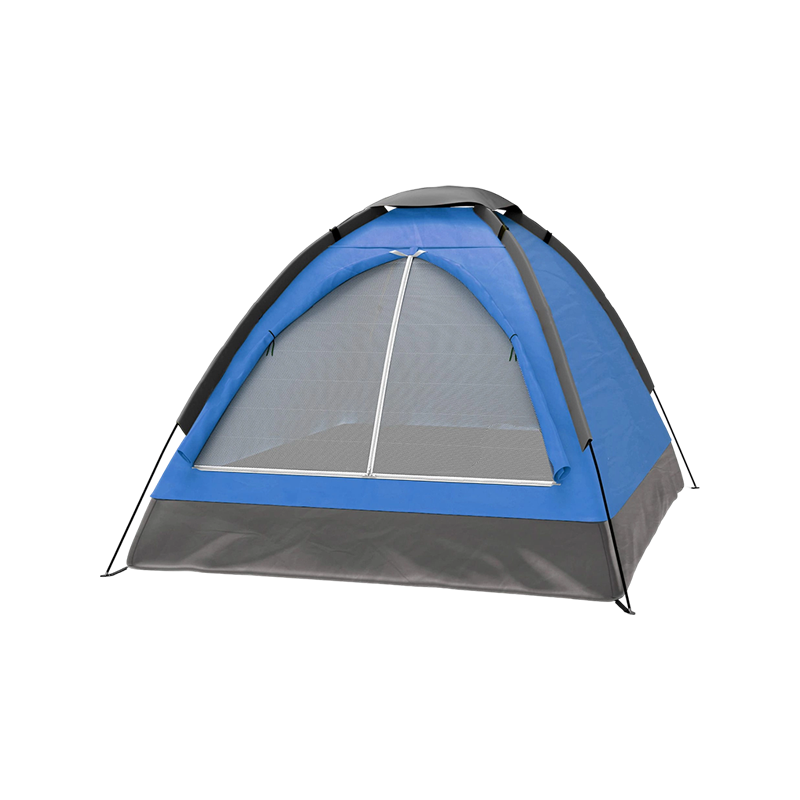
Outdoor thickened tent, quick-setup beach tent, camping sun protection tent.
Designed Around Actual Beach and Camping Scenarios
A tent specification can appear impressive on paper while failing to solve the problems users encounter outdoors. Capacity, fabric weight, waterproof coating, and frame type are important, but they have to work together. A shelter that is difficult to pitch may be inconvenient for novice campers. A tent with excellent mesh but poor ventilation geometry may still feel hot. A thick fabric without appropriate seam construction may resist abrasion but leak in prolonged rain. A quick-opening frame without a dependable locking and folding method may create unnecessary safety and maintenance concerns.
This product is intended for users who want a practical balance between convenience and protection. It is suitable for beach leisure, short camping trips, family recreation, outdoor rest, and warm-weather overnight use. Its two-person capacity provides enough room for two sleeping occupants when personal equipment is kept to a reasonable minimum. For beach use, the same floor area can accommodate users seeking shade, although chairs, coolers, bags, and other equipment will reduce the available interior space.
That distinction between advertised capacity and real-world use is important. A “sleeps two” rating generally assumes that sleeping pads and bags occupy most of the floor. A family using the tent as a daytime sun shelter may prefer to sit inside with fewer items, while campers carrying large backpacks may require additional storage outside the sleeping area. CragHaven Outdoor treats capacity as a use-case question rather than a single marketing number. Floor dimensions, peak height, access points, ventilation, and the intended activity all contribute to comfort.
The dome-style structure offers a useful combination of stability and efficient deployment. Its curved frame creates a recognizable shelter profile while allowing the tent to collapse into a comparatively compact package. The shape also helps shed light rain and provides overhead clearance for sitting or reclining. Because a dome naturally loses usable space near the edges, users should consider both floor size and peak height when comparing similar products.
One Shelter for Multiple Outdoor Activities
The tent’s application range extends beyond the beach. At a campsite, it can function as a compact sleeping shelter for two people. During a day hike or picnic, it can provide a protected place to rest, change clothing, or escape intense sunlight. At a family gathering, it can serve as a temporary play or relaxation area. For event organizers and outdoor vendors, the rapid deployment system can reduce setup labor when multiple units must be opened and closed repeatedly.
This versatility is a competitive advantage because many low-cost shelters are optimized for only one narrow purpose. Some are intended only for shade and lack sufficient weather protection. Others are designed for overnight camping but take too long to pitch for short daytime use. The present design seeks to bridge that gap by combining pop-up convenience with features associated with a more considered camping shelter, including a double-layer structure, raised floor edges, breathable mesh, and a thicker outdoor fabric.
Hydraulic Spring Deployment and Quick-Opening Convenience
The defining feature of the tent is its hydraulic spring quick-opening design. During transport, the spring-loaded ribs are folded and secured in a flat configuration. Once the retaining strap is released and the frame is guided into position, stored mechanical energy helps the structure expand into its dome form in approximately two to three seconds. The user does not need to thread long poles through fabric sleeves or connect a series of separate clips before the shelter becomes usable.
This mechanism changes the setup experience substantially. Conventional pole-and-sleeve tents usually require the user to identify each pole section, assemble the poles, feed them through fabric channels, attach the ends, and tension the fly or body. That process can be straightforward for experienced campers, but it may take five to ten minutes or longer for a beginner, especially in wind, low light, or crowded surroundings. A quick-opening frame removes many of those steps and makes the shelter more accessible to first-time users.
The spring system is not simply a convenience feature; it is an engineering component that must be matched to the fabric body and folding geometry. The frame needs enough stored force to deploy the tent consistently, but it must not create excessive stress at connection points. The spring ribs also need suitable thickness, curvature, and surface treatment so that repeated bending does not quickly reduce their ability to hold the dome shape.
Frame Reliability Through Material and Geometry Control
Repeated cycling is one of the main challenges for any pop-up frame. A tent used only a few times per year may experience relatively little mechanical wear. By contrast, a family that uses it throughout the summer, a beach business that opens it every day, or an event team that transports it frequently may subject the ribs to hundreds of open-close cycles. Thin spring steel can fatigue when repeatedly bent beyond an appropriate range, especially if the bend radius is too tight or the material is inconsistent.
CragHaven Outdoor addresses this issue by considering spring gauge and bend radius together rather than selecting a frame solely for low packed weight. A thicker spring gauge can retain tension more effectively, while a wider bend radius helps distribute stress along the rib. The goal is a frame that deploys smoothly, remains sufficiently resilient, and holds its intended shape after repeated use.
Frame performance also depends on how the ribs interact with the fabric. If fabric panels are cut too tightly, they can resist deployment and place unnecessary tension on seams. If they are too loose, the shelter may appear slack and collect water more easily. During product development, the frame and fabric should therefore be evaluated as one system. Sampling allows the manufacturer to inspect deployment speed, panel tension, attachment points, and the ease of folding before production specifications are finalized.
Safe and Correct Folding Practice
Quick setup does not mean that folding can be performed randomly. Spring-loaded tents usually require a specific twist-and-fold motion that returns the ribs to their compact transport position. Users should follow the supplied folding instructions, keep hands clear of points where the frame closes, and confirm that the retaining strap is secured before carrying or storing the tent.
The retaining strap has two functions. It keeps the folded frame compact during transport, and it prevents accidental release while the tent is being moved. A strap that is not fully engaged may allow the spring frame to expand unexpectedly. For this reason, the strap, stitching, buckle, and attachment points should be inspected as part of normal product care.
Clear instructions are especially important for novice campers and for commercial users who may train several staff members. A quick-opening product delivers its greatest value when every user can deploy and pack it consistently. CragHaven Outdoor can support OEM customers with user instructions, packaging guidance, folding diagrams, and product-specific communication suitable for different markets.
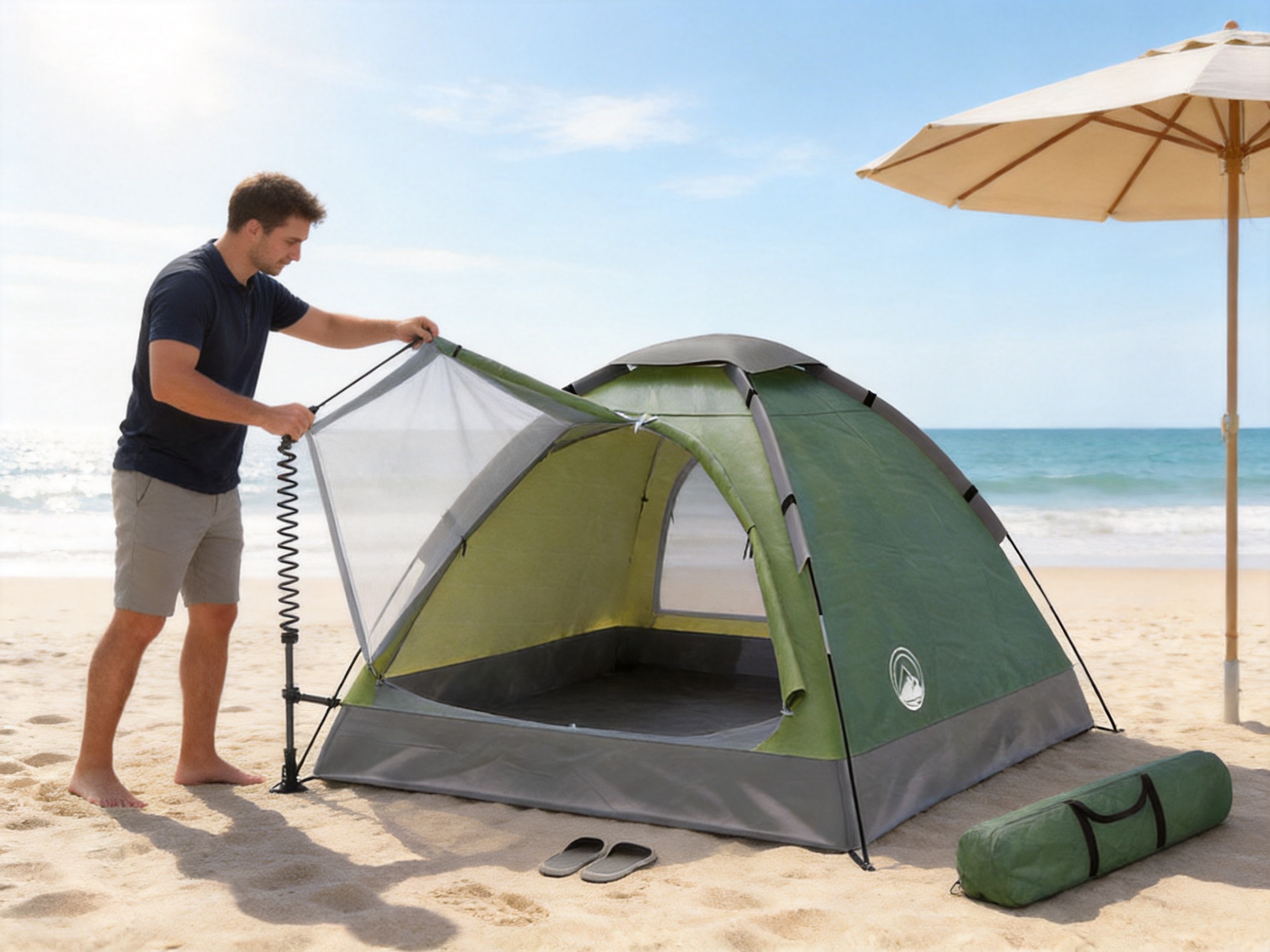
Double-Layer Fabric for Sun, Heat, and Rain Management
The tent uses a double-layer construction to improve protection and comfort in conditions where a single layer of coated polyester may be insufficient. The outer layer is responsible for resisting direct sunlight and light rain, while the inner layer helps create an insulating air space. This separation reduces direct heat transfer and can make the interior more comfortable than a shelter with one thin layer stretched directly over the occupants.
The principle is similar to the performance of an air gap in other forms of insulation. Air is a relatively poor conductor of heat compared with solid materials, so the space between fabric layers can slow the movement of heat from the sun-heated exterior toward the interior. The result is not a substitute for shade, ventilation, or appropriate user behavior, but it is a useful structural advantage during hot-weather use.
Sun protection is also influenced by color, coating, fabric density, panel design, and the angle of the sun. A thicker outdoor fabric can provide a more substantial barrier than a lightweight decorative shade cloth. However, fabric thickness alone does not determine complete performance. The coating must be compatible with the base textile, seams must be constructed carefully, and openings must be positioned so that the shelter does not become a sealed heat box.
Denier, Coating, and Abrasion Resistance
Denier is commonly used to describe the weight and fineness of synthetic fibers. In practical terms, a higher denier fabric is often better equipped to resist abrasion and puncture than a very lightweight textile, although actual performance also depends on weave construction, yarn quality, coating, and finishing. Beach use can expose fabric to sand, shells, rough ground, and repeated dragging during repositioning. A suitably thickened fabric helps reduce the likelihood of damage from ordinary handling.
CragHaven Outdoor evaluates denier and coating together. A heavy fabric with an inadequate coating may still allow water to pass through under sustained exposure. Conversely, a moderate-denier textile with an appropriate polyurethane coating and carefully sealed seams can provide effective rain performance without adding unnecessary weight. This balanced approach helps the manufacturer avoid selecting materials based on a single parameter.
The coating also influences flexibility and folding behavior. If the coating becomes excessively stiff, repeated folding can create stress points or surface cracking. If the coating is too soft or thin, it may provide inadequate water resistance. Sampling and inspection help identify a suitable combination of base fabric, coating weight, curing conditions, and folding method.
| Fabric and Construction Factor | Primary Contribution | Why It Matters in Use |
|---|---|---|
| Higher denier textile | Improved resistance to abrasion and puncture | Useful on sand, rough ground, and during frequent handling |
| Polyurethane coating | Water resistance and rain protection | Supports performance during changing weather conditions |
| Double-layer structure | Creates an insulating air gap | Helps limit heat buildup under direct sunlight |
| Reinforced attachment areas | Distributes stress at frame and anchor points | Reduces localized strain during deployment and wind exposure |
| Carefully finished seams | Limits water entry through stitched joins | Improves reliability during light rain and repeated use |
Rain Protection Requires More Than a Waterproof Fabric
Water can enter a tent through the fabric, seams, zippers, floor edges, or poorly protected openings. For that reason, rain performance cannot be judged by fabric coating alone. Panel overlap, seam positioning, thread selection, seam allowance, and finishing methods all affect the final result. A shelter intended for outdoor use should be evaluated as an assembled product rather than as a roll of treated fabric.
The double-layer design creates an opportunity to manage water more effectively because the outer shell can take the first exposure while the inner layer provides an additional barrier. The floor edge should rise sufficiently above the ground to reduce the chance of splashback and surface water entering at the base. Users should still avoid placing the tent in depressions where water can pool, and they should use suitable ground conditions and anchoring methods.
CragHaven Outdoor’s manufacturing approach emphasizes the relationship between material selection and process control. Fabric rolls must be checked for consistency, panels must be cut accurately, seams must be sewn with suitable tension, and finished assemblies must be inspected for visible defects. These steps support repeatability across production batches, which is particularly important for OEM buyers who need consistent products for retail distribution.
Mesh Ventilation and Insect Protection
A comfortable warm-weather tent must manage two competing requirements: it needs openings large enough to move air, but the mesh must be fine enough to keep insects outside. A very fine weave can block smaller insects such as sand flies and no-see-ums, yet it may also restrict airflow if the mesh panels are too small. A coarse mesh can ventilate efficiently but may allow unwanted insects to enter. Product performance therefore depends on both mesh density and panel area.
The tent uses high-density mesh in a layout intended to support breathable comfort and mosquito protection. Large mesh panels are more effective than a single small vent because they provide a greater total area for air movement. When openings are positioned on opposite or adjacent sides, the shelter can benefit from cross-ventilation. Air entering through one panel can move across the interior and exit through another, reducing stagnant pockets.
Cross-ventilation is valuable even when the wind is light. Differences in temperature and air pressure can encourage movement through opposing openings, while an outdoor breeze can increase the effect. This approach is more effective than relying on one small opening, especially when two people are inside or when the tent is exposed to direct sunlight.
Ground-Level Protection Against Sand and Insects
The lower edge of a beach tent is a common point of failure. Sand can enter through gaps between the floor and the side panels, while small insects can exploit openings that are difficult to notice during setup. A raised and carefully finished floor edge helps reduce these problems. It also gives the lower structure a more defined boundary against damp ground and light splashback.
Floor construction must be balanced with ease of folding. Excessively rigid or bulky floor reinforcements may make the packed product difficult to manage. The manufacturer therefore has to coordinate floor fabric, edge finishing, corner geometry, and spring-frame movement. These details may not be visible in a product photograph, but they directly influence user satisfaction in real conditions.
Ventilation should also be used together with sensible campsite practices. Users should keep doors and mesh panels clear, avoid blocking airflow with large bags, and dry the tent thoroughly after use. If the shelter is packed while wet or covered in salt and sand, materials may degrade faster and odors may develop. Good product design reduces risk, but appropriate care remains essential for long service life.
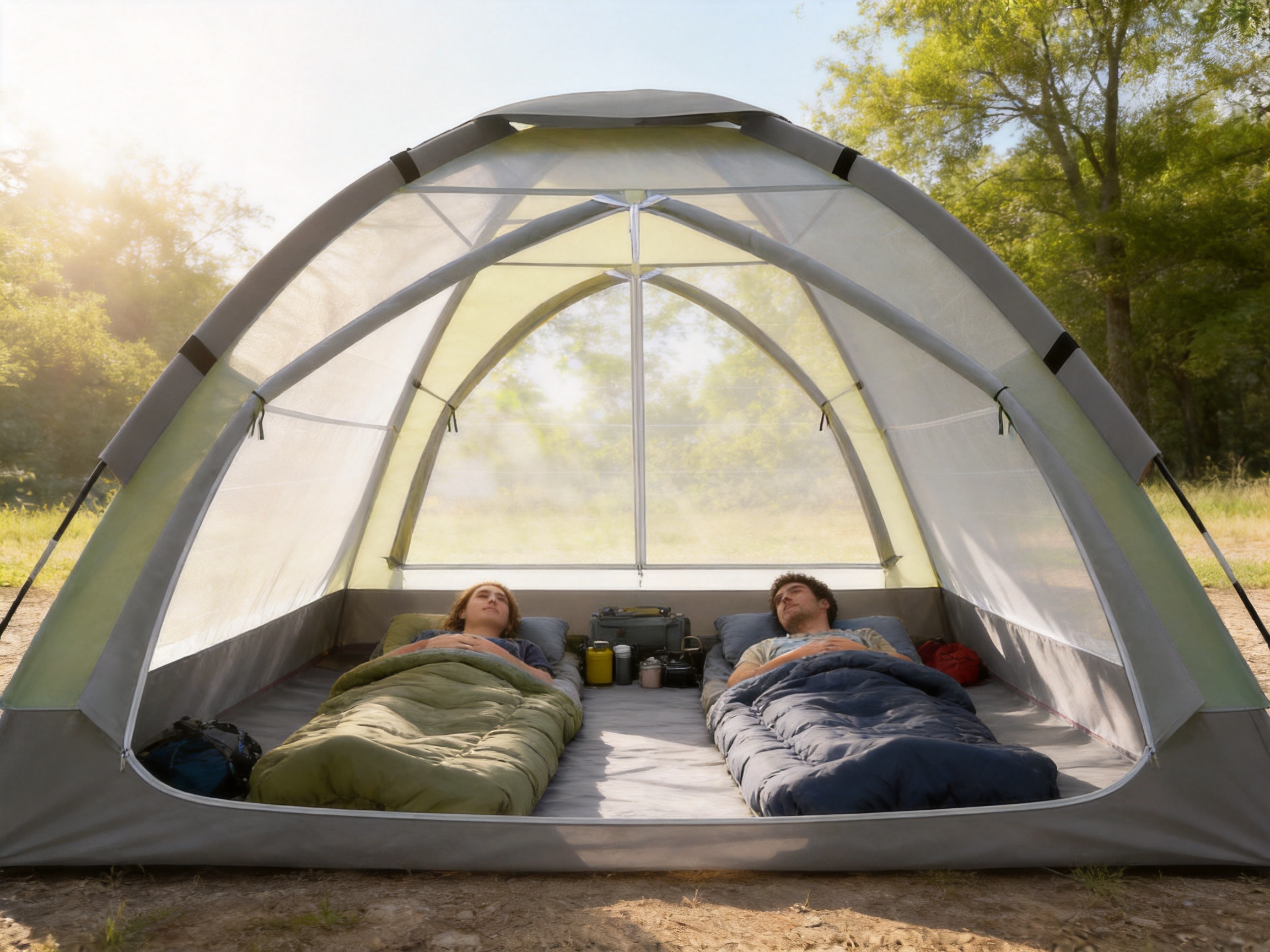
Capacity, Floor Shape, and Interior Comfort
The shelter is designed to accommodate two people in a compact outdoor footprint. This makes it suitable for couples, parents and children, individual users who want additional room, or two campers traveling with limited equipment. The interior should be considered in relation to the activity. Overnight users may fill the floor with sleeping pads and bags, while beach users may value open sitting space and shade more than maximum sleeping capacity.
Floor shape influences comfort as much as floor area. A dome profile provides efficient structural support and quick deployment, but the walls curve inward toward the edges. This can reduce the practical area available for tall bags or occupants who sit near the perimeter. Peak height is therefore an important comparison point. Two tents with similar stated floor dimensions can feel very different if one provides more central headroom or a more efficient interior layout.
The product’s spacious design is intended to make two-person use more comfortable than a highly compressed shelter. Nevertheless, users should organize equipment carefully. Soft bags can be placed along lower side areas, while frequently used items should remain near the entrance or in an external storage location. Keeping the central ventilation paths open helps maintain airflow and makes the space feel less crowded.
Balancing Packed Size and Usable Space
A quick-opening tent must collapse into a manageable form without sacrificing the structural area needed for comfortable use. This creates a design trade-off between transport convenience and interior volume. A very compact package may require a more complex folding sequence or a smaller floor, while an oversized shelter may be difficult to carry and store.
The spring frame helps address this trade-off by allowing the ribs and fabric body to fold into a compact configuration while retaining enough stored energy for rapid deployment. The final packed size depends on frame diameter, fabric volume, attachment details, and the folding method. During sampling, the manufacturer can assess whether the packed tent fits expected retail packaging, shipping cartons, vehicle storage areas, and consumer closets.
For OEM customers, packed dimensions are also important for logistics planning. They influence carton quantity, warehouse utilization, container loading, shipping cost, and shelf presentation. CragHaven Outdoor can work with customers on packaging dimensions, labeling, colorways, instruction materials, and product configurations while maintaining the core functional design.
Manufacturing Strengths Behind Consistent Outdoor Gear
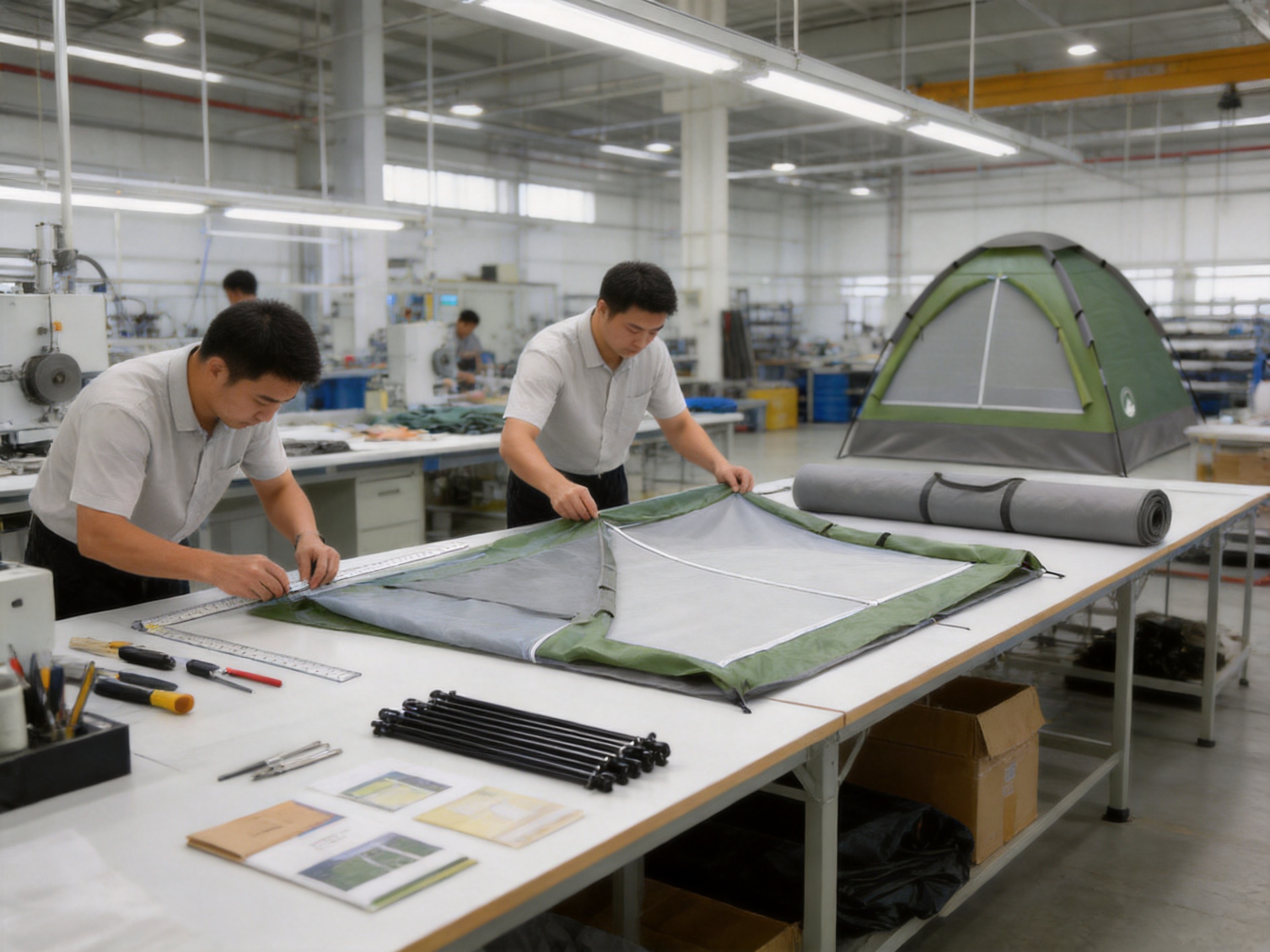
A product’s advertised features matter only when they can be reproduced consistently at production scale. Outdoor shelters involve multiple materials and processes, including fabric inspection, cutting, printing or labeling when required, sewing, seam finishing, frame forming, spring assembly, mesh installation, attachment reinforcement, final folding, and packaging. Weakness in any one stage can affect the finished product.
CragHaven Outdoor is positioned as both an outdoor brand and a cross-border manufacturing partner based in Hangzhou, China. Its focus on mountaineering, hiking, and camping scenarios supports a product-development mindset that begins with use conditions rather than catalog appearance. The company’s stated principles emphasize weather, terrain, and time; materials are selected for durability and reliability, and sampling, testing, and optimization are treated as standard steps rather than optional additions.
Development Begins with the Use Scenario
The first stage of a reliable product is a clear understanding of how it will be used. For this tent, relevant questions include where it will be pitched, how frequently it will be opened, whether it will be used overnight, how much direct sun it will receive, what kinds of ground it will encounter, and how users are expected to pack it. These questions shape the frame specification, fabric weight, ventilation layout, floor construction, and packaging format.
A manufacturer that begins only with a target price may select a thin fabric, a minimal frame, or a simplified seam structure before considering the consequences for durability. By contrast, scenario-led development allows cost, performance, and user expectations to be evaluated together. The objective is not to add features without purpose, but to ensure that each feature addresses a real outdoor problem.
For international customers, this approach also helps translate local manufacturing capability into products that suit Western-market expectations. Buyers often need clear specifications, stable production, practical instructions, reliable communication, and consistent shipment quality. CragHaven Outdoor aims to participate in design and manufacturing rather than acting solely as a source-finding intermediary.
Sampling, Testing, and Optimization
Sampling is essential for a tent with a spring-loaded frame because drawings alone cannot fully predict deployment behavior. A physical sample allows the development team to inspect how fast the frame opens, whether fabric tension is balanced, whether seams pull at connection areas, and whether the folding process can be explained clearly to the intended user.
Samples can also be evaluated for ventilation, visibility, floor-edge coverage, zipper movement, mesh tension, and packed size. If the first sample is too difficult to fold, too hot in direct sun, or too tight around the frame, the design can be revised before mass production. This iterative approach reduces the risk of discovering fundamental issues after a large quantity has already been manufactured.
Testing should reflect practical use rather than only appearance. Repeated opening and closing can reveal frame fatigue or stress at the fabric attachment points. Light rain testing can identify leakage through seams and openings. Handling and packing checks can expose weak straps, inaccurate folds, or packaging that is difficult to close. These evaluations help turn design intent into a repeatable product specification.
Production Control Across Multiple Components
Fabric quality begins with incoming inspection. Rolls should be checked for visible defects, color consistency, coating uniformity, width, and usable length. Panels must then be cut accurately so that opposing sides align and the finished frame receives balanced tension. Inaccurate cutting can create wrinkles, uneven openings, or excessive stress during deployment.
Sewing quality is equally important. Seam allowance, stitch density, thread tension, reinforcement patches, and corner construction all contribute to strength and water resistance. Areas connected to the spring frame or exposed to pulling forces deserve particular attention. Mesh should be attached without excessive slack or distortion, while zippers and closures should run smoothly after assembly.
Frame components require their own inspection process. Spring ribs should be checked for shape, surface condition, connection compatibility, and reliable return force. The assembled frame must be evaluated with the fabric body because a rib that performs well alone may behave differently once enclosed within the tent. Final inspection should include deployment, folding, strap engagement, appearance, accessory completeness, and package dimensions.
| Manufacturing Stage | Key Control Point | Expected Benefit |
|---|---|---|
| Material selection | Match denier, coating, mesh, and spring specifications to the use scenario | Balances comfort, protection, durability, and cost |
| Fabric inspection | Check coating, color, width, and visible defects | Improves batch consistency |
| Panel cutting | Maintain dimensional accuracy and symmetrical shapes | Supports correct fit and balanced frame tension |
| Sewing and reinforcement | Control stitch quality, seam allowance, and stress-point reinforcement | Reduces seam failure and leakage risk |
| Frame assembly | Verify spring form, movement, and connection points | Supports fast and repeatable deployment |
| Finished-product inspection | Test opening, folding, appearance, and packaging | Confirms the product is ready for shipment |
Advantages Over Conventional and Lower-Cost Alternatives
The main advantage over traditional pole-and-sleeve tents is setup efficiency. Users do not need to assemble a long pole system before the shelter becomes functional. This is especially valuable for short beach visits, sudden weather changes, families with young children, and users who are not familiar with camping equipment.
The main advantage over thin single-layer shade shelters is the combination of a double-layer structure and thicker outdoor fabric. The product is designed to address both direct sunlight and light rain while providing a more substantial barrier against abrasion. The air gap between layers can also help reduce interior heat accumulation compared with a single layer stretched over the occupants.
The main advantage over basic pop-up products is the attention given to spring-frame durability and use-cycle performance. Rapid deployment is only useful when the mechanism continues to work after repeated folding. A more considered spring gauge, wider bend radius, suitable fabric tension, and reinforced attachment areas can support longer service life.
The main advantage over poorly ventilated shelters is the use of high-density mesh in a broader ventilation layout. Rather than relying on one small opening, the design seeks to combine insect protection with cross-ventilation. Raised floor edges further improve comfort by reducing sand and insect entry at ground level.
These advantages should not be understood as permission to use the tent in extreme weather beyond its design purpose. A compact beach and camping tent is not a substitute for a four-season mountain tent, a storm shelter, or a permanently anchored event structure. Its strength lies in delivering practical convenience and balanced protection for ordinary warm-weather outdoor use.
OEM and Private-Label Cooperation
Retailers and outdoor brands often need more than a standard product. They may require a particular color palette, logo application, instruction language, retail packaging, carton marking, or a configuration suited to a specific sales channel. CragHaven Outdoor’s role as a manufacturing partner allows these requirements to be discussed during development rather than added as an afterthought.
OEM cooperation can begin with the core product platform and then proceed through specification review, sample development, material confirmation, branding, testing, packaging approval, and production scheduling. This process gives the buyer opportunities to confirm how the tent will be positioned in the market and how its specifications will be communicated to end users.
For international buyers, professional communication is as important as production capability. Clear documents should identify fabric composition, dimensions, packed size, frame materials, color standards, accessories, folding instructions, inspection criteria, and shipping marks. Defining these details before mass production helps reduce ambiguity and supports more stable repeat orders.
Customization should preserve the functional balance of the shelter. A darker fabric may improve visual appeal but could absorb more heat. A different logo placement may interfere with a seam or coating. A new packaging format may change the folding pressure on the frame. Experienced product development therefore evaluates each requested change for its effect on deployment, comfort, durability, and logistics.
Use and Care Recommendations
Users should select a reasonably level site free from sharp stones, branches, shells, and other objects that could damage the floor. On sand or soft ground, suitable anchors should be used when conditions require them. The tent should not be positioned in a low area where water can accumulate, even if the fabric offers light-rain protection.
During deployment, the retaining strap should be released in a controlled manner and the user should keep fingers away from folding points. The frame should be allowed to open without being forced against obstacles. Once deployed, the fabric panels, mesh, seams, floor edges, and frame connections should be checked visually.
After use at the beach, sand should be brushed or shaken from the fabric and frame before folding. Salt and moisture should not be left on metal or coated components for extended periods. If the tent becomes wet, it should be opened and dried completely before storage. Packing a damp shelter can encourage mildew, odor, coating deterioration, and fabric damage.
When folding, users should follow the intended twist-and-fold sequence. The frame should not be forced into an incorrect shape, and the retaining strap should be secured before the tent is placed in its carry bag. Storing the product in a dry, ventilated location away from prolonged heat and direct sunlight will help preserve the fabric and coatings.
Q&A: Common Questions About the Quick-Setup Tent
Q1: How quickly can the tent be deployed?
The hydraulic spring frame is designed to open automatically in approximately two to three seconds after the retaining strap is released and the frame is guided into position. Actual setup time also depends on removing the tent from its bag, selecting a site, and securing it appropriately.
Q2: Does the tent require traditional poles?
The quick-opening structure is based on an integrated spring frame rather than the separate folding fiberglass poles and fabric sleeves used by many conventional tents. This reduces the number of assembly steps and makes the product easier for novice campers to use.
Q3: How many people can sleep inside?
The tent is designed to sleep two people under typical compact-tent conditions. Personal equipment will reduce available floor space, so users carrying large bags or bulky gear should plan their interior arrangement carefully.
Q4: Is it suitable only for the beach?
No. It can be used for beach leisure, camping, picnics, family recreation, warm-weather overnight stays, and other outdoor activities requiring a compact shelter. It is particularly useful where rapid setup and sun protection are important.
Q5: What is the purpose of the double-layer structure?
The double-layer structure helps separate the outer sun- and rain-resistant shell from the interior layer. The resulting air gap can slow heat transfer and improve comfort compared with many single-layer shelters. It also adds another layer of protection between occupants and changing outdoor conditions.
Q6: Does the fabric provide complete waterproof protection?
The tent is intended to provide sun protection and light-rain performance, but no compact shelter should be treated as completely immune to severe weather. Correct site selection, proper setup, seam construction, and keeping doors and openings appropriately closed all influence rain protection.
Q7: How does the mesh support ventilation?
High-density mesh helps block mosquitoes and other insects while allowing air to move through the shelter. Larger panels positioned to encourage cross-ventilation can reduce stagnant air and heat buildup more effectively than a single small vent.
Q8: Why is spring gauge important?
Spring gauge affects the frame’s ability to retain tension after repeated bending. A suitable gauge, combined with an appropriate bend radius and correct fabric tension, helps reduce fatigue and supports more reliable open-close cycles.
Q9: Is folding difficult?
Folding requires a specific twist-and-fold motion and may take practice the first time. Users should follow the product instructions, keep hands away from closing points, and secure the retaining strap before transport. Once learned, the process allows the tent to return to its compact packed form.
Q10: Can the product be customized for an OEM project?
OEM customers can discuss branding, colors, packaging, instructions, labels, and other project requirements with CragHaven Outdoor. Customization should be reviewed alongside material, frame, ventilation, and logistics considerations so that appearance changes do not compromise function.
Q11: What makes this product different from a low-cost pop-up shelter?
Its design combines rapid deployment with a thicker outdoor fabric, double-layer construction, high-density mesh, raised floor edges, and attention to repeated frame cycling. The objective is to provide a more balanced shelter rather than optimizing only for the lowest initial price.
Q12: Can the tent be used in extreme mountain conditions?
The product is intended for beach, camping, and warm-weather outdoor use. It should not be represented as a technical four-season mountaineering tent or used in severe storms, heavy snow, exposed alpine terrain, or conditions beyond its structural design.
Why Partner with CragHaven Outdoor
CragHaven Outdoor combines outdoor product understanding with China-based manufacturing resources. The company’s work covers mountaineering, hiking, camping, and related outdoor scenarios, allowing product decisions to be connected to actual terrain, weather, handling, and long-term use. This is important for buyers seeking more than a generic catalog item.
The company’s development philosophy centers on solving real usage problems. Materials are selected for durability, reliability, and long-term value rather than short-lived trends. Sampling, testing, and optimization are treated as necessary parts of the process. This philosophy supports a product such as the quick-setup tent, where the final experience depends on many details that are easy to overlook in a basic specification sheet.
CragHaven Outdoor also aims to reduce uncertainty in the supply chain. Participation in design and manufacturing allows the company to discuss product function, material alternatives, packaging, and production feasibility with buyers. Professional, Western-market-oriented communication can help international retailers and brands establish clearer requirements and more stable cooperation.
For a retailer, the value of the product lies in its clear use case: a two-person, quick-opening shelter that provides sun protection, light weather resistance, ventilation, and insect protection. For a private-label brand, the value also lies in the ability to build a consistent product program around a manufacturer that understands sampling, repeatability, and scalable production.
Conclusion
A useful outdoor tent must do more than appear convenient in a product photograph. It must open with minimal effort, provide practical protection from sun and light rain, allow air to circulate, keep insects outside, fit the intended number of occupants, and remain dependable after repeated use. The outdoor thickened quick-setup tent addresses these requirements through a coordinated design based on a hydraulic spring frame, double-layer fabric, high-density mesh, a raised floor edge, and a two-person dome footprint.
Its competitive advantage comes from balance. The spring frame improves setup speed without ignoring cycle durability. The thicker fabric supports abrasion resistance without relying on fabric weight alone. The double-layer construction helps manage heat and rain, while the mesh layout supports ventilation and insect protection. The spacious interior is designed for practical two-person use, yet the product remains relevant for beach shade, family recreation, and short camping trips.
Behind those features is a manufacturing philosophy that emphasizes use scenarios, material selection, sampling, testing, optimization, and production consistency. CragHaven Outdoor’s role as an outdoor brand and cross-border manufacturing partner enables it to support both standard product supply and OEM development. For global retailers and outdoor brands, this combination can provide a practical route to a reliable quick-setup shelter with clear market positioning and adaptable production support.
References
1. CragHaven Outdoor. Product Development and Manufacturing Information for Outdoor Thickened Quick-Setup Tents.
2. CragHaven Outdoor. Product Specification: Hydraulic Spring Quick-Opening Beach and Camping Tent.
3. Textile Research and Testing Practice. General Principles of Synthetic Outdoor Fabric Construction, Coatings, and Abrasion Resistance.
4. Outdoor Shelter Design Principles. Considerations for Tent Ventilation, Mesh Density, Cross-Ventilation, and Condensation Management.
5. Manufacturing Quality Control Guidelines. General Inspection Practices for Cut-and-Sewn Outdoor Products and Spring-Frame Assemblies.
6. Consumer Product Care Practices. Recommendations for Cleaning, Drying, Folding, Transporting, and Storing Outdoor Tents.
Product: Outdoor thickened tent, quick-setup beach tent, camping sun protection tent.


- Phone: +86-15968800379
- E-mail: [email protected]
- Address: Room 1002, Huishang Building, Gongshu District, Hangzhou City, Zhejiang Province.
Copyright © CragHaven Outdoor All Rights Reserved. Outdoor Gear Manufacturers Wholesale Mountaineering Camping Gear Suppliers
