

 English
 Deutsch
 Español
 Français

How to Choose a High-Performance Foldable Hiking Backpack for Outdoor Retail
Content
- 1 Product Overview and Market Position
- 2 Why Foldability Matters in Modern Outdoor Gear
- 3 Material Advantages of High-Density Polyester Fabric
- 4 Durability in Real Outdoor Conditions
- 5 Comfort and Load Distribution
- 6 Capacity and Application Planning
- 7 Water Repellency and Weather Protection
- 8 Advantages Over Conventional Casual Backpacks
- 9 Advantages Over Heavy Technical Backpacks
- 10 Advantages Over Low-Cost Packable Bags
- 11 Manufacturing Process and Quality Control
- 12 Manufacturing Strengths of a Reliable Outdoor Partner
- 13 Private Label and OEM Considerations
- 14 Logistics and Commercial Efficiency
- 15 How Retailers Can Position the Product
- 16 Buyer Checklist for Product Evaluation
- 17 Care and Use Recommendations
- 18 Q&A
- 18.1 What is the main purpose of a foldable hiking backpack?
- 18.2 Is this backpack suitable for heavy mountaineering loads?
- 18.3 Does the DWR treatment make the backpack completely waterproof?
- 18.4 What material is used in the backpack?
- 18.5 How does the product compare with a basic promotional packable bag?
- 18.6 What capacity is suitable for day hiking?
- 18.7 Can the backpack be used for travel?
- 18.8 What should buyers test before placing a wholesale order?
- 18.9 Can the backpack support private-label customization?
- 18.10 Why is manufacturing experience important for this product?
- 18.11 How can a retailer describe the product accurately?
- 19 Conclusion
- 20 References
- 21 Product: Ultralight folding outdoor hiking backpack, large capacity backpack
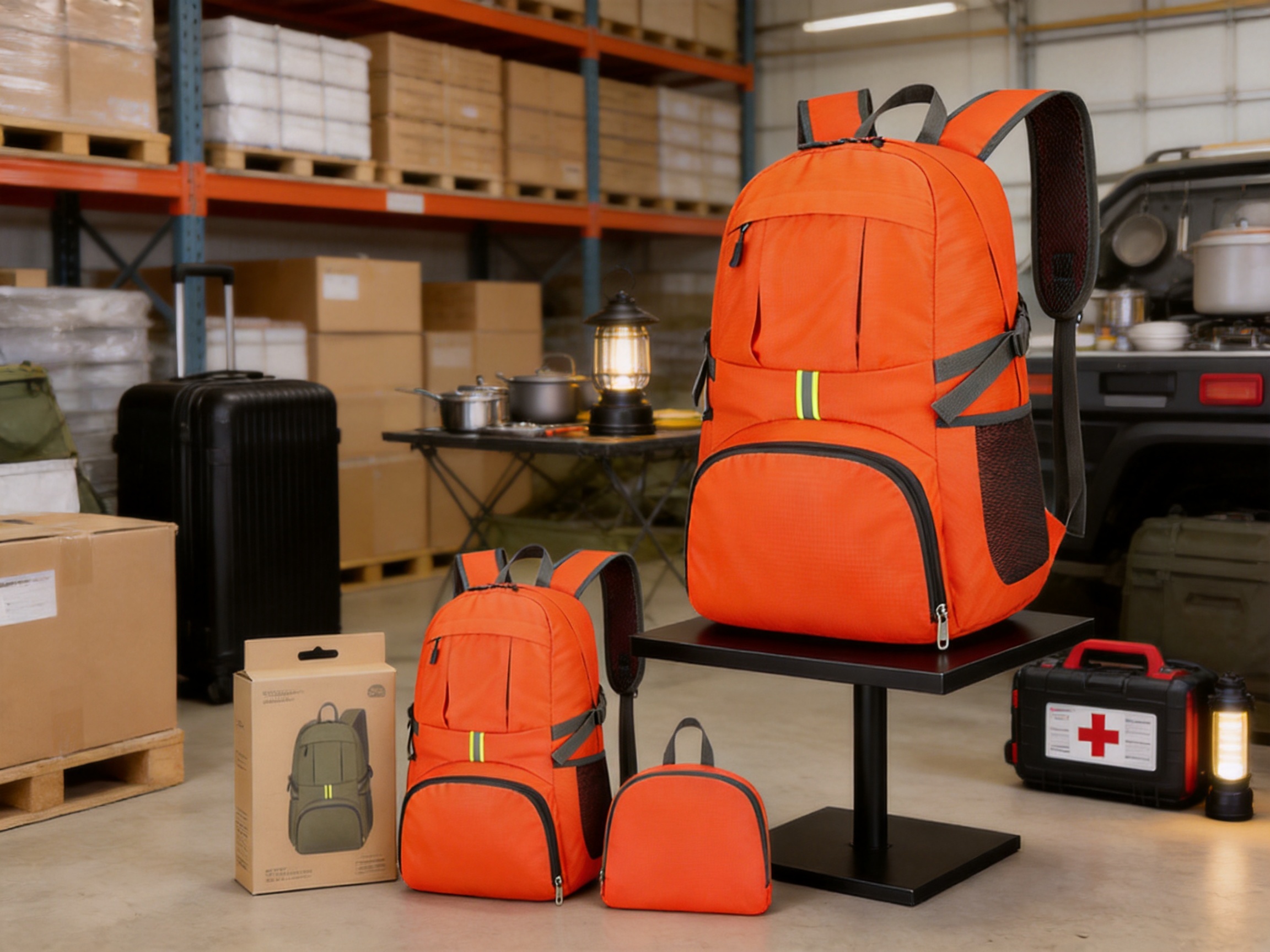
Foldable hiking backpacks have become increasingly important in the outdoor equipment market. Hikers, travelers, campers, and emergency-preparedness users all value products that can provide practical carrying capacity without creating unnecessary storage volume. For retailers and distributors, a well-designed foldable backpack also offers an attractive combination of broad market appeal, efficient logistics, and opportunities for private labeling or product customization.
The Ultralight Folding Outdoor Hiking Backpack is designed for buyers who want a lightweight, packable, and dependable solution for day hikes, short trips, camping, travel, and outdoor backup use. It combines high-density polyester fabric, a lightweight construction, quick folding performance, and a durable surface treatment that helps protect the contents from light rain. Its design is focused on real outdoor use rather than appearance alone, making it suitable for brands and retailers seeking a practical addition to their hiking and camping product lines.
Compared with ordinary casual backpacks, this product is optimized for portability, storage efficiency, and outdoor versatility. Compared with heavier technical backpacks, it offers a more compact and accessible option for users who do not require a rigid frame or an expedition-scale load system. This balance allows the backpack to serve several different consumer groups while remaining easy to store, transport, display, and distribute.
Product Overview and Market Position
A foldable hiking backpack is designed to perform two functions. During use, it must carry personal equipment securely and comfortably. When not in use, it should collapse into a compact form that can be placed inside luggage, a larger backpack, a vehicle compartment, or a storage cabinet. Achieving both functions requires careful attention to textile selection, seam construction, panel design, hardware quality, and folding logic.
The featured backpack uses high-density, ultra-lightweight polyester fabric. This material helps reduce the overall product weight while providing useful resistance to abrasion and tearing. The fabric is suitable for repeated folding and unfolding, which is essential because a packable backpack may be stored and reopened frequently during travel or outdoor activities.
The surface is treated with a durable water-repellent finish. This treatment helps water form droplets and roll away from the fabric surface during light rain or brief exposure to moisture. It is important to understand that water repellency is not the same as complete waterproofing. The product is intended to provide practical protection in normal outdoor conditions, while prolonged heavy rain may require an additional rain cover or waterproof packing system.
The backpack’s large-capacity positioning makes it useful for users who need more space than a small day bag can provide, while its folding construction keeps the storage footprint low when the backpack is not needed. This combination creates a strong value proposition for outdoor retailers because a single product can support multiple sales scenarios, including hiking, travel, camping, festivals, road trips, emergency kits, and everyday outdoor activity.
| Product Characteristic | Practical User Benefit | Retail and Distribution Benefit |
|---|---|---|
| Ultra-lightweight construction | Reduces carrying fatigue during hikes and travel | Lower shipping weight and easier product handling |
| Foldable design | Stores easily in luggage, vehicles, or larger packs | Efficient warehousing and compact retail presentation |
| High-density polyester fabric | Provides useful abrasion and tear resistance | Supports reliable positioning for outdoor customers |
| Water-repellent surface | Helps protect belongings from light rain | Improves suitability for hiking and camping collections |
| Versatile outdoor application | Works for hiking, camping, travel, and backup use | Expands the potential customer base |
Why Foldability Matters in Modern Outdoor Gear
Traditional backpacks often prioritize structure, padding, and load support. These features are useful for heavy loads, but they can also increase weight, storage requirements, and transport costs. A foldable backpack follows a different design philosophy. It emphasizes flexibility, portability, and availability when the user needs an extra carrying solution.
For travelers, a foldable backpack can be packed into a suitcase during the outbound journey and used for local sightseeing, shopping, day trips, or short hikes at the destination. For campers, it can serve as a secondary bag for collecting supplies, carrying water, or organizing equipment away from the main campsite. For hikers, it can function as a lightweight daypack or as a backup bag stored inside a larger trekking pack.
Foldability is also valuable in retail and wholesale operations. A product that collapses into a small volume can reduce warehouse pressure and improve carton utilization. More units can be transported in the same shipment volume, which may contribute to more efficient logistics planning. Retailers can also display the product in a compact folded configuration while showing a sample in its expanded form.
However, foldability should not be judged only by the smallest folded size. A backpack that folds compactly but is difficult to reopen, uncomfortable to carry, or vulnerable to seam damage will not deliver long-term value. A successful design must balance compact storage with usable capacity, textile recovery, stitching strength, and ease of operation.
Features of an Effective Folding System
An effective folding system should allow the user to collapse the backpack quickly without requiring complicated instructions. The fabric should bend naturally along practical panel lines, and the storage pouch or integrated pocket should be easy to access. When reopened, the backpack should regain its functional shape without excessive creasing or distortion.
The folding process should also place limited stress on zippers, seams, webbing attachment points, and pocket openings. Repeated folding can expose weaknesses that may not appear during a single factory inspection. For this reason, folding performance should be considered part of product durability rather than treated as a purely cosmetic feature.
Another important consideration is the relationship between folded volume and product weight. A backpack may fold into a compact shape, but if the folding mechanism adds heavy components, the result may no longer meet the needs of ultralight users. The featured design focuses on a lightweight textile structure that can be stored efficiently without adding unnecessary rigid parts.
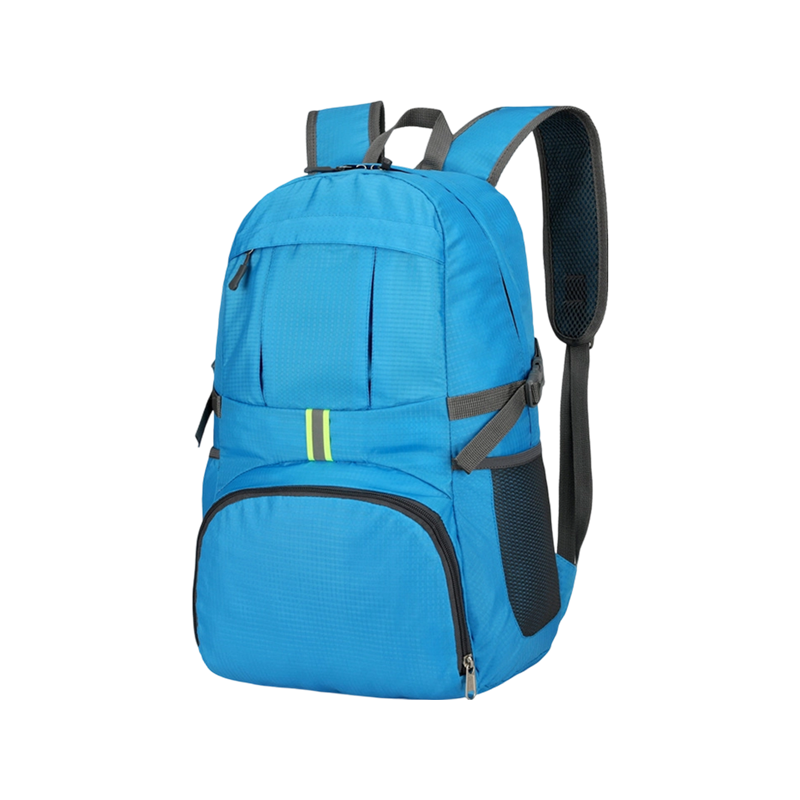
Ultralight folding outdoor hiking backpack, large capacity backpack
Material Advantages of High-Density Polyester Fabric
Material selection has a direct effect on the backpack’s appearance, performance, lifespan, and production consistency. High-density polyester is a practical material for foldable outdoor backpacks because it offers a useful balance between weight, dimensional stability, abrasion resistance, color retention, and manufacturing efficiency.
Polyester fibers generally provide good resistance to stretching and shrinking. This is helpful for a backpack that may be folded, compressed, packed into luggage, and exposed to changing temperatures during transport. Stable fabric dimensions can support more consistent cutting and sewing, helping manufacturers maintain reliable panel alignment and finished measurements.
The high-density construction creates a tighter textile surface than loosely woven fabric. A denser structure can improve resistance to surface wear caused by contact with rocks, vehicle interiors, camping equipment, floors, and other rough surfaces. It can also contribute to a more uniform appearance and a smoother base for printing, coating, or other finishing processes.
Polyester is also widely used in outdoor product manufacturing, which supports broad access to established textile supply chains. This can help brands select different fabric weights, colors, finishes, and performance levels while maintaining a realistic commercial cost. For private-label programs, material familiarity can simplify sampling, quality assessment, and production planning.
Comparison with Common Alternative Materials
Ripstop nylon is often selected for lightweight hiking and backpacking products because of its excellent strength-to-weight ratio and tear-resistant woven structure. It can be an excellent choice for certain technical applications. Polyester, however, offers advantages in dimensional stability, color retention, and general-purpose outdoor use. The most suitable material depends on the intended load, climate, target price, visual requirements, and product positioning.
Lower-density polyester may reduce cost, but it can provide less resistance to abrasion and repeated handling. Very heavy fabrics may increase durability but undermine the lightweight and packable character of the product. The high-density lightweight approach seeks to avoid both extremes by providing practical strength without making the backpack unnecessarily heavy.
PU-coated fabrics may offer enhanced resistance to water penetration, but coatings can add weight and may affect softness, folding behavior, and long-term aging. A durable water-repellent treatment is often a practical solution for a foldable pack intended for light rain and everyday outdoor use. It preserves the flexible character of the fabric while adding a useful level of moisture protection.
| Material Type | Strengths | Considerations for Foldable Backpacks |
|---|---|---|
| High-density polyester | Stable, lightweight, abrasion resistant, good color retention | Well suited to general hiking, camping, and travel products |
| Ripstop nylon | Lightweight and highly resistant to tearing | May require careful specification for surface feel and long-term appearance |
| PU-coated fabric | Improved water resistance | May increase weight and affect flexibility or folding behavior |
| Low-density polyester | Economical and lightweight | May offer lower resistance to abrasion and repeated use |
| Heavy-duty woven fabric | Strong and durable under demanding loads | Can reduce portability and increase shipping weight |
Durability in Real Outdoor Conditions
Outdoor backpacks are exposed to conditions that are more demanding than those found in ordinary daily bags. They may be placed on rough ground, pushed against tree trunks, dragged across vehicle floors, compressed under other equipment, and filled with irregularly shaped objects. A backpack intended for outdoor use must therefore be evaluated as a system rather than by fabric weight alone.
Fabric abrasion resistance is one important factor. High-density polyester helps reduce the likelihood of rapid surface wear, especially in areas that frequently contact clothing, rocks, camping equipment, or luggage. Tear resistance is also significant because a small cut or puncture can expand when the bag is loaded. A stable woven structure helps limit the spread of damage.
Stitching quality is equally important. Stress points around shoulder strap attachments, handles, pocket openings, and the base of the backpack should be carefully constructed. Reinforced stitching, appropriate seam allowances, and controlled thread tension can improve the product’s ability to withstand normal loads and repeated movement.
Zippers and other hardware must operate smoothly without placing excessive stress on the surrounding fabric. A zipper that catches repeatedly can cause users to pull unevenly, increasing the chance of seam distortion or damage. Hardware selection should consider corrosion resistance, slider performance, tooth alignment, pull strength, and compatibility with the fabric construction.
Durability Testing Priorities
Manufacturers and buyers should establish testing procedures that reflect the intended market. Useful evaluations may include fabric abrasion testing, seam strength testing, strap attachment testing, zipper cycling, load testing, folding and unfolding cycles, colorfastness assessment, and water-repellent performance checks.
Testing does not mean that every foldable backpack must meet the same specification as an expedition pack. Instead, the test program should correspond to the product’s actual role. A lightweight pack for day hiking and travel should be assessed for realistic loads and repeated short-term use. If the product is marketed for camping or extended outdoor activity, the testing program should include higher load levels and more demanding stress conditions.
Consistent inspection is particularly important for wholesale buyers. A sample may perform well while a poorly controlled production run produces variation in fabric density, color, stitching, dimensions, or hardware function. A reliable manufacturing partner should use documented specifications and quality checkpoints to reduce such variation.
Comfort and Load Distribution
Lightweight construction does not automatically guarantee comfort. A poorly shaped backpack can create shoulder pressure, instability, or excessive movement even when the total product weight is low. Comfort depends on the relationship between the shoulder straps, back contact area, chest support, load position, and user adjustment.
Breathable shoulder straps can improve ventilation and reduce the feeling of heat during warm-weather hiking. Their width and shape should distribute pressure across a suitable area rather than concentrating it on a narrow section of the shoulder. Adjustable strap length allows different users to position the backpack more effectively.
A chest strap can help stabilize the shoulder straps during walking, especially when the user moves quickly or travels over uneven terrain. It can reduce side-to-side movement and help keep the backpack closer to the body. For larger or more generously sized configurations, an adjustable waist strap may improve load distribution by transferring part of the weight toward the hips.
A foldable backpack may not include the same level of padding or frame support as a large technical trekking pack. This is not necessarily a disadvantage. The product is designed for a different usage category, emphasizing low weight, compact storage, and flexible applications. Buyers should match the backpack to the expected load rather than compare it unfairly with a framed expedition pack.
| Comfort Element | Function During Use | Importance for Product Selection |
|---|---|---|
| Breathable shoulder straps | Improve ventilation and reduce pressure | Important for warm climates and active use |
| Adjustable chest strap | Improves stability and reduces strap movement | Useful for hiking and uneven terrain |
| Waist strap | Helps distribute heavier loads | Valuable for larger-capacity configurations |
| Ergonomic panel layout | Supports natural body movement | Helps improve comfort during extended wear |
| Balanced pocket placement | Prevents uneven loading | Supports better organization and handling |
Capacity and Application Planning
The phrase “large capacity” should be evaluated according to the intended use rather than treated as an absolute measurement. A backpack for short city walks may require only a modest volume, while a camping or extended hiking product may need additional space for clothing, food, water, and safety equipment. Retailers should define the target application clearly so that the product description, images, packaging, and customer expectations remain consistent.
For day hiking, a capacity of approximately 15 to 25 liters can often accommodate water, snacks, a light jacket, basic first-aid items, personal electronics, and small accessories. For camping or longer outdoor trips, a 25 to 35 liter format may provide more practical space for clothing layers, cooking accessories, food, and personal equipment.
Travel users often value compact folding dimensions as much as expanded capacity. They may use the backpack as a secondary bag during sightseeing, shopping, or local transportation. Emergency-preparedness users may prioritize minimal folded volume, quick deployment, and the ability to keep the product stored in a vehicle or household emergency kit.
Mountaineering applications require careful product positioning. A foldable backpack can be useful for lightweight summit approaches, day excursions, or as a backup carrying option. It should not automatically be presented as a replacement for a specialized expedition backpack unless its capacity, suspension system, materials, and safety features have been designed and tested for that purpose.
| Approximate Capacity Range | Typical Application | Key Buyer Priorities |
|---|---|---|
| 10–20 liters | Short walks, city travel, emergency backup | Compact storage, low weight, quick deployment |
| 20–30 liters | Day hiking and light outdoor activities | Comfort, organization, water bottle storage |
| 30–40 liters | Camping and extended hiking | Durability, balanced load support, multiple compartments |
| 40 liters and above | Multi-day trekking and specialized outdoor use | Advanced support system, reinforced construction, tested load capacity |
Water Repellency and Weather Protection
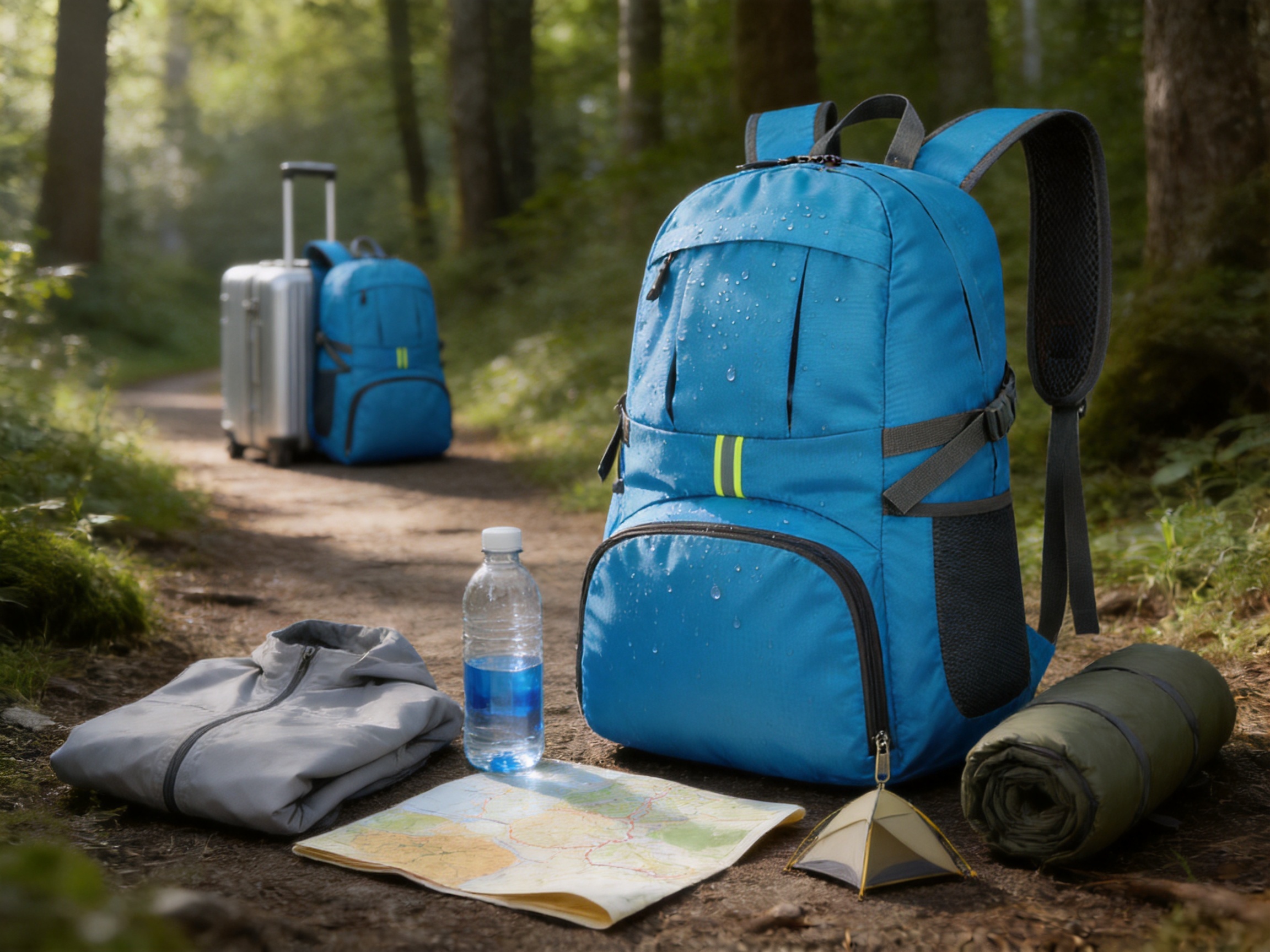
Weather can change quickly during hiking and camping. Even a short shower can make clothing, maps, electronics, or food uncomfortable or unusable if the backpack fabric absorbs water rapidly. A durable water-repellent treatment helps reduce surface wetting and gives users additional time to seek shelter or protect sensitive contents.
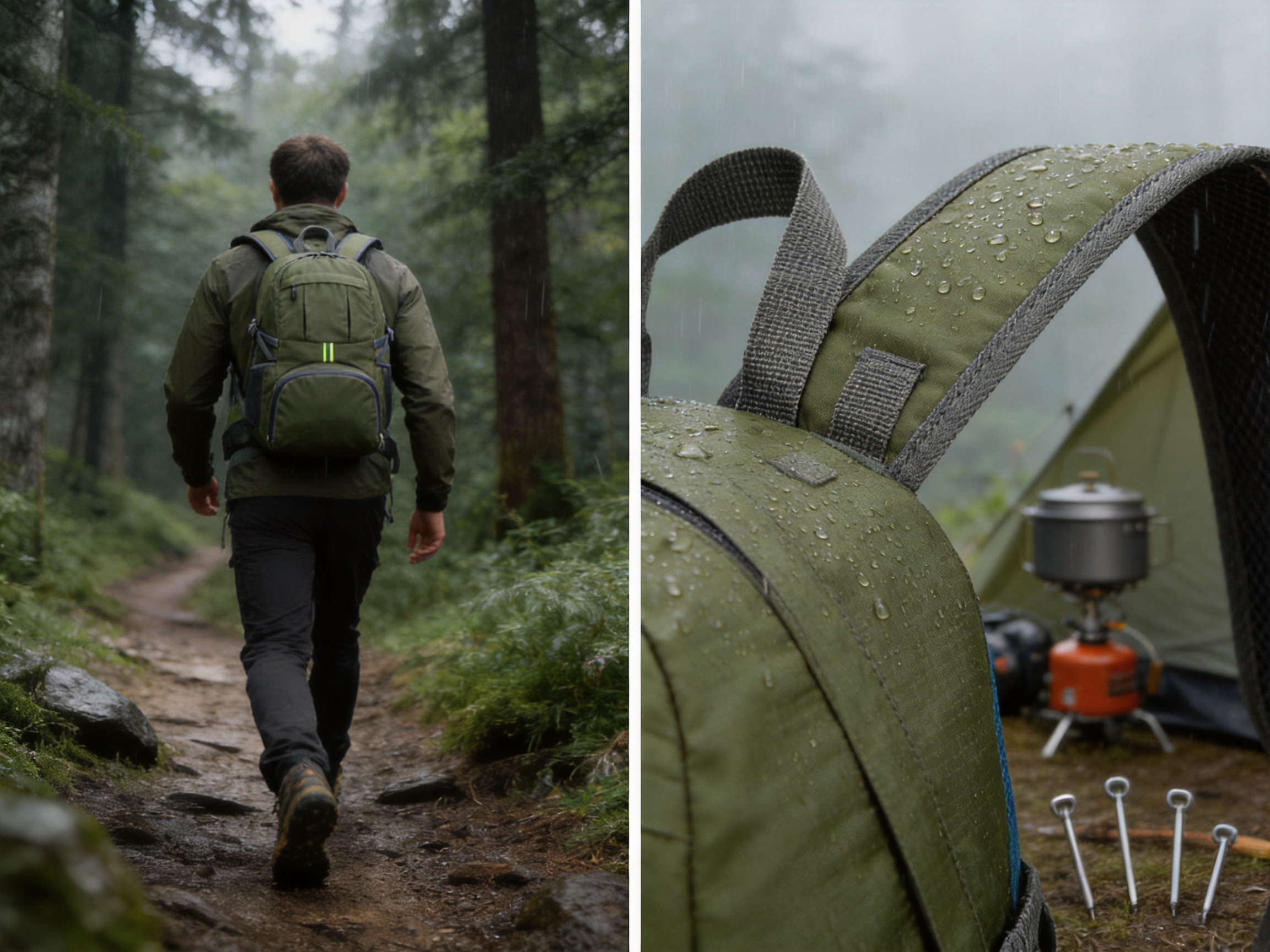
The DWR treatment on the backpack is intended to help resist light rain. Water forms droplets on the surface instead of immediately saturating the textile. This can reduce fabric absorption and help maintain a relatively low product weight in damp conditions. It may also make the backpack easier to wipe clean after exposure to light moisture or outdoor dirt.
Buyers should distinguish between surface water repellency and full waterproof construction. A water-repellent fabric does not guarantee that water cannot enter through zippers, seams, needle holes, or prolonged exposure. For users operating in heavy rain, the backpack may be combined with waterproof pouches, dry bags, or an external rain cover.
Manufacturing quality affects weather performance. Uneven coating application, incomplete treatment, damaged fabric, poorly aligned seams, or defective zipper installation can reduce the practical benefit of the textile finish. Quality control should therefore examine both the fabric itself and the finished backpack.
Maintaining Water-Repellent Performance
Users should follow suitable care instructions to preserve the fabric finish. Excessive washing with harsh detergents, high-temperature drying, aggressive brushing, or chemical contamination may reduce water repellency over time. Gentle cleaning and thorough air drying are generally more appropriate for lightweight treated outdoor fabrics.
Retailers can improve customer satisfaction by communicating the intended weather protection clearly. Accurate descriptions help prevent customers from expecting expedition-grade waterproofing from a lightweight foldable pack. Honest positioning is an advantage because it supports trust, reduces returns, and reinforces the professional image of the product line.
Advantages Over Conventional Casual Backpacks
Conventional casual backpacks are often designed primarily for urban commuting, school use, or general daily carrying. They may have heavier lining materials, thick padding, rigid structures, decorative hardware, or internal compartments intended for laptops and documents. These features can be useful in the city but may add unnecessary weight and bulk during hiking or travel.
The foldable hiking backpack is more focused on outdoor flexibility. Its high-density lightweight fabric supports movement without the burden of a heavy construction. Its ability to collapse into a compact package provides an advantage for travelers and users who need a backup bag. Its water-repellent finish also gives it a more suitable profile for outdoor conditions than many basic casual backpacks.
Another advantage is application flexibility. The same product may be sold through hiking stores, camping retailers, travel shops, online outdoor marketplaces, emergency-preparedness channels, and promotional equipment programs. This broad positioning can help retailers reach more customers without managing a completely different product for every use case.
Advantages Over Heavy Technical Backpacks
Technical backpacks designed for extended trekking or mountaineering may include internal frames, thick suspension systems, extensive padding, reinforced panels, and numerous specialized adjustment points. These features can be essential when carrying heavy loads over multiple days. However, they also increase weight, cost, folded volume, and storage requirements.
A foldable backpack is advantageous when the user’s priority is convenience rather than maximum load support. It can be carried as an emergency alternative, packed inside another backpack, or used for a short excursion after the main equipment has been stored. It is also more approachable for consumers who are new to outdoor activities and do not want to invest immediately in a large technical pack.
For retailers, the product can complement rather than replace heavy technical backpacks. It may serve as an entry-level outdoor product, a travel accessory, a seasonal item, or an add-on purchase. Customers buying tents, sleeping bags, hiking clothing, or travel accessories may also find value in a lightweight packable backpack.
Advantages Over Low-Cost Packable Bags
The market contains many inexpensive foldable bags that prioritize the lowest possible price. Some are made from thin fabric with limited abrasion resistance, weak stitching, basic zippers, and minimal attention to user comfort. Such products may be suitable for occasional light carrying, but they can create dissatisfaction when used in outdoor settings.
A higher-quality foldable hiking backpack differentiates itself through material density, construction consistency, stress-point reinforcement, carrying design, and functional testing. The objective is not simply to make a bag that folds. It is to make a bag that remains usable after repeated folding, transportation, loading, and exposure to normal outdoor conditions.
The featured product’s combination of lightweight polyester, tear and abrasion resistance, water-repellent treatment, and outdoor-oriented design supports a stronger market position than disposable or purely promotional packable bags. Its performance characteristics give retailers meaningful features to communicate instead of relying solely on low pricing.
Manufacturing Process and Quality Control
Advanced manufacturing is not limited to automated machinery. It includes the complete system used to transform a design concept into a stable, repeatable, and scalable product. This system includes material selection, pattern development, sample evaluation, process control, sewing management, hardware installation, inspection, packing, and feedback from actual use scenarios.
For outdoor products, manufacturing decisions should begin with the environment in which the product will be used. A backpack intended for light hiking must account for movement, changing weather, ground contact, repeated opening and closing, and the need to carry irregular items. Product development should therefore focus on practical performance rather than adding features that look attractive but offer limited benefit.
Material Inspection
Before cutting begins, fabric should be checked for color consistency, width, weight, surface defects, coating or treatment uniformity, and dimensional stability. Rolls should be inspected to identify weaving irregularities, stains, holes, or areas with inconsistent density. Such checks help reduce the risk of visible defects appearing in finished products.
Material inspection is also important for color matching across production batches. Outdoor retailers often require consistent appearance across a product range, especially when the backpack is sold alongside other bags, apparel, or camping accessories. Controlled material sourcing and documented approval standards support a more reliable visual result.
Pattern Engineering and Cutting
Pattern engineering determines how the backpack panels will fit together and how forces will move through the finished product. Efficient patterns can reduce fabric waste while preserving essential seam allowances and reinforcement areas. The cutting process must maintain accurate dimensions so that panels align properly during sewing.
For a foldable backpack, pattern design must also consider how the fabric bends and folds. Sharp or poorly positioned seam intersections may create unnecessary bulk or stress. A thoughtful panel layout supports compact storage while helping the expanded backpack maintain a functional shape.
Sewing and Reinforcement
Sewing quality has a direct effect on durability. Operators must control stitch length, thread tension, seam alignment, edge finishing, and reinforcement at high-stress areas. Shoulder strap attachment zones and handle connections deserve particular attention because they receive concentrated pulling forces.
Reinforcement techniques may include additional fabric patches, bar-tack stitching, boxed seams, folded edges, or layered webbing. The appropriate method depends on the design and intended load. Reinforcement should improve strength without adding excessive weight or creating uncomfortable hard points against the user’s body.
Hardware and Component Assembly
Hardware components such as buckles, adjusters, zipper sliders, pulls, webbing, and cord systems should be selected for compatibility with the backpack’s weight and application. Components must be correctly aligned and securely attached. Poorly installed hardware can reduce usability even when the fabric and stitching are otherwise satisfactory.
Zippers should be checked for smooth operation throughout the opening and closing path. Pull tabs should be practical for users wearing gloves or operating the backpack in low-light conditions. Webbing should be cut cleanly and finished to reduce fraying. Each component contributes to the customer’s perception of quality.
Sample Development and Optimization
Sampling is a core part of responsible product development. The first sample may reveal issues related to capacity, folding volume, strap position, pocket access, seam stress, or overall appearance. Repeated sampling allows the design team to address these issues before mass production.
Outdoor products should be evaluated in realistic scenarios, not only on a worktable. A sample may be loaded with clothing, water bottles, food, or camping accessories and then carried during walking tests. It may be folded and unfolded repeatedly, exposed to light rain, placed on rough surfaces, and inspected for changes in shape or stitching.
This process helps manufacturers distinguish between theoretical specifications and practical usability. A feature is valuable when it solves a real problem for the user. A design should not be approved merely because it appears attractive in a catalog or product photograph.
Final Inspection and Packing
Final inspection should verify dimensions, color, fabric condition, stitching, zipper function, hardware attachment, folding operation, labeling, and packaging. Defective products should be identified before shipment rather than after arrival at the buyer’s warehouse.
Packaging should protect the backpack from dust, moisture, compression damage, and handling marks during transport. Because the product is foldable, packing instructions should prevent unnecessary permanent creases or distortion. Carton planning should also consider the most efficient arrangement of folded units while avoiding excessive compression.
Manufacturing Strengths of a Reliable Outdoor Partner
CragHaven Outdoor operates as an outdoor brand and cross-border manufacturing partner based in Hangzhou, China. Its focus on mountaineering, hiking, and camping scenarios supports a product development approach centered on practical outdoor use. The company’s manufacturing philosophy emphasizes material reliability, careful sampling, repeated testing, and stable production rather than short-term catalog expansion.
This approach can reduce uncertainty for international buyers. Outdoor retailers need suppliers that understand product performance, market expectations, packaging requirements, communication standards, and the consequences of inconsistent production. A manufacturing partner that participates in design and optimization can provide more value than a factory that only reproduces a basic specification.
The company’s stated principles are based on designing for weather, terrain, and time. In practical terms, this means considering how a product will be used in changing environments, how its materials will age, and how its construction will respond to repeated handling. These principles are particularly relevant to foldable backpacks because the product must withstand both outdoor use and repeated storage cycles.
Another strength is the connection between product development and China’s mature manufacturing system. Efficient textile, sewing, hardware, packaging, and logistics networks can support scalable production when they are managed with clear specifications and quality procedures. For global customers, this can create opportunities for stable replenishment, private labeling, customized colors, and product-line development.
Professional communication is also important in international sourcing. Buyers need clear information about materials, samples, tolerances, packaging, production timing, inspection procedures, and customization options. A supplier that communicates in a structured and market-oriented way can help customers make decisions more efficiently and reduce misunderstandings during development.
Private Label and OEM Considerations
Foldable hiking backpacks are suitable for private-label and OEM programs because the basic product concept can be adapted to different retail identities and customer segments. Buyers may request specific colors, woven labels, printed logos, packaging formats, hangtags, zipper pulls, or carton markings, subject to development and order requirements.
Customization should be approached carefully. Adding too many components or changing the fabric weight can affect folding volume, product weight, cost, and production stability. A professional development process should evaluate the effect of each requested modification before approving a final specification.
Color selection is especially important for outdoor retail. Earth tones, neutral colors, high-visibility shades, and seasonal colors may appeal to different markets. The selected color should be assessed for batch consistency, colorfastness, compatibility with printing, and relationship to the brand’s wider product range.
Packaging can also influence the product’s commercial performance. A compact folded presentation may be suitable for online fulfillment and travel retail, while an expanded sample may communicate capacity more effectively in a physical store. Product cards should explain the intended uses, folding method, material characteristics, and weather limitations in clear language.
Logistics and Commercial Efficiency
Packable products can offer logistical advantages because their folded form occupies less space than many conventional backpacks. This may support more efficient warehouse storage and shipment planning. The actual benefit depends on the folded dimensions, packaging method, carton configuration, order quantity, and transportation route.
Lower product weight can also simplify handling during fulfillment. For online retailers, shipping weight is an important commercial consideration because it can influence delivery costs and customer purchasing decisions. A lightweight product may be easier to include in bundles or promotional packages with other outdoor accessories.
Retailers should request accurate packing information before placing large orders. Important details include folded product dimensions, unit net weight, packed weight, carton dimensions, carton quantity, labeling requirements, and loading recommendations. Accurate logistics data helps buyers calculate landed cost and plan warehouse space.
Efficient logistics should not compromise product protection. Excessive compression may damage fabric appearance, stress zippers, or make the backpack difficult to display. The packing method should balance volume efficiency with the need to preserve the product’s condition throughout transportation.
How Retailers Can Position the Product
The backpack can be positioned as a versatile outdoor essential rather than a single-purpose mountaineering product. Suitable sales messages may focus on lightweight portability, compact storage, day hiking, travel convenience, camping support, and emergency readiness.
For hiking retailers, the product can be presented as a practical daypack or secondary pack. For travel retailers, it can be promoted as a suitcase-friendly bag for destination activities. For camping stores, it can be offered as a lightweight utility backpack for short trips around a campsite. For emergency-preparedness channels, its compact folded form and quick deployment can be emphasized.
Retail descriptions should use accurate performance language. Terms such as “water repellent,” “suitable for light rain,” “abrasion resistant,” and “packable” are more precise than claiming the backpack is completely waterproof or suitable for every mountaineering expedition. Clear language protects the buyer’s reputation and helps customers select the right product.
Visual merchandising should show both the folded and expanded forms. Customers need to understand the storage advantage, the available carrying space, and the intended method of use. Images can also show common contents such as a light jacket, water bottle, snacks, travel accessories, or camping items, provided that the presentation accurately reflects the product’s usable capacity.
Buyer Checklist for Product Evaluation
Before selecting a foldable hiking backpack for wholesale or private-label distribution, buyers should review the product from several perspectives. A low unit price alone does not demonstrate strong value. Product durability, consistency, usability, service support, and long-term availability can have a greater effect on commercial success.
Confirm the fabric composition, density, weight, color options, and surface treatment.
Review the intended capacity and compare it with the target user application.
Check folded dimensions and confirm that the backpack fits the planned travel or storage scenario.
Evaluate shoulder strap construction, adjustability, chest support, and load distribution.
Inspect zipper movement, buckle quality, webbing attachment, and stress-point reinforcement.
Ask how water repellency, seam strength, abrasion resistance, and folding durability are evaluated.
Request samples and test them with realistic loads rather than evaluating appearance alone.
Confirm packaging, labeling, carton information, and private-label requirements.
Discuss production capacity, quality control, lead times, replenishment, and communication procedures.
Ensure that marketing claims accurately reflect the product’s tested performance.
Care and Use Recommendations
Proper care can extend the useful life of a lightweight foldable backpack. Users should avoid carrying sharp objects without protective packing because concentrated edges can damage fabric. Heavy loads should remain within the product’s intended application, and items should be distributed evenly to reduce strain on seams and shoulder attachments.
After exposure to light rain, the backpack should be allowed to dry fully before it is folded and stored. Long-term storage while damp can encourage odors, staining, or material deterioration. Dirt should be removed using gentle cleaning methods appropriate for treated polyester fabric.
The backpack should be folded along its natural structure rather than forced into an excessively tight shape. If it includes an integrated pouch, the pouch should be used according to the recommended folding method. Avoiding unnecessary compression helps preserve the fabric, zipper, and seam structure.
Users should also inspect the backpack periodically. Loose threads, damaged buckles, zipper problems, or weakened strap attachment points should be addressed before the product is used in demanding conditions. Routine inspection is especially important when the backpack is used for camping, travel, or emergency equipment storage.
Q&A
What is the main purpose of a foldable hiking backpack?
The main purpose is to provide a practical carrying solution that can be stored in a compact form when not in use. It can support day hiking, travel, camping, emergency backup, and other lightweight outdoor activities. Its value comes from combining usable capacity with portability and storage efficiency.
Is this backpack suitable for heavy mountaineering loads?
The backpack is best positioned for lightweight hiking, short trips, travel, camping support, and backup use. Customers carrying heavy technical equipment over multiple days may require a specialized framed mountaineering pack with a more advanced suspension system. Buyers should match the product to the expected load and activity.
Does the DWR treatment make the backpack completely waterproof?
No. The DWR surface treatment helps protect the fabric from light rain and brief moisture exposure, but it does not make the entire backpack fully waterproof. Water may still enter through zippers, seams, needle holes, or prolonged exposure. Additional waterproof protection may be appropriate in heavy rain.
What material is used in the backpack?
The product uses high-density, ultra-lightweight polyester fabric. This material provides a balance of low weight, abrasion resistance, tear resistance, dimensional stability, and suitability for repeated folding.
How does the product compare with a basic promotional packable bag?
The product is developed for outdoor use rather than occasional promotional carrying alone. Its value is supported by higher-density fabric, outdoor-oriented construction, water-repellent treatment, carrying considerations, and attention to folding durability. Buyers should still evaluate samples and specifications according to their intended market.
What capacity is suitable for day hiking?
A capacity between approximately 20 and 30 liters is commonly suitable for day hiking because it can accommodate water, food, clothing layers, personal items, and basic safety equipment without becoming unnecessarily bulky. The exact choice depends on the user’s equipment and the product configuration.
Can the backpack be used for travel?
Yes. Its compact folded form makes it suitable for placement inside a suitcase or larger travel bag. Once at the destination, it can be used for sightseeing, shopping, local transportation, short walks, or day excursions.
What should buyers test before placing a wholesale order?
Buyers should test material quality, folded size, expanded capacity, zipper function, stitching, strap comfort, load stability, water repellency, and repeated folding performance. The sample should be evaluated with realistic contents and under conditions that reflect the target market.
Can the backpack support private-label customization?
Private-label possibilities may include colors, labels, logos, packaging, hangtags, and selected component changes. Each customization should be reviewed for its effect on cost, minimum order quantity, lead time, folding volume, durability, and production consistency.
Why is manufacturing experience important for this product?
A foldable backpack must balance several potentially conflicting requirements: low weight, compact storage, usable capacity, strength, comfort, and weather resistance. Experienced manufacturing processes help manage these requirements through appropriate material selection, sample testing, accurate cutting, controlled sewing, component inspection, and final quality checks.
How can a retailer describe the product accurately?
Retailers can describe it as an ultralight, foldable, packable outdoor hiking backpack made with high-density polyester fabric and treated for water repellency in light rain. They should avoid describing it as fully waterproof or as a replacement for every type of technical mountaineering backpack unless those claims are supported by specific testing.
Conclusion
The Ultralight Folding Outdoor Hiking Backpack responds to a clear need in the outdoor market: carrying flexibility without excessive storage volume. Its high-density lightweight polyester fabric provides practical abrasion and tear resistance, while the foldable design supports travel, hiking, camping, emergency backup, and efficient retail distribution. The water-repellent surface treatment adds useful protection for light rain without compromising the flexible character expected from a packable product.
Its strongest competitive advantage is balance. It is more outdoor-oriented than a basic casual backpack, more compact and accessible than many heavy technical packs, and more durable and functional than low-cost disposable packable bags. This positioning gives buyers the opportunity to offer a product that serves multiple customer groups while maintaining a clear and credible performance profile.
Manufacturing quality is central to the product’s value. Reliable fabric sourcing, careful pattern engineering, precise cutting, reinforced sewing, dependable hardware installation, sample optimization, repeated testing, and final inspection all contribute to consistent results. CragHaven Outdoor combines outdoor product knowledge with cross-border manufacturing capabilities to help global retailers develop functional, reliable, and long-term value gear.
For buyers seeking a foldable hiking backpack, the most important decision is not simply whether the product looks compact or carries a large amount of equipment. The key question is whether the product can maintain its performance through repeated use, folding, transport, and changing outdoor conditions. A carefully developed backpack supported by disciplined manufacturing provides a stronger foundation for customer satisfaction, private-label growth, and long-term retail partnerships.
References
1. Outdoor Industry Association. Outdoor Participation and Consumer Equipment Trends.
2. American Society for Testing and Materials. Standard Practices for Textile Testing and Performance Evaluation.
3. International Organization for Standardization. Textile Testing Methods for Colorfastness, Dimensional Stability, and Fabric Performance.
4. European Committee for Standardization. General Guidance for Consumer Product Safety and Textile Product Quality.
5. Textile Exchange. Preferred Fiber and Material Considerations for Outdoor Product Development.
6. Association of the European Sporting Goods Industry. Outdoor Equipment Market and Product Responsibility Guidance.
7. International Trade Centre. Practical Considerations for International Sourcing, Packaging, and Quality Management.
8. Outdoor product development principles concerning material selection, repeated sampling, field testing, seam construction, and manufacturing consistency.
Product: Ultralight folding outdoor hiking backpack, large capacity backpack




- Phone: +86-15968800379
- E-mail: [email protected]
- Address: Room 1002, Huishang Building, Gongshu District, Hangzhou City, Zhejiang Province.
Copyright © CragHaven Outdoor All Rights Reserved. Outdoor Gear Manufacturers Wholesale Mountaineering Camping Gear Suppliers
