

 English
 Deutsch
 Español
 Français

Outdoor Aluminum Folding Camping Table: Lightweight Strength for Cooking, Dining, and Basecamp Use
Content
- 1 Why Aluminum Is a Practical Material for Portable Outdoor Tables
- 2 Roll-Up Tabletop Design for Fast Setup and Compact Storage
- 3 Frame Geometry and Stability in Outdoor Conditions
- 4 Cross-Bracing and Torsional Rigidity
- 5 Manufacturing Process and Quality Control
- 6 Wind Testing and Engineering Validation
- 7 Advantages Over Basic and Mass-Market Folding Tables
- 8 Use in Camping, Cooking, Hiking, and Mountaineering
- 9 OEM and Wholesale Manufacturing Support
- 10 Recommended Use and Care
- 11 Q&A: Common Questions About the Aluminum Folding Camping Table
- 11.1 Q1: What is the main advantage of an aluminum folding camping table?
- 11.2 Q2: Is the egg roll tabletop strong enough for cooking and dining?
- 11.3 Q3: How does X-bracing improve table performance?
- 11.4 Q4: Is a table with H-bracing suitable for windy campsites?
- 11.5 Q5: Can the table be used on uneven ground?
- 11.6 Q6: How should the table be used in strong wind?
- 11.7 Q7: What makes this product suitable for OEM buyers?
- 11.8 Q8: How does the manufacturer control production quality?
- 11.9 Q9: Is the table intended for ultralight backpacking?
- 11.10 Q10: How can buyers request a customized version?
- 12 Conclusion
- 13 References
- 14 Product: Outdoor aluminum alloy folding table, camping table, egg roll table
Outdoor Aluminum Folding Camping Table: Lightweight Strength for Cooking, Dining, and Basecamp Use
A dependable table can transform an outdoor campsite from a temporary stopping point into a functional basecamp. Whether it is used for preparing meals, organizing climbing equipment, holding a stove, serving food, or creating a clean work surface beside a tent, a camping table must perform in conditions that are very different from those found indoors. Uneven ground, sudden wind, moisture, sand, repeated folding, transportation, and limited storage space all place demands on the product.
The outdoor aluminum alloy folding table, also known as a camping table or egg roll table, is designed to address these demands through a combination of lightweight aerospace-grade aluminum alloy, a roll-up tabletop, a folding support structure, and portable storage. It is suitable for camping, hiking basecamps, mountaineering support areas, outdoor cooking, picnics, fishing trips, beach use, and temporary outdoor dining.
Its main value is not simply that it folds. Many portable tables fold, but the quality of the materials, the geometry of the frame, the accuracy of the joints, the reliability of the tabletop connection, and the way the product is tested determine whether it remains stable after repeated use. A well-designed folding table should be easy to transport without feeling fragile, quick to assemble without tools, and stable enough for practical outdoor work.
CragHaven Outdoor develops and supplies outdoor equipment for global retailers, outdoor brands, distributors, and OEM buyers. Based in Hangzhou, China, the company combines outdoor product understanding with China’s established manufacturing capabilities. Its approach is centered on actual use scenarios, including mountain campsites, coastal locations, windy ridges, family campgrounds, and long-term repeated use.
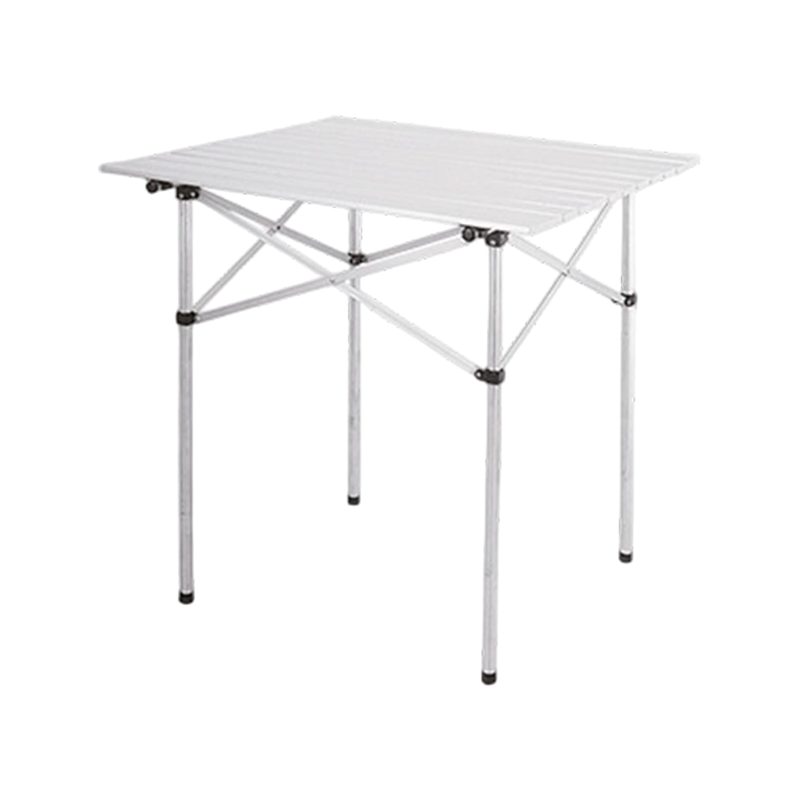
Outdoor aluminum alloy folding table, camping table, egg roll table
Why Aluminum Is a Practical Material for Portable Outdoor Tables
Material selection is one of the first factors that separates a useful camping table from a low-cost temporary product. A table used outdoors must balance low weight, rigidity, corrosion resistance, surface durability, and manufacturing consistency. Aluminum alloy is well suited to this combination of requirements.
The selected aerospace-grade aluminum alloy used in this table provides a high strength-to-weight ratio. Compared with many steel alternatives, aluminum can reduce the carrying burden for campers and retailers while still supporting the rigid frame needed for cooking and dining. Lower weight is particularly valuable for users who carry equipment from a vehicle to a campsite, move between campsites, or transport gear on hiking and mountaineering approaches.
Aluminum is also naturally resistant to corrosion. Outdoor tables may be exposed to rain, humidity, condensation, salt spray, mud, and food spills. When properly processed and finished, aluminum alloy is suitable for these environments and is easier to maintain than materials that are more vulnerable to rust. This does not mean the table should be stored wet or neglected. Cleaning, drying, and appropriate storage remain important, especially after beach use or exposure to saltwater.
The material is also compatible with precise extrusion, cutting, forming, machining, and surface treatment processes. This allows the manufacturer to produce repeatable frame components and tabletop slats with controlled dimensions. Consistency is important in folding products because small dimensional errors can affect hinge movement, leg alignment, locking action, and the smooth installation of the roll-up tabletop.
Strength Without Unnecessary Bulk
A portable table should not be made heavy merely to create a sense of strength. Excessive material can make the table more difficult to carry and reduce its appeal to travelers. The better approach is to place material where it contributes most to structural performance. Tubular frame sections, reinforced pivot areas, accurate connectors, and carefully supported tabletop slats can provide useful rigidity without making the complete product unnecessarily bulky.
The roll-up tabletop follows this principle. Individual aluminum slats create a firm working surface when connected to the support frame, while the tabletop can be rolled or folded into a compact package for transport. This arrangement is more space-efficient than a large rigid panel and supports a portable product format suitable for storage in a vehicle, tent vestibule, equipment room, or retail package.
Corrosion Resistance for Multiple Outdoor Environments
Camping environments vary widely. A table may be used in a forest with high humidity, on a dry mountain plateau, beside a lake, or on a sandy beach. Aluminum alloy is suitable for these different conditions because it does not rely on a conventional steel structure that can develop red rust when the finish is damaged.
For long-term product quality, the alloy must be combined with appropriate surface finishing and quality control. Surface treatment helps improve appearance, cleanability, and resistance to ordinary outdoor wear. Manufacturing teams must also pay attention to contact between dissimilar metals, drainage around joints, exposed cut ends, and areas where moisture or dirt may collect.
Roll-Up Tabletop Design for Fast Setup and Compact Storage
The egg roll tabletop is one of the product’s most recognizable features. Instead of requiring a large solid panel to be carried as one piece, the tabletop consists of connected aluminum sections that can be rolled or folded into a compact form. This provides a practical balance between usable surface area and transport efficiency.
Setup is straightforward. The user unfolds the supporting frame, positions the tabletop sections, and connects or secures the tabletop to the frame. The process requires no complicated tools and is suitable for users who want to prepare a cooking or dining area quickly after arrival at camp.
When packed, the table occupies considerably less space than a rigid outdoor table of comparable working area. The included portable storage bag protects the folded components from contact with other equipment and makes carrying more convenient. A storage bag also helps retailers present the product as a complete portable system rather than as a loose collection of frame parts and slats.
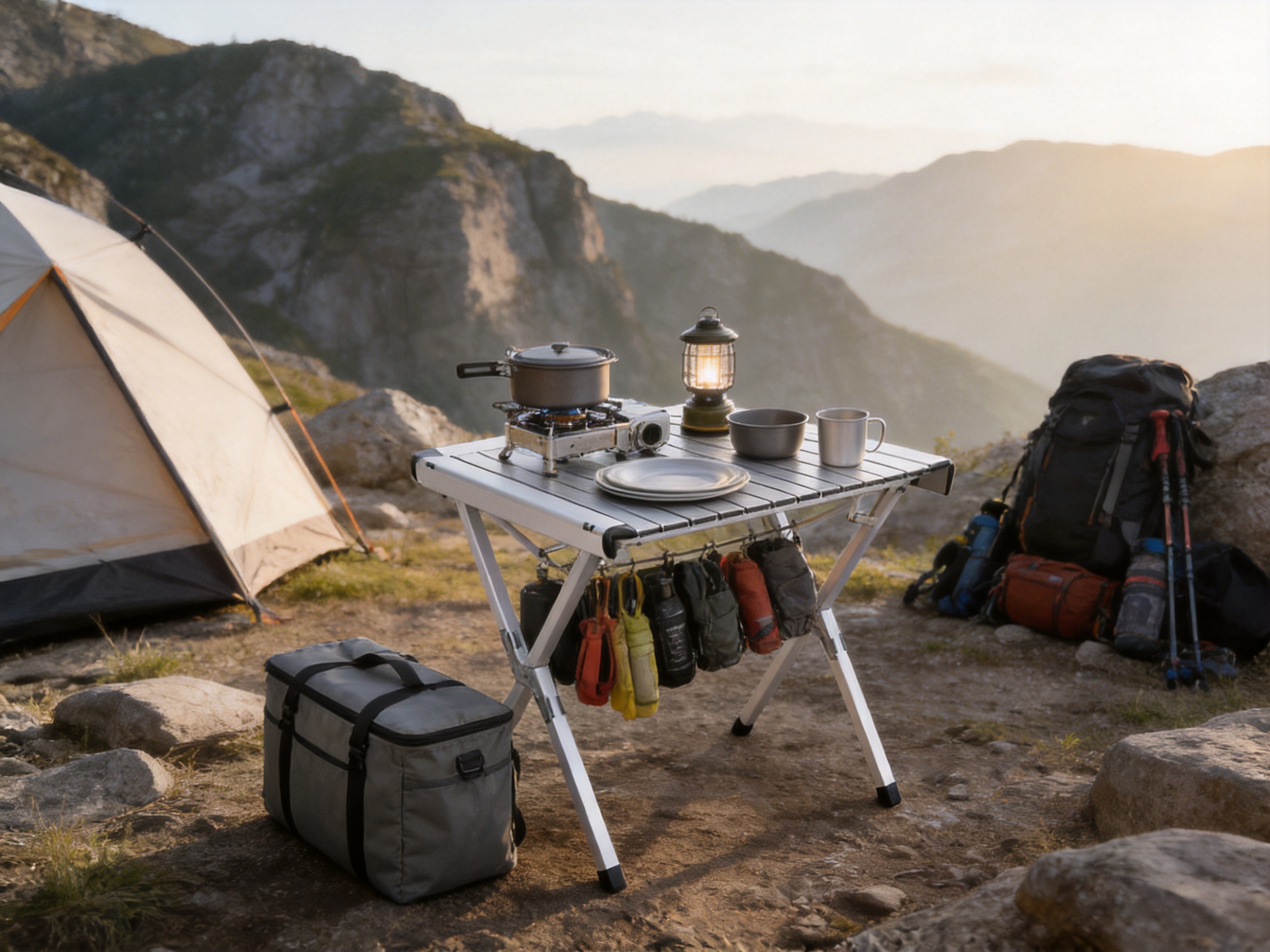
The tabletop design is useful for several outdoor activities. It can support cookware during meal preparation, provide a place for plates and beverages, organize lanterns and small equipment, or serve as a general work surface. In a basecamp setting, it can help separate cooking equipment from the ground, reducing contact with dirt, stones, and moisture.
Frame Geometry and Stability in Outdoor Conditions
Stability is more complex than maximum static load. A table can support a heavy object when the object is placed in the center, yet still sway or twist when exposed to a gust of wind or an uneven sideways force. For this reason, the frame geometry must be considered together with the tabletop, leg spread, brace position, joint construction, and center of gravity.
Wind applies pressure to the tabletop and frame. A typical 70 by 70 centimeter tabletop exposed to a wind speed of approximately 40 kilometers per hour may experience a lateral force of about 37 newtons on the tabletop alone, depending on the shape, orientation, and drag characteristics of the complete product. At approximately 60 kilometers per hour, the lateral force can exceed 83 newtons. Actual conditions vary, but these figures show why a lightweight table still needs a carefully designed base.
Wind is also dynamic rather than constant. Gusts can temporarily produce much higher forces than the average wind speed. A table may move slightly under a steady breeze but experience a sudden shift when a gust strikes the tabletop corner. The resulting force can create sliding, leg splay, tipping, or twisting.
Leg Splay and Footprint Width
Legs that angle outward from vertical create a wider footprint at ground level. This wider base improves resistance to side loading and reduces the likelihood that the table will pivot around a narrow leg position. A splay angle between approximately 8 and 12 degrees can offer a useful balance between stability and folded packability.
Vertical legs may save material and simplify folding, but they generally provide a narrower support base. A modest outward angle can increase effective footprint width without requiring a dramatic increase in overall table dimensions. The result is a more stable platform for cooking and dining, particularly on firm and reasonably level surfaces.
The exact performance still depends on leg length, ground contact, hinge stiffness, frame width, and load distribution. A wider base cannot eliminate the need for sensible use. Users should avoid placing the table on unstable slopes and should secure it or lower it in unusually strong wind.
Height and Center of Gravity
Table height affects both usability and wind response. A standard dining or food-preparation height of approximately 70 centimeters is comfortable for many users. It creates sufficient clearance for cookware, storage boxes, and seating arrangements. However, a taller table also places the center of pressure farther above the ground, increasing the overturning moment generated by a lateral wind force.
A lower configuration, such as approximately 50 centimeters, reduces the lever arm between the wind force and the ground contact area. This can reduce tipping tendency in exposed conditions. For users who camp in variable weather, adjustable or alternative leg positions can provide useful flexibility. The table can be used at a comfortable dining height in calm conditions and positioned lower when wind becomes a concern.
Square and Rectangular Footprints
A square tabletop offers balanced use from all sides and is convenient for group dining. A rectangular tabletop can provide a more directional layout and may reduce wind exposure when its shorter side is oriented toward the prevailing wind. For example, a 70 by 50 centimeter surface presents less windward area than a 70 by 70 centimeter surface when the 50 centimeter side faces the wind.
However, a rectangular shape can produce a longer lever arm along its extended dimension. This may increase certain twisting forces when the wind strikes a corner. The best configuration depends on the intended use, expected orientation, support layout, and bracing arrangement.
Cross-Bracing and Torsional Rigidity
Cross-bracing helps keep the legs in their designed positions when the table is subjected to lateral forces. It also helps transfer loads between opposing sides of the frame. Without adequate bracing, a folding table may not immediately collapse, but it can develop excessive movement, progressive twisting, or an unstable rocking sensation.
X-Bracing
X-bracing uses diagonal members that cross between opposing parts of the frame. The triangular load path created by diagonal members is efficient for resisting side-to-side movement. In internal comparison testing, X-braced tables showed approximately 65 to 75 percent less lateral deflection under a 60 kilometer-per-hour wind condition than comparable tables without bracing.
The trade-off is added material and greater mechanical complexity. X-braces may add approximately 15 to 20 percent weight compared with an unbraced frame, depending on the configuration. The braces must also be designed so they do not obstruct the folding action or create pinch points for the user.
H-Bracing
H-bracing uses horizontal members to connect the legs and create a more rigid perimeter. It is relatively simple to manufacture and can fold efficiently. Compared with an unbraced table, an H-braced structure may provide a 30 to 40 percent improvement in lateral stability in comparable tests.
H-bracing alone may not provide the same torsional resistance as a diagonal system. The frame can still twist if the legs move relative to the tabletop or if wind strikes a corner. For general recreational use in sheltered campsites, H-bracing may be adequate. For exposed locations and premium products, a combined system can offer more balanced performance.
Hybrid X and H-Bracing
A hybrid structure combines diagonal bracing with horizontal frame support. The diagonal members resist lateral deformation while the horizontal members help control the relationship between the legs and the upper frame. This creates a more complete load path and improves resistance to both rocking and twisting.
The WindMaster frame developed by CragHaven Outdoor uses X-bracing along the long axis and an H-brace near the top of the leg assembly. Internal testing indicated an 82 percent reduction in lateral deflection and torsional twist below 2 degrees under a 70 kilometer-per-hour wind condition, while adding approximately 12 percent weight compared with a basic H-braced frame. Exact performance depends on product size, surface condition, loading, and test configuration, so such figures should be understood as engineering test results rather than a guarantee for every field situation.
Why Perimeter Straps Are Not Equivalent to Rigid Braces
Some ultralight tables use fabric or cord straps around the legs. These components can help limit leg splay while adding very little weight. Their main function is tension control, not rigid structural triangulation. Because straps do not resist compression in the same way as metal braces, they provide limited torsional stiffness.
Internal testing of strap-braced configurations showed only a 10 to 15 percent improvement in lateral stability and approximately 8 to 10 degrees of twist under a 60 kilometer-per-hour wind condition. Such a design may be suitable for light-duty use in sheltered areas, but it is less appropriate for exposed campsites, cooking tasks, or users who require a firm surface.
| Frame configuration | Leg splay | Bracing pattern | Lateral deflection at 60 km/h | Torsional twist | Added weight | Recovery time |
|---|---|---|---|---|---|---|
| No bracing, vertical legs | 0 degrees | None | 48–55 mm | 9.2–11.5 degrees | Baseline | More than 6 seconds |
| H-brace, moderate splay | 5 degrees | Horizontal perimeter | 32–38 mm | 6.5–8.0 degrees | 6 percent | 4–5 seconds |
| X-brace, moderate splay | 5 degrees | Single-plane diagonal cross | 15–18 mm | 3.5–4.5 degrees | 18 percent | 2.0–2.5 seconds |
| H-brace with wider splay | 10 degrees | Perimeter and mid-height H-brace | 12–15 mm | 3.0–3.8 degrees | 10 percent | 1.8–2.2 seconds |
| X and H hybrid | 12 degrees | X-brace on long axis and upper H-brace | 7–9 mm | 1.6–2.0 degrees | 14 percent | 1.2–1.5 seconds |
| Perimeter strap, wide splay | 10 degrees | Fabric or cord tension | 42–48 mm | 8.5–10.2 degrees | 2 percent | 5–6 seconds |
The comparison shows why a premium camping table should be evaluated by more than packed weight. A very light table may be attractive in a catalog, but excessive movement can reduce its usefulness and create safety concerns when cookware, hot liquids, or valuable equipment is placed on the surface.
Manufacturing Process and Quality Control
Product performance is determined not only by the design concept but also by how consistently the design is manufactured. Folding furniture contains multiple moving and connected components. If one pivot, tube end, tabletop connector, or locking point is produced outside its intended tolerance, the final table may feel loose, bind during assembly, or develop premature wear.
Material Selection and Incoming Inspection
Manufacturing begins with material selection. Aluminum alloy tubing and tabletop sections are reviewed for dimensional consistency, surface condition, alloy identification, and suitability for the intended forming and finishing processes. Incoming inspection helps prevent variations in wall thickness, hardness, straightness, or surface quality from entering the production line.
Other components, including stainless steel pivot pins, fasteners, plastic connectors, end caps, feet, and carrying-bag materials, are also checked against approved specifications. A folding table is a system, so the quality of a single aluminum component cannot compensate for an unreliable hinge or weak connector.
Precision Cutting and Forming
Aluminum tubes and profiles are cut to controlled lengths before bending, drilling, swaging, or assembly. Precision cutting supports accurate frame geometry and helps ensure that the legs contact the ground evenly. Forming operations must maintain the designed angle and avoid deformation that could weaken the tube or interfere with folding.
Where tube ends are used in structural joints, double-roll swaging can create a more secure and consistent connection. This process shapes the tube end so that it engages with the corresponding component and transfers force more effectively. The objective is to reduce joint play and create a stable mechanical connection after repeated folding cycles.
Joint Engineering
Joints are especially important in a portable table because they experience repeated movement, vibration during transport, and changing loads during use. CragHaven Outdoor uses stainless steel pivot pins at frame intersections and pays close attention to the fit between pins, tubes, brackets, and washers.
The stated joint articulation tolerance is maintained at approximately plus or minus 0.15 millimeters, compared with a commonly observed industry tolerance of approximately plus or minus 0.5 millimeters. Tighter control can help reduce looseness and unwanted movement, although durability also depends on material hardness, surface treatment, load conditions, and cycle testing.
Surface Treatment and Finishing
Surface finishing improves the appearance and practical durability of aluminum components. A consistent finish helps protect the surface from ordinary abrasion, makes the table easier to clean, and supports a uniform appearance across production batches. Finishing specifications can be adapted for OEM programs, including approved colors, textures, logos, and packaging requirements.
Quality control should include visual inspection for scratches, discoloration, incomplete coverage, sharp edges, and contamination. Functional inspection is equally important. A visually attractive table that does not assemble smoothly or lock securely does not meet the needs of professional outdoor users.
Assembly and Functional Testing
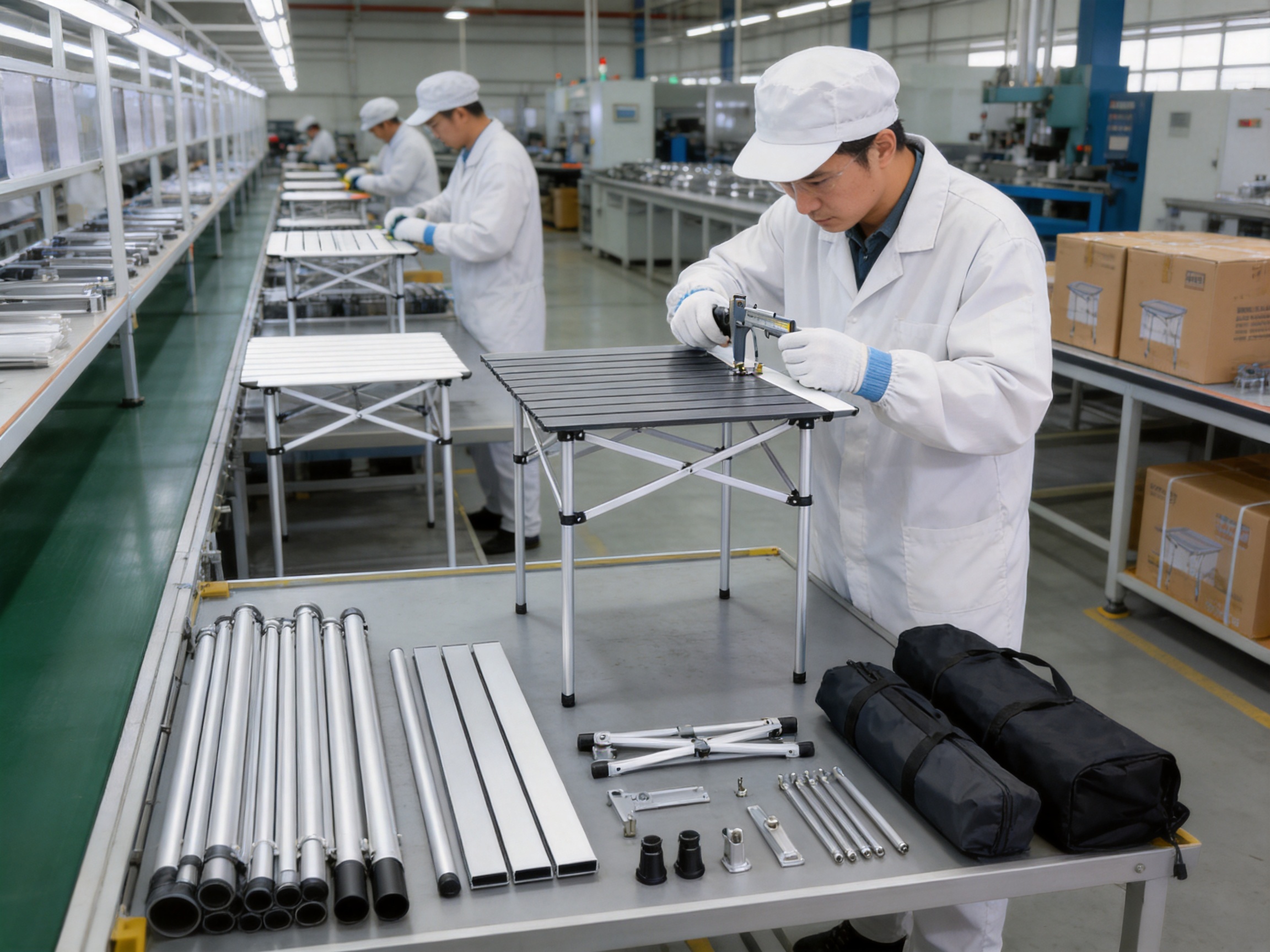
During assembly, workers verify the orientation of the frame, the operation of folding points, the installation of tabletop slats, and the connection of the storage accessories. Finished products should be opened and closed according to a defined procedure to identify interference, loose joints, incorrect component placement, or excessive operating force.
Load testing, stability checks, dimensional inspection, and packaging inspection are used to improve consistency. Products intended for different markets may also require testing or documentation related to materials, labeling, packaging, chemical content, and retailer-specific compliance requirements.
Wind Testing and Engineering Validation
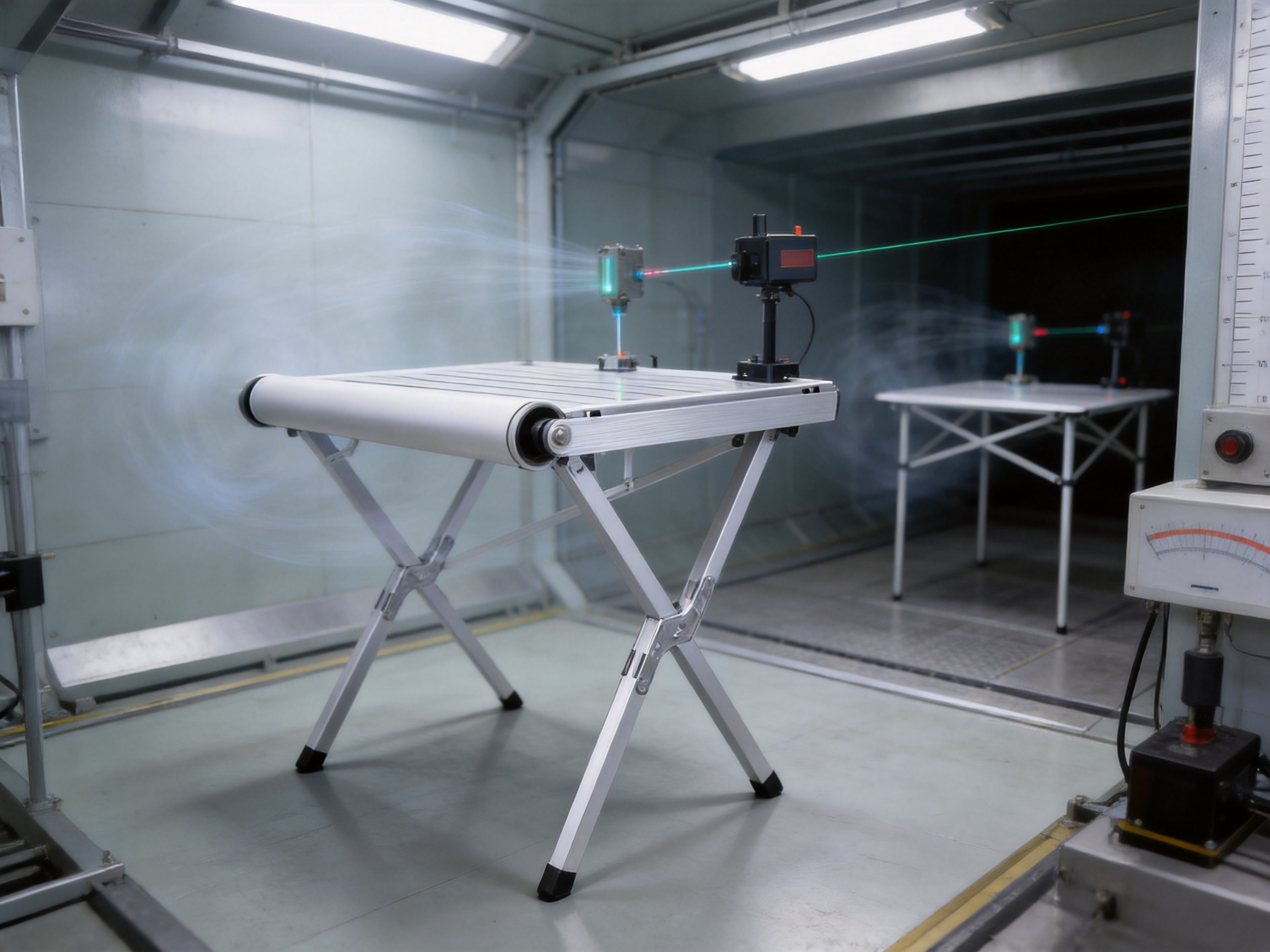
CragHaven Outdoor uses a structured wind-test program to evaluate folding table behavior under both steady and changing airflow. The portable wind tunnel rig has a test section of approximately 2.0 by 2.0 meters and uses laser displacement sensors to measure movement in real time.
Testing is conducted across wind speeds ranging from approximately 20 to 80 kilometers per hour. Both steady airflow and gust conditions are considered. The gust protocol applies peak loads at approximately twice the steady-state pressure for three-second periods. This approach is intended to represent the sudden changes that can occur in coastal, open-field, and mountain environments.
Key Test Measurements
Lateral deflection is the horizontal movement measured at the tabletop center. For practical dining and cooking use, a target below 15 millimeters is considered a useful performance reference. Lower deflection generally produces a more stable user experience and reduces the risk of cookware sliding or liquid containers tipping.
Torsional twist is the angular rotation of the tabletop around the vertical axis. A target below 3 degrees is used as a reference for acceptable stability in the described test program. Excessive twist can make the table feel uneven even when it has not tipped.
Vertical displacement measures upward movement or sag caused by wind lift and structural response. Recovery time records how quickly the table returns to less than 5 percent of its peak deflection after a gust ends. A shorter recovery time indicates that the structure dissipates movement more quickly and returns to a stable position.
CFD and Physical Prototypes
Computational Fluid Dynamics modeling can identify areas of concentrated pressure around the tabletop and frame before physical prototypes are produced. This helps engineers compare tabletop proportions, edge profiles, leg arrangements, and brace positions. According to the company’s development process, CFD work can reduce the number of physical test iterations by approximately 40 to 50 percent.
Computer modeling does not replace physical testing. Real tables include joints, surface irregularities, flexible components, and manufacturing tolerances that may not be fully represented in a simplified digital model. For this reason, prototype tables are tested in controlled conditions and then evaluated in field environments.
Coastal and Mountain Field Testing
Field testing takes place in coastal and mountain locations to expose prototypes to different types of wind and terrain. Coastal testing may include salt spray, steady onshore wind, sand, and high humidity. Mountain testing can involve turbulence, uneven ground, sudden gusts, low temperatures, and difficult access.
Triaxial accelerometers and other measurement tools can record movement and vibration during real-world deployment. Field testing also reveals practical issues that may not appear in a laboratory, such as how easily users can assemble the table while wearing gloves, how the feet behave on gravel, or whether the storage bag remains secure during transport.
Advantages Over Basic and Mass-Market Folding Tables
The product is positioned above basic folding tables through a combination of structural design, material selection, testing, and manufacturing control. A low-cost table may use vertical legs, limited bracing, thin connectors, and loose joints to reduce production cost. Such a design can be acceptable for occasional light use, but it may provide less stability and a shorter service life in demanding outdoor conditions.
The aluminum folding camping table offers several differentiating advantages:
Lightweight aerospace-grade aluminum alloy: The material reduces carrying weight while maintaining a strong and corrosion-resistant frame structure.
Compact roll-up tabletop: The egg roll design reduces packed volume and simplifies storage in vehicles, tents, warehouses, and retail packaging.
Tool-free assembly: Users can set up the table without carrying additional tools or learning a complicated procedure.
Improved frame stability: Outward leg splay and structured bracing provide better resistance to side loads than narrow vertical-leg designs.
Reduced torsional movement: Diagonal and horizontal bracing work together to control twisting when wind strikes at an angle.
Portable storage bag: The complete table can be protected and transported as one organized package.
Engineering-based development: CFD modeling, wind-tunnel testing, field testing, and joint analysis support product improvement.
OEM flexibility: Retailers and outdoor brands can request packaging, colors, labeling, dimensions, and other product adaptations.
These advantages are especially relevant to buyers who want to build a durable outdoor furniture category rather than purchase an undifferentiated low-price item. A product that is easier to use, more stable, and more consistent can generate better customer reviews and reduce returns caused by loose joints, difficult assembly, or disappointing performance.
Use in Camping, Cooking, Hiking, and Mountaineering
The table is designed for a wide range of outdoor scenarios. At a family campsite, it can serve as a dining table for plates, cups, cookware, and food containers. Beside a vehicle, it can act as a preparation station for a portable stove or cooler. At a mountain basecamp, it can organize ropes, hardware, gloves, maps, and communication equipment while keeping them away from wet or dirty ground.
For cooking, users should place the stove and hot cookware on a stable, heat-appropriate surface and follow the safety instructions for the cooking equipment. The table should not be used as a substitute for a heat shield unless the stove manufacturer specifically permits that arrangement. Spilled food and liquids should be cleaned promptly to preserve surface condition and reduce slipping risks.
For hiking and mountaineering support, the compact packed shape can be useful when equipment must be transported in a vehicle or carried over a short approach. Although the table is portable, it is best suited to basecamp and established campsite use rather than long-distance ultralight backpacking where every gram is critical.
At the beach, aluminum’s corrosion resistance is an advantage, but sand and salt require attention. Users should rinse or wipe components after use, allow them to dry completely, and avoid forcing sand-filled hinges. At mountain camps, the legs should be positioned carefully on uneven ground, and heavier items can be placed low or centrally to improve stability.
OEM and Wholesale Manufacturing Support
CragHaven Outdoor serves as both an outdoor brand and a cross-border manufacturing partner. This combination allows the company to support buyers who need more than a standard factory product. Retailers may require reliable product specifications, packaging coordination, production communication, sample development, quality documentation, and consistent delivery. Outdoor brands may need modifications to fit an established product line or regional market.
OEM development can include adjustments to tabletop size, frame color, logo placement, carrying-bag design, packaging language, carton configuration, accessory combinations, and retail presentation. Product customization should be evaluated against tooling, minimum order quantity, production schedule, material availability, and testing requirements.
The company’s Hangzhou location provides access to China’s mature supply chain for aluminum processing, hardware, surface finishing, sewing, packaging, and outdoor product assembly. A coordinated supply network can help control lead times and support scalable production. However, supply-chain efficiency is most valuable when combined with clear specifications, documented inspections, and stable communication.
CragHaven Outdoor’s stated philosophy is to reduce uncertainty for international buyers. The company participates in design and manufacturing rather than treating the product as a simple catalog item. This approach is useful when buyers need to understand how a table will perform in actual weather and usage conditions, not only how it appears in product photographs.
Packaging and Retail Readiness
Portable furniture must be packaged carefully because aluminum sections, hinges, and finished surfaces can be damaged during handling. The storage bag and folded product should be protected from impact, abrasion, and compression. Carton dimensions should be optimized for warehouse storage and shipping efficiency while leaving sufficient internal protection.
Retail packaging can communicate the table’s key benefits, including aluminum construction, roll-up tabletop design, tool-free setup, portable storage, intended use, and safety guidance. Product labels may also include dimensions, net weight, packed size, material information, cleaning recommendations, and operating limitations.
Recommended Use and Care
Before using the table, inspect the frame, tabletop connectors, feet, braces, pivot points, and locking components. Confirm that all sections are fully unfolded and that the tabletop is correctly secured. Place the table on firm, reasonably level ground and distribute loads evenly whenever possible.
Do not sit, stand, or climb on the tabletop. Avoid placing concentrated loads near unsupported edges. Keep children from playing on the folding mechanism, and keep fingers away from pivot points while opening or closing the table.
In strong or gusty wind, lower the table if an adjustable configuration is available, move it to a sheltered position, add appropriate ballast to the designated area, or secure it using suitable anchors. Do not rely on a lightweight table to remain stable in severe weather. Cooking should be stopped when wind conditions make flames, hot cookware, or unstable equipment unsafe.
After use, remove dirt, food residue, and moisture with a soft cloth and mild cleaning solution. Sand should be brushed away before folding so that it does not enter moving joints. If the table has been exposed to salt spray, rinse the relevant components with clean water and dry them thoroughly. Store the table in its bag in a dry, ventilated location.
Regular inspection can extend service life. Check for bent tubes, cracked connectors, loose pivot pins, damaged feet, torn straps, sharp edges, or abnormal movement. Any damaged structural component should be repaired or replaced before the next use.
Q&A: Common Questions About the Aluminum Folding Camping Table
Q1: What is the main advantage of an aluminum folding camping table?
The main advantage is the balance between portability and structural performance. Aluminum alloy keeps the table relatively light and corrosion-resistant, while the folding frame and roll-up tabletop make it compact for transport. The braced frame also provides more useful stability than many basic tables with narrow vertical legs and limited support.
Q2: Is the egg roll tabletop strong enough for cooking and dining?
The roll-up tabletop is designed to create a firm working surface when correctly installed on the frame. It is suitable for normal camping cooking, food preparation, dining, and equipment organization. Users should follow the product’s load guidance, distribute weight sensibly, and avoid sitting or standing on the tabletop.
Q3: How does X-bracing improve table performance?
X-bracing creates diagonal load paths that resist side-to-side movement and help limit twisting. It can substantially reduce lateral deflection compared with an unbraced frame. The trade-off is additional weight and a more complex folding arrangement, so the brace design must be integrated carefully with the hinges and storage format.
Q4: Is a table with H-bracing suitable for windy campsites?
H-bracing improves stability compared with no bracing and may be suitable for ordinary use in relatively sheltered areas. However, H-bracing alone generally provides less torsional resistance than a hybrid X-and-H system. For exposed beaches, open fields, alpine ridges, or cooking in gusty conditions, users should consider a table with stronger diagonal support and use appropriate anchoring or ballast.
Q5: Can the table be used on uneven ground?
It can be used on moderately uneven ground if the user positions each leg securely and confirms that the tabletop is stable. Very steep, soft, loose, or unstable ground should be avoided. On gravel, sand, or soil, suitable feet, mats, anchors, or ballast may improve stability. The table should never be used on a slope where it can slide or tip.
Q6: How should the table be used in strong wind?
Move the table to a sheltered location whenever possible. Lower the height if the design allows it, keep heavy items low and centered, use designated anchor points or sandbag loops, and remove unnecessary objects from the tabletop. Do not use the table for cooking when wind makes flames or hot cookware unsafe. Severe weather requires the table to be folded and stored.
Q7: What makes this product suitable for OEM buyers?
The product can be adapted for different outdoor retail programs through options such as dimensions, colors, logos, carrying-bag specifications, packaging, labeling, and accessory combinations. The manufacturer can support sampling, engineering review, quality inspection, and production coordination. Buyers should confirm customization feasibility, minimum order quantities, testing requirements, and delivery schedules during project planning.
Q8: How does the manufacturer control production quality?
Quality control includes material inspection, dimensional checks, controlled tube cutting and forming, joint evaluation, surface inspection, assembly checks, functional folding tests, stability testing, and packaging review. Particular attention is given to pivot points, swaged tube ends, stainless steel pins, tabletop connections, and the fit of moving parts.
Q9: Is the table intended for ultralight backpacking?
The table is portable and compact, but its strongest applications are car camping, family camping, outdoor cooking, basecamp use, picnics, fishing, and short-access mountaineering sites. Users planning long-distance ultralight travel should compare the packed weight and volume with their specific equipment priorities.
Q10: How can buyers request a customized version?
Buyers should provide the intended market, tabletop dimensions, target packed size, preferred finish, estimated order quantity, packaging requirements, logo artwork, compliance needs, and expected delivery schedule. The manufacturer can then review the design, recommend suitable materials and bracing, prepare samples, and establish a production specification for approval.
Conclusion
The outdoor aluminum alloy folding table combines practical portability with a frame designed for more demanding outdoor use. Its aerospace-grade aluminum alloy offers a lightweight and corrosion-resistant foundation, while the roll-up tabletop reduces storage volume and supports quick, tool-free assembly. The portable bag makes the product easier to carry, organize, and present for retail sale.
Its most important distinction is the relationship between material, geometry, bracing, and testing. Outward-splayed legs widen the support footprint, diagonal braces help reduce lateral movement and torsional twist, and hybrid X-and-H configurations provide a stronger structural solution than strap-only or minimally braced alternatives. Wind-tunnel analysis, CFD modeling, field testing, joint engineering, and manufacturing inspection further support product consistency.
For outdoor brands, distributors, and retailers, the table offers a practical platform for a reliable camping furniture category. CragHaven Outdoor combines product development with manufacturing support, helping buyers move from a general concept to a tested, repeatable, and scalable outdoor product. The result is a folding table designed not only for convenient catalog presentation, but also for real campsites, changing weather, repeated transport, and long-term use.
References
1. CragHaven Outdoor internal structural laboratory data, comparative folding table wind-load testing, Hangzhou, China.
2. CragHaven Outdoor product development documentation for aluminum folding camping tables and WindMaster frame configurations.
3. American Society of Civil Engineers, Minimum Design Loads and Associated Criteria for Buildings and Other Structures, wind-load principles.
4. International Organization for Standardization, Outdoor furniture and product safety guidance relevant to portable furniture design.
5. Aluminum Association, Aluminum Standards and Data, material properties and alloy selection principles.
6. Engineering fundamentals of structural bracing, lateral stability, torsional rigidity, and load-path design for lightweight frames.
7. Field observation records from coastal campsite and mountain basecamp testing conducted during outdoor product development.
Product: Outdoor aluminum alloy folding table, camping table, egg roll table


- Phone: +86-15968800379
- E-mail: [email protected]
- Address: Room 1002, Huishang Building, Gongshu District, Hangzhou City, Zhejiang Province.
Copyright © CragHaven Outdoor All Rights Reserved. Outdoor Gear Manufacturers Wholesale Mountaineering Camping Gear Suppliers
