

 English
 Deutsch
 Español
 Français

How to Choose a Lightweight Folding Camping Chair for Coastal Adventures, Hiking, and Everyday Outdoor Use
Content
- 1 1. Why the Right Camping Chair Matters
- 2 2. Product Overview and Core Advantages
- 3 3. Frame Material and Structural Efficiency
- 4 4. Strength-to-Weight Ratio and Portability
- 5 5. Comfort Features for Extended Sitting
- 6 6. Side Pockets and Cup Holders as Functional Differentiators
- 7 7. Folding Mechanism and Space Efficiency
- 8 8. Marine and Coastal Performance
- 9 9. Manufacturing Process and Quality Control
- 10 10. Testing for Real Outdoor Use
- 11 11. Advantages Over Conventional Competitors
- 12 12. OEM and ODM Development Opportunities
- 13 13. Packaging, Logistics, and Retail Readiness
- 14 14. Sustainability and Long-Term Product Value
- 15 15. Recommended Applications
- 16 16. Usage and Maintenance Guidance
- 17 17. Frequently Asked Questions
- 18 Product: Outdoor folding chair, portable multi-functional camping chair
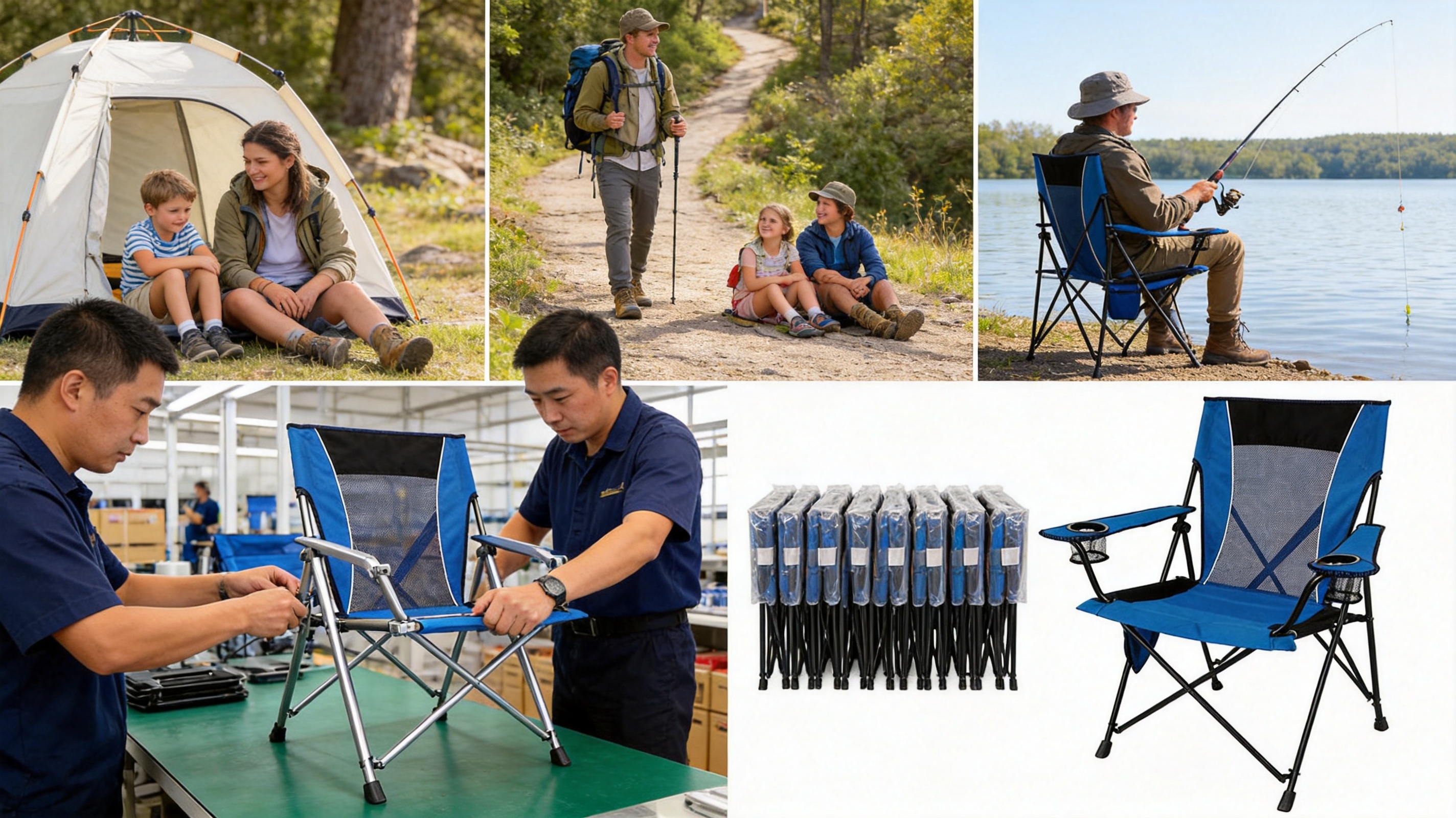
A portable chair is one of the most useful pieces of equipment in a modern camping system. It provides a stable place to rest beside a tent, relax after a long hike, prepare food at a basecamp, or enjoy a quiet evening outdoors. However, not every folding chair delivers the same balance of comfort, portability, durability, and practical convenience. A chair that performs well in a dry forest may not be the best choice for a beach campsite. A chair designed for occasional backyard use may not withstand repeated folding, transportation, and exposure to changing weather conditions.
The outdoor folding chair discussed in this article is designed as a multifunctional seating solution for camping, hiking, mountaineering support areas, fishing, travel, outdoor events, and recreational use. It combines a lightweight aluminum alloy frame with an Oxford cloth seat, a breathable mesh back panel, side storage pockets, integrated cup holders, and a quick-folding structure. These features are intended to solve the most common problems faced by outdoor users: excessive weight, poor ventilation, limited storage, difficult transport, and inefficient use of space.
For retailers, distributors, and outdoor brands, the product also provides a practical platform for private-label development. Its construction can be adapted for different markets, including ultralight trekking, family camping, coastal recreation, institutional use, and general outdoor leisure. Careful material selection, controlled production, repeatable assembly, and usage-oriented testing are essential to ensuring that a portable chair performs consistently beyond the showroom.
1. Why the Right Camping Chair Matters
Outdoor seating is often treated as a secondary accessory, but it has a direct effect on user comfort and the overall quality of an outdoor experience. A poorly designed chair can be unstable, difficult to carry, uncomfortable during extended sitting, or vulnerable to premature wear. These weaknesses become especially noticeable when the chair is used on uneven ground, transported over long distances, or exposed to moisture, dust, sand, and salt spray.
A well-designed folding chair must perform several functions at the same time. It should support the user securely without unnecessary structural weight. It should fold into a compact form that fits inside a vehicle, storage box, tent vestibule, or equipment bag. It should provide enough back support for extended sitting while allowing heat and moisture to escape. It should also include practical storage features so that small personal items remain within reach rather than being placed on the ground.
The product’s design addresses these requirements through a combination of structural and comfort features. The aluminum alloy frame reduces carrying weight compared with conventional steel frames. Oxford cloth provides a durable seating surface that can tolerate regular outdoor use. The mesh back panel improves airflow, while side pockets and cup holders create accessible storage for bottles, phones, tools, snacks, and other small items.
These details may appear simple, but they are important differentiators in a competitive outdoor furniture market. Many low-cost chairs focus primarily on the lowest possible production price. More advanced products focus on the complete user experience, including the moments before sitting down, while carrying the chair, during extended use, and when packing the product away.
2. Product Overview and Core Advantages
The portable multifunctional camping chair uses a folding frame architecture designed for quick deployment and compact storage. Users can open the chair when they arrive at a campsite and fold it again when moving to another location. This makes it suitable for consumers who value mobility and for professional users who need to transport multiple units efficiently.
The principal product advantages include:
- Lightweight aluminum alloy construction for easier carrying.
- Oxford cloth seating for durability and dependable daily use.
- A breathable mesh back panel that reduces heat accumulation.
- Side pockets for personal accessories and outdoor essentials.
- Integrated cup holders for convenient beverage storage.
- Quick folding that minimizes transport and warehouse volume.
- A versatile design suitable for camping, hiking, fishing, events, and travel.
- Adaptability for OEM and ODM product programs.
Compared with basic folding stools, the chair provides more complete back support and improved sitting comfort. Compared with heavier steel camping chairs, it offers lower transport weight and improved portability. Compared with minimalist ultralight seats, it offers more practical features, including side storage and a cup holder. This combination gives the product a broad market position between simple low-cost seating and highly specialized expedition furniture.
The design is also suitable for multiple sales channels. Outdoor specialty stores can position it as a dependable camping accessory. General retailers can present it as a family recreation product. E-commerce sellers can emphasize its portability, storage functionality, and compact folded profile. Rental operators, event organizers, and institutional buyers may also benefit from its repeatable construction and easy handling.
3. Frame Material and Structural Efficiency
The frame is the foundation of a folding chair. It determines the product’s load-bearing behavior, folding action, stability, weight, and resistance to long-term fatigue. Selecting a material only by its nominal strength is not enough. The material must also be evaluated according to density, corrosion resistance, forming characteristics, joint design, wall thickness, and actual use conditions.
Three common frame choices for portable outdoor chairs are 7075 aluminum, 6061 aluminum, and high-tensile steel. Each material has a different engineering profile. 7075 aluminum offers high strength at low weight. 6061 aluminum provides a balanced combination of strength, corrosion resistance, formability, and cost. High-tensile steel offers excellent toughness and impact resistance but carries a substantial weight penalty and requires more extensive corrosion protection.
3.1 7075 Aluminum
7075 aluminum is a zinc-magnesium-copper alloy commonly associated with high-performance aerospace and sporting applications. In T6 temper, it can provide a typical yield strength of approximately 503 MPa and an ultimate tensile strength of about 572 MPa, with a density near 2.81 g/cm³.
Its strength-to-weight ratio makes it attractive for premium ultralight products. A properly engineered 7075 frame can achieve high load-bearing performance while maintaining a low overall product weight. This is valuable for backpackers, mountaineers, and users who carry equipment over long distances.
However, high strength does not automatically mean superior outdoor performance in every environment. 7075 aluminum is less corrosion-resistant than 6061 aluminum, particularly when exposed to chloride-rich marine conditions. Surface damage, stress concentration, and repeated loading can increase the possibility of pitting or stress-corrosion cracking. For this reason, a 7075 chair intended for coastal or beach use requires careful finishing, inspection, drainage, and maintenance.
7075 is best suited to applications where low weight is the primary purchasing factor and where users are willing to follow appropriate care instructions. It is an excellent option for premium backcountry chairs, moderate-humidity environments, and products where high strength is required without increasing frame dimensions.
3.2 6061 Aluminum
6061 aluminum is a magnesium-silicon alloy widely used in consumer products, outdoor equipment, transportation components, and fabricated structures. In T6 temper, its typical yield strength is approximately 276 MPa, its ultimate tensile strength is about 310 MPa, and its density is close to 2.70 g/cm³.
Although its nominal strength is lower than that of 7075, 6061 aluminum offers an excellent balance for general-purpose outdoor chairs. It has strong corrosion resistance, good weldability, reliable formability, and relatively stable availability. These characteristics make it easier to use in frames that require bends, joints, brackets, and repeatable production processes.
6061 aluminum is particularly appropriate for coastal camping, fishing, family recreation, and all-purpose outdoor seating. It can be anodized or powder-coated to provide additional protection and a consistent visual finish. In a product intended for broad retail distribution, this balance of performance and manufacturability can be more valuable than the maximum possible tensile strength.
The chair described here uses an aviation-grade aluminum alloy frame concept to support low weight and dependable structural performance. For different product programs, the frame specification may be adjusted according to the intended market. A retailer focused on general camping may prefer 6061 aluminum, while an expedition-oriented brand may request a lighter premium alloy configuration.
3.3 High-Tensile Steel
High-tensile steel remains popular in outdoor furniture because it offers excellent impact toughness and a comparatively low raw material cost. Depending on the grade and heat treatment, yield strength may range from approximately 350 to 700 MPa, while ultimate tensile strength can exceed 800 MPa in some applications. Steel also tolerates accidental impacts that may permanently bend a lightweight aluminum tube.
The main disadvantage is density. At approximately 7.85 g/cm³, steel is nearly three times as heavy as aluminum. A steel chair therefore requires more carrying effort and occupies a larger weight allowance in a camping or travel system. In marine environments, bare steel can also develop red rust quickly. Protective systems such as phosphate pretreatment, zinc-rich primer, epoxy coating, and polyester powder coating are necessary for improved durability.
Steel may be appropriate for heavy-duty basecamp furniture, institutional seating, rental operations, or budget products where impact resistance and low initial cost are more important than portability. Nevertheless, the aluminum construction of the featured chair gives it a clear advantage for users who regularly move equipment between vehicles, campsites, trails, and storage areas.
4. Strength-to-Weight Ratio and Portability
For portable furniture, structural efficiency is often more meaningful than absolute material strength. Specific strength can be estimated by dividing yield strength by density. Using representative values, 7075 aluminum provides approximately 179 kN·m/kg, 6061 aluminum approximately 102 kN·m/kg, and high-tensile steel approximately 57 kN·m/kg.
These figures explain why aluminum is so widely used in portable outdoor equipment. The objective is not simply to make a frame strong. The objective is to make a frame strong enough for its intended load while keeping the product light enough to carry, fold, transport, and store easily.
| Property | 7075 Aluminum | 6061 Aluminum | High-Tensile Steel |
|---|---|---|---|
| Typical yield strength | Approximately 503 MPa | Approximately 276 MPa | Approximately 350–700 MPa |
| Density | Approximately 2.81 g/cm³ | Approximately 2.70 g/cm³ | Approximately 7.85 g/cm³ |
| Specific strength | Approximately 179 kN·m/kg | Approximately 102 kN·m/kg | Approximately 57 kN·m/kg |
| Typical frame weight for a 120 kg-capacity design | Approximately 1.1–1.3 kg | Approximately 1.5–1.8 kg | Approximately 2.8–3.5 kg |
| Corrosion resistance | Moderate; requires careful protection in marine conditions | Very good; suitable for coastal applications | Low without a complete protective coating system |
| Manufacturing characteristics | High strength but more demanding forming and inspection | Good formability, weldability, and production flexibility | High toughness and impact resistance but heavier |
| Best application | Premium ultralight and high-load products | General outdoor and marine-oriented chairs | Heavy-duty or cost-focused basecamp seating |
Actual chair weight depends on more than alloy selection. Tube diameter, wall thickness, joint construction, fabric density, fastener type, hardware, reinforcement points, and finishing systems all contribute to the final result. A lighter frame is not automatically better if it compromises stability or fatigue life. Engineering must therefore consider the complete chair rather than one isolated material specification.
The featured chair is designed to provide a useful balance between low weight and practical comfort. It avoids the excessive mass of many steel products while offering more support and functionality than a basic three-legged stool. This makes it especially suitable for retailers seeking a broadly appealing product rather than a chair limited to a narrow specialist audience.
5. Comfort Features for Extended Sitting
Portability is important, but a chair must also be comfortable once it is deployed. Outdoor users may sit for an hour or more while cooking, talking, fishing, watching children, reading, or resting after physical activity. The seat and back system must therefore distribute body pressure and manage heat effectively.
The Oxford cloth seat provides a durable textile platform that can be tensioned across the frame. Its woven construction is commonly selected for outdoor products because it offers a practical balance of strength, abrasion resistance, flexibility, and cleanability. Compared with thin decorative fabric, Oxford cloth is better suited to repeated loading and the rough handling associated with camping equipment.
The breathable mesh back panel is another important comfort feature. Solid fabric backs can retain heat, particularly in warm climates or when the chair is exposed to direct sunlight. Mesh allows air to circulate behind the user, reducing stuffiness during extended sitting. It also helps moisture evaporate more quickly after use in humid conditions.
Comfort is affected by the relationship between seat depth, back height, fabric tension, frame angle, and arm positioning. These dimensions should be evaluated through physical prototypes rather than relying only on computer drawings. A chair may appear efficient in a specification sheet but feel uncomfortable if the seat edge presses against the legs or if the back angle does not support a relaxed posture.
For OEM and ODM projects, comfort can be further customized through fabric tension, seat dimensions, color combinations, branding elements, and accessory placement. A retailer selling to family campers may request a wider seat and softer textile feel, while a hiking-oriented brand may prioritize lower weight and a more compact folded package.
6. Side Pockets and Cup Holders as Functional Differentiators
Small storage features can significantly improve the perceived value of an outdoor chair. Without integrated storage, users often place phones, sunglasses, snacks, maps, flashlights, or water bottles on the ground. These items can become dirty, wet, misplaced, or difficult to reach.
The side pockets provide a dedicated location for personal accessories. Their position allows users to access common items without standing up or placing them on the seat. The pocket structure can be developed in different sizes and configurations according to the target market. For example, a fishing-oriented version may need space for small tools, while a family camping version may benefit from larger compartments for toys, drinks, and personal belongings.
The integrated cup holders are useful for bottles, cans, travel mugs, and other beverage containers. Keeping a drink off the ground reduces the risk of tipping and makes the chair more convenient around a campfire, picnic table, or outdoor event area. For commercial buyers, these features provide visible product differentiation that can be communicated easily in packaging and online product listings.
These storage components must be securely attached to the frame or seat structure. Stitching quality, reinforcement patches, edge binding, and load distribution affect their long-term performance. A pocket that is attractive but poorly reinforced can tear when users place heavier objects inside. Manufacturing inspection must therefore include both appearance checks and attachment-strength evaluation.
7. Folding Mechanism and Space Efficiency
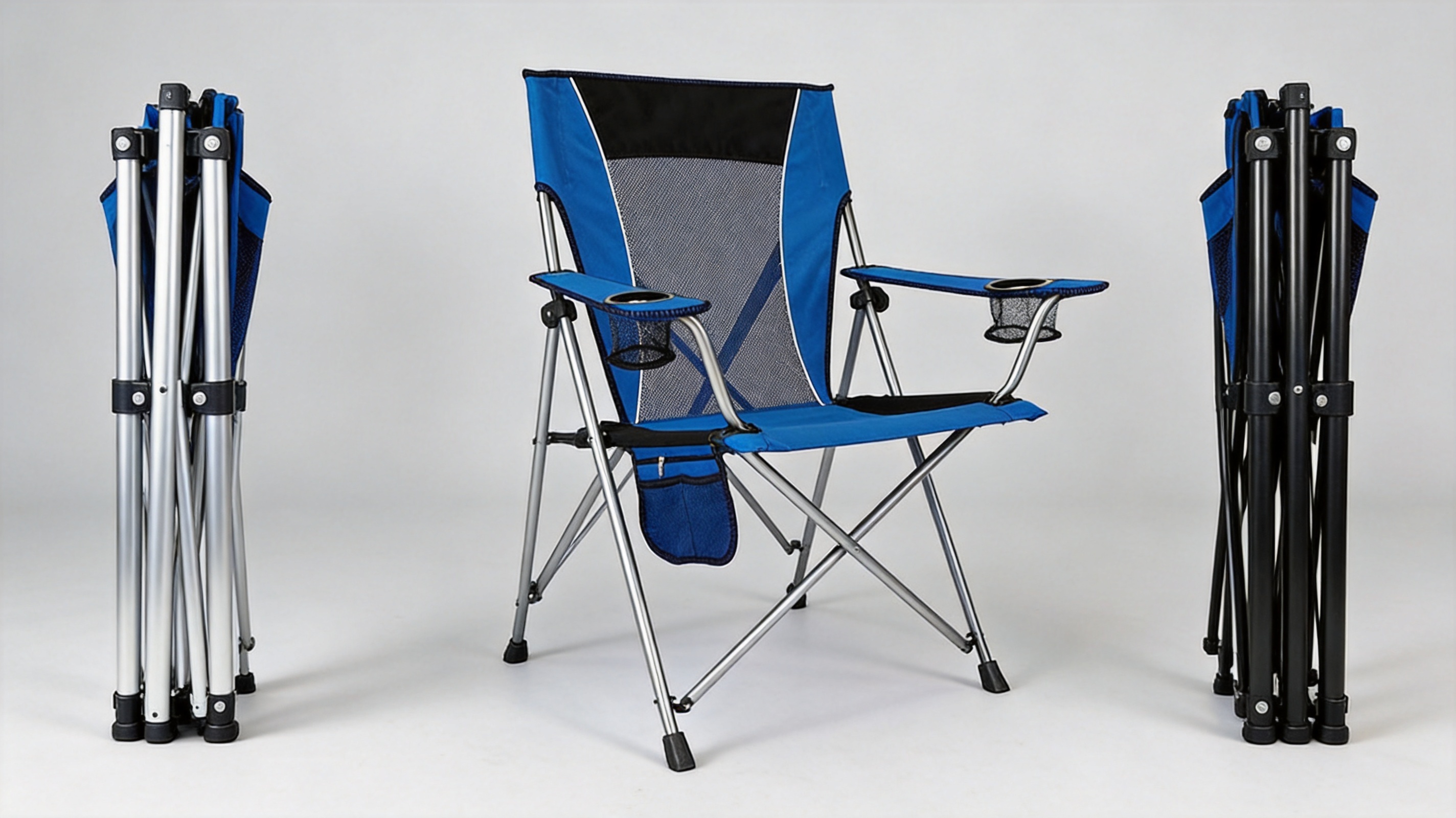
Quick folding is central to the product’s value. A chair that is difficult to fold may discourage regular use, while a chair that folds smoothly encourages users to bring it on more trips. The folding system should be intuitive, stable when open, and resistant to accidental collapse during normal sitting.
Compact folding also benefits transportation and storage. Consumers can place the chair in a vehicle trunk, camping equipment box, closet, garage, or tent storage area. Retailers benefit from reduced carton volume, more efficient warehouse utilization, and improved shipping economics. When multiple chairs are purchased for events or commercial facilities, the space savings become even more significant.
The folding mechanism should be designed with attention to pinch-point control. Hinges, pivot connections, and moving tubes need adequate clearance so that users can open and close the chair safely. Fasteners must remain secure after repeated cycles, and joint surfaces should be designed to reduce excessive wear.
Repeated folding is a more realistic durability challenge than a single static load test. A chair may support a user successfully during its first use but develop looseness, fabric distortion, or joint play after hundreds of folding cycles. Production validation should therefore include repeated opening and closing, static loading, uneven-surface testing, and inspection of pivot hardware.
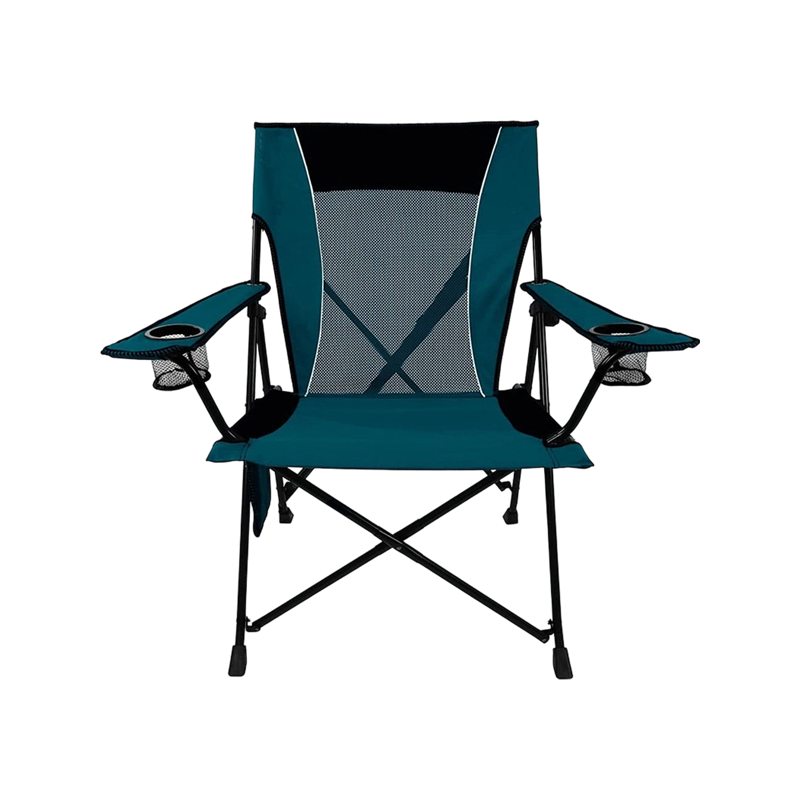
Outdoor folding chair, portable multi-functional camping chair
8. Marine and Coastal Performance
Coastal camping creates a demanding environment for portable outdoor furniture. Salt spray, humidity, sand, ultraviolet radiation, and repeated wet-dry cycles can affect metal frames, textile components, coatings, fasteners, and joints. The correct material and finishing system depend on how frequently the chair will be exposed to these conditions.
6061 aluminum is generally the most balanced choice for frequent coastal use. It has strong natural corrosion resistance and typically shows limited deterioration in salt-spray testing when compared with unprotected steel or 7075 aluminum. Anodizing, sealing, or powder coating can provide additional protection and create a consistent appearance.
7075 aluminum can also be used in coastal products, but it requires more careful engineering. Its high strength is attractive for lightweight applications, yet chloride exposure and surface damage can increase pitting and stress-corrosion concerns. Type III hard anodizing, additional protective coatings, careful joint design, and regular cleaning can reduce the risk, but they do not eliminate the need for maintenance.
Steel is the most vulnerable material when protective coatings are damaged. A scratch, edge chip, or pinhole can expose the underlying metal and allow corrosion to develop beneath the coating. This under-film corrosion can spread without being immediately visible. Steel chairs used near the sea should be rinsed, dried, inspected, and repaired promptly after coating damage.
Material selection alone does not determine marine performance. Tube ends, hinges, fasteners, and overlapping joints can collect saltwater and create crevice-corrosion locations. Sealed tube ends, drainage paths, corrosion-resistant hardware, suitable gaskets, and controlled coating coverage can all improve service life.
8.1 Recommended Care for Coastal Users
After use near the sea, the chair should be rinsed with fresh water to remove salt deposits. Users should allow it to dry completely before folding it into a storage bag. Sand should be removed from hinges and moving connections because abrasive particles can increase wear and interfere with smooth folding.
Periodic inspection should focus on coating damage, loose fasteners, fabric stitching, hinge movement, and areas where water may collect. If an aluminum frame is scratched, the damaged area should be cleaned and treated according to the recommended maintenance procedure. For coated steel, exposed metal should receive prompt touch-up protection.
Clear care instructions help reduce warranty claims and improve customer satisfaction. They also allow retailers to present the chair as a durable product that performs well when used and maintained appropriately, rather than making unrealistic claims of complete immunity to environmental damage.
9. Manufacturing Process and Quality Control
A reliable camping chair is the result of a controlled manufacturing system rather than a single material choice. The production process must connect product design, material purchasing, tube processing, textile preparation, assembly, finishing, inspection, and packaging. Each stage influences the performance of the finished product.
9.1 Product Engineering and Sampling
Product development begins with the intended usage scenario. Designers consider the terrain, climate, expected user weight, transport method, storage requirements, and frequency of use. A chair for occasional family camping may have different priorities from a chair intended for mountaineering support areas or coastal fishing.
Initial samples are used to evaluate dimensions, sitting posture, opening and folding action, stability, fabric tension, pocket placement, and visual appearance. Feedback from sample testing is incorporated into revised prototypes. Repeated sampling is important because many practical issues are not visible in two-dimensional drawings or computer models.
Engineering reviews should also assess load paths. The user’s weight must be transferred through the fabric, support rails, tubes, pivot points, and feet without creating excessive stress concentration. Reinforcement may be added around hinge areas, tube connections, seat corners, or fabric attachment points.
9.2 Aluminum Frame Processing
Aluminum tubes must be cut accurately to maintain symmetry and consistent folding behavior. If the product uses bent tubes, bending tools and process parameters must be controlled to minimize ovalization, wrinkling, or local thinning. Incorrect tube geometry can affect both appearance and structural stability.
Drilled holes and pivot openings require consistent positioning. Small variations can cause the chair to sit unevenly, create excessive friction, or produce inconsistent locking behavior. Jigs and fixtures help maintain repeatability during cutting, drilling, bending, and assembly.
After mechanical processing, aluminum components may receive anodizing, powder coating, or another specified surface treatment. Surface preparation is critical. Oil, dust, oxide contamination, and handling marks can reduce coating adhesion. Production controls should include cleaning, pretreatment, coating-thickness verification, visual inspection, and adhesion checks where required.
9.3 Textile Cutting and Sewing
The Oxford cloth seat and mesh back panel must be cut according to controlled patterns. Consistent pattern dimensions help maintain fabric tension across production batches. If the fabric is too loose, the user may feel unstable. If it is too tight, excessive stress may be placed on seams and frame attachment points.
Sewing quality is evaluated through stitch consistency, seam allowance, reinforcement placement, edge finishing, and attachment strength. High-stress areas may require bar-tack reinforcement, double stitching, webbing, or additional fabric layers. Pocket openings and cup-holder connections deserve particular attention because they are handled frequently and may carry concentrated loads.
Fabric selection can also be adapted for different markets. Outdoor brands may request different colors, denier levels, mesh structures, water-resistant treatments, logo positions, or packaging configurations. These options support differentiated product lines without requiring an entirely new chair architecture.
9.4 Assembly and Functional Inspection
Assembly combines the frame, hardware, seat fabric, back panel, pockets, cup holders, and protective components. Workers must follow defined torque and alignment procedures for pivot hardware. Fasteners that are too loose can create instability, while excessive tightening can restrict folding movement or damage components.
Each assembled chair should be checked for smooth opening and closing, balanced contact with the ground, secure locking, fabric alignment, visible defects, and correct accessory attachment. Functional inspection is especially important for folding furniture because a chair can pass a visual inspection while still having poor movement or an incorrect joint relationship.
9.5 Batch Testing and Traceability
Production testing may include static load testing, repeated folding cycles, fabric seam testing, frame dimensional checks, coating inspection, and packaging drop tests. The exact test plan should correspond to the product specification and target market.
Batch traceability helps identify the source of any future quality issue. Material lots, production dates, inspection records, and component suppliers can be documented to support corrective action. This approach reduces uncertainty for importers and retailers, particularly when products are supplied in large quantities or across multiple seasons.
10. Testing for Real Outdoor Use
Laboratory testing provides useful information, but it should be interpreted alongside real-world evaluation. Salt-spray testing can compare materials under controlled conditions, while field exposure reveals how products behave when salt deposits, sunlight, drying, sand, movement, and user handling occur together.
Representative corrosion testing for outdoor chair components may use ASTM B117 salt-spray procedures. In comparative testing, unprotected 7075 aluminum may show pitting after extended exposure, while 6061 aluminum may show primarily surface discoloration under similar conditions. Bare steel can develop red rust rapidly. Coatings and anodizing improve performance, but the result depends on pretreatment, thickness, coverage, edge protection, and the presence of scratches or defects.
Cyclic corrosion testing can be more representative of outdoor conditions because it alternates salt exposure with drying and humidity. Real coastal use also introduces crevice conditions at joints, where water and salt may remain trapped. For this reason, design validation should inspect hinges, tube ends, overlapping members, hardware, and fabric-to-frame interfaces rather than evaluating only flat material samples.
Mechanical testing should include more than a single static load. Repeated loading can reveal fatigue, fabric stretching, joint loosening, and permanent deformation. Uneven-surface tests can assess stability when one foot is placed on a different level. Transport simulation can identify damage caused by folding, packing, vibration, and impact.
For a product intended for global retailers, the testing program should be documented in a way that is understandable to buyers and quality teams. Clear test methods, sample quantities, acceptance criteria, and inspection records provide greater confidence than general statements about strength or durability.
11. Advantages Over Conventional Competitors
The outdoor chair market includes very simple stools, traditional steel folding chairs, oversized padded camp chairs, and premium ultralight seats. The featured product competes by combining several useful features in a compact, practical format.
11.1 Advantage Over Basic Folding Stools
Basic stools are often lightweight and inexpensive, but they provide limited back support and little personal storage. They are suitable for short rests but less comfortable during meals, conversations, or extended campsite use. The folding chair’s back panel gives users a more supportive seating position, while the pockets and cup holders improve everyday convenience.
11.2 Advantage Over Heavy Steel Chairs
Steel chairs can be robust, but their weight makes them inconvenient for users who move equipment frequently. The aluminum frame reduces carrying effort and makes the chair easier to load into a vehicle or carry between campsite locations. This advantage is particularly relevant to hikers, families, photographers, anglers, and event users who transport several pieces of equipment.
11.3 Advantage Over Oversized Padded Chairs
Large padded chairs may feel comfortable but often occupy substantial storage space. Their bulk can be inconvenient in compact vehicles, small apartments, and crowded gear rooms. The quick-folding architecture of this product offers a more efficient alternative for users who want practical seating without the volume of a full-size recliner.
11.4 Advantage Over Minimalist Ultralight Seats
Specialized ultralight chairs can achieve extremely low weight, but they may sacrifice storage, ease of use, back ventilation, or general comfort. The featured product is designed for a broader balance. It remains portable while adding features that support relaxed, everyday outdoor use.
11.5 Advantage for Retail Product Lines
For retailers, a product with several visible benefits is easier to position across different price levels. The base model can emphasize lightweight portability and essential comfort. Higher-level versions can use upgraded aluminum, specialized finishes, premium textiles, customized hardware, or branded packaging. This allows a product family to be developed around a stable design platform.
12. OEM and ODM Development Opportunities
Outdoor brands increasingly require products that reflect their own market identity rather than generic catalog items. A folding camping chair provides many opportunities for customization without compromising the basic function of the product.
Possible OEM and ODM options include frame color, fabric color, mesh design, logo placement, woven labels, printed graphics, packaging artwork, instruction manuals, carry-bag design, carton configuration, and accessory combinations. More advanced development may include changes to seat width, back height, arm support, tube diameter, frame alloy, coating system, or storage-pocket layout.
Customization should begin with a clear product brief. The brief should identify the target user, intended environment, desired packed size, weight objective, load requirement, visual style, retail price position, and expected order quantity. This information helps the engineering team avoid unnecessary features and select materials that support the commercial goal.
Sampling is especially important for customized chairs. A change in fabric thickness can affect folding volume. A different coating can change surface friction at joints. A wider pocket can interfere with the folding path. A revised seat dimension may alter balance and load distribution. These interactions should be reviewed through prototypes before mass production.
Manufacturing partners with experience in outdoor products can provide value beyond component sourcing. They can advise on material availability, production feasibility, packaging efficiency, testing plans, and potential failure points. This collaborative approach helps brands move from a concept to a stable, scalable product more efficiently.
13. Packaging, Logistics, and Retail Readiness
The product’s folding structure offers advantages after manufacturing as well as during use. Compact packaging helps reduce carton size and can improve pallet utilization. Lower volume may reduce transportation costs and simplify warehouse handling. These factors are important for retailers managing international supply chains.
Packaging should protect the frame, textile surfaces, coating, and moving joints during transport. Internal positioning must prevent metal parts from rubbing against fabric or damaging the product surface. The packaging should also communicate opening instructions, care requirements, load guidance, and safety information clearly.
Retail-ready presentation can include a branded carry sleeve, color-coded labels, product feature icons, and concise usage instructions. For e-commerce, images and written content should explain the folded form, storage pockets, cup holders, mesh back, and frame material. Accurate product communication helps reduce customer misunderstanding and returns.
For commercial buyers, cartons may be optimized for bulk delivery rather than individual retail presentation. Multiple units can be packed efficiently for campsites, outdoor events, hospitality operations, rental programs, or institutional customers. Packaging specifications should be agreed during the development stage rather than treated as an afterthought.
14. Sustainability and Long-Term Product Value
A durable product can support more responsible consumption by reducing the need for frequent replacement. Frame longevity, fabric quality, repairable hardware, and replaceable components all contribute to the useful life of a folding chair.
Aluminum is also valuable from a materials perspective because it can be recycled through established metal-recovery systems. Efficient frame design can reduce material use while maintaining appropriate strength. Packaging can be reviewed to minimize unnecessary volume and reduce the use of excess plastic where suitable protective alternatives are available.
Long-term value does not mean using the most expensive material in every product. It means selecting the correct material for the real environment and usage pattern. A 6061 aluminum chair with appropriate finishing may deliver better lifetime value for frequent coastal users than a lighter 7075 chair that requires more careful maintenance. Similarly, a coated steel chair may be appropriate where impact resistance is more important than carrying weight.
Responsible product development therefore considers durability, repairability, manufacturing efficiency, logistics, user care, and end-of-life material recovery together.
15. Recommended Applications
The portable multifunctional camping chair is suitable for a wide range of outdoor scenarios.
- Camping: It provides convenient seating around tents, cooking areas, picnic tables, and campfires.
- Hiking support areas: Its portable structure gives users a comfortable place to rest at trailheads and temporary camps.
- Mountaineering basecamps: A lightweight configuration can reduce equipment burden while improving rest conditions.
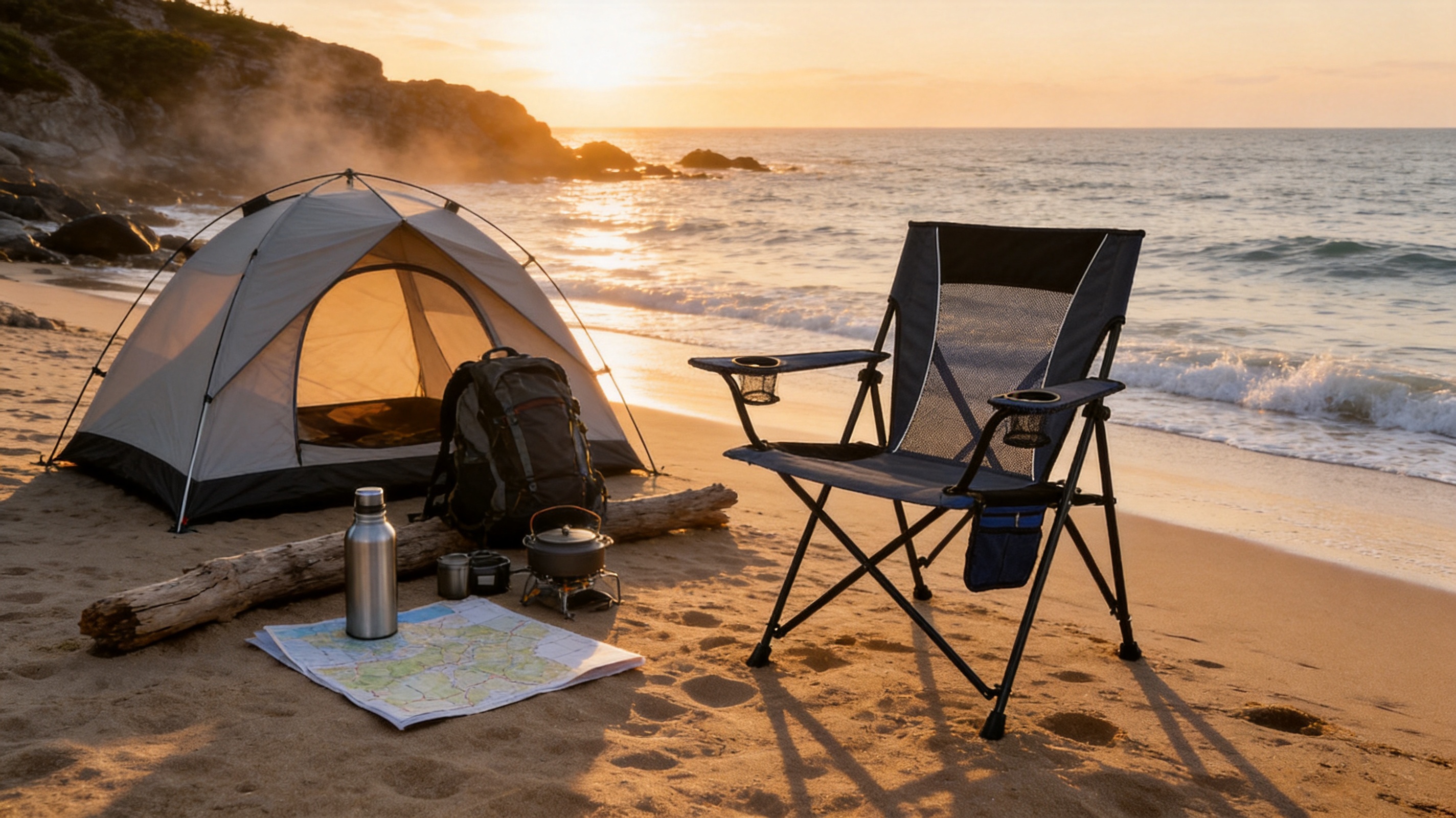
- Beach and coastal recreation: A corrosion-resistant aluminum configuration is suitable when combined with fresh-water rinsing and proper drying.
- Fishing: Side pockets and cup holders keep small equipment and beverages within reach.
- Outdoor events: Folded storage and efficient transport are useful for organizers managing multiple units.
- Travel and road trips: Compact folding allows the chair to fit into vehicle storage spaces.
- Backyard and garden use: The chair can serve as convenient supplementary seating for gatherings and leisure.
Different applications may require different specifications. Buyers should consider climate, expected load, frequency of transport, exposure to saltwater, desired retail price, and the level of customization required before selecting a final configuration.
16. Usage and Maintenance Guidance
Users should place the chair on a stable surface and ensure that the frame is fully opened before sitting. The chair should not be used on unstable edges, steep slopes, or surfaces that may cause one leg to slide. Users should also avoid standing on the seat or using the chair for purposes other than seating.
The fabric should be cleaned with mild soap and water. Abrasive cleaners may damage coatings or textile treatments. After exposure to rain, humidity, or salt spray, the chair should be opened and dried thoroughly. Folding wet fabric can encourage odor, mildew, or premature textile deterioration.
Hinges and moving joints should be inspected regularly. Sand, mud, and debris should be removed before folding. Any loose fastener, damaged seam, bent tube, or cracked component should be repaired or replaced before continued use.
For long-term storage, the chair should be kept in a dry, ventilated environment away from corrosive chemicals and prolonged direct sunlight. A suitable storage sleeve can reduce dust accumulation and minimize contact with moisture during transportation.
17. Frequently Asked Questions



- Phone: +86-15968800379
- E-mail: [email protected]
- Address: Room 1002, Huishang Building, Gongshu District, Hangzhou City, Zhejiang Province.
Copyright © CragHaven Outdoor All Rights Reserved. Outdoor Gear Manufacturers Wholesale Mountaineering Camping Gear Suppliers
