

 English
 Deutsch
 Español
 Français
Three-Section Telescopic Trekking Pole for Reliable Mountain and Trail Movement
Content
- 1 Product Overview
- 2 Why Trekking Poles Matter in Mountain and Camping Scenarios
- 3 Core Product Advantages
- 4 Comparison with Common Competitor Designs
- 5 Design Logic for Real Outdoor Use
- 6 Manufacturing Strength and Process Control
- 7 Supply Chain Value for Global Markets
- 8 User Experience in Different Terrain Conditions
- 9 Comfort, Efficiency, and Safety Benefits
- 10 Professional Value for Retailers and Outdoor Brands
- 11 Care and Use Recommendations
- 12 Company Capability Behind the Product
- 13 Q&A Section
- 13.1 What is the main advantage of the three-section telescopic design?
- 13.2 Why is the 3LS external locking system important?
- 13.3 Is aluminum alloy a good material for trekking poles?
- 13.4 What is the benefit of the tungsten steel alloy tip?
- 13.5 Who is this trekking pole suitable for?
- 13.6 How does this product compare with lower-cost competitor poles?
- 13.7 How should users maintain the trekking pole?
- 13.8 What manufacturing strengths support this product?
- 14 Conclusion
- 15 References
Modern mountain travel demands equipment that is light enough for long-distance movement, strong enough for unstable terrain, compact enough for transport, and dependable enough to remain secure when fatigue, weather, and gradient all become challenging. A trekking pole is not a decorative accessory in this context. It is a load-management tool, a balance aid, a rhythm stabilizer, and a confidence device for steep ascents, long descents, muddy paths, loose gravel, snowfields, forest trails, and mixed outdoor environments. The aluminum alloy three-section telescopic folding external locking trekking pole with a straight handle is designed for exactly this kind of practical outdoor use.
This article examines the product in depth, focusing on its structure, field advantages, user benefits, and manufacturing logic. It also explains how CragHaven Outdoor, based in Hangzhou, China, approaches outdoor product development through real usage scenarios, material selection, sampling, testing, and scalable manufacturing. Rather than presenting the trekking pole as a simple adjustable stick, the following discussion treats it as a functional outdoor system whose value comes from the relationship between shaft material, locking structure, tip durability, portability, and manufacturing consistency.
Product Overview
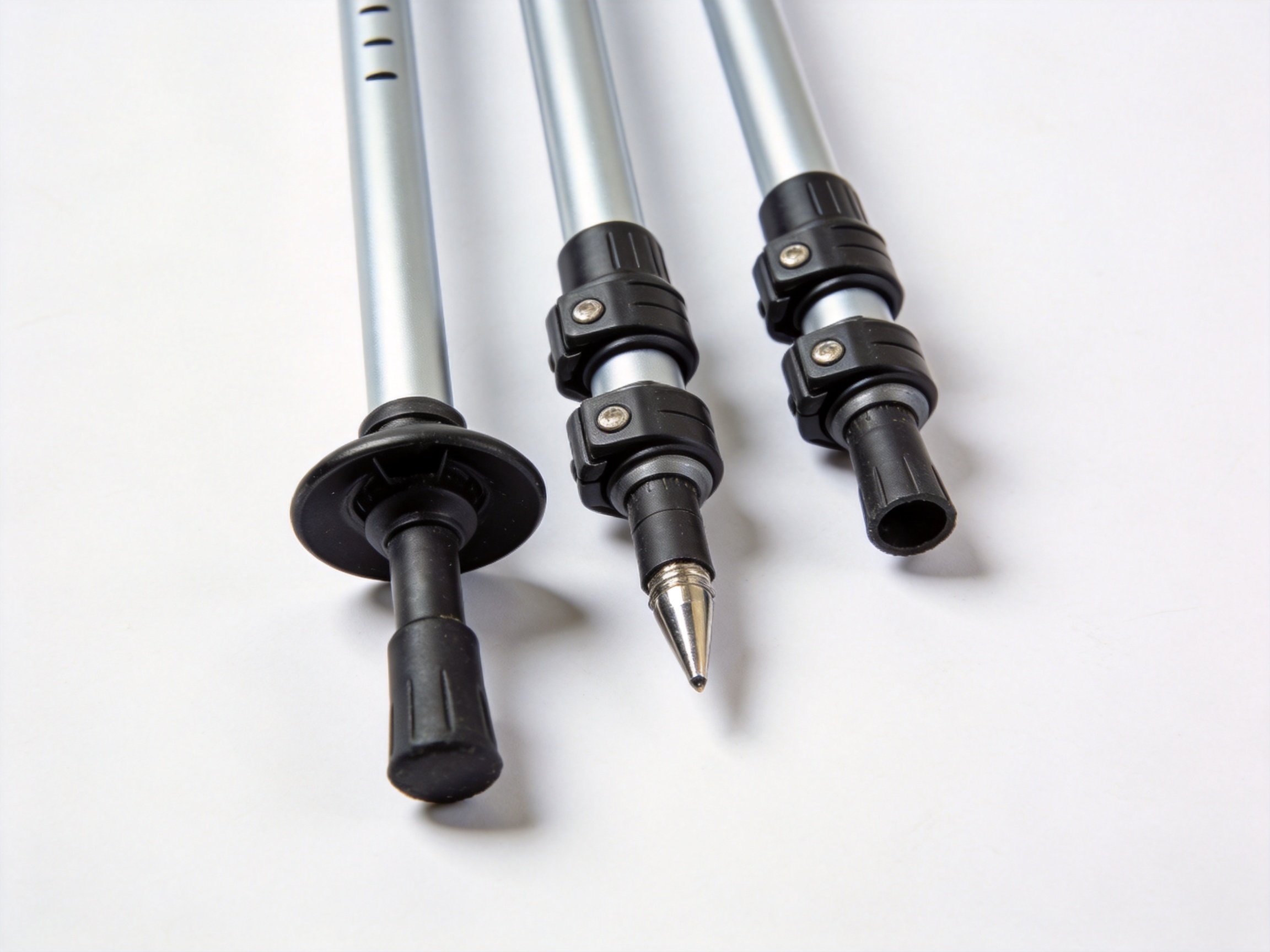
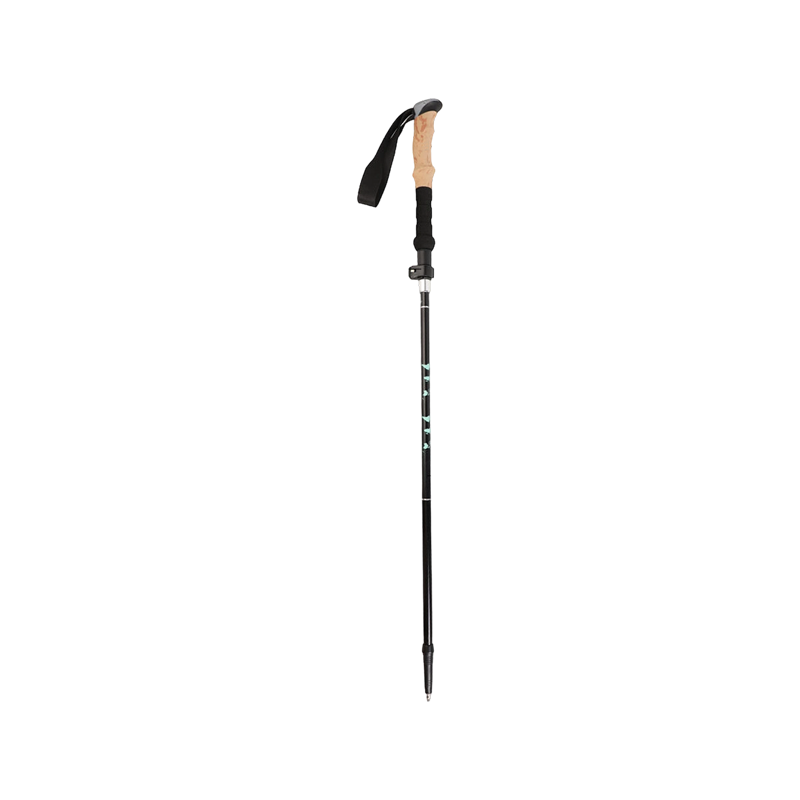
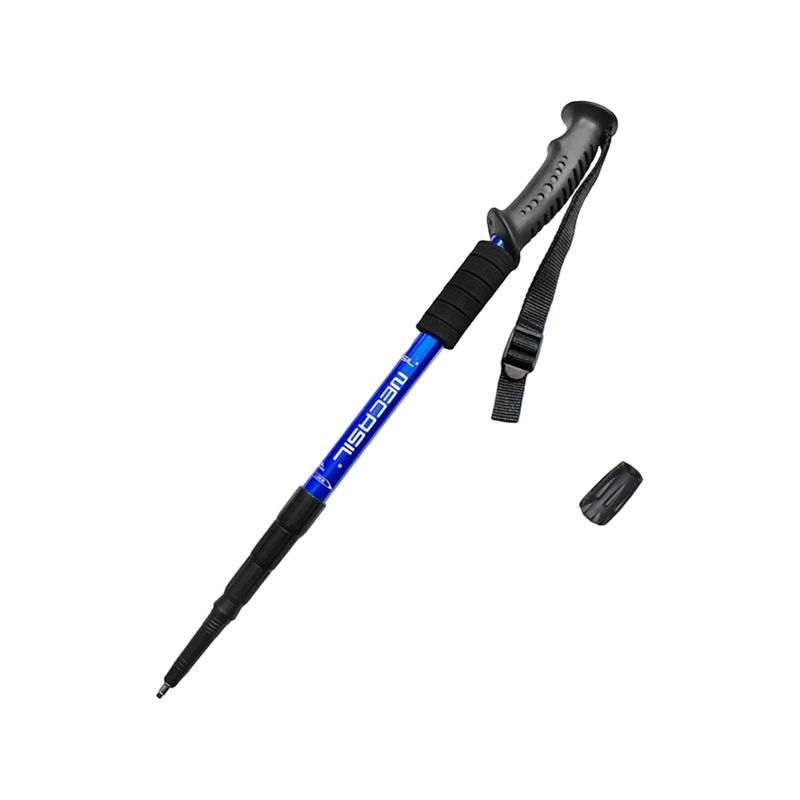
The product is an aluminum alloy three-section telescopic trekking pole featuring an external locking speed adjustment system, a straight handle, a tungsten steel alloy tip, and a portable telescopic structure. Its product category is trekking poles, and it is intended for mountain-climbing, hiking, camping, trekking, and broader outdoor movement scenarios. The model information provided for the product is WFDS262001.
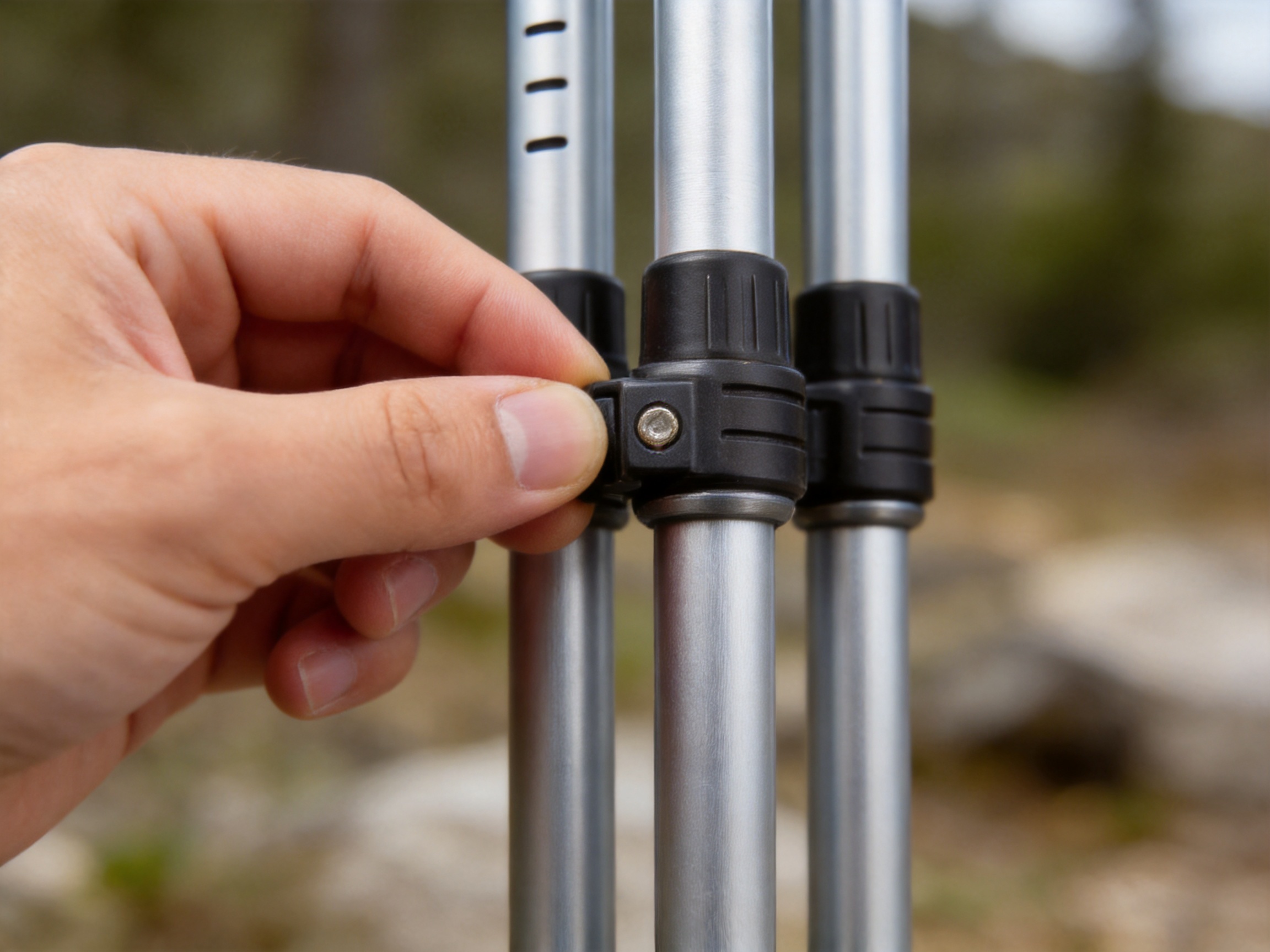
The key design feature is the 3LS external locking speed adjustment system. This system supports quick length adjustment and provides a secure one-button locking experience. In practical use, an external lock is often preferred by many hikers because it is easy to see, easy to operate, and easier to check visually than many internal locking structures. When the pole must be adjusted during a steep climb, a descent, or a change from flat ground to technical terrain, fast and confident locking becomes a significant advantage.
The shaft is made from lightweight yet high-strength aluminum alloy. This material choice reflects a balanced engineering decision. Carbon fiber can be lighter in certain premium designs, but aluminum alloy offers excellent toughness, impact resistance, value, and practical reliability. In real outdoor environments, poles may be dropped on rock, pressed between stones, used in cold and wet conditions, or packed tightly with other camping gear. Aluminum alloy provides a dependable combination of weight efficiency and durability for users who need long-term performance rather than fragile specifications.
The pole also uses a wear-resistant, non-slip tungsten steel alloy tip. This is important because the tip is the point of contact between the trekking pole and the ground. It must handle friction, impact, abrasion, and changes in surface texture. On rock, compacted soil, frozen trails, gravel, and rough mountain paths, a weak tip can reduce grip and shorten product life. A tungsten steel alloy tip helps the pole maintain traction and durability over repeated use.
Why Trekking Poles Matter in Mountain and Camping Scenarios
Outdoor beginners sometimes underestimate the value of trekking poles until they experience long descents, wet rocks, river crossings, heavy backpacks, or uneven camp approaches at dusk. In mountain-climbing and camping scenarios, the user often carries additional equipment such as tents, sleeping systems, cookware, food, water, lighting, and protective clothing. The heavier the load, the greater the demand on knees, ankles, hips, and lower back. Trekking poles distribute part of the movement load to the upper body and help create a more stable four-point walking rhythm.
During ascents, trekking poles help users push upward with both arms and legs. This can reduce fatigue in the lower body and improve pace control. During descents, poles help absorb impact and provide additional contact points before the foot lands. This can be especially valuable on long downhill trails where knee pressure gradually accumulates. On uneven terrain, poles can test ground stability before full weight is committed. On wet trails, they can help maintain balance when foot traction is uncertain.
For campers, trekking poles also support practical movement around camp areas. Many campsites are not flat or perfectly prepared. Users may need to move between tent sites, water sources, cooking areas, fire-safe zones, and storage locations over roots, mud, rocks, or sloped ground. A compact telescopic pole is easy to pack and can be quickly deployed when needed.
The three-section telescopic structure makes this trekking pole suitable for people who need portability. When collapsed, it occupies less space than a fixed-length pole. This matters for cross-border retail, travel hiking, public transportation, air travel, backpack storage, vehicle camping, and multi-activity itineraries. A pole that is difficult to pack is less likely to be carried, and a pole left at home provides no support on the trail.
Core Product Advantages
The strengths of this trekking pole can be summarized through five connected advantages: adjustable structure, secure external locking, durable aluminum alloy construction, strong tungsten steel alloy tip, and lightweight professional portability. Each of these advantages contributes to field reliability, but the product’s real value comes from how they work together.
Three-Section Telescopic Design
The three-section telescopic design allows the pole to be lengthened or shortened according to user height, terrain angle, and storage needs. On flat ground, the pole length can be adjusted so the user’s elbow forms a comfortable angle. On ascents, many hikers shorten their poles to improve uphill pushing efficiency. On descents, they often lengthen the poles to reach lower terrain and reduce impact on the knees. A fixed-length pole cannot easily adapt to these changing requirements.
Compared with two-section poles, a three-section design generally provides better packability. Compared with some folding-only designs, a telescopic structure offers flexible length adjustment and simple visual control. This makes the pole suitable for a wide range of users and trail conditions. It is practical for outdoor clubs, retail programs, rental scenarios, camping equipment sets, and individual hikers who want a versatile pole rather than a highly specialized model.
3LS External Locking Speed Adjustment System
The 3LS external locking speed adjustment system provides rapid and secure adjustment. The phrase “external locking” is significant because the user can inspect the lock directly. In rough environments, gear should communicate its status clearly. If a lock is open, misaligned, or not fully engaged, the user should be able to see and correct it quickly. External locking systems often support this kind of immediate usability.
A one-button lock experience reduces unnecessary complexity. Outdoor gear should not require complicated operation when the user is wearing gloves, carrying a pack, standing on a slope, or adjusting equipment in cold wind. A good locking system must combine simplicity with security. If adjustment is fast but the lock is weak, the pole becomes unsafe. If the lock is strong but difficult to operate, the user may avoid making necessary length changes. The 3LS design addresses this balance by offering reliable adjustment with convenient operation.
Aluminum Alloy Shaft
The aluminum alloy shaft provides a strong foundation for the pole. Aluminum alloy is widely respected in outdoor equipment because it performs well under impact and repeated stress. In trekking poles, shaft failure can occur from bending, compression, side loading, and accidental strikes. Aluminum alloy is not only light enough for long-distance use but also tough enough for rugged trail conditions.
In competitive comparison, some low-cost trekking poles may use inferior alloy grades, thin wall construction without adequate strength control, or inconsistent tube processing. These shortcuts can lead to weak locking performance, deformation, noise, or shortened product life. A properly manufactured aluminum alloy pole, however, offers a trustworthy balance between portability, toughness, and cost-effectiveness. For global markets, this is especially important because the product must satisfy different user groups, climates, terrains, and retail expectations.
Tungsten Steel Alloy Tip
The tungsten steel alloy tip improves grip and wear resistance. Because the pole tip contacts the ground thousands of times during a single long hike, its material quality directly influences the product’s long-term usability. A poor-quality tip may wear quickly, slip on hard surfaces, or become unstable under pressure. Tungsten steel alloy is selected for its hardness and abrasion resistance, helping the pole maintain dependable contact with the trail.
On rocky mountain paths, the tip must resist repeated impact. On compacted dirt and gravel, it must maintain penetration and friction. On wet natural surfaces, the tip’s stability becomes part of the user’s safety system. Although no trekking pole can remove all risk from outdoor movement, a durable and non-slip tip can significantly improve confidence and control.
Straight Handle Configuration
The straight handle gives the pole a clean and efficient handling style. A straight handle is suitable for many trekking and hiking scenarios because it supports a natural grip, easy forward placement, and quick hand repositioning. Users who move across mixed terrain often shift grip pressure and wrist position depending on slope and pace. A straightforward handle design can reduce unnecessary bulk and maintain functional simplicity.
When paired with an adjustable telescopic shaft and external lock, the straight handle supports a professional but accessible user experience. It does not overcomplicate the product, and it allows the core engineering qualities—shaft strength, lock security, tip durability, and portability—to remain central.
Comparison with Common Competitor Designs
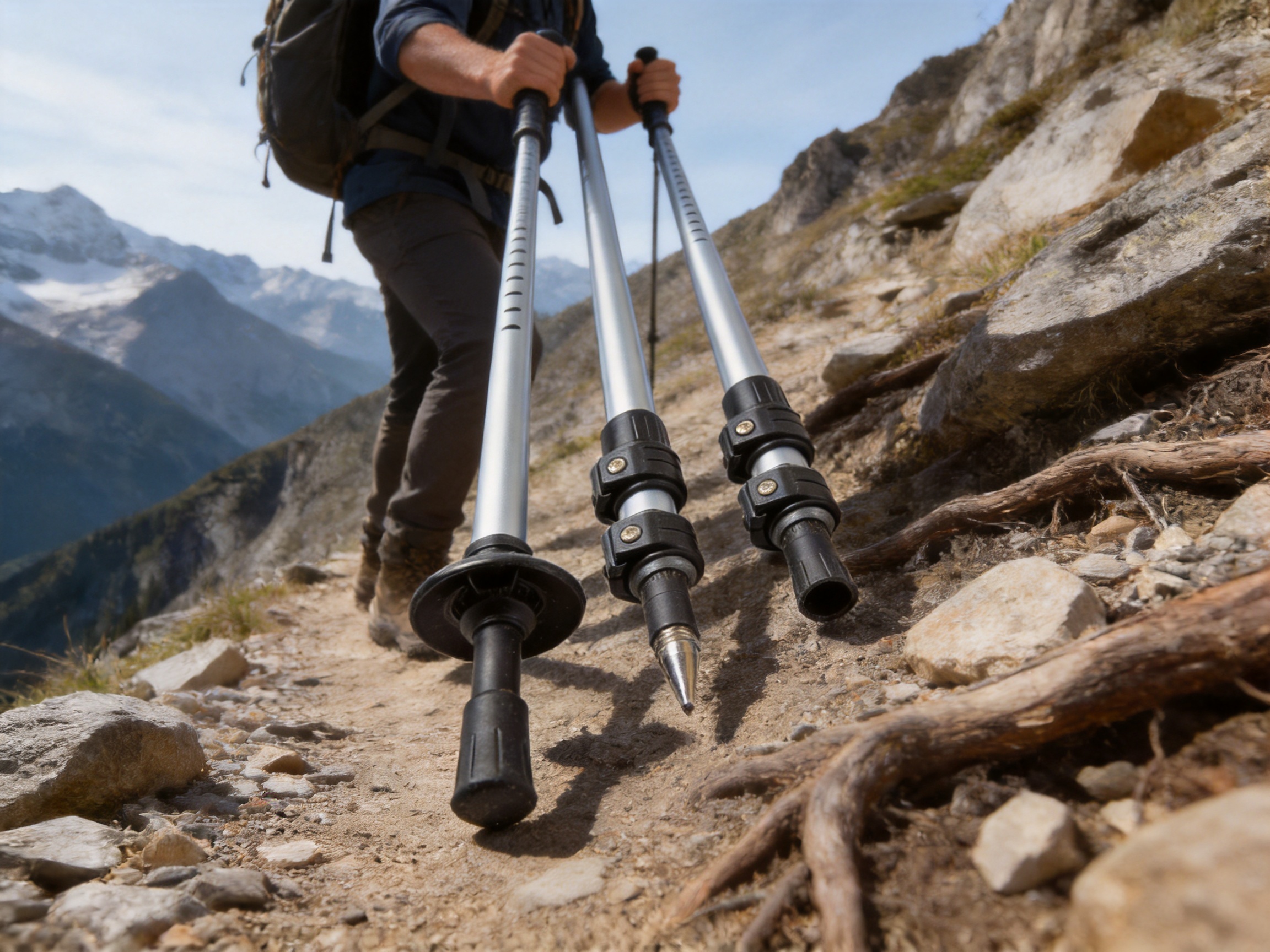
The trekking pole market includes a wide range of products, from entry-level recreational poles to premium technical models. Many products look similar in photographs, but their real performance differs in the details: lock stability, tube precision, material consistency, tip hardness, adjustment smoothness, surface finishing, and quality control. The aluminum alloy three-section telescopic external locking trekking pole offers practical advantages over many common competitor designs because it focuses on reliability rather than unnecessary decoration.
| Feature | This Trekking Pole | Common Lower-Grade Competitor Issue | User Benefit |
|---|---|---|---|
| Locking System | 3LS external locking speed adjustment with secure one-button operation | Loose internal locks, unclear lock status, slower adjustment | Faster length changes and better confidence on changing terrain |
| Shaft Material | Lightweight high-strength aluminum alloy | Inferior alloy, inconsistent wall thickness, weak deformation resistance | Better durability, impact tolerance, and long-term reliability |
| Structure | Three-section telescopic construction | Bulky fixed length or less portable two-section structures | Compact packing and flexible adjustment for different terrain |
| Tip | Wear-resistant non-slip tungsten steel alloy tip | Soft metal tips or low-durability contact points | Improved grip and longer service life on rough ground |
| Design Philosophy | Built for real mountain, hiking, and camping usage | Designed mainly for catalog appearance or low-cost display | More dependable performance in practical outdoor scenarios |
One important competitive advantage is the visible and intuitive external lock. Many users are not product engineers; they want gear that communicates clearly. If they can see the locking mechanism and operate it quickly, they are more likely to adjust pole length correctly. Correct adjustment improves comfort and reduces inefficient movement. Competitor designs with hidden internal locks may work well when new, but if they become wet, dirty, worn, or difficult to tighten, the user may experience slipping or uncertainty.
Another advantage is the material balance. Premium carbon fiber poles may be attractive to ultralight enthusiasts, but carbon fiber can be less forgiving under certain impact or side-loading conditions. Very cheap aluminum poles may save cost but compromise strength. This product occupies a practical and reliable middle ground: light enough for regular trekking, strong enough for rugged use, and manufacturable with stable quality for global supply.
The tungsten steel alloy tip also sets the product apart from lower-end alternatives. Since the tip is a consumptive contact point, it must withstand abrasion. A good tip extends usable life and helps preserve performance after repeated hikes. Many competitor poles lose their sense of security when the tip wears down quickly. This product’s tip choice reflects an understanding of real trail contact and long-term use.
Design Logic for Real Outdoor Use
CragHaven Outdoor describes its approach through a practical principle: products should not be designed merely for catalogs, but for weather, terrain, and time. This philosophy is highly relevant to trekking poles. In a catalog, a pole may be judged by weight, folded length, color, and price. On a mountain, it is judged by whether the lock slips, whether the shaft bends, whether the tip grips, whether the user can adjust it with cold hands, and whether it remains trustworthy after repeated use.
Weather affects equipment. Rain can introduce moisture into lock areas. Cold can reduce hand dexterity. Mud and dust can interfere with moving parts. Sun exposure and temperature shifts can test materials and surface treatments. Terrain also affects equipment. Rock causes impact. Gravel causes abrasion. Steep slopes create angled force. Roots and holes create sudden side loads. Time then reveals whether design decisions were truly durable or merely attractive at the point of sale.
This trekking pole’s design responds to these realities. The aluminum alloy shaft supports repeated mechanical load. The three-section telescopic system provides terrain adaptability. The external locking system offers visible security and fast adjustment. The tungsten steel alloy tip improves ground contact durability. The straight handle keeps the interface simple and functional. Together, these features create a product that addresses actual user problems instead of only competing through superficial specifications.
Manufacturing Strength and Process Control
CragHaven Outdoor is positioned as an outdoor brand and cross-border manufacturing partner based in Hangzhou, China. Its manufacturing strength comes from combining outdoor product understanding with access to China’s mature, efficient, and scalable manufacturing system. In the outdoor equipment industry, stable production is as important as design inspiration. A good sample is not enough. The design must be repeatable across production batches, and each batch must meet practical performance expectations.
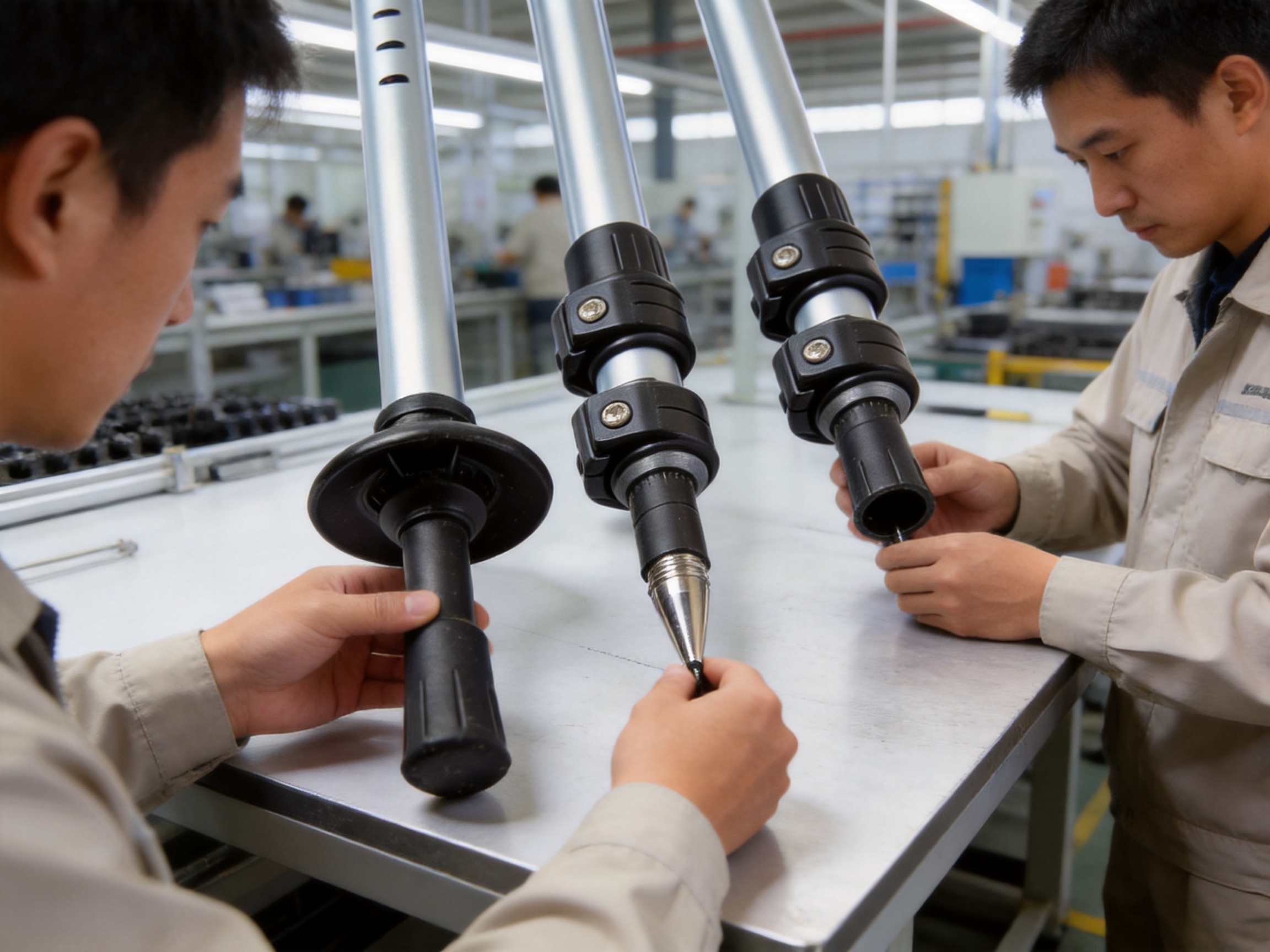
The company emphasizes sampling, testing, and optimization as standard processes that cannot be omitted. This is an important point for trekking poles because small dimensional differences can affect lock stability, adjustment smoothness, and shaft alignment. Tube diameter, wall thickness, surface treatment, lock component tolerance, and tip assembly quality all influence final performance. A professional manufacturing process must control these details from material selection through assembly and inspection.
Material Selection
The first manufacturing strength is material selection. Aluminum alloy is selected not only because it is lightweight, but because it provides toughness, manufacturability, and consistent performance. Material selection should consider the entire product lifecycle: forming, cutting, surface finishing, assembly, packaging, transportation, storage, retail handling, and field use. A material that performs well in one dimension but fails in another is not suitable for a practical trekking pole.
The tungsten steel alloy tip also reflects careful material thinking. The tip is exposed to abrasive and high-pressure contact. It must be harder and more wear-resistant than ordinary low-grade metals. Selecting a better tip material reduces premature performance loss and helps the product retain user trust over time.
Tube Processing and Shaft Consistency
For telescopic poles, tube processing is critical. Each section must fit properly with the others. If tolerances are too loose, the pole may rattle or feel unstable. If tolerances are too tight, adjustment may become difficult, especially when dust or moisture is present. Wall thickness must also be controlled to maintain strength without unnecessary weight. Surface smoothness affects telescoping movement, while finishing quality contributes to corrosion resistance and overall appearance.
Advanced manufacturing is not always visible to the end user, but the user feels it. A pole that extends smoothly, locks firmly, and remains aligned after repeated use reflects careful processing. A pole that scratches easily, sticks during adjustment, or creates noise under load often reflects poor manufacturing discipline. CragHaven Outdoor’s value lies in treating these production details as part of the product, not as secondary concerns.
Lock System Assembly
The external lock must be assembled with precision. It must hold the shaft securely without crushing it, operate smoothly without looseness, and remain reliable after repeated opening and closing. Lock components must match the tube dimensions accurately. The user expects quick operation, but quick operation is only valuable when the final lock is stable.
During manufacturing, lock testing should evaluate closing force, holding strength, repeated cycle performance, and user feel. If the lock is too stiff, it becomes inconvenient. If it is too loose, it becomes unsafe. The best result is a balanced mechanism that gives the user a clear sense of engagement. The 3LS external locking system is designed to provide this combination of speed, security, and practical usability.
Tip Installation and Contact Reliability
The tungsten steel alloy tip must be installed securely because it experiences repeated impact. A durable material is not enough if assembly is weak. The connection between the tip and the lower shaft must resist loosening, misalignment, and premature wear. Manufacturing control in this area directly affects product safety and service life.
Tip geometry and installation alignment influence how the pole contacts the ground. A poorly aligned tip may reduce grip or create uneven wear. A properly assembled tip gives the user better contact feedback and improves confidence on difficult surfaces.
Inspection, Sampling, and Optimization
CragHaven Outdoor’s process includes repeated sampling and testing. This matters because outdoor gear must survive variation. Laboratory measurements are useful, but real outdoor use includes unpredictable force angles, dirt, moisture, temperature changes, and user behavior. Sampling allows the company to identify weaknesses before mass production. Optimization improves details that might otherwise become customer complaints.
Inspection can include visual checks, dimension checks, lock function checks, telescoping movement checks, surface finish checks, tip stability checks, and packaging verification. For cross-border markets, packaging and consistency are also important because products may travel long distances before reaching the end user. A strong supply partner must understand not only how to make a product, but how to deliver it reliably.
Supply Chain Value for Global Markets
CragHaven Outdoor aims to reduce uncertainty in the supply chain. This is a meaningful promise for importers, distributors, outdoor retailers, and private-label partners. In cross-border outdoor equipment sourcing, uncertainty can appear in many forms: inconsistent materials, delayed communication, unstable production quality, weak packaging, unclear specifications, poor market understanding, and insufficient product testing. These issues can damage both profitability and brand reputation.
The company’s strength is its combination of manufacturing participation and outdoor product understanding. It does not position itself only as a factory sourcing intermediary. Instead, it participates in design and manufacturing decisions. This allows product development to begin with actual usage scenarios rather than only with price targets. For global buyers, this can reduce the risk of receiving products that look acceptable but fail under real outdoor use.
Professional communication is another advantage. Outdoor products sold in Western markets must meet consumer expectations for usability, durability, safety, and clear product positioning. A supplier that understands these expectations can help buyers develop more appropriate product lines. For example, a trekking pole should not be described only by its dimensions. It should be explained through terrain adaptability, lock reliability, shaft strength, portability, and tip durability. This kind of communication supports better marketing and more accurate customer education.
Long-term partnership is also central to manufacturing value. Outdoor gear programs often require seasonal planning, sample review, packaging updates, order forecasting, quality feedback, and product iteration. A short-term supplier may chase immediate orders without improving the product. A long-term partner supports stable development. CragHaven Outdoor’s focus on sustainable partnerships aligns with the needs of brands and distributors that want reliable supply rather than one-time transactions.
User Experience in Different Terrain Conditions
A trekking pole must perform across different terrain types. The product’s three-section telescopic design and external locking system make it adaptable, while the aluminum alloy shaft and tungsten steel alloy tip support durability.
Mountain Trails
On mountain trails, users frequently encounter elevation changes, uneven stone steps, exposed roots, loose rocks, and narrow paths. The pole can be shortened for climbing and lengthened for descending. The external lock helps users make these adjustments quickly without complicated twisting. The aluminum alloy shaft provides dependable support when the pole is planted firmly to assist upward movement or control downhill impact.
Gravel and Loose Ground
Loose surfaces are challenging because the foot may slide unexpectedly. Trekking poles help create additional contact points. The tungsten steel alloy tip is useful here because it can maintain better contact against rough particles and compacted surfaces. A weak tip may wear rapidly or fail to grip, while a durable tip helps maintain control.
Wet and Muddy Trails
Wet conditions increase the value of quick adjustment and dependable locking. Mud can make slopes unstable, and users may need to change pole length while moving between flat forest paths and steep sections. An external lock is easier to inspect and manage when conditions are dirty. The user can confirm whether the lock is closed and continue with greater confidence.
Camping Approaches
Campers often carry heavier loads than day hikers. A tent, sleeping bag, pad, stove, water, food, and spare clothing add weight. Trekking poles help distribute some effort to the arms and improve stability when walking into a campsite. The pole’s collapsible three-section structure is convenient for packing with camping gear, especially when space is limited.
Travel and Multi-Activity Use
Many outdoor users combine hiking with travel, road trips, backpacking, or weekend camping. Equipment must be compact and easy to store. The telescopic folding structure supports this lifestyle by reducing storage length and making the pole easier to transport. Users are more likely to bring equipment that packs well, and equipment that is present when needed provides real value.
Comfort, Efficiency, and Safety Benefits
The product contributes to comfort by improving walking rhythm and reducing lower-body strain during long movement. When used correctly, trekking poles encourage a coordinated motion between arms and legs. This can help maintain pace and reduce fatigue. On long trails, small reductions in strain can become significant over hours of movement.
Efficiency is also improved through better terrain adaptation. The pole can be adjusted according to slope, user height, and load. Instead of forcing the body to adapt to a fixed tool, the tool adapts to the route. This is one of the main reasons the three-section telescopic structure is valuable.
Safety benefits come from balance support, ground testing, and added contact points. A trekking pole cannot replace caution, skill, proper footwear, or route planning, but it can help users respond to unstable conditions. Before stepping onto uncertain ground, the user can test depth, firmness, or slipperiness. During stream crossings, poles can provide extra support. During descents, they can help manage impact and reduce sudden loss of balance.
The secure lock is important to safety. If a pole collapses unexpectedly, it can cause a fall. Therefore, the 3LS external locking speed adjustment system is more than a convenience feature. It is part of the product’s functional safety design. A stable lock gives the user confidence to rely on the pole under pressure.
Professional Value for Retailers and Outdoor Brands
For retailers and outdoor brands, this trekking pole offers a strong combination of selling points: aluminum alloy durability, external locking convenience, three-section portability, tungsten steel alloy tip performance, and practical mountain-camping positioning. These features are easy for customers to understand and easy for sales teams to explain.
The product can be positioned for hikers who want dependable value, campers who need compact support equipment, outdoor beginners seeking confidence, and experienced users who prefer reliable aluminum construction over fragile low-cost alternatives. It is not limited to one narrow scenario. Its broad usability helps retailers serve multiple customer groups with one well-balanced product.
From a merchandising perspective, the product avoids overcomplication. Some trekking poles include excessive features that increase cost without improving real trail performance. This product focuses on features that matter: adjustment, locking, strength, grip, and portability. That makes it suitable for practical product lines where customer satisfaction and repeat purchase trust are more important than novelty.
For private-label or cross-border programs, CragHaven Outdoor’s development and manufacturing capabilities add further value. The company’s understanding of Western-market communication can help buyers present the product accurately. Its manufacturing process can support consistency, while its design philosophy can guide future product improvements.
Care and Use Recommendations
To obtain the best performance from the trekking pole, users should adjust the length according to terrain. On flat ground, the elbow should generally remain at a comfortable angle when the pole tip touches the ground. On uphill sections, shortening the pole can improve pushing efficiency. On downhill sections, lengthening the pole can improve reach and reduce impact.
Before each hike, users should check that the external locks are fully closed and that the pole sections are secure. During long hikes, especially in wet or dusty environments, it is useful to inspect the lock occasionally. After use, the pole should be wiped clean, especially around telescoping sections and the tip. If the pole has been exposed to mud, sand, or water, drying it before storage can help maintain smooth adjustment.
The tungsten steel alloy tip is wear-resistant, but users should still avoid unnecessary abuse such as striking hard surfaces without purpose. Trekking poles are support tools, not hammers or pry bars. Proper use extends service life and preserves performance.
When packing the pole, collapse it carefully and secure it so it does not damage other gear. The three-section design makes storage easier, but good packing habits prevent scratches, bending, or accidental pressure on the locking mechanism.
Company Capability Behind the Product
CragHaven Outdoor is located in Hangzhou, Zhejiang Province, China, and serves global outdoor markets as both an outdoor brand and a manufacturing partner. Its company philosophy emphasizes balance and stability in nature, which is reflected in product design decisions that prioritize durability, reliability, and long-term value.
The company’s development approach begins with real outdoor usage experience. This matters because outdoor products are often judged under conditions that cannot be fully represented by simple specifications. A pole may look good in a photo, but real value appears when it is used repeatedly on wet stone, steep tracks, muddy forest trails, and long backpacking routes. CragHaven Outdoor’s focus on terrain, weather, and time supports a more practical product development process.
Another strength is the company’s access to China’s mature and efficient manufacturing system. China’s outdoor equipment manufacturing ecosystem includes material suppliers, component producers, processing facilities, assembly capabilities, packaging resources, and export logistics experience. When this industrial system is guided by thoughtful product development and quality control, it can transform design intent into stable, replicable, and scalable products.
The company also emphasizes professional communication for Western markets. This is important because product development does not end at production. Buyers need clear positioning, accurate feature language, and confidence that the supplier understands customer expectations. CragHaven Outdoor’s ability to participate in both design and manufacturing makes it a stronger partner for businesses seeking reliable outdoor gear supply.
Q&A Section
What is the main advantage of the three-section telescopic design?
The three-section telescopic design improves portability and adjustment flexibility. Users can shorten the pole for storage or travel and adjust the length for flat ground, climbing, or descending. This makes the pole suitable for hiking, camping, mountain trails, and mixed outdoor routes.
Why is the 3LS external locking system important?
The 3LS external locking speed adjustment system allows quick and secure length changes. Because the lock is external, users can visually check its status and operate it more easily in outdoor conditions. This improves convenience and confidence compared with many hidden or slower locking systems.
Is aluminum alloy a good material for trekking poles?
Yes. Aluminum alloy offers a strong balance of light weight, toughness, impact resistance, and value. It is especially practical for users who need dependable performance in rugged environments. While carbon fiber may be lighter in some designs, aluminum alloy is often more forgiving under impact and rough use.
What is the benefit of the tungsten steel alloy tip?
The tungsten steel alloy tip provides wear resistance and improved ground contact durability. Since the tip repeatedly contacts rock, soil, gravel, and other trail surfaces, a hard and durable tip helps maintain grip and extends service life.
Who is this trekking pole suitable for?
It is suitable for hikers, campers, trekkers, mountain walkers, outdoor travelers, and users carrying loads over uneven terrain. It is also suitable for retailers and outdoor brands looking for a reliable, practical, and scalable trekking pole product.
How does this product compare with lower-cost competitor poles?
Many lower-cost poles may use weaker alloy, less precise tube processing, less durable tips, or less reliable locks. This product focuses on real outdoor performance through high-strength aluminum alloy, an external locking system, a three-section adjustable structure, and a tungsten steel alloy tip.
How should users maintain the trekking pole?
Users should clean and dry the pole after wet or muddy use, check the external locks before hiking, avoid unnecessary impact abuse, and store the pole in a collapsed position when not in use. Regular inspection helps preserve smooth adjustment and reliable locking.
What manufacturing strengths support this product?
The product is supported by careful material selection, tube processing control, lock system assembly, tip installation quality, sampling, testing, and optimization. CragHaven Outdoor combines outdoor usage understanding with China’s mature manufacturing system to support consistent production.
Conclusion
The aluminum alloy three-section telescopic folding external locking trekking pole with a straight handle is a practical outdoor tool designed around real movement needs. Its strengths are not limited to a single feature. The value comes from the complete system: a portable three-section structure, secure 3LS external locking speed adjustment, lightweight high-strength aluminum alloy shaft, durable non-slip tungsten steel alloy tip, and simple straight handle configuration.
Compared with many competitor products, it offers a stronger balance of usability, durability, portability, and manufacturing reliability. It avoids unnecessary complexity and focuses on the features that matter most in mountain-climbing, hiking, trekking, and camping scenarios. For users, it provides stability, confidence, and terrain adaptability. For retailers and outdoor brands, it provides clear product positioning and dependable supply potential.
Behind the product, CragHaven Outdoor brings a development philosophy rooted in weather, terrain, and time. The company’s strength lies in understanding how outdoor gear is actually used and in transforming that understanding into stable, scalable manufacturing. Through material discipline, sampling, testing, optimization, and professional cross-border communication, the company supports outdoor products that are built not merely to look good in a catalog, but to perform when the trail becomes demanding.
References
British Mountaineering Council. Trekking Pole Use and Mountain Walking Safety Guidance.
Mountaineering: The Freedom of the Hills. The Mountaineers Books.
Outdoor Industry Association. Outdoor Participation and Equipment Trend Reports.
International Organization for Standardization. General Principles of Product Quality Management and Manufacturing Consistency.
American Hiking Society. Hiking Gear Selection and Trail Safety Recommendations.
Materials Handbook. Aluminum Alloy Properties and Outdoor Equipment Applications.
Journal of Sports Sciences. Studies on Trekking Pole Use, Load Distribution, and Walking Efficiency.


- Phone: +86-15968800379
- E-mail: [email protected]
- Address: Room 1002, Huishang Building, Gongshu District, Hangzhou City, Zhejiang Province.
Copyright © CragHaven Outdoor All Rights Reserved. Outdoor Gear Manufacturers Wholesale Mountaineering Camping Gear Suppliers
