

 English
 Deutsch
 Español
 Français

How an Ultralight Internal-Lock Trekking Pole Improves Hiking Performance
Content
- 1 1. The Role of Trekking Poles in Outdoor Activities
- 2 2. Product Construction and Functional Design
- 3 3. Advantages of the Aluminum Alloy Shaft
- 4 4. Internal Locking Technology
- 5 5. Shock Absorption and Impact Management
- 6 6. Ergonomic Straight Handle and Telescopic Strap
- 7 7. Portability for Hiking, Travel, and Camping
- 8 8. Performance Advantages over Basic Trekking Poles
- 9 9. Manufacturing Process and Production Strength
- 10 10. Quality Control from Prototype to Shipment
- 11 11. Customization for Outdoor Brands and Retailers
- 12 12. Applications in Hiking, Trekking, and Camping
- 13 13. Correct Adjustment and Use
- 14 14. Maintenance and Service Life
- 15 15. Competitive Positioning for Global Markets
- 16 16. Why Manufacturing Experience Matters
- 17 17. Buying Considerations for Importers and Product Developers
- 18 18. Frequently Asked Questions
- 18.1 What is an internal-lock trekking pole?
- 18.2 Is an internal-lock pole suitable for long-distance hiking?
- 18.3 Are internal locks stronger than external clamps?
- 18.4 How does the built-in spring system help?
- 18.5 Can the wrist strap be adjusted?
- 18.6 What materials are used in the product?
- 18.7 Is the pole suitable for camping?
- 18.8 How should the pole be cleaned?
- 18.9 What should a buyer inspect before placing an order?
- 18.10 Can the trekking pole be customized?
- 19 19. Conclusion
- 20 References
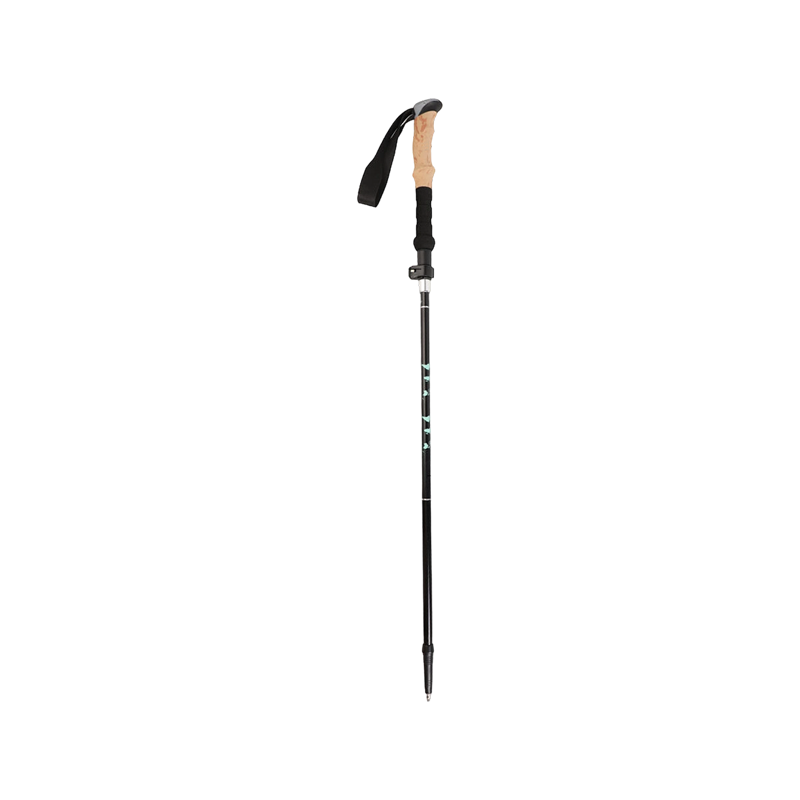
- 21 Product: Ultralight, internally locking aluminum alloy straight handle trekking pole with telescopic strap and shock absorption.
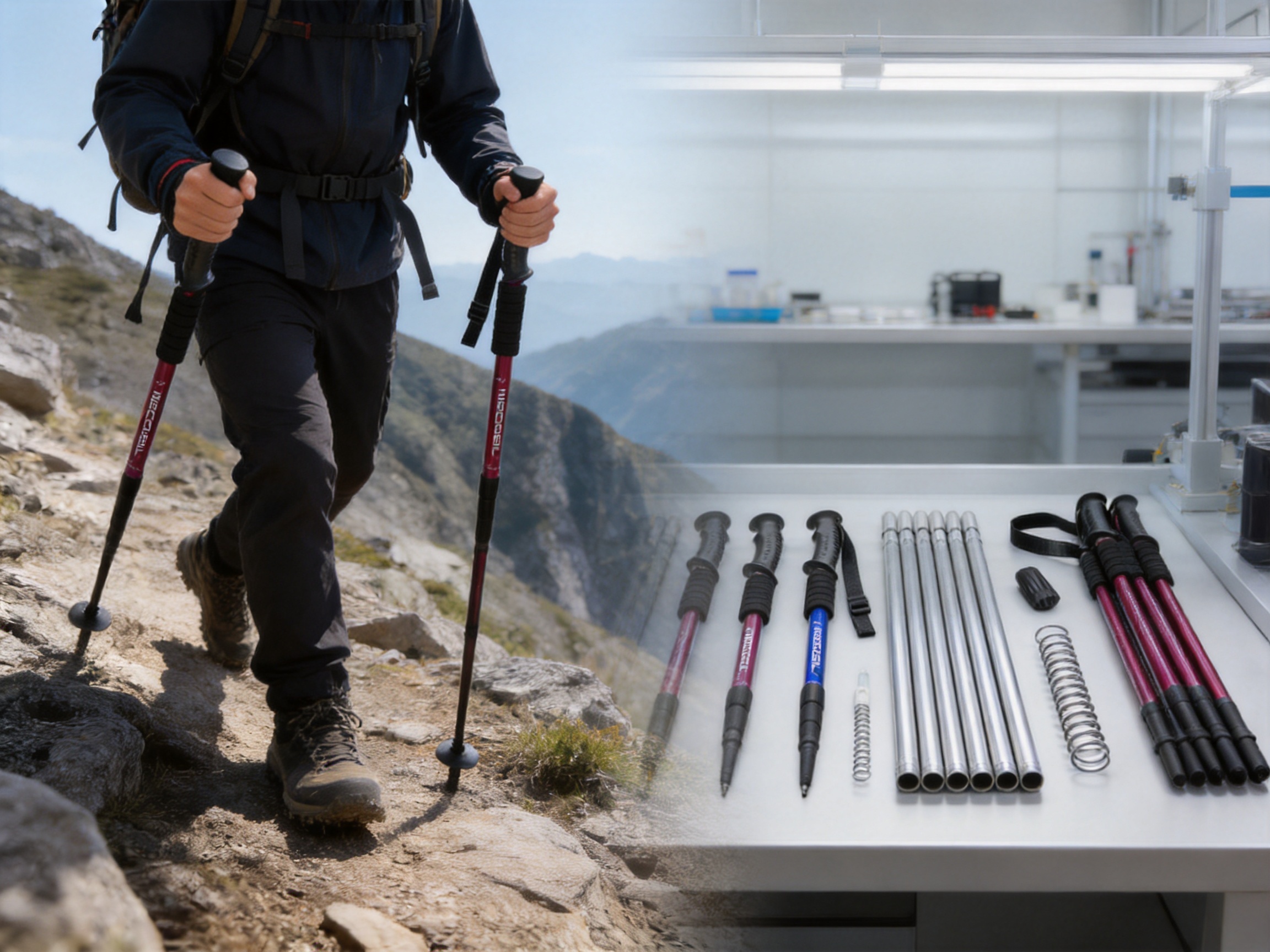
Trekking poles have become an important part of modern hiking, backpacking, mountaineering, and camping equipment. A well-designed pole can improve balance, support a more stable walking rhythm, reduce stress on the lower body, and provide additional confidence on uneven terrain. However, not every trekking pole delivers the same level of comfort, durability, portability, or adjustment reliability. Differences in shaft material, locking structure, grip design, shock absorption, manufacturing precision, and quality control all influence the user experience.
The ultralight internally locking aluminum alloy straight handle trekking pole is designed for outdoor users who want dependable support without carrying unnecessary weight. Its construction combines an aerospace-grade aluminum alloy shaft, an internal expansion locking system, an ergonomic non-slip straight handle, a telescopic wrist strap, and a built-in spring shock absorption system. Together, these features create a practical solution for long-distance trekking, daily hiking, backpacking, and general outdoor travel.
Unlike a basic adjustable pole that relies only on a shaft and a simple twist mechanism, this product is developed around the complete outdoor experience. The objective is not merely to make the pole extend and retract. It is to create a tool that remains comfortable in the hand, stable during repeated loading, easy to carry, and dependable across changing trail conditions. The design also supports efficient manufacturing, consistent assembly, and flexible supply for outdoor brands, retailers, distributors, and private-label customers.
This article examines the product’s construction, performance benefits, internal locking technology, material selection, shock absorption, ergonomic features, manufacturing capabilities, quality management, customization potential, and competitive advantages. It also explains how to select, use, inspect, and maintain an internal-lock trekking pole for long-term outdoor service.
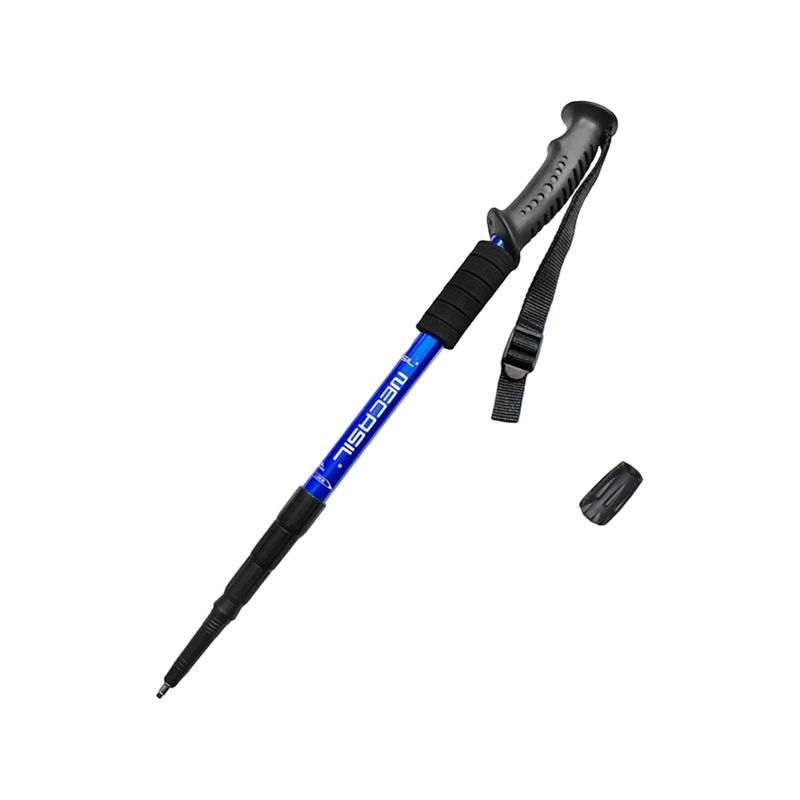
Ultralight, internally locking aluminum alloy straight handle trekking pole with telescopic strap and shock absorption.
1. The Role of Trekking Poles in Outdoor Activities
Trekking poles are used in many environments, from maintained walking paths to steep mountain trails. On level ground, they help establish a consistent rhythm and can reduce the feeling of fatigue during extended walks. On uphill sections, they help users distribute effort between the legs and upper body. During descents, they provide additional points of contact that can improve balance and help users manage changes in elevation.
On rocky, muddy, sandy, or wet terrain, a trekking pole can offer valuable support when the ground surface is unstable. It can also help users test the depth of puddles, loose soil, or snow before placing a foot. While a pole cannot replace appropriate footwear, route planning, or safe movement techniques, it can become an important part of a broader stability system.
The usefulness of trekking poles depends heavily on how well they are designed. A pole that slips during adjustment may create a safety concern. A shaft that is too heavy may increase arm fatigue. A handle that becomes uncomfortable after several hours may reduce the advantages of using poles. A poorly fitted strap may cause pressure around the wrist. For these reasons, the product must be evaluated as a complete system rather than by one specification alone.
The product described here focuses on several core user expectations:
- Low carrying weight for long-distance outdoor use.
- Reliable internal locking for telescopic length adjustment.
- Strong aluminum alloy construction for everyday durability.
- Comfortable handling through an ergonomic non-slip grip.
- Additional wrist support through a telescopic strap.
- Reduced impact through an integrated spring shock absorption structure.
- Smooth extension and retraction for convenient transportation.
- Suitability for hiking, trekking, camping, travel, and daily outdoor activities.
These requirements are especially relevant to customers who need an outdoor product that can serve multiple markets. Retail customers may want a pole for recreational hiking and travel. Professional outdoor users may focus more closely on stability, load handling, comfort, and reliability. Retailers and distributors may also value consistent production, clear product positioning, and a design that can be adapted for different sales channels.
2. Product Construction and Functional Design
The trekking pole uses a telescopic aluminum alloy shaft with an internal locking structure. The telescopic design allows the pole to be shortened for storage and extended for use. This makes it suitable for users who carry equipment in backpacks, vehicles, travel luggage, or camping storage systems. The internal lock is integrated into the shaft instead of being placed as a prominent external clamp on the outside of the pole.
The straight handle is shaped to support a natural hand position. Its non-slip surface helps users maintain control when the palm is exposed to perspiration, light rain, or repeated movement. The handle is also designed to remain comfortable during extended use, which is important because long-distance trekking often involves thousands of repeated pole placements.
A telescopic strap is attached to the handle area to provide additional wrist support. The strap can help users maintain contact with the pole without gripping excessively tightly. When properly adjusted, it allows the hand to relax slightly while still maintaining control. This can be particularly helpful during long descents or on routes where the pole is used continuously.
The built-in spring shock absorption system is intended to reduce the transmission of impact through the pole. When the tip contacts firm ground, the spring mechanism can provide controlled movement that helps moderate the force transferred toward the handle and the user’s arm. This feature is designed to improve comfort and may help reduce perceived stress around the wrist, elbow, and knee during repeated use.
The combination of these elements produces a practical structure for outdoor users who want more than a basic walking stick. The aluminum alloy shaft provides a balance between strength and weight. The internal lock maintains a clean outer profile. The handle and strap support comfort. The shock absorption system adds a layer of cushioning. Each feature contributes to the overall performance of the product.
3. Advantages of the Aluminum Alloy Shaft
Material selection is one of the most important factors in trekking pole performance. The shaft must be light enough for comfortable carrying but strong enough to withstand repeated compression, bending, and contact with variable terrain. Aluminum alloy is widely used in outdoor equipment because it offers a practical balance of structural strength, manufacturing efficiency, and cost control.
The aerospace-grade aluminum alloy used for this product is selected to support a high strength-to-weight ratio. While the exact alloy specification may vary according to customer requirements and production programs, the design objective is consistent: create a shaft that offers dependable support without making the product unnecessarily heavy.
Compared with some lower-grade metals, a properly selected aluminum alloy can provide better resistance to deformation during normal hiking use. It can also be processed into smooth, consistent tubes with controlled dimensions. These characteristics are important for a telescopic product because the sections must fit together accurately and operate smoothly.
Aluminum alloy also offers manufacturing flexibility. Tube diameter, wall thickness, surface finish, color, and section configuration can be developed according to product positioning and market requirements. This allows outdoor brands to create different versions for lightweight travel, general hiking, family camping, or more demanding trekking applications.
The shaft’s surface quality is equally important. A smooth surface improves the visual appearance of the pole and helps prevent snagging on clothing or backpack materials. It also supports more consistent operation when sections are extended or retracted. Surface treatments can be selected to improve appearance, scratch resistance, and brand presentation, depending on the intended market.
For customers comparing aluminum alloy poles with other materials, the decision should include more than weight alone. Composite materials may offer specific benefits in vibration control or premium positioning, while aluminum alloy often provides a strong balance of reliability, repairability, production scalability, and price competitiveness. For many outdoor product programs, aluminum alloy remains a highly practical choice.
Material and Performance Considerations
A trekking pole should be selected according to intended use. Recreational hikers may prioritize comfort and value. Long-distance trekkers may place greater emphasis on weight and compact storage. Outdoor retailers may need a product that performs consistently across a wide range of customer abilities. The aluminum alloy structure supports these requirements by offering a versatile base for different configurations.
| Product Element | Design Choice | Primary User Benefit |
|---|---|---|
| Shaft | Lightweight aluminum alloy | Balances support, durability, and carrying comfort |
| Locking system | Internal expansion structure | Provides a clean profile and compact telescopic adjustment |
| Handle | Ergonomic non-slip straight handle | Improves grip comfort and control |
| Strap | Telescopic wrist strap | Supports the wrist and reduces the need for constant hard gripping |
| Shock absorption | Built-in spring system | Helps moderate impact during repeated pole placement |
4. Internal Locking Technology
The locking system is central to the performance of an adjustable trekking pole. It must allow the user to change the length while preventing unwanted movement during use. The internal locking structure in this product is positioned inside the shaft. When the sections are rotated, the internal expansion mechanism presses against the inner wall of the tube and helps secure the selected length.
This design differs from an external clamp system, where a visible lever is mounted outside the shaft. External clamps can be very fast to operate and easy to inspect. Internal locks, in contrast, create a more streamlined appearance and reduce the number of exposed components. The choice between the two systems depends on user preference, terrain, adjustment frequency, and product positioning.
One advantage of the internal structure is its clean exterior. There is no large lever extending from the side of the pole, so the product is less likely to catch on branches, straps, clothing, or backpack compartments. This is useful for users who move through narrow trails or carry the poles close to their bodies during transport.
The integrated mechanism also supports a compact visual design. The pole appears more streamlined and can be easier to pack alongside other equipment. For travel-focused products, this clean structure may be an important selling point. It also supports a modern appearance that is suitable for lifestyle-oriented outdoor retail channels.
Internal locks require correct adjustment technique. Users should rotate the sections gradually and avoid excessive force. The pole should be extended only to the indicated safe range, and the locking connection should be checked before the pole is loaded. Proper use helps protect the internal components and improves long-term reliability.
Internal Lock Compared with External Lock
An external locking pole is often preferred by users who change pole length frequently. The clamp can be opened and closed quickly, and its position makes the locking condition easy to see. This can be valuable on technical routes with frequent transitions between climbing, descending, and traversing.
An internal locking pole is often preferred by users who value a smooth structure, lower visual complexity, and compact carrying. It is particularly suitable for long-distance walking, backpacking, travel, and general hiking, where pole length may be adjusted less frequently.
| Comparison Point | Internal Lock Design | External Lock Design |
|---|---|---|
| Operating method | Twist sections to secure or release the internal expander | Open and close a visible clamp |
| Exterior profile | Smooth and streamlined | Includes an external lever or clamp |
| Adjustment speed | Generally requires more rotation | Usually allows rapid adjustment |
| Portability | Compact and less likely to snag | May have a larger external structure |
| Inspection | Internal components are less visible | Lock condition is easy to observe |
| Typical use | Backpacking, long-distance hiking, and travel | Routes requiring frequent length changes |
The internal lock should not be described as universally better than every external lock. Instead, its advantage lies in matching the requirements of users who value streamlined portability, integrated construction, and a comfortable carrying experience. Product selection should always consider the activity, terrain, user habits, and required adjustment frequency.
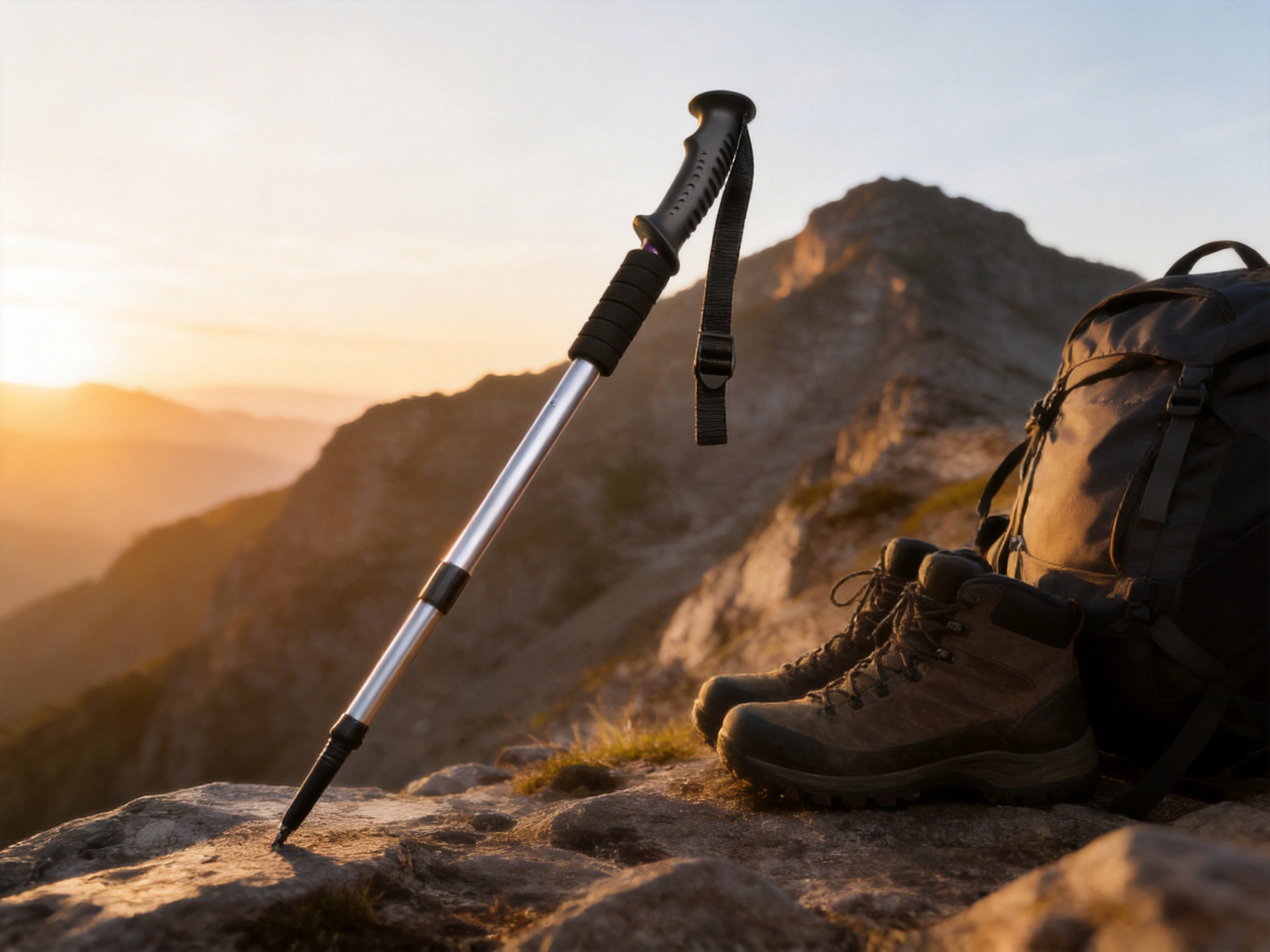
5. Shock Absorption and Impact Management
Every pole placement transfers some force from the ground through the tip, shaft, handle, and user’s arm. On hard surfaces, downhill sections, or routes with repeated steps, this force can become noticeable over time. A shock absorption system is designed to moderate part of this impact and create a smoother feeling during use.
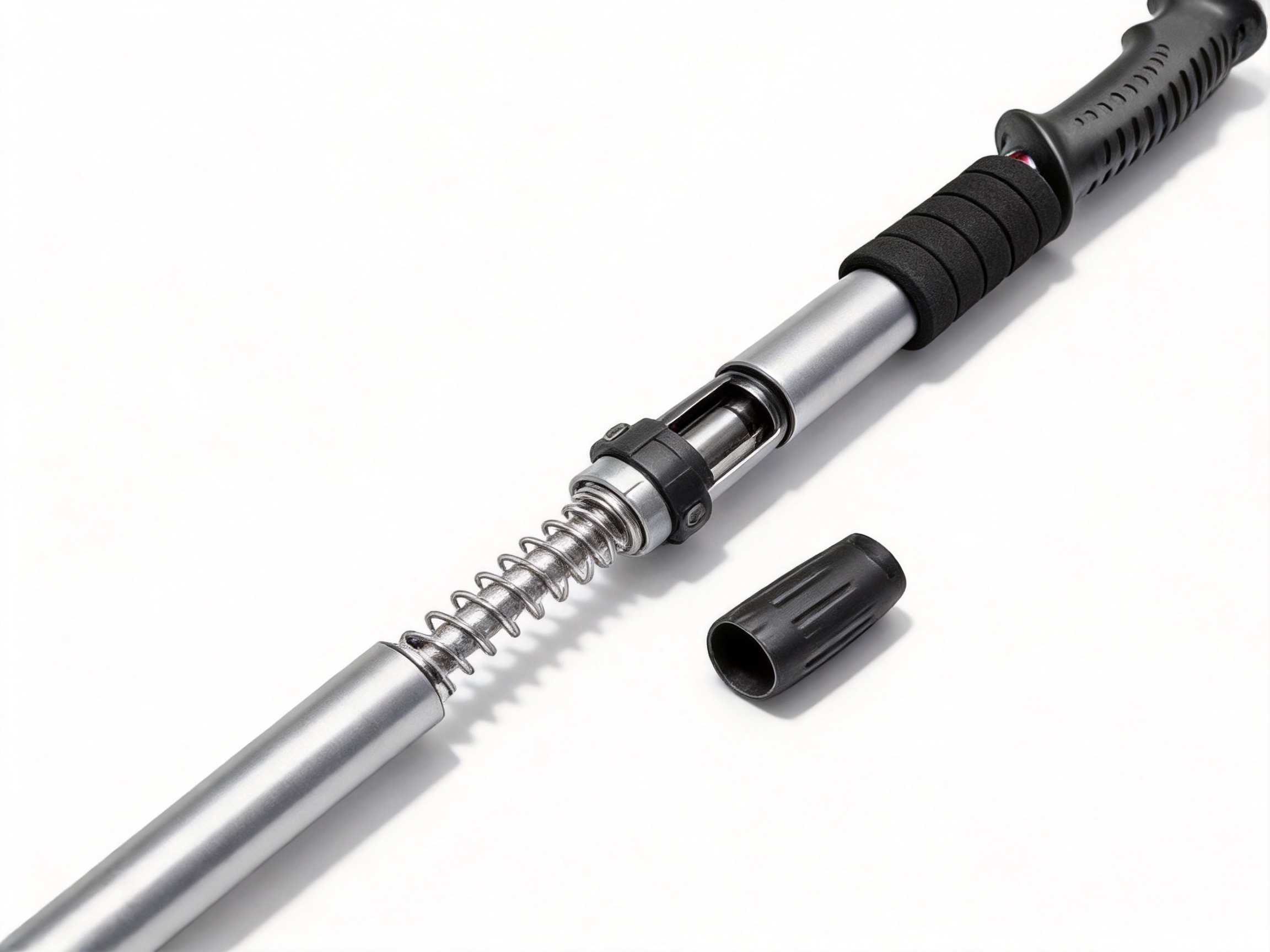
The built-in spring system in this trekking pole provides controlled cushioning within the shaft structure. When the pole is loaded, the spring can move within its designed range and help reduce the sharpness of the impact. The result is a more forgiving contact sensation, especially on firm ground or during repeated descending movements.
Shock absorption can be particularly valuable for users who spend several hours on the trail. It may help improve perceived comfort around the wrist and elbow and can reduce the feeling of harsh contact traveling through the upper body. Because trekking poles also influence walking rhythm and lower-body balance, a smoother pole response may contribute to a more comfortable overall movement pattern.
It is important to understand the role of shock absorption correctly. The spring system is not a replacement for proper technique, suitable footwear, or careful route selection. It also cannot eliminate all forces generated by uneven terrain. Its function is to complement the pole’s shaft, handle, grip, and tip design by moderating some impact within a controlled mechanical range.
The spring should be manufactured and assembled with appropriate tolerances. If the spring is too weak, the cushioning effect may feel insufficient. If it is too soft or moves excessively, the pole may feel unstable. A well-controlled design therefore requires attention to spring selection, housing dimensions, alignment, movement range, and assembly consistency.
Comfort During Extended Use
Comfort is not created by one component alone. The user’s experience depends on the interaction between the handle, strap, shaft weight, locking structure, spring response, and pole length. The ergonomic non-slip handle helps distribute pressure across the hand. The strap supports the wrist. The aluminum alloy shaft limits unnecessary weight. The shock absorption system moderates contact forces.
These features are especially useful during long-distance trekking, where small sources of discomfort can accumulate. A product that feels acceptable for ten minutes may become tiring after several hours if the grip is too hard, the strap is poorly shaped, or the shaft produces excessive vibration. A complete comfort-oriented design considers the entire duration of use rather than only the first impression.
6. Ergonomic Straight Handle and Telescopic Strap
The handle is the main point of contact between the user and the trekking pole. A straight handle design offers a familiar, simple shape that can be held in several positions. Users may place the hand around the primary grip, shift the position slightly on a climb, or use the handle to support the pole while moving at a slower pace.
The non-slip surface helps maintain control in changing weather conditions. Outdoor activities often involve perspiration, humidity, drizzle, or wet vegetation. A handle that is difficult to hold securely may cause the user to grip too tightly, increasing hand fatigue. A textured or non-slip material helps provide confidence without requiring excessive pressure.
The ergonomic form is intended to support natural wrist alignment. When the wrist is held in a more neutral position, the user may find it easier to maintain a consistent motion. Handle comfort is also affected by size, surface texture, edge treatment, and material resilience. These factors are considered during product development and sampling.
The telescopic strap adds another level of support. A properly adjusted strap can carry part of the load through the wrist and palm, allowing the user to relax the fingers during sections where maximum gripping force is not required. It can also help prevent the pole from being dropped when the user temporarily loosens the hand.
Users should place the hand through the strap from below and adjust it so that the wrist is supported without being restricted. The strap should not be tightened so much that it causes pressure or limits circulation. Correct adjustment is especially important when wearing gloves or when using the poles for many consecutive hours.
7. Portability for Hiking, Travel, and Camping
Outdoor equipment must work both on the trail and during transportation. A trekking pole that performs well but is difficult to pack may be inconvenient for travelers. The telescopic structure allows this product to become shorter when not in use, making it easier to place inside a backpack, vehicle, gear box, or luggage compartment.
The internal lock supports a clean packed profile. Because the locking components are located inside the shaft, there are fewer external parts that may interfere with adjacent equipment. This can be helpful when the pole is stored with tents, sleeping bags, cooking equipment, clothing, or other camping accessories.
Portability is also important for users who combine multiple activities in one trip. A traveler may use the pole during a day hike, store it while visiting a town, and carry it again for a second trail. A compact telescopic product supports this flexible pattern of use.
For retailers, portability creates a clear product benefit that can be communicated easily to consumers. Customers often understand the value of equipment that is simple to carry and store. This can help the product appeal to both experienced hikers and occasional outdoor users who may not want a large or complicated piece of equipment.
The product can also complement camping applications. Although trekking poles are not designed to replace every specialized tent pole, they can be part of a broader lightweight camping system. Their compact design makes them suitable for customers who want multifunctional equipment with practical storage characteristics.
8. Performance Advantages over Basic Trekking Poles
Basic trekking poles may consist of a simple shaft, a standard handle, and a basic locking mechanism. Such products can be suitable for occasional use, but they may not provide the same level of comfort, structural integration, or user confidence as a product developed with several performance features working together.
The first advantage of this product is the combination of lightweight construction and functional durability. The aluminum alloy shaft is designed to provide support without creating unnecessary carrying weight. This makes it more suitable for long walking days than a heavy, low-efficiency pole.
The second advantage is the integrated internal lock. Instead of adding a large external clamp, the pole maintains a smooth exterior. This reduces potential snagging and creates a cleaner appearance. The mechanism is also protected within the shaft, which can help reduce exposure to accidental impacts from branches or nearby equipment.
The third advantage is the built-in spring shock absorption system. Many basic poles provide no dedicated impact management. The addition of a spring can make ground contact feel less abrupt and may improve comfort during repeated use.
The fourth advantage is the combination of an ergonomic non-slip handle and telescopic wrist strap. A basic handle may provide only a place to hold the pole. This product is designed to support more comfortable and controlled use over longer periods.
The fifth advantage is versatility. The product can be positioned for hiking, backpacking, camping, outdoor travel, daily walking, and recreational mountaineering. This broad application range gives distributors and retailers more opportunities to serve different customer groups with one well-developed platform.
| Feature | Basic Pole Configuration | Integrated Product Configuration | Practical Advantage |
|---|---|---|---|
| Shaft | Standard metal structure | Lightweight aluminum alloy | Better balance between weight and support |
| Locking system | Simple adjustment mechanism | Internal expansion lock | Cleaner profile and compact structure |
| Shock management | Limited or absent | Built-in spring absorption | More comfortable contact on firm terrain |
| Grip | Basic handle | Ergonomic non-slip handle | Improved control during extended use |
| Wrist support | Standard or limited strap | Telescopic strap | More adaptable hand and wrist support |
| Use scenarios | Occasional walking | Hiking, trekking, camping, and travel | Broader market suitability |
These advantages do not depend on exaggerated specifications. They come from the thoughtful integration of practical components. For outdoor equipment, reliability is often created through many controlled details rather than one dramatic feature.
9. Manufacturing Process and Production Strength
A high-quality trekking pole requires more than a good concept. The manufacturing process must convert the design into a repeatable product with consistent dimensions, reliable locking performance, stable surface quality, and dependable assembly. This requires coordination between material purchasing, tube processing, component production, surface treatment, assembly, inspection, packaging, and shipment.
CragHaven Outdoor operates as an outdoor brand and cross-border manufacturing partner based in Hangzhou, China. Its product development approach combines outdoor application knowledge with China’s mature outdoor manufacturing ecosystem. This allows the company to participate in product design and manufacturing rather than focusing only on basic factory sourcing.
The company’s manufacturing philosophy begins with actual use conditions. Outdoor products are developed for weather, terrain, and time. This means that a trekking pole is evaluated not only by its appearance but also by how it feels after repeated use, how it behaves during adjustment, and how its components work together in realistic outdoor scenarios.
Sampling, testing, and optimization are treated as standard steps rather than optional activities. Before production, samples can be reviewed for grip comfort, extension smoothness, lock engagement, spring response, strap fit, surface finish, and packaging condition. Feedback from these stages can be used to refine materials, dimensions, assembly procedures, and appearance details.
Aluminum Tube Processing
The aluminum alloy shaft requires accurate tube processing. The outer and inner dimensions must remain within appropriate tolerances so that telescopic sections move smoothly while maintaining a stable fit. Excessive variation may cause friction, looseness, or inconsistent locking performance.
Cutting, forming, drilling, deburring, and surface treatment must be coordinated carefully. Burrs or sharp edges can interfere with assembly and may damage internal components. Smooth edge treatment supports both user safety and mechanical consistency. The tubes must also be protected during processing to reduce scratches and cosmetic defects.
Internal Lock Assembly
The internal lock contains multiple components that must be assembled in the correct sequence. Expansion elements, connecting parts, springs, and adjustment sections need to align properly within the shaft. Assembly workers must follow controlled procedures so that the locking mechanism delivers consistent friction and holding performance.
During production, the internal components can be checked for correct placement, movement, and engagement. The pole should be tested through extension and retraction cycles to identify abnormal resistance or insufficient locking. This type of inspection helps prevent small assembly deviations from becoming larger customer complaints.
Shock Absorption Assembly
The spring shock absorption system requires careful control of component fit and movement range. The spring must be correctly positioned, and the surrounding structure must allow the intended compression and return action. Assembly should prevent rattling, excessive movement, misalignment, or interference with the telescopic shaft.
Functional testing can include repeated compression, load application, and return checks. These tests help verify that the shock absorption system produces a stable response rather than an inconsistent or excessively loose feeling. The exact test method may be adjusted according to the product configuration and customer requirements.
Handle and Strap Installation
The handle must be fixed securely to the shaft and aligned correctly. A loose connection can affect user confidence and create noise during movement. Surface treatment and molding quality should be reviewed to ensure that the non-slip texture is consistent and free from defects.
The telescopic strap must be mounted with suitable stitching, attachment strength, and adjustment range. The strap should be checked for smooth adjustment and secure connection. Packaging inspection should also confirm that the strap is not twisted or damaged before shipment.
Surface Treatment and Appearance Control
Outdoor consumers often evaluate a product visually before they test it. Uniform color, clean printing, smooth finishes, and consistent component alignment all contribute to perceived quality. Surface treatment should therefore be managed as both a functional and commercial requirement.
Depending on the program, the aluminum shaft may be produced in different colors or finishes. Branding, product markings, warning information, and packaging graphics can also be adapted for specific markets. Appearance inspection helps identify scratches, color variation, dents, contamination, and other defects before the products are packed.
10. Quality Control from Prototype to Shipment
Quality control is most effective when it begins during development rather than after mass production. A reliable process identifies potential issues at the prototype stage, confirms the intended structure during sampling, and maintains control throughout production. This reduces the risk of large-scale rework and helps ensure that delivered goods match approved samples.
During the development stage, product requirements should be clarified. These may include target weight, shaft configuration, adjustment range, color, handle material, strap design, shock absorption behavior, packaging, logo placement, and destination-market requirements. Clear specifications allow the manufacturing team to create an appropriate production plan.
Incoming material inspection can verify the condition and consistency of aluminum tubes, springs, polymer parts, grip materials, straps, fasteners, and packaging materials. Materials that do not meet the agreed requirements can be identified before they enter assembly.
In-process inspection focuses on the stages where defects are most likely to occur. Tube dimensions, edge treatment, lock assembly, handle connection, spring installation, and strap attachment can be checked at appropriate points. This approach is more efficient than relying only on final inspection.
Final inspection may include appearance review, dimensional checks, telescopic operation, lock engagement, shock absorption response, handle stability, strap adjustment, and packaging verification. Sampling levels can be established according to customer requirements and order volume.
| Control Stage | Typical Inspection Focus | Quality Objective |
|---|---|---|
| Design review | Structure, intended use, materials, and manufacturability | Prevent design-related production problems |
| Prototype evaluation | Comfort, adjustment, shock response, and appearance | Confirm practical product performance |
| Incoming material inspection | Aluminum, springs, grips, straps, and packaging | Maintain stable input quality |
| In-process inspection | Tube processing, lock assembly, and component fitting | Control defects before final assembly |
| Functional inspection | Locking, telescoping, spring movement, and handle security | Verify intended operation |
| Final inspection | Appearance, packaging, quantity, and sample performance | Confirm shipment readiness |
This manufacturing discipline is valuable to international customers because product consistency affects more than returns. It influences retailer confidence, customer reviews, replenishment decisions, and long-term brand reputation. A stable process helps customers reduce uncertainty in their supply chain.
11. Customization for Outdoor Brands and Retailers
The trekking pole can serve as a platform for customized outdoor product programs. Different markets may require different colors, surface finishes, grip materials, logo treatments, packaging formats, and product messages. A manufacturing partner with experience in outdoor equipment can help translate these commercial requirements into workable production specifications.
Common customization areas include shaft color, logo printing, label design, handle color, strap color, packaging artwork, instruction sheets, carton markings, and retail presentation. Customers may also request variations in shaft section configuration, adjustment range, tip components, or shock absorption behavior, subject to technical feasibility and order requirements.
Customization should begin with a clear understanding of the target market. A lightweight travel product may require a minimal package and a compact visual identity. A mountaineering retailer may prefer stronger technical communication and more detailed instructions. A general sports retailer may focus on comfort, ease of use, and broad consumer appeal.
Professional communication is important throughout this process. A manufacturing partner should clarify which changes affect tooling, material purchasing, lead time, testing, packaging, and minimum order quantity. Transparent communication helps customers make practical decisions and avoid unexpected production delays.
CragHaven Outdoor emphasizes long-term, stable, and sustainable partnerships. Its approach is based on participating in both design and manufacturing, communicating in a professional manner, and helping customers develop products that are suitable for Western-market expectations. This is especially useful for customers who want more support than a simple catalog selection.
12. Applications in Hiking, Trekking, and Camping
Long-Distance Hiking
Long-distance hikers typically spend many hours carrying and using their equipment. Weight, comfort, adjustment reliability, and durability are therefore major considerations. The ultralight aluminum shaft reduces unnecessary load, while the ergonomic grip and spring system support a more comfortable walking experience.
The internal lock is suitable for hikers who establish a preferred length and make only occasional adjustments. Its clean profile also helps reduce interference when the poles are carried on a backpack or moved through narrow vegetation.
Backpacking and Travel
Backpackers must manage limited storage space and total carried weight. The telescopic design allows the pole to be shortened when packed. Its integrated structure is easy to combine with other equipment, making it useful for travelers who move between transport, camp, and trail environments.
The product can also appeal to travelers who want one pair of poles for different types of walking. It can be used on natural trails, hilly roads, camping areas, and outdoor sightseeing routes. Its broad application range supports a flexible travel product position.
Mountain Routes
On mountain routes, poles can support balance during elevation changes and uneven foot placement. Users may need to shorten the pole for steep ascents and lengthen it for descents. Although external locks may be faster for frequent adjustments, an internal-lock model remains suitable for users who prefer a streamlined pole and are comfortable with twist adjustment.
Correct technique is important on mountain terrain. Users should maintain a safe length, avoid placing excessive body weight onto a single pole, and check the lock after any adjustment. The pole should be used as a support aid rather than treated as a substitute for careful movement.
Camping and General Outdoor Use
Camping customers may use trekking poles for short hikes, access trails, outdoor exercise, and general campsite movement. The combination of low weight, compact storage, comfortable handling, and durable aluminum construction makes the product suitable for this wider outdoor category.
For general consumers, the product’s benefits can be communicated in clear language: it is easy to carry, comfortable to hold, adjustable in length, and designed to provide additional support on outdoor surfaces. This simple positioning can help retailers reach customers who are new to trekking poles.
13. Correct Adjustment and Use
Before using the pole, inspect the shaft, handle, strap, tip, and locking system. Ensure that the sections are free from dirt and that the internal mechanism moves normally. Extend the pole gradually and stop at the appropriate position. Do not force the sections beyond their intended adjustment range.
To adjust an internal-lock pole, hold the shaft securely and rotate the sections according to the operating direction. Tighten the sections until the internal expander engages firmly. Avoid using excessive force because over-tightening may place unnecessary stress on the internal components.
After adjustment, apply a moderate downward test load while standing in a stable position. If the pole shortens, slips, or feels loose, release the load and adjust the lock again. Do not use a pole that does not lock securely.
The correct length depends on the terrain and the user’s body proportions. On relatively level ground, the elbow is commonly held at a comfortable angle near a right angle. On uphill terrain, a slightly shorter setting may feel more natural. On descents, some users prefer a longer setting to improve reach and balance. Adjustments should always be made before the terrain becomes unsafe.
Place the hand through the strap correctly and adjust the strap so that it supports the wrist without causing discomfort. Maintain a relaxed grip and allow the pole tip to contact the ground in a controlled rhythm. Avoid striking the pole aggressively or using it to support the full body weight during unstable movements.
14. Maintenance and Service Life
Regular maintenance can extend the useful life of an internal-lock trekking pole. After use in mud, sand, or saltwater environments, clean the exterior with fresh water or a damp cloth. Dry the pole thoroughly before storage. Moisture and debris should not be allowed to remain inside the telescopic sections.
When cleaning, avoid forcing abrasive materials into the shaft. If the sections become difficult to rotate, inspect them for dirt, deformation, or damage. Do not apply unsuitable lubricants that may interfere with the internal locking components or attract additional dust.
Inspect the pole periodically for cracks, dents, loose components, worn tips, damaged straps, or unusual movement. A bent shaft may affect telescopic operation and should not be forced back into shape without professional assessment. If the internal lock no longer holds securely, the pole should be removed from use until it has been repaired or replaced.
Store the pole in a dry place away from prolonged heat, direct sunlight, and corrosive substances. It is generally better to store a telescopic pole clean and dry rather than compressed tightly for extended periods. The strap should be kept free from sharp bends and heavy pressure.
Wear parts such as tips may require replacement depending on terrain and frequency of use. Customers who operate in harsh environments should consider spare components as part of their outdoor equipment planning. Retailers can also offer replacement tips and accessories as complementary products.
15. Competitive Positioning for Global Markets
The global outdoor market contains many trekking pole categories, from entry-level walking products to premium technical equipment. A successful product must occupy a clear position. This internally locking aluminum alloy trekking pole is best positioned as a practical, lightweight, comfort-oriented product for users who want reliable features without excessive complexity.
Its competitive value comes from the combination of features rather than from one isolated claim. The product offers a clean internal lock, shock absorption, ergonomic handling, compact telescopic storage, and a durable aluminum alloy body. These features can appeal to outdoor enthusiasts who want a dependable product for regular use.
For retailers, the product provides several communication points. The lightweight structure is relevant to backpackers. The shock absorption system is relevant to comfort-focused customers. The internal lock is relevant to users who prefer a streamlined design. The non-slip grip and strap are relevant to long-duration use. The telescopic format is relevant to travelers and campers.
For distributors, production stability and customization support are equally important. A product may be commercially attractive, but inconsistent supply or uncontrolled quality can reduce its value. A manufacturing partner that supports sampling, testing, packaging development, and repeat production can help create a more dependable business relationship.
The product also benefits from a broad application range. It is not restricted to a narrow technical niche. It can be presented through hiking, camping, travel, fitness walking, outdoor recreation, and mountaineering channels. This flexibility allows customers to adapt the product message according to their distribution strategy.
16. Why Manufacturing Experience Matters
Outdoor products are exposed to repeated movement, changing weather, dirt, moisture, vibration, and mechanical stress. Manufacturing experience helps ensure that these conditions are considered during product development. It also supports better communication between design ideas and production realities.
CragHaven Outdoor’s development philosophy is based on observing how outdoor products are used in real environments. The company does not treat products as simple catalog items. It considers terrain, weather, user habits, and the passage of time. This approach helps create products that focus on functional value rather than a collection of disconnected parameters.
The company also emphasizes material selection for durability, reliability, and long-term use. This is relevant to trekking poles because the performance of the shaft, lock, spring, handle, and strap depends on the compatibility of their materials. A strong component may still fail to deliver a good user experience if it is combined with an unsuitable mating part or inconsistent assembly process.
China’s mature outdoor manufacturing ecosystem provides access to specialized suppliers, processing resources, assembly capabilities, packaging services, and logistics networks. When these resources are coordinated effectively, customers can benefit from scalable production and more efficient product development.
A manufacturing partner should also understand that quality includes communication, documentation, timing, packaging, and after-sales support. CragHaven Outdoor aims to reduce supply chain uncertainty by participating in design and manufacturing, maintaining professional communication, and developing long-term customer relationships.
17. Buying Considerations for Importers and Product Developers
Importers and product developers should evaluate a trekking pole from both technical and commercial perspectives. The first consideration is the intended user. A pole for experienced backpackers may require different positioning from a pole for casual walkers or family campers.
The second consideration is the locking system. Internal locks offer a clean structure and compact profile, but users must understand twist adjustment. Product packaging and instructions should explain how to secure the pole correctly and how to avoid over-tightening.
The third consideration is material consistency. Buyers should request information about the shaft material, surface finish, internal components, handle material, strap construction, and tip design. They should also review approved samples before mass production.
The fourth consideration is functional inspection. Sample testing should include extension and retraction, locking stability, spring response, handle security, strap adjustment, and visual quality. If the product will be sold in a demanding market, additional tests may be required according to customer specifications or applicable standards.
The fifth consideration is packaging. Trekking poles must be protected from scratches, bending, and component loss during transportation. Packaging should also include clear usage information, adjustment instructions, care guidance, and safety notices where appropriate.
The sixth consideration is supply capability. Customers should evaluate whether the supplier can manage repeat orders, color changes, packaging updates, quality documentation, and communication across the full production cycle. A stable manufacturing relationship is often more valuable than a one-time low purchase price.
18. Frequently Asked Questions
What is an internal-lock trekking pole?
An internal-lock trekking pole uses an expansion mechanism positioned inside the shaft. When the sections are rotated, the internal component presses against the inner wall of the tube to secure the selected length. This creates a clean outer appearance and reduces the number of exposed locking parts.
Is an internal-lock pole suitable for long-distance hiking?
Yes. Its streamlined structure, telescopic storage, lightweight aluminum alloy shaft, ergonomic handle, wrist strap, and shock absorption system make it suitable for long-distance hiking and backpacking. Users should learn the correct twisting and locking procedure before extended trips.
Are internal locks stronger than external clamps?
Neither system is automatically stronger in every application. Performance depends on design, materials, manufacturing precision, assembly quality, and correct use. Internal locks offer an integrated structure, while external clamps provide visible and rapid adjustment. The best choice depends on the user’s needs.
How does the built-in spring system help?
The spring system provides controlled movement when the pole contacts the ground. It is designed to moderate some impact and create a smoother feel during repeated use. It can improve perceived comfort, but it does not replace proper hiking technique, safe movement, or suitable equipment.
Can the wrist strap be adjusted?
The telescopic wrist strap is designed to accommodate different hand sizes and wearing conditions. It should be adjusted so that it supports the wrist without feeling tight. Users wearing thick gloves may need to make a small adjustment before beginning a hike.
What materials are used in the product?
The primary shaft is made from lightweight aluminum alloy. The product also includes an internal locking mechanism, an ergonomic non-slip handle, a telescopic strap, and a built-in spring shock absorption system. Specific component materials and finishes may be customized according to the product program.
Is the pole suitable for camping?
Yes. The telescopic structure makes it easy to carry and store during camping trips. It can be used for campsite walking, access trails, day hikes, and general outdoor recreation. It should be used according to its intended function and not overloaded beyond its design purpose.
How should the pole be cleaned?
Wipe the pole with a clean damp cloth after use and remove mud, sand, and moisture from the exterior. Dry it fully before storage. Avoid forcing abrasive materials into the shaft or using unsuitable chemicals that could affect the internal components.
What should a buyer inspect before placing an order?
Buyers should review shaft construction, locking performance, handle comfort, strap quality, shock absorption, surface finish, packaging, inspection procedures, customization options, lead time, and repeat-production capability. Approved samples and clear specifications should be used as references for mass production.
Can the trekking pole be customized?
Customization may include colors, surface finishes, logo treatment, grip and strap colors, packaging artwork, labels, instruction sheets, and selected component configurations. Feasibility depends on the requested change, order quantity, tooling requirements, material availability, and production schedule.
19. Conclusion
The ultralight internally locking aluminum alloy straight handle trekking pole is designed to provide a balanced solution for hiking, trekking, camping, travel, and everyday outdoor use. Its performance is based on the integration of several practical features: a lightweight aluminum alloy shaft, an internal expansion locking mechanism, a non-slip ergonomic handle, a telescopic wrist strap, and a built-in spring shock absorption system.
Compared with simpler trekking poles, this product offers a more complete combination of comfort, portability, adjustment convenience, and structural integration. Its internal lock creates a smooth external profile, while the telescopic design supports compact storage. The shock absorption system helps moderate impact, and the handle and strap are designed for controlled use over extended periods.
The product’s commercial value is also supported by a manufacturing approach that emphasizes real outdoor conditions, material compatibility, sampling, testing, optimization, and repeatable production. For global retailers, distributors, and private-label customers, these capabilities can help transform a product concept into a stable outdoor equipment program.
A reliable trekking pole should not be judged only by appearance or by one isolated specification. The most important question is whether the complete product performs consistently in the environments where customers will use it. Through functional design, careful component selection, controlled manufacturing, and professional supply chain cooperation, this internal-lock trekking pole provides a practical foundation for dependable outdoor equipment.
References
1. International Organization for Standardization. Outdoor Equipment Design and General Product Safety Principles.
2. International Organization for Standardization. Ergonomic Principles for Handheld Tools and Equipment.
3. American Society for Testing and Materials. Standard Practices for Testing Metallic Materials and Aluminum Alloys.
4. American Society for Testing and Materials. Standard Guidance for Outdoor Recreation Equipment Evaluation.
5. International Mountain Safety Research. Recommended Practices for Balance, Load Management, and Trekking Pole Use.
6. Outdoor Industry Association. Consumer Trends in Hiking, Backpacking, and Camping Equipment.
7. Human Factors and Ergonomics Research. Principles of Grip Comfort, Wrist Support, and Repetitive Hand Use.
8. Materials Engineering Reference. Aluminum Alloy Selection for Lightweight Structural Applications.
Product: Ultralight, internally locking aluminum alloy straight handle trekking pole with telescopic strap and shock absorption.


- Phone: +86-15968800379
- E-mail: [email protected]
- Address: Room 1002, Huishang Building, Gongshu District, Hangzhou City, Zhejiang Province.
Copyright © CragHaven Outdoor All Rights Reserved. Outdoor Gear Manufacturers Wholesale Mountaineering Camping Gear Suppliers
