

 English
 Deutsch
 Español
 Français

Retractable External Locking Hiking Poles for Stable Mountain Travel
Content
- 1 Why Trekking Poles Matter in Mountain-Climbing and Camping Gear
- 2 Product Overview: Retractable External Locking Hiking Poles
- 3 Core Advantages Over Basic or Competing Trekking Poles
- 3.1 Advantage One: Faster and More Visible Adjustment
- 3.2 Advantage Two: Better Stability Under Repeated Pressure
- 3.3 Advantage Three: Aluminum Alloy Strength with Practical Weight
- 3.4 Advantage Four: Comfortable EVA Foam Grip for Long-Distance Use
- 3.5 Advantage Five: Three-Section Telescopic Portability
- 4 Functional Structure and User Benefits
- 5 How Retractable Adjustment Improves Hiking Performance
- 6 Stability and Balance on Uneven Terrain
- 7 Joint Protection and Energy Distribution
- 8 Manufacturing Strength: From Outdoor Scenario to Product Engineering
- 9 Advanced Manufacturing Process and Quality Control
- 10 Why Manufacturing Discipline Creates Competitive Advantage
- 11 Design for Global Retailers and OEM Programs
- 12 Field Use Scenarios
- 13 Proper Adjustment and Use
- 14 Care and Maintenance for Long-Term Performance
- 15 Product Value for Outdoor Brands and Distributors
- 16 Comparison with Common Alternatives
- 17 Sustainability Through Durability and Long-Term Use
- 18 Q&A Section
- 18.1 What are retractable external locking hiking poles used for?
- 18.2 Why is an external locking system useful?
- 18.3 How do these poles compare with twist-lock trekking poles?
- 18.4 Are aluminum alloy hiking poles durable?
- 18.5 What is the benefit of an EVA foam handle?
- 18.6 How should trekking poles be adjusted for uphill hiking?
- 18.7 How should trekking poles be adjusted for downhill hiking?
- 18.8 Why does the three-section telescopic design matter?
- 18.9 What makes CragHaven Outdoor a strong manufacturing partner?
- 18.10 Who can benefit from these trekking poles?
- 19 Conclusion
- 20 References
- 21 Product: Retractable external locking hiking poles, trekking poles, aluminum alloy hiking sticks
Modern hiking equipment must do more than look suitable for the outdoors. It must perform under uneven terrain, changing weather, repeated adjustment, heavy load transfer, and long-distance fatigue. Retractable external locking hiking poles made with aluminum alloy shafts, EVA foam handles, adjustable wrist straps, and a three-section telescopic structure are designed for precisely these conditions. They help hikers maintain balance, manage physical effort, reduce stress on joints, and adapt quickly to different trail environments.
This article focuses on the product advantages of retractable external locking hiking poles and explains why their structure, materials, and manufacturing discipline matter for real outdoor use. It also examines how CragHaven Outdoor supports product reliability through scenario-based development, material integrity, sampling, testing, and optimization. For buyers, distributors, and outdoor retailers, these factors are important because trekking poles are not simple accessories. They are support tools that must remain dependable when users face slopes, rocks, mud, wet surfaces, long routes, and fatigue.
Retractable external locking hiking poles, trekking poles, aluminum alloy hiking sticks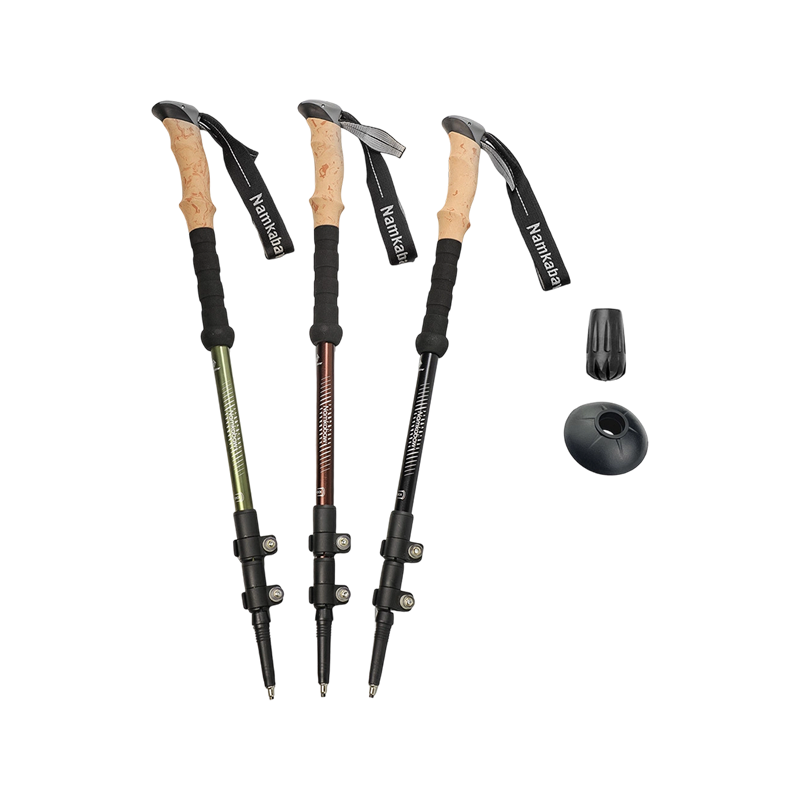
Why Trekking Poles Matter in Mountain-Climbing and Camping Gear
Trekking poles are often underestimated by beginners, but experienced hikers understand that they can significantly improve movement stability and walking rhythm. When a hiker moves across mountain trails, body weight is constantly shifting. The feet may land on gravel, roots, stone steps, wet ground, snow patches, or loose soil. Without additional support points, the legs and knees absorb nearly all impact and balance correction. A pair of well-designed trekking poles adds two more contact points with the ground, allowing the upper body to participate in movement and helping distribute pressure more evenly.
In mountain-climbing and camping scenarios, hikers frequently carry backpacks, tents, food, water, cookware, and other equipment. This added weight changes posture and increases strain on knees, ankles, hips, and lower back. Trekking poles help stabilize the body under load. They are especially useful on descents, where knee pressure can rise sharply, and on steep ascents, where the arms can assist upward propulsion.
For camping trips, trekking poles also support safer movement around campsites, riverbanks, forest paths, and rocky approaches. A reliable pole can test ground firmness, help cross shallow streams, and provide extra confidence when visibility is poor. Therefore, trekking poles should be evaluated not only as walking aids, but as multifunctional stability tools for outdoor travel.
Product Overview: Retractable External Locking Hiking Poles
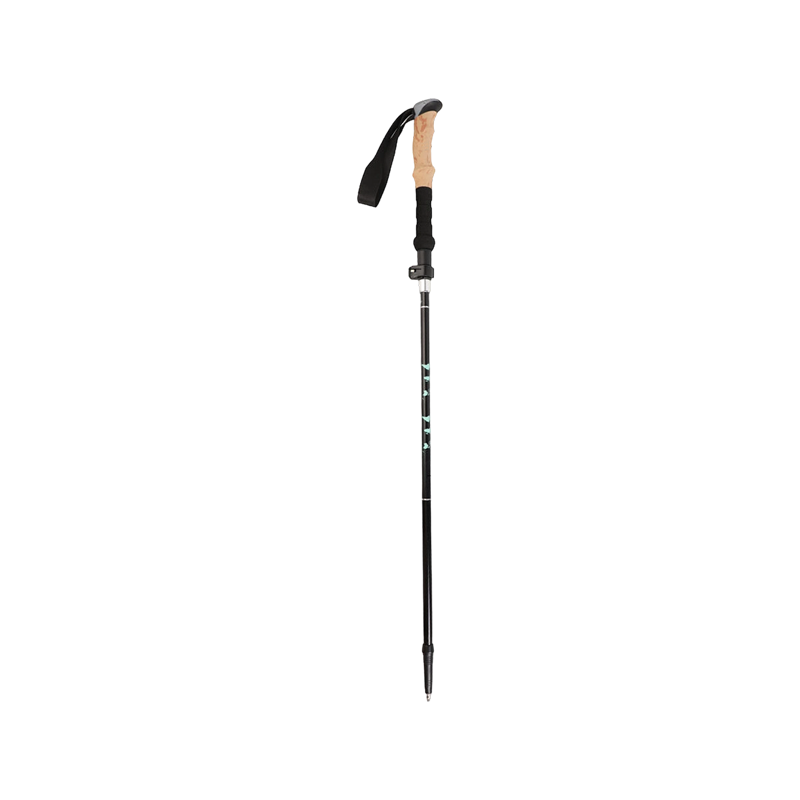
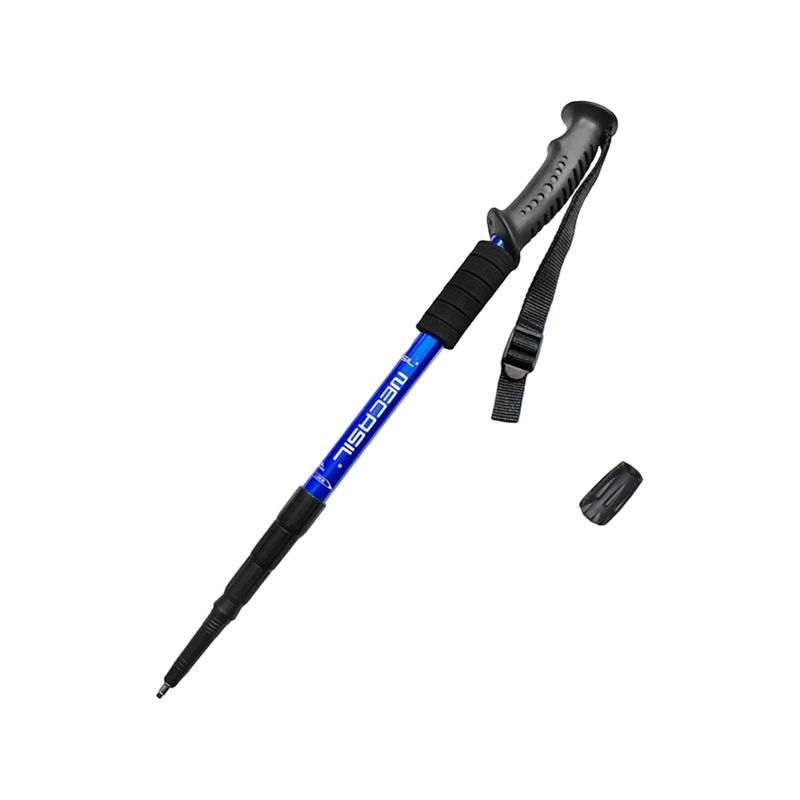
The product discussed here is a retractable external locking hiking pole system featuring a 3LS professional external lock mechanism, an aerospace-grade aluminum alloy shaft, an EVA foam handle, an adjustable wrist strap, and a three-section telescopic design. These features combine to create a pole that is strong, adjustable, comfortable, portable, and suitable for repeated outdoor use.
The external locking system is central to the product’s performance. Unlike simple twist-lock systems that rely on internal friction and may become difficult to verify visually, an external lock is positioned on the outside of the pole section. This gives users direct visibility and easier access. Hikers can quickly open, adjust, and secure the pole length, even when they are wearing gloves or moving through changing trail conditions. A strong, slip-resistant lock helps maintain the selected length during pressure-bearing use.
The aluminum alloy shaft provides the balance that many outdoor users prefer: lightweight handling combined with impact resistance and structural durability. Carbon fiber can be lighter, but aluminum alloy often provides better resistance to sudden impacts and rough field use. For mixed terrain, beginner-to-advanced hiking, and commercial outdoor gear programs, aluminum alloy offers a practical balance of performance and cost-effectiveness.
The EVA foam handle improves grip comfort by offering a sweat-absorbent and non-slip surface. During long hikes, hands become sweaty, wet, or cold, and grip quality directly affects user confidence. EVA foam remains comfortable for extended holding and is less slippery than hard plastic grips. The adjustable wrist strap adapts to different hand sizes and helps maintain control without forcing users to grip too tightly. The three-section telescopic structure makes the poles easier to pack, transport, and store, which is essential for travel, camping, and retail convenience.
Core Advantages Over Basic or Competing Trekking Poles
The market includes many types of trekking poles, ranging from low-cost recreational walking sticks to technical mountaineering poles. Not all products offer the same level of adjustment reliability, material consistency, ergonomic comfort, or field durability. Retractable external locking hiking poles provide several advantages over basic models, especially when used in variable terrain.
Advantage One: Faster and More Visible Adjustment
One of the strongest advantages of an external locking structure is operational clarity. With many internal twist-lock poles, users must twist sections until internal pressure expands and holds the shaft. If the lock is not fully engaged, the pole may shorten unexpectedly under load. The user may not immediately see whether the internal mechanism is secure. This can be inconvenient or unsafe on steep or unstable ground.
External locking poles solve this problem by using visible clamp-style mechanisms. The user can see when the lock is open or closed and can adjust the pole more intuitively. This is useful during hikes where terrain changes frequently. On an uphill section, the hiker may shorten the poles for efficient climbing. On a downhill section, the hiker may lengthen them for better braking and joint support. On flat trails, a neutral length promotes natural arm swing. Fast adjustment encourages proper use because hikers are more likely to change pole length when the mechanism is convenient.
Advantage Two: Better Stability Under Repeated Pressure
A trekking pole must support repeated downward pressure, side loading, and impact. When hikers plant poles into uneven surfaces, the shaft and lock system experience stress from multiple angles. A stable external locking system helps maintain consistent pole length and reduces the risk of sudden collapse. The 3LS professional external lock mechanism is designed to provide strong, slip-resistant fixation, making the product suitable for real outdoor movement rather than casual display or limited urban walking.
Compared with lower-grade locking systems, a properly engineered external lock can offer more predictable performance. It is easier to inspect, easier to clean, and easier to operate during field use. For outdoor retailers and importers, this means fewer customer complaints related to confusing adjustment or unreliable locking. For end users, it means more confidence on descents, crossings, and uneven surfaces.
Advantage Three: Aluminum Alloy Strength with Practical Weight
Material selection directly affects product performance. Very cheap trekking poles may use low-quality metal tubing that bends easily, corrodes quickly, or feels unstable under pressure. Premium carbon fiber poles may offer excellent weight savings but can be more vulnerable to certain impact damage and may sit at a higher price point. Aluminum alloy poles provide a strong middle path.
The aerospace-grade aluminum alloy shaft used in this product balances strength and lightweight handling. It offers dependable impact resistance for rocky trails, forest routes, and mountain use. The material supports repeated compression and helps maintain confidence when a hiker must lean into the pole during steep movement. For commercial supply programs, aluminum alloy also supports stable mass production because it is widely understood, testable, and suitable for consistent quality control.
Advantage Four: Comfortable EVA Foam Grip for Long-Distance Use
Grip comfort is not a small detail. During extended hiking, the hands repeat thousands of grip-and-release movements. A hard, poorly shaped, or slippery handle can cause fatigue, blisters, or loss of control. EVA foam offers a softer, more comfortable contact surface. It absorbs sweat, improves friction, and remains practical across a range of temperatures.
Compared with simple plastic handles, EVA foam feels more secure during long use. Compared with cork-style grips, EVA often provides a consistent feel and good durability in varied weather. The ergonomic handle design helps reduce hand fatigue, while the adjustable wrist strap supports grip control by allowing the wrist and forearm to share some load. This reduces the need for excessive hand pressure and promotes a smoother walking rhythm.
Advantage Five: Three-Section Telescopic Portability
Outdoor users increasingly value packability. Many hikers travel by car, train, airplane, or bus before reaching a trail. Camping gear must often fit into backpacks, storage bins, retail packaging, or luggage. A three-section telescopic design allows the pole to retract into a shorter length for easier storage and transport.
Compared with fixed-length poles, retractable poles are more versatile for different users and environments. A fixed pole may be strong and simple, but it cannot adapt to body height, slope angle, or compact packing needs. A three-section telescopic structure provides both customization and portability, making the product suitable for individual hikers, group rental programs, outdoor schools, and retail channels serving a broad customer base.
Functional Structure and User Benefits
The performance of a trekking pole depends on how its components work together. A strong shaft without a reliable lock is incomplete. A good lock without a comfortable grip still limits long-distance usability. A compact structure without sufficient durability may fail under difficult terrain. The best result comes from integration.
| Component | Product Feature | User Benefit | Advantage Compared with Basic Models |
|---|---|---|---|
| Locking system | 3LS professional external lock mechanism | Fast adjustment and secure length fixation | More visible and convenient than many internal twist systems |
| Shaft | Aerospace-grade aluminum alloy construction | Balanced strength, durability, and carrying comfort | More impact-resistant than fragile low-grade alternatives |
| Handle | EVA foam ergonomic grip | Sweat absorption, comfort, and non-slip control | More comfortable than hard plastic grips during long hikes |
| Wrist strap | Adjustable strap for different hand shapes | Improved control and reduced hand fatigue | More adaptable than fixed or poorly shaped straps |
| Body structure | Three-section telescopic design | Easy storage, transport, and terrain-based adjustment | More versatile than fixed-length poles |
The table shows why trekking pole quality should be assessed as a complete system rather than by a single specification. Weight, length, material, and lock type all matter, but the real value appears when these features support each other in field conditions.
How Retractable Adjustment Improves Hiking Performance
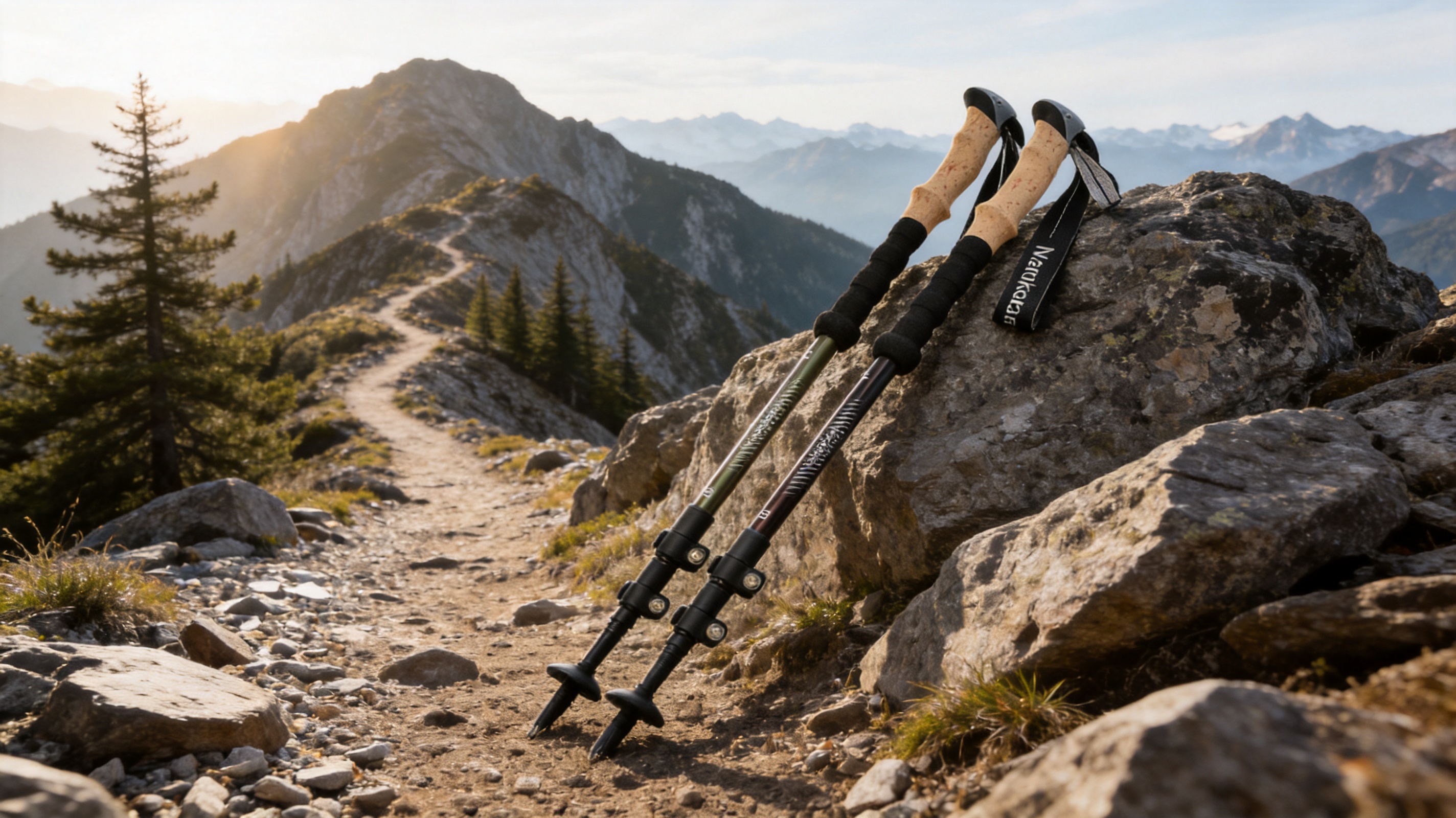
Different hiking conditions require different pole lengths. A pole set too long on an uphill climb may push the shoulders upward and reduce efficiency. A pole set too short on a downhill slope may fail to provide enough forward support. Flat terrain requires a natural arm angle, often close to a 90-degree elbow bend when the tip contacts the ground near the foot. A retractable pole allows users to adapt to these situations rather than forcing the body to compensate for a fixed length.
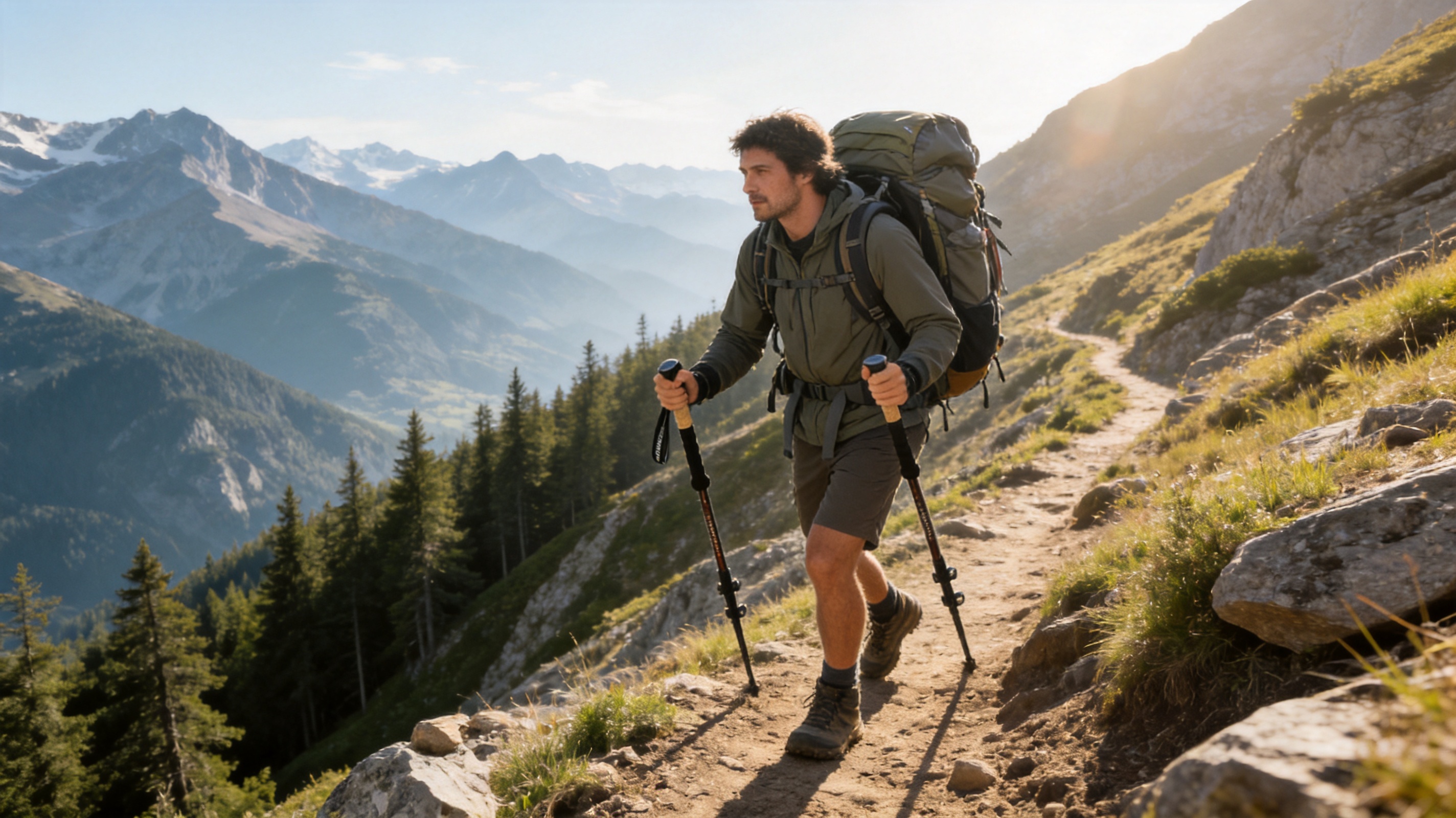
On uphill sections, shorter poles allow the hiker to plant the tips closer to the body and push forward with controlled force. This helps engage the arms, shoulders, and core. The legs still perform the main work, but the upper body contributes, which can reduce perceived effort over long climbs. Shorter settings also help prevent overreaching, which can waste energy and destabilize posture.
On downhill sections, longer poles extend the support point forward and downward. This allows the hiker to transfer part of the impact away from the knees and ankles. Descending with a loaded backpack can be physically demanding, and trekking poles help control speed and improve balance. A secure external locking system is particularly important here because pole collapse on descent can cause sudden imbalance.
On uneven trails, a hiker may set one pole slightly longer or shorter depending on side slopes or trail camber. This flexibility is useful when moving across mountain paths where one side of the body is higher than the other. Retractable adjustment supports better posture and reduces unnecessary strain caused by asymmetrical movement.
Stability and Balance on Uneven Terrain
Mountain and camping environments are rarely smooth. Surfaces may include wet roots, loose stones, sand, mud, grass, snow, wooden steps, and irregular rock. Balance is not only a matter of comfort; it is a safety factor. Trekking poles improve stability by creating a wider base of support. Instead of relying only on two feet, the hiker can use two feet and one or two poles in a coordinated pattern.
External locking hiking poles are particularly helpful in unstable terrain because they allow quick response. If a trail suddenly changes from flat path to rocky ascent, the user can adjust length without complex handling. If the ground becomes slippery, the user can check the lock visually before applying full pressure. This reduces hesitation and encourages consistent use.
Balance support is also important for stream crossings. A pole can be placed upstream or downstream to test water depth and ground stability. When crossing muddy terrain, a pole helps evaluate whether the surface will hold weight. In snowy or sandy areas, poles help maintain rhythm and reduce the risk of sudden slips. While no pole can eliminate all outdoor risks, a dependable pair improves the hiker’s ability to respond to changing surfaces.
Joint Protection and Energy Distribution
Hiking stress accumulates over time. Knees, ankles, hips, and lower back absorb repeated impacts, especially during descents. Trekking poles help distribute part of that load to the arms and upper body. This is not just a comfort advantage; it can influence endurance and recovery after long trips.
When poles are used correctly, the arms participate in forward movement. The user plants the pole, transfers a portion of body weight through the shaft, and moves forward in rhythm. This reduces the peak forces experienced by the lower body. For hikers carrying heavy camping packs, the benefit can be significant because additional load increases downhill stress.
Energy distribution also helps maintain pace. Without poles, the legs perform nearly all propulsion and stabilization. With poles, the arms help maintain cadence, especially on long climbs. This can create a more efficient walking pattern. Proper pole length and reliable locking are critical because inconsistent pole height or slipping sections can interrupt rhythm and increase fatigue.
Manufacturing Strength: From Outdoor Scenario to Product Engineering
CragHaven Outdoor approaches product development from real outdoor usage rather than catalog styling. This distinction is important. A product that looks suitable in a photograph may not perform well when exposed to terrain, weather, impact, sweat, repeated adjustment, and transport. The company’s development philosophy is based on three principles: purpose-driven design, material integrity, and engineering discipline.
Purpose-driven design means that every feature should solve a practical usage problem. The external lock exists because hikers need fast, visible, secure adjustment. The aluminum alloy shaft exists because users require dependable strength without excessive weight. The EVA handle exists because grip comfort and sweat control matter during long movement. The adjustable strap exists because hands differ in size and shape. The three-section design exists because portability matters for hiking and camping logistics.
Material integrity means selecting materials for durability, reliability, and long-term use rather than short-term appearance. Outdoor gear faces abrasion, moisture, temperature variation, pressure, and repeated handling. A material may look attractive at first but fail after repeated use if it is not appropriate for the environment. Aluminum alloy, EVA foam, and well-designed locking components are chosen because they support practical performance.
Engineering discipline means that sampling, testing, and optimization are not optional. A trekking pole should be evaluated for locking strength, shaft straightness, handle attachment, strap comfort, telescopic smoothness, packaging reliability, and field usability. The goal is stable, repeatable production. For global retailers and distributors, this helps reduce uncertainty in the supply chain and supports consistent customer experience.
Advanced Manufacturing Process and Quality Control
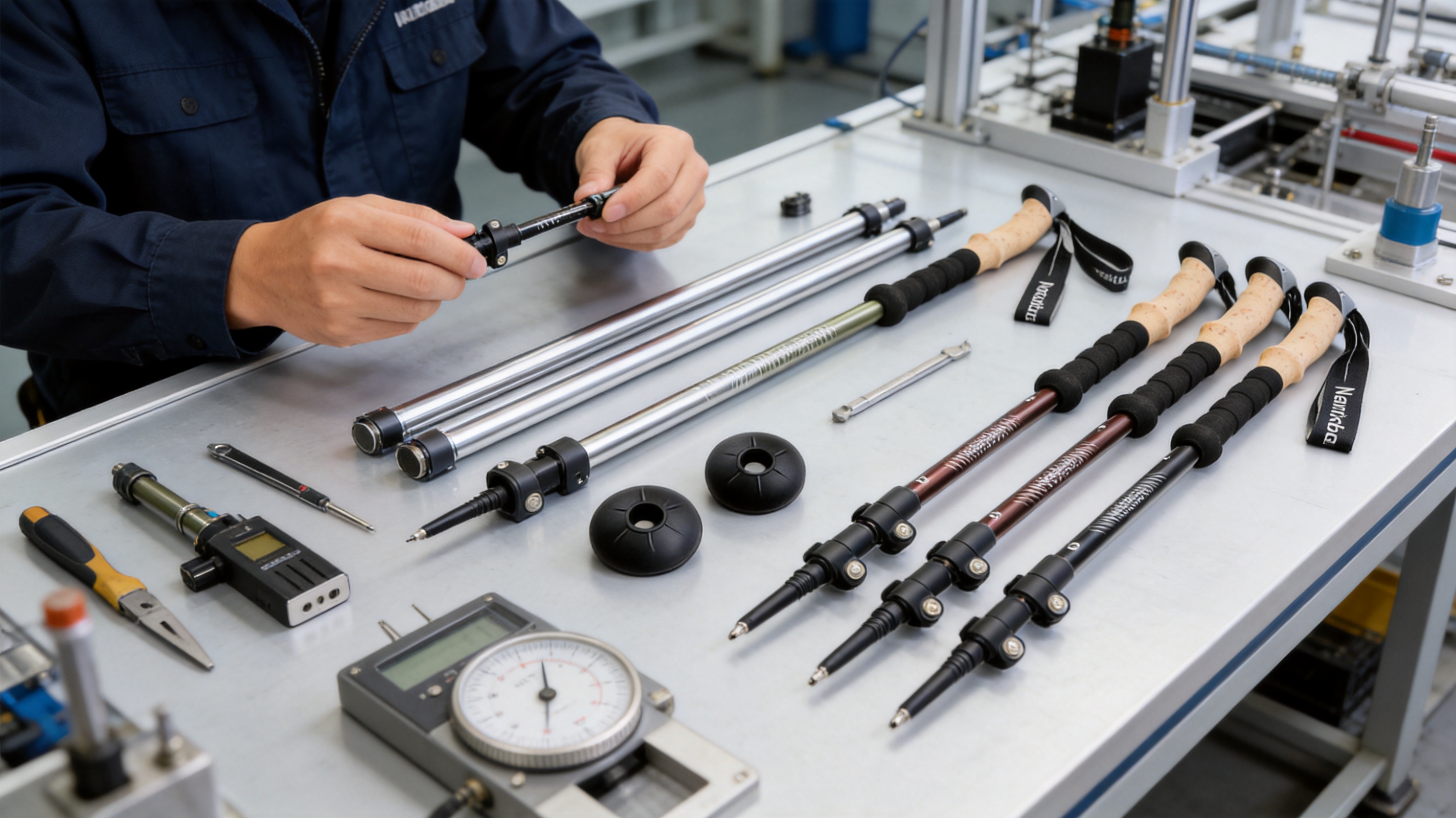
Manufacturing trekking poles requires coordination between material preparation, tube forming, surface treatment, component assembly, lock calibration, grip installation, strap fitting, final inspection, and packaging. Each stage influences final performance. A small error in tube tolerance may affect telescopic smoothness. A weak lock component may reduce load reliability. Poor grip bonding may lead to looseness. Inconsistent packaging may cause shipping damage. Therefore, process control is essential.
Material Selection and Incoming Inspection
The process begins with material selection. Aluminum alloy tubing must meet strength, weight, and dimensional requirements. The wall thickness must be suitable for outdoor use without making the pole unnecessarily heavy. Surface quality must be checked because scratches, dents, or inconsistent finishing can affect both appearance and long-term durability. EVA foam material must provide the right balance of softness, grip, and resilience. Lock components must be checked for fit, clamp strength, and durability.
Incoming inspection helps prevent poor materials from entering production. This is one of the most important safeguards for consistent quality. Even a well-designed product can fail if raw materials vary widely. By evaluating materials before assembly, the manufacturer improves production stability and reduces the likelihood of field defects.
Tube Processing and Dimensional Control
The three-section telescopic structure depends on accurate tube dimensions. Each section must slide smoothly while still locking firmly. If tolerances are too loose, the pole may feel unstable. If tolerances are too tight, adjustment becomes difficult and may cause jamming. Dimensional control is therefore critical.
Tube cutting must maintain consistent length. Edges should be processed to avoid sharp burrs that could damage internal sections or create safety concerns. Straightness must be maintained so that the sections align properly. Surface treatment should protect the aluminum alloy and provide a clean, professional finish suitable for outdoor retail markets.
External Lock Assembly and Calibration
The 3LS external lock mechanism is a key performance component. During assembly, the lock must be positioned correctly and adjusted for secure closure. The clamp should provide strong holding force without damaging the shaft. It must open and close smoothly and remain dependable after repeated operation.
Calibration is important because users apply different levels of force during hiking. A lock that is too loose may slip under pressure. A lock that is too tight may be difficult to operate or may cause unnecessary wear. Proper adjustment ensures that the pole remains user-friendly while maintaining stability. Visual inspection and functional testing help confirm that each unit performs as intended.
Grip, Strap, and Tip Installation
The handle and strap are the user’s direct contact points. EVA foam handles should be installed securely and aligned correctly. Any looseness can reduce confidence and comfort. The wrist strap must be adjustable and durable enough for repeated use. Stitching, fastening, and adjustment components should be checked to ensure they work smoothly and support different hand shapes.
The tip section must provide reliable ground contact. While terrain-specific baskets or rubber caps may vary depending on configuration, the basic tip structure must be strong and properly fitted. The pole’s lower end is exposed to repeated impact, abrasion, and pressure, so assembly quality is essential.
Final Testing and Packaging
Before shipment, final inspection should verify adjustment range, locking performance, shaft appearance, grip security, strap function, and overall cleanliness. Packaging must protect the product during transport while also presenting it clearly for retail or distribution channels. For export-oriented outdoor gear, packaging consistency is part of supply-chain reliability.
CragHaven Outdoor’s strength lies in combining real outdoor understanding with China’s mature manufacturing system. The company participates in both design and manufacturing decisions, rather than merely sourcing existing factory items. This helps ensure that products are developed for practical use, scalable production, and long-term partnership needs.
Why Manufacturing Discipline Creates Competitive Advantage
In outdoor gear markets, competition is not only about price. Retailers and distributors increasingly need products that generate fewer returns, satisfy users, support brand reputation, and remain stable across repeated orders. Manufacturing discipline creates competitive advantage because it reduces uncertainty.
Basic trekking poles may look acceptable at first, but weaknesses often appear after use. Locks may loosen, tubes may wobble, handles may become uncomfortable, straps may slip, and finishes may wear quickly. These problems damage customer trust. By focusing on material integrity, precise assembly, and testing, a manufacturer can deliver more dependable products.
CragHaven Outdoor emphasizes long-term value rather than short-term trends. This matters in mountaineering and camping gear because outdoor users remember whether equipment works when conditions are difficult. A hiking pole that performs reliably on a steep descent creates confidence. A pole that collapses or feels unstable creates frustration and risk. The difference is often found in engineering details that are invisible in simple product photos.
Design for Global Retailers and OEM Programs
Global retailers need trekking poles that meet consumer expectations in different markets. Some customers prioritize lightweight travel. Others focus on durability for mountain routes. Some require affordable yet dependable gear for beginner hikers. Others want technical features for frequent outdoor use. A well-designed retractable external locking hiking pole can serve a wide range of needs because it combines adjustability, strength, comfort, and portability.
CragHaven Outdoor operates as an outdoor brand and cross-border manufacturing partner based in Hangzhou, China. The company focuses on mountaineering, hiking, and camping scenarios and supports global markets with functional and reliable outdoor gear. Its Western-market-oriented communication helps overseas buyers discuss specifications, packaging, quality expectations, and long-term supply plans more efficiently.
For OEM programs, repeatability is essential. A retailer cannot succeed if the first batch performs well but later batches vary. Stable manufacturing processes help maintain product consistency. This includes material verification, sample confirmation, production control, inspection standards, and packaging requirements. The result is a supply relationship that supports brand growth rather than creating operational uncertainty.
Field Use Scenarios
Mountain Trails
Mountain trails often combine steep sections, irregular steps, gravel, and narrow paths. Retractable external locking hiking poles provide adjustable support for these conditions. Hikers can shorten the poles on climbs, lengthen them on descents, and quickly confirm lock security before applying pressure. Aluminum alloy strength is valuable where the poles may contact rocks or experience sudden side pressure.
Forest Paths
Forest paths may include roots, mud, leaves, and damp surfaces. EVA foam grips help maintain control when hands become sweaty or wet. The wrist strap improves handling when users need to release the grip briefly or adjust gear. The external lock allows quick changes without stopping for long periods.
Long-Distance Hiking
On long-distance routes, comfort and reliability become increasingly important. A lightweight yet strong shaft reduces carrying burden. A comfortable handle helps prevent hand fatigue. Stable locking prevents energy loss caused by wobbling or slipping sections. The three-section telescopic design is also useful when poles must be attached to a backpack during transport or during sections where hands need to be free.
Camping Approaches
Camping trips often involve carrying heavier loads than day hikes. Trekking poles help balance the body while moving with a pack. They are useful when approaching campsites over uneven ground, crossing shallow streams, or moving around camp after dark. Compact storage also helps when packing vehicles or tents.
Proper Adjustment and Use
To gain the full benefit of retractable external locking hiking poles, users should adjust them according to terrain. On flat ground, the pole length should generally allow the elbow to bend comfortably when the tip touches the ground. On uphill terrain, shortening the poles helps maintain efficient pushing motion. On downhill terrain, lengthening the poles provides more forward support and helps reduce knee impact.
Users should check the external lock before applying full body weight. The lock should be fully closed and should hold the pole section firmly. If adjustment becomes difficult due to dirt or moisture, the pole should be cleaned and dried after use. Regular care supports long-term performance.
The wrist strap should be adjusted so that it supports the hand without restricting circulation. Proper strap use allows the wrist and forearm to assist with load transfer, reducing excessive gripping. The user should plant the poles naturally in rhythm with walking, avoiding overreaching or striking the ground too forcefully.
Care and Maintenance for Long-Term Performance
Outdoor gear lasts longer when users maintain it properly. After hiking in rain, mud, sand, or snow, trekking poles should be extended, wiped clean, and dried before storage. Moisture and grit can affect telescopic movement and locking performance. The external lock area should be checked for debris, and moving parts should be kept clean.
Users should inspect the shaft for dents or bending after heavy impact. While aluminum alloy is durable, any pole can be damaged by extreme force or improper use. Handles should be checked for looseness, and straps should be inspected for wear. Tip condition should also be monitored because worn tips reduce grip on hard surfaces.
Storage should be in a dry place away from excessive heat or direct sunlight for long periods. Proper storage helps preserve EVA foam condition and reduces unnecessary material aging. For retailers and rental operators, regular inspection routines can extend service life and improve customer safety.
Product Value for Outdoor Brands and Distributors
For outdoor brands, trekking poles must satisfy both user performance and commercial requirements. A good product should be easy to explain, easy to use, reliable in the field, and suitable for consistent production. Retractable external locking hiking poles meet these requirements because their core features are directly connected to user needs.
The external lock provides a clear selling point: fast, visible, secure adjustment. Aluminum alloy construction provides a clear durability message. EVA foam handles support comfort. Adjustable wrist straps improve fit. The three-section telescopic design supports portability. These features are understandable to consumers and practical for outdoor use.
For distributors, the product’s broad usability is valuable. It can serve hiking, camping, trekking, travel, and general outdoor walking categories. It can be positioned for beginner hikers who need stability, experienced hikers who need dependable adjustment, and retailers seeking OEM-ready outdoor gear. The combination of function and manufacturability supports scalable sales channels.
Comparison with Common Alternatives
Fixed-length poles offer simplicity, but they lack adaptability. They may be suitable for users with a specific height and consistent terrain, but they are less practical for mixed hiking conditions. When a route includes uphill, downhill, and flat sections, fixed length becomes a limitation. They are also harder to pack and transport.
Internal twist-lock poles can be compact and lightweight, but many users find them less intuitive. The locking status is less visible, and adjustment may become difficult if the internal parts wear or become dirty. Some twist-lock designs perform well, but lower-quality versions may slip or jam. External locking poles provide a more user-friendly adjustment experience, especially for changing terrain.
Very low-cost poles may reduce material quality, lock strength, or grip comfort to lower price. While this may appeal to casual buyers initially, field performance may disappoint. A pole that feels unstable or uncomfortable reduces confidence and may lead users to stop using it. The retractable external locking aluminum alloy design offers a stronger balance of cost, performance, and durability.
Premium ultralight poles may suit specialized users who prioritize minimal weight above all else. However, for many outdoor consumers and commercial retail programs, practical durability is equally important. Aluminum alloy poles are often better suited for rugged, repeated use and wider market acceptance.
Sustainability Through Durability and Long-Term Use
Sustainability in outdoor gear is not only about material labels. It is also about product life span. A durable product that performs reliably for many trips can reduce waste compared with cheap products that fail quickly. CragHaven Outdoor’s focus on long-term value supports this practical approach. By choosing materials for durability and applying testing and optimization, the company aims to create gear that remains useful over time.
Long-term partnerships also support sustainability in the supply chain. When buyers and manufacturers work together over multiple production cycles, they can improve specifications, reduce defects, optimize packaging, and respond to market feedback. This is more sustainable than constantly switching suppliers based only on short-term price differences.
Q&A Section
What are retractable external locking hiking poles used for?
They are used to improve balance, stability, and movement efficiency during hiking, mountain walking, camping approaches, and uneven trail travel. Their adjustable structure allows users to adapt pole length to uphill, downhill, and flat terrain.
Why is an external locking system useful?
An external locking system is visible, accessible, and easy to operate. Users can quickly open, adjust, and close the lock. This makes it easier to confirm that the pole is secure before applying pressure, which is especially important on steep or unstable ground.
How do these poles compare with twist-lock trekking poles?
Twist-lock poles use an internal mechanism that may be less visible and sometimes harder to verify. External locking poles provide clearer operation and faster field adjustment. For many hikers, this makes them more convenient and confidence-inspiring.
Are aluminum alloy hiking poles durable?
Yes. Aluminum alloy is widely used in trekking poles because it offers a strong balance of durability, impact resistance, and manageable weight. It is especially practical for rocky trails, mountain routes, camping use, and repeated outdoor activity.
What is the benefit of an EVA foam handle?
EVA foam provides a comfortable, sweat-absorbent, and non-slip grip. It helps reduce hand fatigue during long hikes and improves control in warm, wet, or physically demanding conditions.
How should trekking poles be adjusted for uphill hiking?
For uphill hiking, poles are generally shortened. This allows a more efficient pushing motion and helps keep the arms in a comfortable position without forcing the shoulders too high.
How should trekking poles be adjusted for downhill hiking?
For downhill hiking, poles are generally lengthened. This provides additional forward support and can help reduce impact on knees and ankles during descent.
Why does the three-section telescopic design matter?
The three-section design makes the poles easier to store, carry, and transport. It also allows broad length adjustment for different users and terrain conditions.
What makes CragHaven Outdoor a strong manufacturing partner?
CragHaven Outdoor combines outdoor scenario understanding with manufacturing discipline. The company focuses on purpose-driven design, material integrity, sampling, testing, and optimization. This supports reliable product development and stable supply for global markets.
Who can benefit from these trekking poles?
They are suitable for hikers, campers, mountain walkers, outdoor travelers, retailers, distributors, and OEM buyers seeking practical, adjustable, and durable trekking poles for global outdoor gear markets.
Conclusion
Retractable external locking hiking poles are practical tools for modern outdoor activity. Their value comes from the combination of adjustable length, secure external locking, aluminum alloy strength, comfortable EVA foam grip, adjustable wrist strap, and compact three-section telescopic structure. These features help hikers improve balance, reduce physical stress, adapt to terrain, and move with greater confidence.
Compared with basic fixed-length poles, lower-grade twist-lock models, and poorly constructed alternatives, this product offers clearer adjustment, better usability, stronger field practicality, and broader market appeal. For outdoor users, it supports real hiking performance. For retailers and distributors, it provides a clear product story and reliable commercial potential.
CragHaven Outdoor strengthens this product value through manufacturing processes based on real-world outdoor understanding. The company’s commitment to purpose-driven design, material integrity, engineering discipline, sampling, testing, and optimization helps transform design intent into stable, scalable products. In the competitive mountaineering and camping gear market, this combination of product function and manufacturing reliability is what separates dependable outdoor equipment from ordinary catalog items.
References
1. Outdoor Industry Association. Outdoor Participation Trends and Consumer Equipment Usage Reports.
2. International Mountaineering and Climbing Federation. General Guidance on Hiking Equipment and Mountain Safety.
3. American Hiking Society. Recommendations on Trekking Pole Use, Trail Safety, and Hiking Preparation.
4. British Mountaineering Council. Walking and Trekking Equipment Guidance for Hill and Mountain Environments.
5. Materials Engineering Handbook. Aluminum Alloys in Lightweight Structural Applications.
6. Human Factors in Product Design. Ergonomics of Handheld Outdoor Equipment and Load Distribution.
Product: Retractable external locking hiking poles, trekking poles, aluminum alloy hiking sticks


- Phone: +86-15968800379
- E-mail: [email protected]
- Address: Room 1002, Huishang Building, Gongshu District, Hangzhou City, Zhejiang Province.
Copyright © CragHaven Outdoor All Rights Reserved. Outdoor Gear Manufacturers Wholesale Mountaineering Camping Gear Suppliers
