

 English
 Deutsch
 Español
 Français


How to Select a High-Performance Double-Layer Insulated Picnic Bag for Outdoor Use
Content
- 1 1. The Role of an Insulated Picnic Bag in Modern Outdoor Activities
- 2 2. Product Construction and Material Architecture
- 3 3. Double-Layer Organization Compared with Single-Layer Designs
- 4 4. Performance Advantages for Commuting and Daily Use
- 5 5. Performance Advantages for Camping, Hiking, and Picnics
- 6 6. Product Development Based on Real Usage Scenarios
- 7 7. Manufacturing Process and Quality Considerations
- 8 8. Testing and Validation Before Delivery
- 9 9. Competitive Advantages in the Market
- 10 10. OEM and ODM Value for Outdoor Brands
- 11 11. Supply-Chain Reliability and Manufacturing Communication
- 12 12. Recommended Selection Process for Buyers
- 13 13. Care and Use Recommendations
- 14 14. Frequently Asked Questions
- 14.1 Q1: What is the main advantage of a double-layer picnic bag?
- 14.2 Q2: Is this product suitable for both commuting and camping?
- 14.3 Q3: Does the bag keep food cold for a guaranteed period?
- 14.4 Q4: Why is Oxford cloth useful for an outdoor picnic bag?
- 14.5 Q5: What is the benefit of the PEVA interior?
- 14.6 Q6: Can the bag carry ice packs?
- 14.7 Q7: Is the product suitable for children or students?
- 14.8 Q8: How does this design compare with a simple fabric lunch tote?
- 14.9 Q9: Can buyers request customized dimensions or branding?
- 14.10 Q10: What should a buyer review before placing a large order?
- 14.11 Q11: How should the bag be cleaned?
- 14.12 Q12: What makes CragHaven Outdoor different from a basic sourcing supplier?
- 15 15. Conclusion
- 16 References
- 17 Product: Large capacity double-layer lunch bag, Oxford cloth insulated bag, picnic bag, handheld ice pack
Food transport becomes more demanding when people leave the home, office, or vehicle and spend time outdoors. A lunch bag used for a short commute may only need to carry one meal, while a picnic bag for camping, hiking, or family travel must manage several different food types, changing temperatures, moisture, movement, and repeated handling. These requirements make the construction of the bag just as important as its appearance.
The large capacity double-layer picnic bag described in this article is designed to address these practical challenges through independent storage compartments, layered insulation, durable Oxford cloth, and a waterproof PEVA interior. It can be carried by hand or over the shoulder, allowing it to serve commuters, students, outdoor enthusiasts, families, retailers, and professional distributors. More importantly, the product reflects a manufacturing approach based on real use scenarios rather than superficial styling.
Compared with a basic single-layer lunch bag, a well-designed double-layer model provides better organization and a more controlled internal environment. Wet and dry products can be separated, hot and cold items can be arranged more logically, and delicate food can be protected from unnecessary pressure. The result is a more reliable product for workdays, day trips, picnics, camping weekends, and other outdoor activities.
This article examines the product’s construction, performance, competitive advantages, manufacturing considerations, application scenarios, purchasing criteria, and customization potential. It also explains why a professional outdoor equipment manufacturer must contribute more than production capacity. Material selection, sample development, testing, structural optimization, and supply-chain communication all influence the final value of an insulated picnic bag.
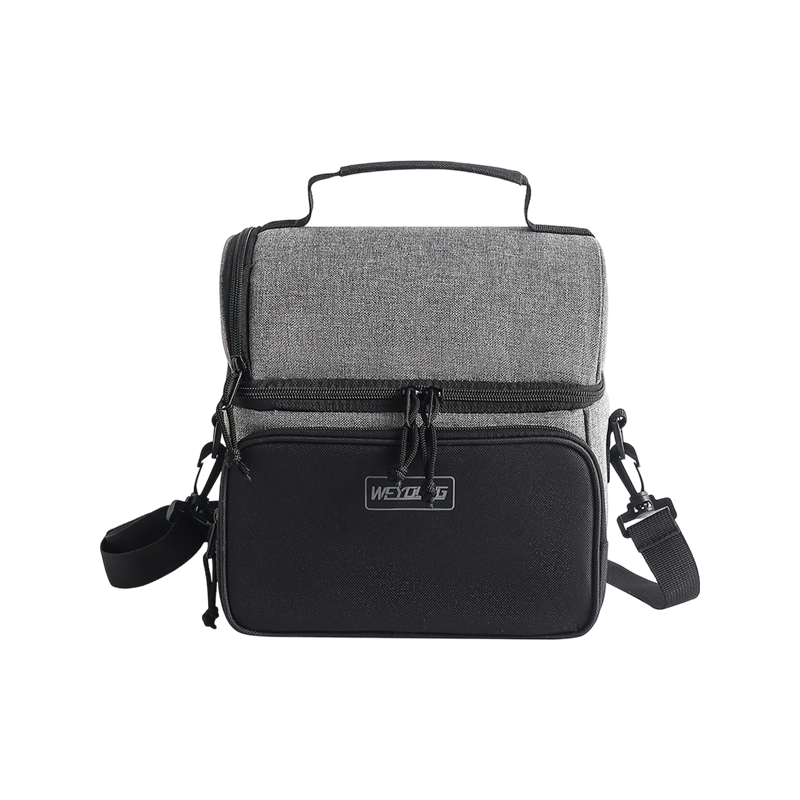
Large capacity double-layer lunch bag, Oxford cloth insulated bag, picnic bag, handheld ice pack
1. The Role of an Insulated Picnic Bag in Modern Outdoor Activities
An insulated picnic bag is no longer simply a soft container for carrying sandwiches. Consumers increasingly expect one product to support commuting, school, travel, hiking, camping, family gatherings, and short-distance transportation. These situations involve different combinations of meals, beverages, fruit, snacks, ice packs, utensils, and containers. A practical bag therefore needs to offer more than volume. It must provide organization, thermal separation, moisture management, carrying comfort, and resistance to repeated use.
Many conventional lunch bags use a single internal compartment. This configuration may be adequate for one dry meal, but it becomes inconvenient when users carry drinks, sauces, fruit, prepared dishes, or chilled items at the same time. Moisture can spread across the interior, liquid containers may press against delicate food, and strong odors can transfer between different products. The user must often place additional plastic bags or containers inside the lunch bag, reducing usable capacity.
A double-layer design offers a more functional solution. Separate compartments allow users to arrange items according to temperature, moisture, food type, or serving time. A beverage can be kept apart from bread or fruit, while a chilled food container can be separated from dry snacks. This arrangement creates a more predictable packing system and makes the contents easier to access during a busy commute or outdoor activity.
The design is especially useful for people who need to transport more than one meal. Office workers may carry breakfast and lunch, while students may need snacks and drinks for a long school day. Families may pack a combination of prepared meals, fresh fruit, chilled beverages, and tableware. Hikers and campers can use the compartments to separate ready-to-eat products from items that may release moisture.
The benefit of a double-layer structure is not limited to organization. Divided storage can also improve weight distribution. When the contents are arranged across two sections instead of compressed into one space, the load can be positioned more evenly. This can help reduce deformation of the bag and make carrying more comfortable when the bag is held by hand or transported with the shoulder strap.
2. Product Construction and Material Architecture
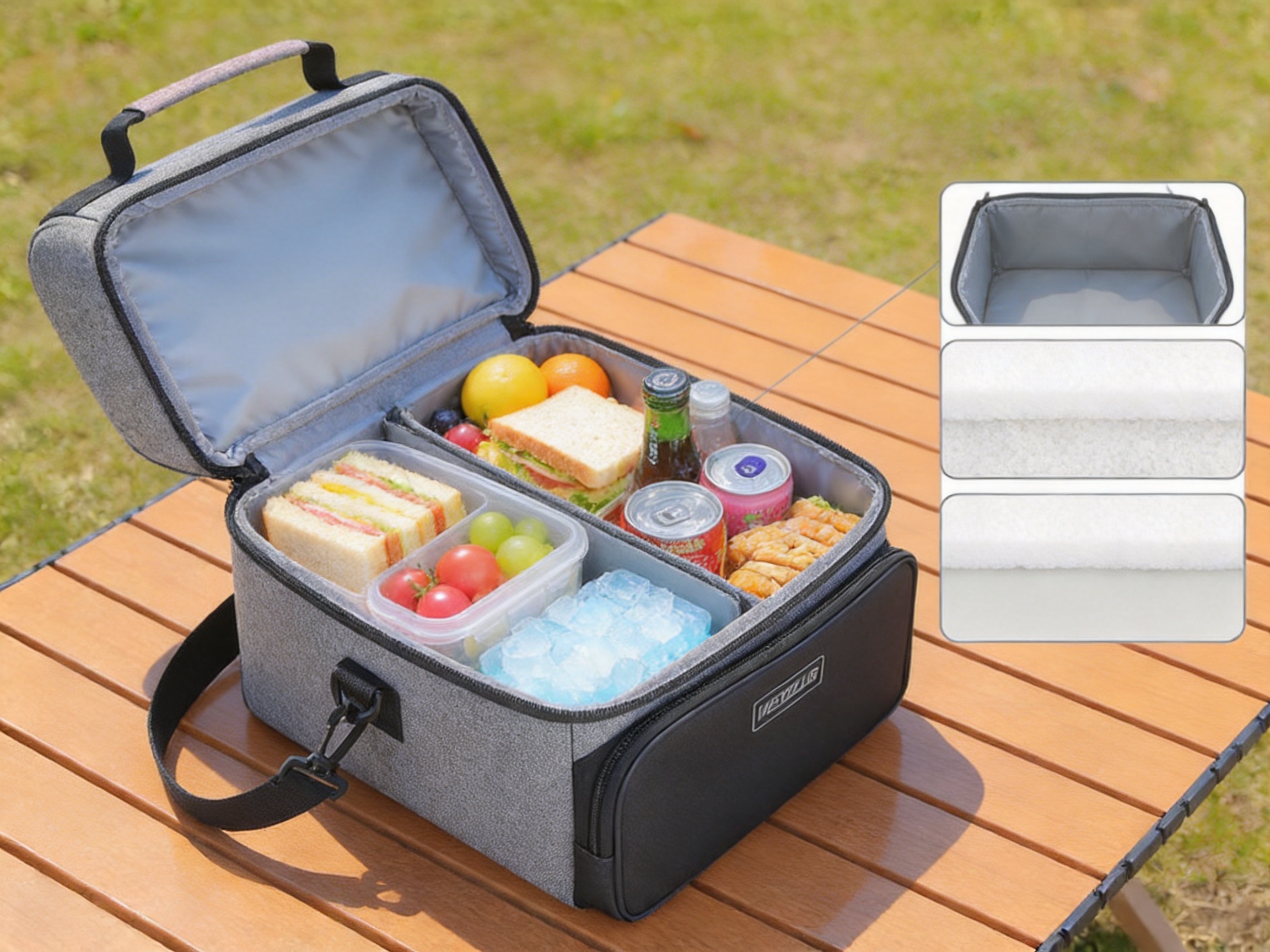
The product uses a three-layer material structure consisting of an outer Oxford cloth layer, a middle pearl cotton insulation layer, and an inner PEVA waterproof membrane. Each layer performs a different function. The outer material supports durability and shape retention, the middle layer helps reduce heat transfer, and the inner membrane helps contain moisture while simplifying cleaning.
2.1 Oxford Cloth Exterior
Oxford cloth is widely used in bags and outdoor accessories because it balances flexibility, durability, and appearance. In an insulated picnic bag, the exterior must withstand contact with tables, vehicle interiors, floors, grass, and other surfaces. It may also be folded, loaded, unloaded, and carried repeatedly. A fabric with suitable abrasion resistance can help the bag maintain its appearance and structural integrity during regular use.
The Oxford cloth exterior also contributes to the overall shape of the bag. A very thin outer fabric may collapse when the bag is empty or become unstable when fully loaded. A properly selected Oxford material provides enough body to support the compartments without making the product unnecessarily rigid. This balance is important because users want a bag that is durable but still convenient to store and transport.
For outdoor applications, the outer layer also provides a first barrier against dust, light splashes, and contact with rough surfaces. It should not be considered a substitute for a fully waterproof shell, but its durable woven construction supports the practical needs of picnics, day trips, and camping use. Color, weave, coating, and weight can be adjusted according to the product positioning and target market.
2.2 Pearl Cotton Insulation
The middle layer uses pearl cotton as an insulating material. Its primary purpose is to reduce the rate at which heat moves between the internal contents and the surrounding environment. No soft lunch bag can guarantee a fixed internal temperature under all conditions, because performance depends on food temperature, ambient temperature, packing method, exposure time, and the use of ice packs. However, a properly integrated insulation layer can help slow temperature change.
Pearl cotton is also useful because it contributes cushioning. Containers, fruit, drinks, and prepared meals can shift during transport. A middle layer with a certain amount of resilience helps absorb minor impacts and reduces the direct effect of external pressure on the contents. This is particularly valuable when the bag is carried in a vehicle, placed under a desk, or transported along a trail.
Insulation quality depends on more than material selection. Thickness consistency, cutting accuracy, seam construction, and the absence of unnecessary compression all influence the final result. If the insulation is uneven or excessively compressed in key areas, thermal performance may vary across the bag. A disciplined manufacturing process is therefore necessary to ensure that the material is applied consistently throughout the product.
2.3 PEVA Waterproof Interior
The inner PEVA membrane creates a smooth and moisture-resistant interior. This feature is important because food bags frequently encounter condensation, melted ice, spilled drinks, sauce leakage, and damp food containers. A fabric-only interior may absorb these liquids, making the bag difficult to clean and increasing the possibility of odor retention.
PEVA provides a practical surface that can generally be wiped after use. If a spill occurs, the user can remove remaining food, wipe the affected area, and allow the bag to dry before storage. This simple maintenance process supports repeated use and makes the product more suitable for families, commuters, and outdoor users who do not want a disposable or difficult-to-clean carrier.
The interior membrane also supports wet-and-dry separation. Although users should still close containers securely, the waterproof lining helps limit the spread of minor leakage inside the relevant compartment. When combined with the double-layer structure, it creates a more controlled internal environment than a single fabric compartment.
3. Double-Layer Organization Compared with Single-Layer Designs
The clearest advantage of this product is its independent upper and lower storage structure. A single-layer lunch bag normally places every item in one shared space. This can be efficient for a small meal, but it becomes less practical as the number of items increases. Containers may stack unevenly, drinks may roll against food, and wet products may come into contact with dry products.
A double-layer bag divides the load into two functional areas. Users can assign one section to main meals and another to snacks, beverages, or chilled products. The exact arrangement depends on the user’s preference, but the separation itself improves packing flexibility. It also allows frequently used items to be accessed without disturbing the entire contents.
| Evaluation Area | Single-Layer Design | Double-Layer Design | Practical Result |
|---|---|---|---|
| Food organization | All items share one compartment | Items can be divided between two compartments | Faster packing and easier access |
| Wet and dry separation | Limited unless additional containers are used | Independent storage areas support separation | Reduced moisture transfer |
| Odor management | Odors can spread throughout the bag | Food types can be placed in separate sections | Less odor mixing |
| Capacity management | Stacking can become disorganized | Volume is distributed across two levels | Improved load arrangement |
| Family use | May become crowded with multiple meals | Suitable for meals, drinks, fruit, and snacks | Greater flexibility for group activities |
| Cleaning convenience | Depends on the interior material | Water-resistant PEVA lining supports wiping | More convenient routine maintenance |
The double-layer structure is also valuable when different foods require different handling. A dry sandwich should not be placed directly beside a damp container of fruit. A chilled drink may be more conveniently stored away from bread or paper packaging. By giving each category a defined location, the bag reduces unnecessary contact and helps preserve the condition of the contents.
Another advantage is the reduced need for secondary plastic bags. Users may still choose to use sealed containers for food safety, but the bag itself provides a basic organization system. This can reduce clutter and help users make better use of the available volume. For retailers, this functional difference creates a clear selling point that is easy to explain to consumers.
4. Performance Advantages for Commuting and Daily Use
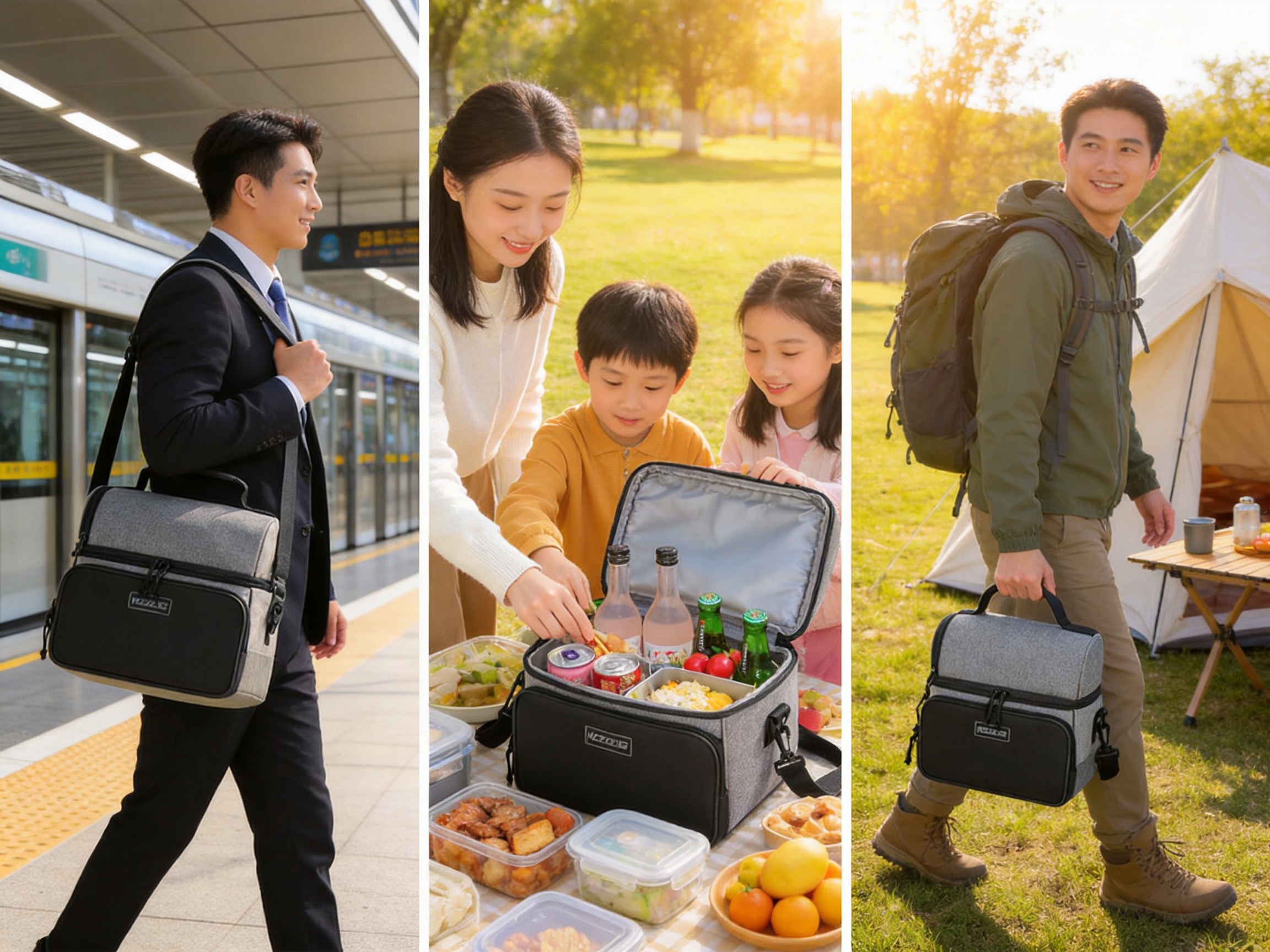
Daily commuting places different demands on a lunch bag than a long camping trip. The product may be carried through public transportation, placed beside a workstation, stored under a desk, or moved between indoor and outdoor environments. It must look practical, remain easy to carry, and accommodate food for several hours without becoming an awkward burden.
The large-capacity format is suitable for users who carry more than one item category. A commuter may pack a breakfast container, a lunch box, fruit, a beverage, and snacks. A student may need food for a full school day. An office worker may transport a prepared meal while keeping a drink and dessert in a separate section. The dual-compartment layout provides a simple way to distribute these items.
The handle supports quick hand carrying, while the shoulder strap allows the user to keep both hands free. This flexibility is useful when carrying documents, a backpack, a camera, or other outdoor equipment. A shoulder strap can also help distribute the load during longer walks between a vehicle, office, campsite, or picnic area.
For daily users, cleaning efficiency is an important consideration. A waterproof interior reduces the time required to remove minor spills. The user can wipe the PEVA surface and check the seams and corners before storing the bag. This maintenance process is more manageable than cleaning a fully absorbent textile interior.
The product can also serve as a practical secondary bag for shopping or short travel. Its insulated construction provides additional utility when transporting chilled groceries, prepared food, or beverages for a limited period. While it is not a replacement for commercial cold-chain equipment, its combination of capacity and portability makes it useful for ordinary personal transportation.
5. Performance Advantages for Camping, Hiking, and Picnics
Outdoor environments expose a bag to more demanding conditions than an office or classroom. The product may rest on grass, soil, wooden tables, vehicle seats, or rocky ground. It may be loaded with different shapes and sizes of containers and carried over uneven paths. The Oxford cloth exterior is intended to provide a stronger level of everyday resistance than very lightweight fabric alternatives.
During a picnic, the two compartments can be used for separate meal categories. One section may hold prepared dishes and sealed containers, while the other holds drinks, fruit, snacks, or an ice pack. This arrangement helps users avoid opening and rearranging the entire bag whenever they need a beverage or small item.
For camping, capacity and organization become particularly important. Outdoor users may prepare food in advance and need to transport multiple portions. The bag can help divide foods by serving time or type. For example, dry snacks may be kept above or apart from foods that require more careful containment. The waterproof interior provides a useful line of defense against condensation and minor leakage.
Hikers may appreciate the option to carry the bag by the shoulder strap for short distances or use the handle when moving between locations. The appropriate carrying method depends on the load and terrain. Because the product is not a technical backpack, it should be used within a reasonable carrying range, but its flexible transport options make it suitable for day outings and nearby picnic sites.
Family activities often require more food volume than individual commuting. Parents may need to carry meals for adults and children, together with beverages, fruit, snacks, and small accessories. A larger double-layer format helps distribute these items instead of forcing everything into one crowded container. This can make meal preparation and serving more orderly during travel and outdoor gatherings.
6. Product Development Based on Real Usage Scenarios
A reliable outdoor product begins with a clear understanding of how it will be used. A bag designed only from a visual concept may look attractive but fail when exposed to real loading, repeated carrying, moisture, or cleaning. Scenario-based development begins by identifying the user, the environment, the type of load, the expected duration of use, and the most likely failure points.
For this picnic bag, the relevant scenarios include office commuting, school use, family picnics, camping, hiking, short-distance travel, and vehicle transportation. Each scenario raises different questions. How much food must the bag hold? Will the user need one-handed access? Could the contents leak? Will the bag be placed on rough ground? Should chilled food be separated from dry food? Can the interior be cleaned quickly?
These questions guide the selection of the compartment structure, materials, carrying methods, and production details. They also help prevent unnecessary features. A product should not become complicated merely to appear advanced. Each component should support a specific user requirement or improve durability, safety, organization, or convenience.
CragHaven Outdoor follows a development philosophy centered on practical engineering. Product concepts are evaluated through sampling, testing, feedback, and structural optimization. This process is valuable for buyers because it reduces the risk of receiving a product that looks correct in a specification sheet but performs inconsistently in actual use.
6.1 Sampling and Prototype Evaluation
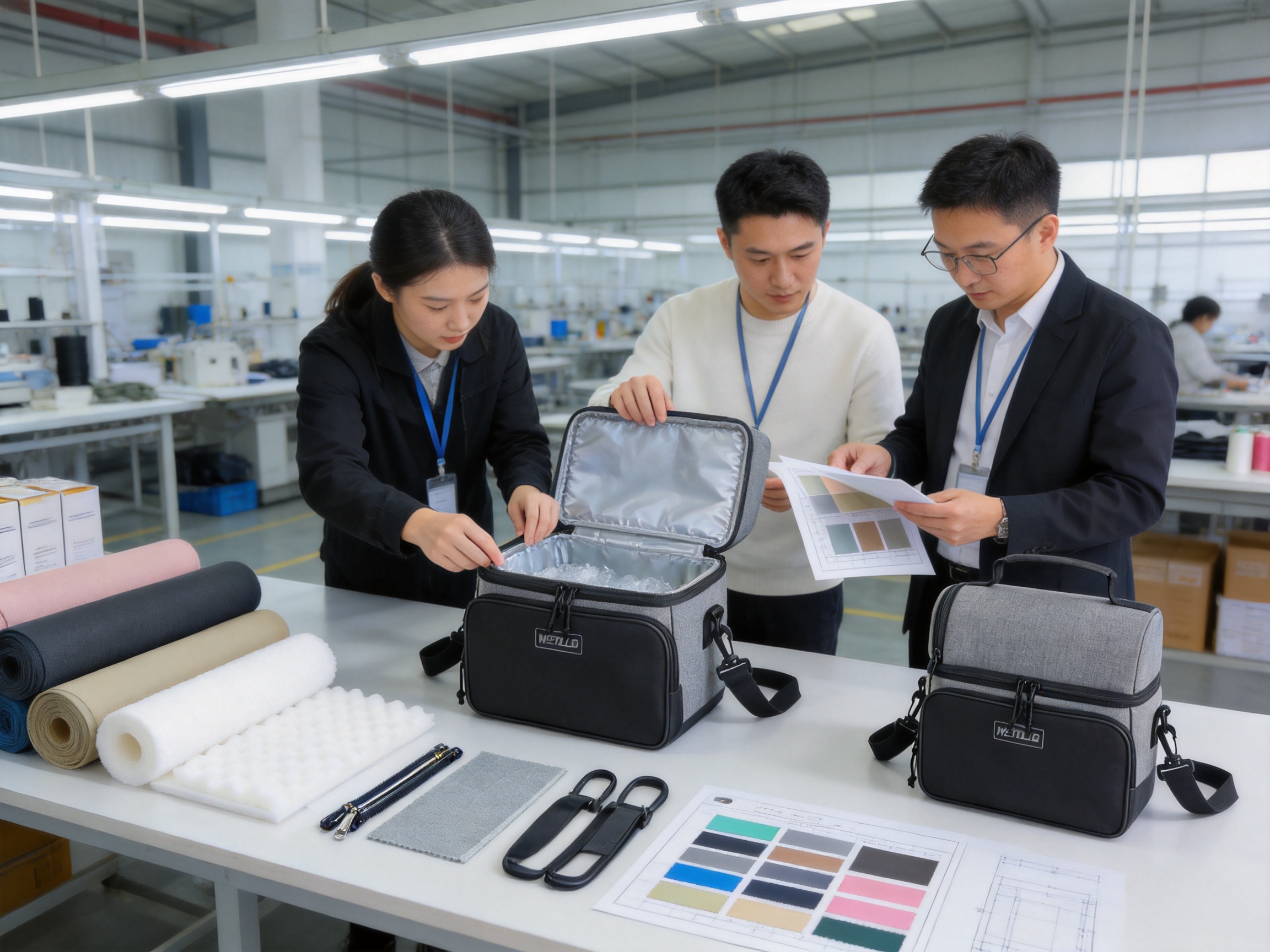
Sampling is the stage at which design intentions are converted into a physical product. A prototype can reveal problems that are difficult to identify in drawings or digital files. The sample may show that a compartment is too narrow, that the insulation creates unwanted bulk, or that the strap position affects balance when the bag is fully loaded.
Prototype evaluation should examine both empty and loaded conditions. The empty bag needs to retain an appropriate shape and remain easy to handle. The loaded bag should support its contents without excessive sagging, distortion, or pressure on the seams. The opening should permit practical access, and the two compartments should remain usable after the bag is filled.
Samples also allow the development team to review visual details, including fabric appearance, color consistency, trim, edge finishing, logo placement, and packaging compatibility. For wholesale and private-label customers, this stage is especially important because the product must meet both functional and brand presentation requirements.
6.2 Structural Optimization
Structural optimization involves improving the relationship between materials, components, and user needs. If the outer fabric is strengthened without considering the insulation and lining, the bag may become unnecessarily heavy. If the insulation is increased without reviewing the compartment dimensions, usable capacity may be reduced. If the strap is attached without considering load distribution, carrying comfort may suffer.
A professional manufacturer evaluates these relationships as a system. The objective is not simply to add material, but to place the right material in the right location and use construction methods that support repeated performance. This approach can improve consistency while maintaining a reasonable balance between cost, weight, durability, and appearance.
7. Manufacturing Process and Quality Considerations
The production of a multi-layer insulated picnic bag involves more than cutting and sewing an exterior shell. The factory must coordinate the outer fabric, insulation, waterproof lining, compartments, handles, shoulder strap, closures, reinforcement points, and finishing operations. Each component must be compatible with the others.
7.1 Material Inspection
Material inspection is the first major quality-control step. Oxford cloth should be checked for color consistency, surface defects, width stability, and general appearance. Pearl cotton should be evaluated for thickness uniformity and resilience. PEVA lining should be reviewed for surface quality, flexibility, and visible imperfections.
Inspection at this stage helps prevent defects from entering the cutting and assembly process. If materials vary significantly between production lots, the finished bags may differ in appearance or performance. A disciplined inspection system creates better control over repeat orders, which is particularly important for retailers and distributors that need consistent products over time.
7.2 Cutting Accuracy
Cutting accuracy affects both appearance and function. The two compartments must align correctly, and the outer fabric, insulation, and lining should correspond to the intended dimensions. Inaccurate cutting can create uneven seams, distorted corners, inconsistent capacity, or tension around the zipper and handles.
For larger production runs, standardized templates and controlled cutting procedures can improve repeatability. When a customer requests custom dimensions, the pattern should be reviewed carefully before mass production. Small changes to width, height, depth, or compartment spacing can influence fabric consumption, insulation placement, packaging size, and shipping efficiency.
7.3 Layer Assembly
Layer assembly requires careful handling because the outer fabric, insulation, and PEVA lining behave differently during sewing. The insulation may compress, the lining may shift, and the exterior may require alignment of woven patterns or decorative details. Operators must maintain consistent positioning so that the interior remains smooth and the insulation covers the intended areas.
Assembly quality also affects the thermal performance of the finished product. Gaps, excessive compression, or poorly aligned panels can create weak points. The goal is to produce a continuous, balanced insulating structure while preserving the bag’s usable space.
7.4 Seam and Reinforcement Control
Seams carry the forces generated by the contents and the carrying system. Handles and shoulder straps are particularly important because their attachment points may experience concentrated loads. Reinforcement stitching or additional support material may be used where appropriate to reduce stress on the primary seams.
Quality control should review stitch consistency, thread tension, skipped stitches, loose ends, seam alignment, and attachment strength. A clean seam is not merely a visual advantage. It contributes to durability, reduces the chance of fraying, and helps the bag maintain its shape during repeated handling.
7.5 Waterproof Interior Finishing
The PEVA lining should be fitted carefully around the interior corners and compartment boundaries. Wrinkles or excessive slack can reduce usable space and make cleaning more difficult. The lining should also be securely connected to the surrounding construction so that normal use does not cause it to pull away or expose the insulation.
Any product intended for food transport should be handled with appropriate cleanliness controls during production and packing. The final product should be free of loose threads, visible debris, strong unwanted odors, and obvious manufacturing residue. These details influence customer confidence, especially when products are sold through quality-sensitive retail channels.
8. Testing and Validation Before Delivery
Testing helps confirm that the product performs in a way consistent with its intended use. The exact test program may vary according to customer requirements, market regulations, materials, and order specifications. However, a professional development process should consider several basic categories of evaluation.
8.1 Load and Carrying Tests
Load testing examines how the bag behaves when filled with representative contents. The test should consider the combined weight of food containers, drinks, fruit, snacks, and ice packs. The handle and shoulder strap should be reviewed for attachment security, comfort, and deformation after repeated loading.
Carrying tests can also reveal balance issues. If one compartment is significantly heavier than the other, the bag may tilt or place excess pressure on one side. The strap location, handle position, and internal structure should work together to create a stable carrying experience.
8.2 Leakage and Moisture Evaluation
Moisture evaluation is important because the product is intended to hold food and beverages. A practical review may examine how the lining responds to condensation, a small spill, or a damp container. The purpose is to verify that the interior can be wiped and that ordinary moisture does not immediately penetrate the structure.
Users should still place liquids in properly sealed containers. A soft insulated bag is not necessarily designed to contain large quantities of free-flowing liquid. Clear usage guidance protects the consumer and helps ensure that the product is used within its intended performance range.
8.3 Zipper and Opening Evaluation
The opening system should be checked for smooth operation, alignment, and resistance to repeated use. A zipper that is difficult to operate can reduce the value of a well-organized bag. The opening should also provide sufficient access to both compartments so that users do not need to force containers through a narrow space.
Where the design includes corners or curved sections, zipper installation requires particular attention. Uneven tension can lead to wavy edges, difficult movement, or premature wear. Sample review and in-line inspection can reduce these problems before final packing.
8.4 Cleaning and Maintenance Review
Cleaning evaluation focuses on the smoothness and accessibility of the PEVA interior. Corners should be reasonably reachable, and the lining should not contain unnecessary folds that trap food residue. After cleaning, the bag should be allowed to dry completely before being closed and stored.
Clear care instructions can extend the product’s service life. Users should avoid storing the bag while damp, overloading the compartments, or placing sharp objects directly against the lining. Retail packaging and product documentation can communicate these recommendations in a concise and understandable way.
9. Competitive Advantages in the Market
The market includes many soft lunch bags, cooler bags, food carriers, and picnic totes. A product must therefore offer clear reasons for customers to choose it over a lower-cost single-layer alternative. The strongest advantages of this design come from the combination of features rather than from one isolated material.
First, the double-layer structure provides a clear organizational benefit. Many competing products offer only one open compartment, forcing users to create their own separation with containers or plastic bags. Independent compartments provide a more deliberate solution and make the product easier to position for commuting, family use, and outdoor recreation.
Second, the three-layer construction provides balanced protection. The Oxford cloth exterior supports durability, the pearl cotton layer helps with insulation and cushioning, and the PEVA interior supports moisture control and cleaning. A product that combines these functions can offer a more complete value proposition than a thin fabric carrier with minimal insulation.
Third, the large capacity makes the bag useful for more than one meal. This expands the target audience from individual lunch users to families, campers, travelers, wholesalers, and outdoor retailers. A broader application range can support stronger product positioning and reduce dependence on a single seasonal use case.
Fourth, the handheld and shoulder-carry options improve portability. Some competing products focus only on a short handle, while others may be designed like a cooler with limited flexibility. Offering both transport methods gives users more control according to distance, load, and activity.
Fifth, the product supports private-label and customized development. Buyers may be able to adjust dimensions, colors, fabrics, accessories, branding, packaging, or compartment details according to their market. This is an important advantage for distributors that need a product differentiated from generic listings.
| Product Attribute | Basic Fabric Lunch Bag | Single-Compartment Cooler | Double-Layer Picnic Bag |
|---|---|---|---|
| Compartment organization | Limited | Usually one main space | Two independent storage areas |
| Wet and dry separation | Usually unavailable | Depends on additional containers | Built into the product structure |
| Insulation construction | Basic or thin lining | Often insulated | Oxford cloth, pearl cotton, and PEVA system |
| Carrying methods | Usually handheld | May use handles or a strap | Handheld and shoulder carrying |
| Family capacity | Limited | Variable | Large-capacity configuration |
| Customization potential | Often limited | Depends on supplier | Suitable for OEM and ODM development |
10. OEM and ODM Value for Outdoor Brands
Retailers and outdoor brands increasingly seek products that match a defined market position. Some need compact lunch bags for urban consumers, while others prefer larger picnic carriers for camping and family travel. OEM and ODM support allows the product to be adapted without requiring the buyer to build an independent manufacturing system.
OEM development generally involves producing a product according to the customer’s specifications, brand identity, packaging requirements, and quality expectations. ODM development may include deeper cooperation in structure, materials, dimensions, and functional features. Both models require clear communication and reliable technical follow-through.
CragHaven Outdoor positions itself as more than a sourcing intermediary. The company participates in product development and manufacturing, helping customers review design concepts, select materials, refine dimensions, and assess production feasibility. This approach can reduce communication gaps between a buyer’s commercial idea and the factory’s production reality.
Customization may include compartment proportions, exterior fabric, interior color, carrying strap, handle design, zipper selection, label placement, logo application, packaging, and accessory combinations. Each change should be evaluated for its effect on cost, lead time, durability, appearance, and minimum order quantity.
Professional development also requires attention to repeatability. A sample may look satisfactory, but the same result must be reproduced during mass production. Standardized specifications, approved samples, material records, inspection points, and production communication help maintain consistency across orders.
11. Supply-Chain Reliability and Manufacturing Communication
Outdoor product buyers face uncertainty when a supplier only forwards orders to an unrelated factory. Questions about materials, production schedules, quality deviations, and design changes may take longer to resolve. A manufacturing partner that understands both product development and production can communicate more directly about feasibility and risk.
CragHaven Outdoor is based in Hangzhou, China, within a mature manufacturing environment that supports material sourcing, sampling, production coordination, and international distribution. The company’s focus on outdoor scenarios allows it to evaluate products according to weather, terrain, handling, and long-term use rather than relying only on catalog descriptions.
Supply-chain reliability is built through process discipline. It includes clear specifications, realistic production schedules, pre-production confirmation, in-process inspection, final inspection, and transparent communication when adjustments are necessary. These steps help reduce unexpected differences between approved samples and delivered goods.
For international customers, professional communication is equally important. Product details should be presented in clear commercial language, with practical explanations of materials, intended use, limitations, packaging, and customization options. This helps retailers create accurate product pages and reduces the chance of consumer misunderstanding.
12. Recommended Selection Process for Buyers
Buyers should begin by defining the primary use case. A bag for office workers may prioritize compact organization and professional appearance, while a family picnic bag may prioritize capacity and flexible carrying. A camping retailer may need stronger exterior materials, private-label packaging, and a structure suitable for repeated outdoor handling.
Determine the expected capacity. Estimate how many meals, drinks, snacks, and containers the target customer will carry.
Define the compartment arrangement. Decide whether the product should emphasize hot-and-cold separation, wet-and-dry separation, or meal organization.
Select the outer material. Consider abrasion resistance, appearance, flexibility, weight, color, and target price.
Review the insulation system. Confirm the intended insulation material, thickness, coverage, and performance expectations.
Evaluate the lining. Confirm that the interior is suitable for wiping, moisture management, and repeated food transport.
Assess the carrying methods. Determine whether the product needs a handle, shoulder strap, adjustable components, or reinforced attachment points.
Review loading and access. Ensure that the opening and compartments accept the containers commonly used by the target market.
Confirm testing requirements. Establish expectations for load, seam strength, leakage resistance, zipper operation, and appearance.
Finalize branding and packaging. Approve labels, logo placement, hangtags, cartons, and retail presentation before mass production.
Establish repeat-order controls. Keep approved samples and material specifications available for future production reference.
This process helps buyers avoid evaluating the product only by its appearance or unit price. A low-cost bag may become expensive if it generates returns, inconsistent quality, difficult cleaning, or poor customer reviews. A well-specified double-layer bag can provide stronger long-term value because its features solve practical problems that consumers experience every day.
13. Care and Use Recommendations
Users should place food and beverages in closed containers before packing them into the bag. The waterproof PEVA interior helps manage moisture, but it should not be treated as a guarantee against uncontrolled liquid leakage. Proper containers protect both the bag and the food.
The compartments should be loaded without excessive force. Overfilling may place pressure on zippers, seams, and the lining. Heavy items should be distributed as evenly as possible between the two sections, especially when the bag will be carried over the shoulder.
After use, users should remove all food and wipe the interior with a clean cloth or suitable mild cleaning solution. The bag should be opened and allowed to dry fully before storage. Strong solvents, abrasive tools, and high heat may damage the lining or exterior and should generally be avoided unless specifically approved for the selected materials.
Sharp utensils, uncovered ice edges, and rough objects should not be placed directly against the PEVA lining. When transporting prepared meals, users should allow excessively hot food to cool to a safe packing temperature where appropriate. The bag’s insulation helps slow temperature change but does not replace proper food-handling practices.
14. Frequently Asked Questions
Q1: What is the main advantage of a double-layer picnic bag?
The main advantage is improved organization. The two compartments allow users to separate wet and dry products, meals and drinks, or chilled items and snacks. This can reduce odor mixing, moisture transfer, and unnecessary compression of delicate food.
Q2: Is this product suitable for both commuting and camping?
Yes. Its large capacity, Oxford cloth exterior, layered insulation, waterproof PEVA lining, and handheld or shoulder-carry options support daily commuting as well as picnics, camping, hiking, and family outings. The user should select a load appropriate to the carrying method and intended activity.
Q3: Does the bag keep food cold for a guaranteed period?
No insulated soft bag can guarantee one fixed holding period under every condition. Performance depends on the starting temperature of the food, ambient temperature, packing density, exposure to sunlight, opening frequency, and whether an ice pack is used. The insulation is designed to help slow temperature change.
Q4: Why is Oxford cloth useful for an outdoor picnic bag?
Oxford cloth provides a practical combination of flexibility, abrasion resistance, and structural stability. It is suitable for repeated contact with common outdoor surfaces and helps the bag maintain a useful shape while remaining portable.
Q5: What is the benefit of the PEVA interior?
The PEVA interior provides a smooth, water-resistant surface that can be wiped after minor spills or condensation. It helps simplify cleaning and supports the separation of moisture from the insulation and outer fabric.
Q6: Can the bag carry ice packs?
Yes. An ice pack can be placed in one compartment with appropriately sealed food or beverages. Users should avoid sharp-edged packs and should distribute the load carefully so that excessive pressure is not placed on the lining or seams.
Q7: Is the product suitable for children or students?
The product can be suitable for students when its size and loaded weight are appropriate. The shoulder strap and handle provide carrying flexibility, while the compartments help organize meals and drinks. Parents should ensure that the packed load is comfortable and that food containers are securely closed.
Q8: How does this design compare with a simple fabric lunch tote?
A simple fabric tote may be lighter and less expensive, but it often provides less insulation, less moisture control, and less internal organization. The double-layer picnic bag combines separate storage areas with a three-layer protective construction, making it more versatile for repeated use.
Q9: Can buyers request customized dimensions or branding?
OEM and ODM projects may support customization of dimensions, compartments, materials, accessories, labels, logo application, and packaging. Final options depend on the requested design, order quantity, production feasibility, and approved sample.
Q10: What should a buyer review before placing a large order?
The buyer should review the approved sample, material specifications, compartment dimensions, carrying components, packaging, quality standards, inspection procedures, production schedule, and repeat-order requirements. Clear confirmation before mass production helps reduce avoidable differences.
Q11: How should the bag be cleaned?
Remove all contents, wipe the PEVA interior with a soft cloth and mild cleaning solution, and leave the bag open until completely dry. Avoid storing it while damp, and follow any care instructions supplied with the final product.
Q12: What makes CragHaven Outdoor different from a basic sourcing supplier?
CragHaven Outdoor combines outdoor product understanding with design support and manufacturing coordination. Its process emphasizes real usage scenarios, material selection, repeated sampling, testing, structural optimization, and long-term supply-chain consistency rather than simple order forwarding.
15. Conclusion
A large capacity double-layer insulated picnic bag offers a balanced solution for consumers who need organization, portability, moisture management, and practical insulation in one product. Its separate compartments provide a direct advantage over single-layer alternatives by helping users manage wet and dry items, reduce odor mixing, protect delicate food, and distribute the load more effectively.
The three-layer material structure strengthens this value proposition. Oxford cloth provides a durable outer surface, pearl cotton supports insulation and cushioning, and PEVA creates a moisture-resistant interior that is easier to clean. Together, these materials make the product suitable for commuting, school, family travel, hiking, camping, and outdoor recreation.
For commercial buyers, the product’s value also depends on how it is developed and manufactured. Sampling, material inspection, cutting accuracy, layer assembly, seam reinforcement, testing, and final inspection all contribute to consistent quality. OEM and ODM support gives retailers and outdoor brands the opportunity to adjust the product to specific markets while maintaining a professional manufacturing process.
CragHaven Outdoor’s approach is based on practical outdoor engineering and long-term cooperation. By considering weather, terrain, handling, usage patterns, and supply-chain requirements, the company aims to reduce uncertainty for international buyers. The result is not merely an insulated food carrier, but a functional piece of outdoor equipment designed around real daily and recreational needs.
References
1. Food and Agriculture Organization of the United Nations. General Principles of Food Hygiene and Food Transportation Practices.
2. International Organization for Standardization. Quality Management Principles and Process-Based Manufacturing Guidance.
3. Textile Exchange. General Guidance on Textile Fiber, Fabric, and Material Performance Considerations.
4. American Society for Testing and Materials. Standard Practices for Evaluating Textile Products, Seam Performance, and Material Durability.
5. International Association for Protective Packaging. Practical Principles of Packaging Design, Handling, and Product Protection.
6. Outdoor Industry Association. Consumer Use Trends in Hiking, Camping, Travel, and Recreational Outdoor Equipment.
Product: Large capacity double-layer lunch bag, Oxford cloth insulated bag, picnic bag, handheld ice pack


- Phone: +86-15968800379
- E-mail: [email protected]
- Address: Room 1002, Huishang Building, Gongshu District, Hangzhou City, Zhejiang Province.
Copyright © CragHaven Outdoor All Rights Reserved. Outdoor Gear Manufacturers Wholesale Mountaineering Camping Gear Suppliers
