

 English
 Deutsch
 Español
 Français


Portable Extendable Folding Stool: A Practical Seating Solution for Hiking, Camping, and Outdoor Recreation
Content
- 1 Why Compact Seating Matters in Outdoor Activities
- 2 Product Overview and Functional Concept
- 3 Key Advantages Compared with Conventional Outdoor Seating
- 4 Use in Hiking and Mountaineering
- 5 Use in Camping and Basecamp Environments
- 6 Use for Fishing, Travel, and Outdoor Events
- 7 Material Selection and Product Reliability
- 8 Advanced Manufacturing Approach
- 9 Supply Chain Strength and OEM Cooperation
- 10 Practical Use and Care Recommendations
- 11 How Retailers Can Position the Product
- 12 Product Advantages at a Glance
- 13 Environmental and Long-Term Value Considerations
- 14 Why Manufacturing Experience Matters to Global Buyers
- 15 Q&A
- 15.1 What is an extendable folding stool?
- 15.2 What makes this stool different from a fixed outdoor stool?
- 15.3 Is the stool suitable for hiking?
- 15.4 Can it be used for camping?
- 15.5 Can the stool be used for fishing?
- 15.6 What material is used to make the stool?
- 15.7 How should users adjust the height?
- 15.8 Is the stool a replacement for a full-size camping chair?
- 15.9 What should buyers inspect before placing a large order?
- 15.10 How does manufacturing affect the final product?
- 15.11 Can the product be customized for OEM projects?
- 15.12 How should the stool be maintained?
- 15.13 What safety limitations should users remember?
- 16 Conclusion
- 17 References
- 18 Product: Portable outdoor storage folding extendable stool, adjustable hiking stool
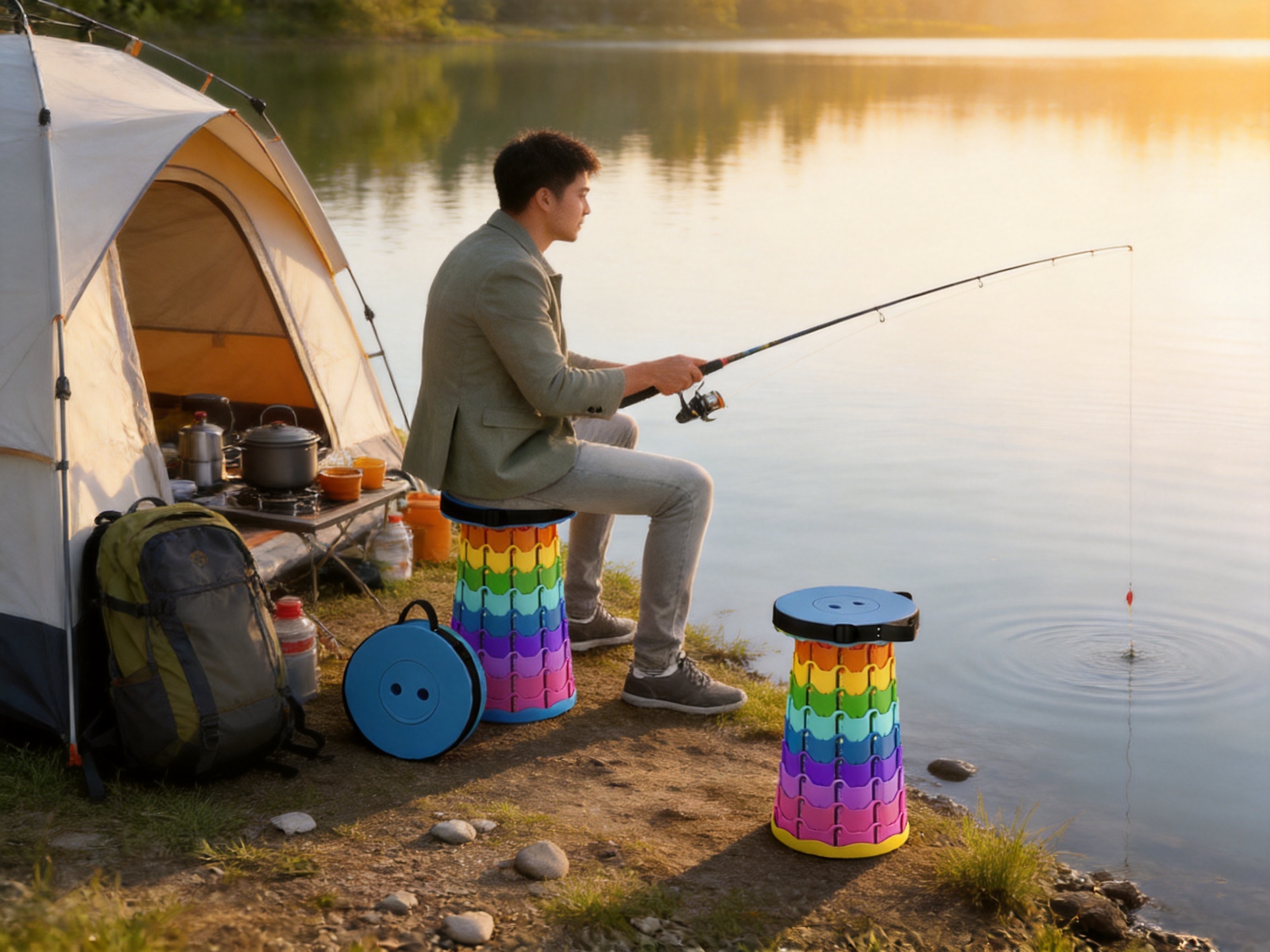
Outdoor equipment is becoming lighter, more compact, and more adaptable to real-world conditions. Hikers, campers, anglers, travelers, and outdoor event visitors increasingly need products that perform several useful functions without taking up unnecessary space. Seating is a good example of this changing demand. A traditional chair may provide comfort, but it can also be bulky, heavy, and inconvenient to carry across uneven ground. A small fixed stool may be easier to transport, but it often lacks height flexibility and may not adapt well to different users or environments.
The portable outdoor storage folding extendable stool addresses these limitations through a combination of folding portability, adjustable height, practical stability, and durable polypropylene construction. When opened, it provides convenient personal seating for rest stops, campsites, fishing locations, queues, and outdoor events. When folded, its compact form occupies minimal room in a backpack, vehicle, equipment cabinet, or storage system. This balance between mobility and usability makes it a valuable accessory for modern outdoor recreation.
Product code WFDS263001 represents a practical approach to outdoor seating design. Its innovative folding structure is intended for immediate use: users can unfold the stool when a rest point is needed and fold it again before continuing a route. The extendable structure allows the sitting height to be adjusted according to user preference and ground conditions. Thickened PP material supports a strong, durable body while helping the product remain lightweight enough for regular transport.
Beyond the product itself, reliable outdoor equipment depends on sound development methods, suitable materials, precise manufacturing, inspection, and consistent supply. A stool intended for outdoor use must withstand repeated opening and closing, transportation, changing environments, and regular handling. For this reason, the quality of the product is connected not only to its visible design but also to the manufacturing process behind it.
Why Compact Seating Matters in Outdoor Activities
Outdoor recreation usually involves carrying several categories of equipment. A hiking trip may require water, food, navigation tools, clothing, first-aid supplies, lighting, and weather protection. Camping may involve tents, sleeping systems, cooking equipment, storage containers, and personal accessories. When every item is large or difficult to organize, the total load quickly becomes inconvenient.
Seating is often useful, but it is not always easy to transport. Full-size folding chairs can offer back support and a broad sitting area, yet they may occupy substantial storage space. Larger chairs are also less convenient on narrow trails, during short breaks, or when users are traveling by public transportation. A compact folding stool offers a different balance. It focuses on quick personal seating while reducing the storage volume associated with conventional outdoor furniture.
The extendable folding stool is especially suitable for people who want a resting option without carrying a separate chair bag or a rigid seat. Its folded shape is comparable in size to a water bottle, according to the product concept, which helps users place it in a backpack or carry it alongside other gear. This compact profile is valuable for short walks, long hikes, outdoor markets, fishing trips, sporting events, and queues where standing for an extended period may become uncomfortable.
Portability does not mean that a product should be treated as disposable. Outdoor users expect equipment to provide repeated service. The folding mechanism must operate smoothly, the connected components must remain secure, and the body must maintain its structural function after regular use. A product that combines compact storage with dependable construction can provide greater long-term value than a cheaper item that becomes difficult to open, unstable, or damaged after limited use.
Product Overview and Functional Concept
The portable outdoor storage folding extendable stool is designed around three primary functions: folding, height adjustment, and temporary seating. These functions are integrated into one compact product rather than being supplied as separate accessories. The design is therefore appropriate for users who prefer simple equipment with a clear purpose.
The folding structure allows the stool to be reduced for transport. This feature supports several practical situations. A camper can store it beside other equipment in a vehicle. A hiker can place it inside a backpack during movement and remove it at a rest location. An angler can carry it to a fishing spot without handling a large chair. A traveler can keep it in luggage or a small equipment compartment. A visitor at an outdoor event can take personal seating without adding significant bulk.
The extendable structure provides adjustable sitting height. Outdoor ground is rarely uniform. A campsite may contain compact soil, gravel, grass, or a slight slope. A hiking route may include a rocky rest area or a level point beside a trail. Although users should always select firm and safe ground, height adjustment can make the stool more adaptable than a fixed-height alternative. It also allows different users to select a sitting position that feels more suitable for their body and activity.
The use of thickened PP material supports the product’s practical design objectives. Polypropylene is widely used in products that require a combination of relatively low weight, toughness, moisture resistance, and ease of processing. In this stool, the material is intended to contribute to a durable body while maintaining the portability expected from compact outdoor equipment.
| Product Element | Primary Function | User Benefit |
|---|---|---|
| Folding structure | Reduces the product’s storage volume | More convenient carrying and organization |
| Extendable body | Allows adjustable sitting height | Improved adaptability to users and terrain |
| Thickened PP material | Provides a durable lightweight body | Suitable for repeated outdoor handling |
| Compact folded profile | Fits into limited storage areas | Useful for backpacks, vehicles, and travel gear |
| Immediate opening design | Enables quick preparation for use | Convenience during breaks and waiting periods |
Key Advantages Compared with Conventional Outdoor Seating
Product comparison should consider the complete user experience rather than one isolated specification. A large chair may be more suitable for users who need armrests, a backrest, or extended lounging. However, many outdoor situations do not require those features. For brief rest periods, a personal stool can provide a more efficient solution because it reduces weight, storage requirements, and setup complexity.
Compactness and Storage Efficiency
The most visible advantage of the extendable folding stool is its compact folded form. Storage efficiency is important for both individual consumers and commercial buyers. Outdoor retailers need products that can be displayed and packaged efficiently. Distributors benefit when more units can be stored or transported within a given space. End users benefit when the product does not compete with essential equipment in a backpack or vehicle.
Compared with fixed stools, the folding model offers greater flexibility during transport. Compared with many full-size folding chairs, it requires less room. The compact form can also reduce the organizational burden inside camping equipment. Users can store it vertically beside a backpack, place it under a vehicle seat, or keep it in an entryway where a larger chair would be inconvenient.
Adjustability for Different Conditions
A fixed-height stool provides only one seating position. That position may be comfortable on level ground but less suitable on uneven terrain or for users with different preferences. The extendable design offers more flexibility. A lower setting may be preferred during a short rest or when stability is the priority. A higher setting may provide easier sitting and standing for certain users or situations.
Height adjustment does not eliminate the need to choose safe ground. The stool should be placed on a firm, stable, and reasonably level surface, and the adjustment mechanism should be fully secured before sitting. Nevertheless, the ability to adapt the height gives the product a practical advantage over non-adjustable alternatives.
Quick Setup and Reduced Handling
Outdoor activities often involve moments when users need a seat quickly. A hiker may want to rest after climbing a steep section. A camper may need a small seat near a cooking area. An angler may wait beside a lake or river for several hours. At an event or queue, users may need personal seating without carrying a complicated frame.
A folding stool with an immediate-use structure reduces preparation time. The user does not need to assemble multiple legs, attach a fabric seat, or carry separate hardware. Fewer steps can also reduce the possibility of losing small components in outdoor environments. A simple operating process is especially valuable when users are tired, wearing gloves, or working in changing weather.
Balanced Portability and Structural Function
Some ultralight seating products are easy to carry but provide limited confidence during use. Other products feel sturdy but are too heavy or large for regular transport. The product concept behind this stool is to balance both requirements. Thickened PP construction contributes to a stronger body, while the folding and extendable format preserves mobility.
This balance is one of the product’s main competitive advantages. It is not designed merely to be the smallest possible seat, nor is it intended to replace a large relaxation chair. Instead, it occupies a useful middle position: compact enough for mobile activities and practical enough for regular temporary seating.
Multi-Scenario Usability
Many outdoor accessories are purchased for one specific activity and remain unused outside that situation. The extendable folding stool has broader application value because the basic need for temporary seating appears across multiple environments. A single product can support hiking breaks, campsite tasks, fishing, travel, outdoor photography, sporting events, festivals, queues, and general leisure.
For consumers, this multi-scenario value can make the purchase more economical. For retailers, it can simplify product positioning because the stool belongs to several related categories, including mountaineering accessories, camping gear, travel equipment, and outdoor leisure products.
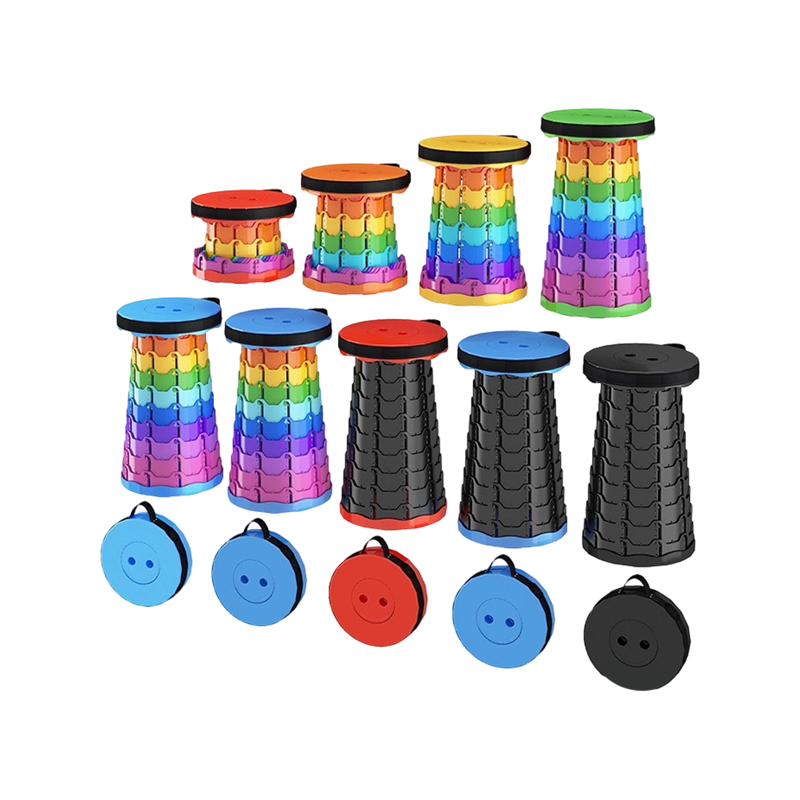
Portable outdoor storage folding extendable stool, adjustable hiking stool
Use in Hiking and Mountaineering
Hiking and mountaineering place special demands on equipment. Products must be carried over distance, exposed to dust and moisture, and used in locations where replacement or repair may not be immediately available. Every accessory must therefore justify its carrying weight and provide a clear practical benefit.
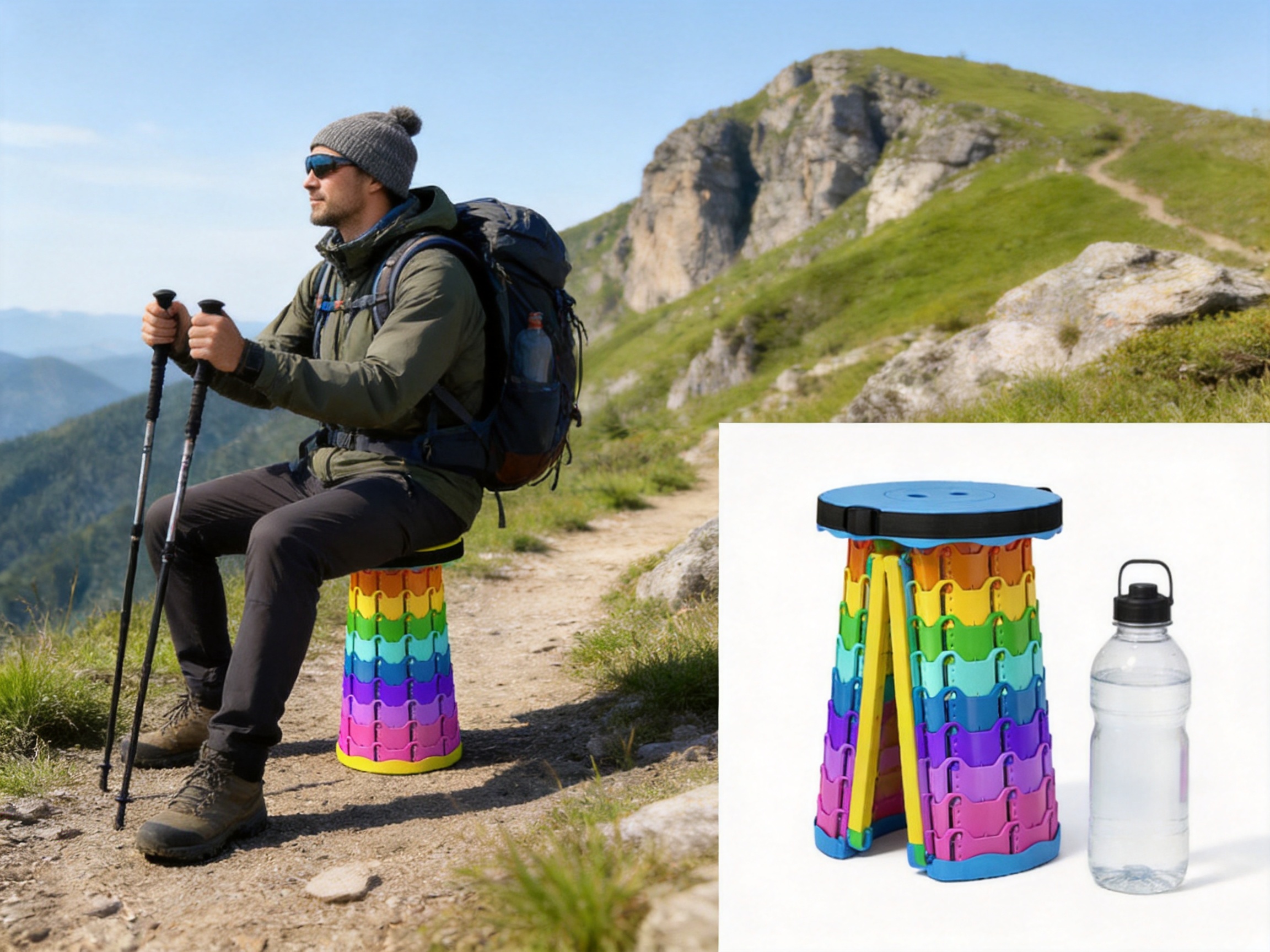
An adjustable hiking stool can serve as a quick rest platform during route breaks. Hikers can select a suitable height, sit briefly, and continue their journey without setting up a large chair. The stool may also be useful at trailheads, scenic viewpoints, transport stations, or campsites reached after a long approach.
For mountaineering-related use, users should distinguish between general outdoor seating and technical safety equipment. This stool is intended for sitting and resting on suitable ground. It is not a climbing anchor, belay device, step, rescue tool, or load-bearing component for technical climbing. Clear product positioning helps users select the right equipment and use it responsibly.
The compact form is especially useful for day hikers who prefer a minimal load. A small stool can be carried inside a daypack without requiring a separate external frame. It may also be useful for older outdoor participants or users who need more frequent rest opportunities but do not want to carry a conventional chair.
Use in Camping and Basecamp Environments
Camping creates many short-duration seating needs. Users may need a seat while preparing food, organizing equipment, putting on footwear, sorting clothing, or waiting for water to boil. A large chair may be comfortable around a long-term campsite, but it is not always necessary for every task. The compact stool can function as a personal utility seat that is easy to move around the camp.
At a campsite with limited floor area, compact storage can be as important as seating comfort. The stool can be folded when not needed and placed beside a tent, inside a vehicle, or with cooking and storage equipment. This helps reduce clutter and keeps pathways clearer. When the ground changes from a hard campsite surface to grass or compact soil, adjustable height can provide additional flexibility.
Camping equipment is frequently exposed to moisture, dirt, smoke, food residue, and repeated transportation. A practical stool should therefore be easy to handle and maintain. The PP body offers a surface that can be wiped after use, subject to the product’s care instructions. Users should allow the stool to dry before long-term storage and inspect the folding and extension areas regularly.
Use for Fishing, Travel, and Outdoor Events
Fishing often involves long periods of waiting. A compact stool can improve comfort without the carrying burden of a large fishing chair. It can be moved between locations as conditions change and stored with tackle or personal equipment. When used beside water, the stool should be placed on firm ground away from unstable edges, slippery surfaces, and areas vulnerable to sudden water movement.
Travelers can also benefit from a compact adjustable seat. Airports, transport stations, public attractions, and roadside stops may not always provide sufficient seating. A folding stool can be carried in a vehicle, placed in a travel bag, or kept with outdoor equipment. Its value is particularly clear during road trips, visiting remote attractions, or traveling with children and older family members.
At outdoor events, queues, exhibitions, markets, and sporting activities, personal seating can reduce fatigue. A product that opens quickly and folds down efficiently is more practical in crowded environments than a large chair. Users can sit when space permits, then fold the stool and move easily when the queue or event area changes.
| Application | Typical Need | Relevant Product Advantage |
|---|---|---|
| Mountain hiking | Short rest periods during a route | Low storage volume and adjustable height |
| Camping | Personal seating around a compact campsite | Easy folding and simple storage |
| Fishing | Seating during extended waiting periods | Portable design and practical support |
| Travel | Backup seating during transport and visits | Compact form for luggage or vehicles |
| Outdoor events | Resting while waiting or watching activities | Quick opening and easy carrying |
| Photography | Temporary seating during long sessions | Height flexibility and mobility |
Material Selection and Product Reliability
Material selection is a central part of outdoor product development. A material must be evaluated according to strength, weight, environmental exposure, processing requirements, maintenance, and expected service life. For a folding stool, the material also needs to support repeated movement around joints, connections, and extendable sections.
Thickened polypropylene is used in this product concept because it can support a useful balance between durability and portability. PP is valued in many practical products for its relatively low density, resistance to moisture, and ability to be formed into precise components. Its use can help create a stool that is easier to carry than a comparable product made from excessive metal or other heavy materials.
Material thickness alone does not determine performance. Geometry, rib structure, connection design, molding quality, tolerances, and assembly accuracy all influence the final result. A well-designed PP component distributes pressure more effectively than an overly thin or poorly supported component. For this reason, engineering evaluation should consider the complete structure rather than focusing only on the material name.
The folding and extending sections also require careful attention. Connection points must be designed to reduce unnecessary looseness while allowing normal operation. Moving components should align correctly, and the user should be able to confirm that the stool is fully opened and secured. Consistent manufacturing tolerances are important because excessive variation can affect smooth movement, fit, and perceived quality.
Important Material and Construction Considerations
| Area of Evaluation | Reason It Matters | Manufacturing Focus |
|---|---|---|
| Body material | Influences weight, strength, and service life | Appropriate PP grade and controlled molding |
| Structural geometry | Distributes forces during sitting | Tool design, rib placement, and dimensional control |
| Extension mechanism | Supports height adjustment | Accurate fit and reliable locking engagement |
| Folding connections | Enable repeated opening and closing | Consistent component alignment and assembly |
| Surface quality | Supports appearance and easier cleaning | Controlled molding conditions and finishing inspection |
Outdoor users should follow all supplied instructions and observe the product’s stated load and usage limitations. The stool should not be used as a ladder, platform for jumping, technical climbing equipment, or a substitute for a safety device. Correct use protects the user and reduces unnecessary stress on the product.
Advanced Manufacturing Approach
A reliable outdoor product is the result of a controlled development process rather than a single design idea. Manufacturing capability affects repeatability, quality consistency, delivery performance, and the ability to improve a product over time. For international buyers, these factors are especially important because the product must perform consistently across different markets and usage conditions.
The manufacturing approach behind this type of stool begins with scenario-based product planning. Instead of designing only from a catalog photograph or a list of superficial features, development should begin by examining how the stool will actually be used. Hiking, camping, fishing, and travel each present different requirements for storage, opening, stability, cleaning, and transportation.
After the usage scenario is defined, the design can be developed around practical priorities. These may include the folded dimensions, the opening process, the relationship between the body and extension mechanism, the shape of contact surfaces, and the degree of reinforcement required. A product intended for repeated outdoor use should be evaluated through samples and physical testing rather than approved only through computer drawings.
Design and Engineering Integration
Design and manufacturing should be considered together from the beginning. A visually attractive structure may be difficult to mold, assemble, inspect, or package. Conversely, a design that is easy to manufacture may not provide the best user experience if its adjustment mechanism is awkward or its folded form is inefficient.
Integrated development helps identify these issues earlier. Engineers can assess part thickness, draft angles, reinforcement, connection points, assembly sequence, and packaging requirements. Product designers can then refine the appearance and operating experience without compromising structural function. This collaboration is particularly important for PP products, where molding conditions and part geometry influence dimensional stability and surface quality.
Sampling, Testing, and Optimization
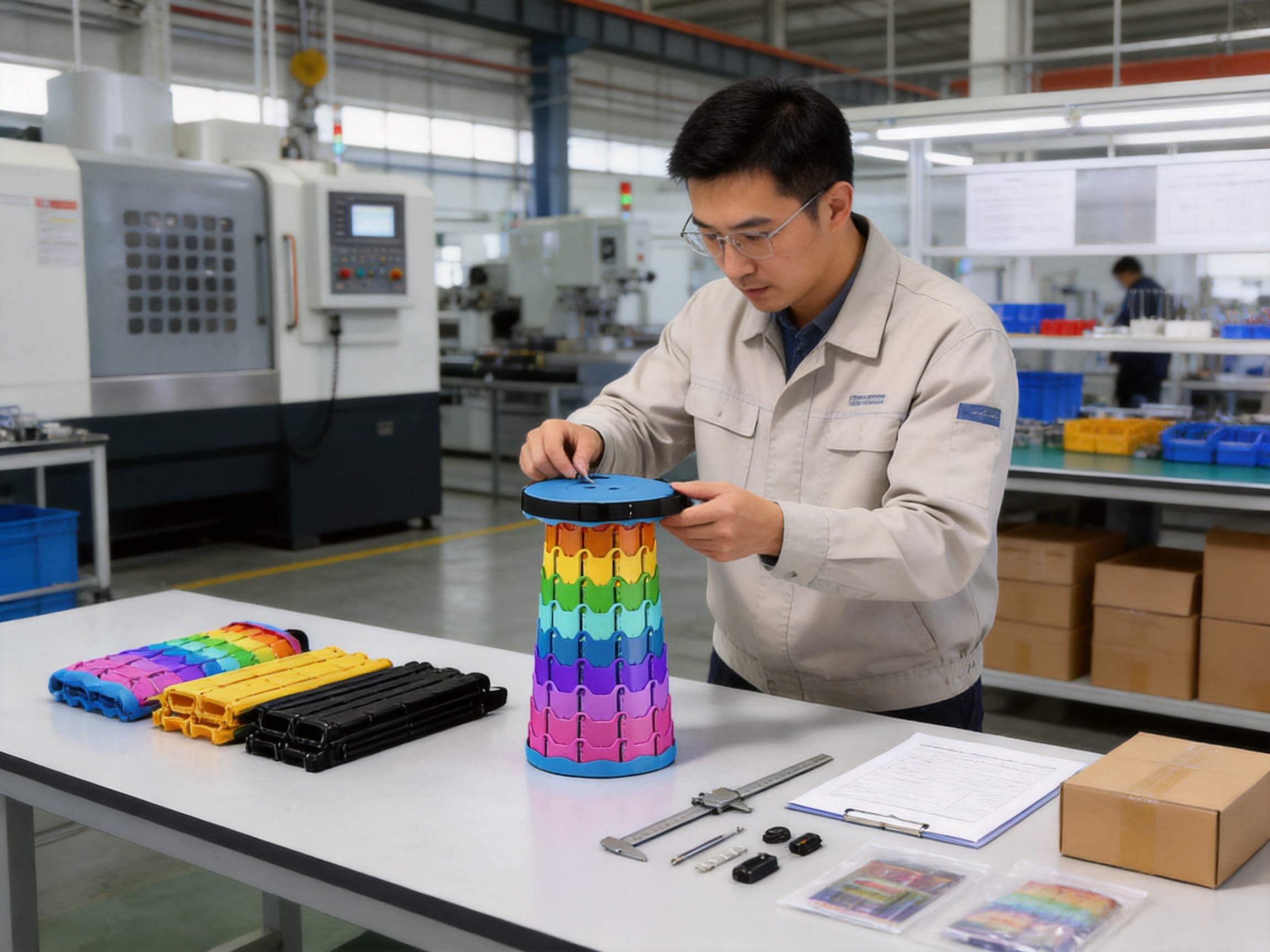
Sampling is a necessary stage between concept and mass production. A sample allows the development team to evaluate whether the stool opens smoothly, folds compactly, adjusts correctly, and feels stable on suitable ground. It also reveals problems that may not be obvious in a digital model, such as difficult hand positions, sharp edges, excessive looseness, or insufficient clearance between moving parts.
Testing should reflect realistic use. Repeated folding and unfolding can help evaluate connection durability. Adjustment cycling can assess the reliability of the extendable mechanism. Surface and visual inspections can identify molding defects, uneven seams, or incomplete filling. Basic stability checks can help verify that the stool remains properly engaged when placed on an appropriate surface.
Optimization may require several rounds of sampling. A component may need reinforcement, a connection may need a revised tolerance, or the folded profile may need to be adjusted for better packaging. This iterative process is not a sign of weak development; it is an important method for improving product reliability before larger-scale production.
Quality Control During Production
Mass production requires consistency from the first unit to the last. Quality control may include incoming material checks, in-process inspections, assembly verification, functional testing, and final appearance review. The specific inspection plan should correspond to the product structure and the customer’s requirements.
For a folding stool, inspectors may verify critical dimensions, component fit, opening and closing performance, extension positions, surface condition, and packaging completeness. The objective is not merely to remove visibly defective products. A strong quality system also helps identify recurring process variation and supports corrective action at the source.
Traceability can further improve manufacturing management. Production records, batch information, inspection results, and sample retention provide useful references when investigating a problem or planning a product improvement. For global buyers, this type of organized information supports more efficient communication and reduces uncertainty throughout the supply chain.
Supply Chain Strength and OEM Cooperation
Outdoor gear buyers often need more than a finished product. Retailers, distributors, and private-label brands may require packaging adaptation, color coordination, labeling, product documentation, inspection support, and stable replenishment. A manufacturing partner with experience in outdoor equipment can help coordinate these needs more effectively than a source that focuses only on one-time production.
CragHaven Outdoor is based in Hangzhou, China, and focuses on mountaineering, hiking, and camping scenarios. Its operating philosophy emphasizes practical design, suitable material selection, sampling, testing, and long-term product value. This approach is relevant to OEM cooperation because it connects customization with actual product performance instead of treating customization as appearance changes alone.
OEM development may involve several levels of cooperation. A buyer may select an existing product and request packaging or branding adjustments. Another buyer may need color, surface, or accessory changes. A more advanced project may require modifications to the structure, dimensions, materials, or operating details. Each level requires clear communication about technical feasibility, tooling, minimum quantities, testing, and production schedules.
A professional manufacturing partner should help distinguish between desirable changes and changes that may compromise reliability. For example, reducing material in a critical structural area may lower weight but also reduce strength. Changing the shape of a connection may improve appearance while making assembly less consistent. Effective OEM support includes honest technical discussion so that the final product remains suitable for its intended use.
Benefits of a Manufacturing-Led Development Model
A manufacturing-led model can shorten the distance between design decisions and production results. When product developers understand tooling, materials, assembly, and inspection, they can identify potential manufacturing risks early. This may reduce repeated revisions, unexpected production delays, and quality disputes.
Manufacturing experience also supports scalability. A product that performs well in a small sample batch must still be produced consistently at commercial volume. Stable processes, controlled tooling, trained production personnel, and organized inspection help transform a successful sample into a repeatable product line.
For buyers serving Western markets, communication quality is another important strength. Product descriptions, instructions, packaging information, and quality expectations should be discussed in clear commercial language. Consistent communication can reduce misunderstandings involving product functions, order details, inspection standards, and delivery requirements.
Practical Use and Care Recommendations
Correct use begins with inspection. Before sitting, users should check that the stool is free from visible damage and that the folding structure operates normally. The extendable sections should be positioned at the selected height and fully secured. The stool should be placed on solid, stable ground, avoiding loose stones, mud, steep slopes, wet surfaces, and areas close to unstable edges.
Users should sit in a controlled manner rather than dropping heavily onto the seat. The product should not be dragged while occupied, used as a step, or exposed to loads beyond its stated specification. Children should use the stool only with appropriate supervision. If the stool becomes damaged, develops unusual looseness, or fails to lock properly, it should be removed from service until inspected or replaced.
Cleaning is generally straightforward. Dirt and moisture should be removed after outdoor use, particularly around moving or connecting areas. Abrasive chemicals and tools should be avoided unless specifically approved by the care instructions. After cleaning, the stool should be allowed to dry completely before being folded and stored for a long period.
Long-term storage should take place in a dry, reasonably ventilated location away from excessive heat, direct sunlight, and sharp objects. Keeping the stool folded when not in use helps preserve storage efficiency, but users should occasionally open and inspect it if it has been stored for an extended period.
How Retailers Can Position the Product
Retailers can present the stool as a compact mountaineering accessory rather than only as a basic seat. Its strongest selling points are its portability, adjustable height, folding convenience, and broad outdoor application. Product displays should communicate how the item fits into a real equipment system. Showing the folded form beside a backpack or water bottle can help customers understand its storage advantage.
Retail descriptions should remain accurate and avoid unsupported claims. The stool should be presented as temporary outdoor seating, not as a technical support device or a replacement for every type of chair. Clear information about material, operation, intended scenarios, maintenance, and applicable limitations can improve customer confidence and reduce misuse.
The product may be merchandised with hiking backpacks, camping cookware, fishing equipment, picnic accessories, travel organizers, and outdoor event supplies. Because it serves multiple use cases, it can attract customers who may not initially search for a stool. A shopper looking for camping gear, queue seating, or compact travel equipment may all recognize its value.
For distributors and private-label buyers, packaging efficiency is another consideration. The compact folded form may simplify warehouse organization and reduce the space needed for retail display. Buyers should confirm packaging dimensions, carton quantities, protection requirements, labeling, and inspection procedures during the order-planning stage.
Product Advantages at a Glance
| Competitive Consideration | Portable Extendable Folding Stool | Typical Fixed Stool | Typical Full-Size Folding Chair |
|---|---|---|---|
| Storage volume | Very compact when folded | Limited by fixed shape | Usually larger and more difficult to store |
| Height flexibility | Adjustable | Usually fixed | May be fixed or have limited adjustment |
| Carrying convenience | Designed for backpacks and travel | Generally convenient but less compact | Often requires more space and handling |
| Setup complexity | Quick folding and opening | Simple but may not fold | May require broader unfolding and positioning |
| Outdoor applications | Hiking, camping, fishing, travel, and events | Primarily basic seating | Camping and leisure seating |
| Portability-to-function balance | Strong balance for temporary seating | Good portability but less adaptable | More comfort features but lower mobility |
This comparison does not suggest that one seating format is suitable for every user. Full-size chairs remain useful when back support, armrests, or long-duration comfort are priorities. Fixed stools may be appropriate where adjustment is unnecessary. The competitive strength of the extendable folding stool is its balance: it provides more adaptability than a fixed stool while requiring less storage and transport effort than many full-size chairs.
Environmental and Long-Term Value Considerations
Product durability can contribute to more responsible consumption because equipment that remains functional for a longer period may not need to be replaced as frequently. Long-term value depends on proper design, suitable materials, quality manufacturing, careful use, and appropriate maintenance. A compact product can also reduce the need for users to purchase multiple stools for different activities.
Manufacturers and buyers should consider packaging efficiency and material use during product planning. Compact packaging may support more efficient storage and transportation, although the final environmental impact depends on the complete supply chain. Clear instructions can extend product life by helping users avoid misuse and maintain the folding structure correctly.
End-of-life considerations should follow applicable local recycling and disposal practices. Because the stool may contain several materials or connected components, users should consult local guidance rather than assume that every part can be processed in the same way. Responsible product communication should provide practical information without making unsupported environmental claims.
Why Manufacturing Experience Matters to Global Buyers
International buyers often face uncertainty when selecting outdoor gear suppliers. The product must meet commercial expectations, but it must also be delivered with consistent quality, dependable communication, and repeatable production. A supplier that understands only basic trading may not be able to support structural revisions, testing, or quality improvement effectively.
CragHaven Outdoor’s company approach is based on observing how equipment is used in weather, terrain, and time-sensitive situations. This scenario-based philosophy supports a more practical development process. Products are considered in relation to real users and real environments rather than being designed only for catalog presentation.
The company’s location in Hangzhou connects its outdoor product development work with China’s mature manufacturing ecosystem. Access to established material, tooling, assembly, packaging, and logistics capabilities can support efficient development and commercial production. However, manufacturing resources are most valuable when they are coordinated through clear standards and disciplined quality control.
For a buyer evaluating this stool, important questions include how samples are approved, how critical dimensions are controlled, how the extension mechanism is tested, how packaging is verified, and how production changes are communicated. A transparent supplier should be able to discuss these points clearly. Such communication helps the buyer assess not only the product’s appearance but also the reliability of the supply relationship.
Q&A
What is an extendable folding stool?
An extendable folding stool is a compact seat with a folding structure and an adjustable body. It is designed to provide temporary seating while occupying limited storage space during transport. The product is suitable for activities such as hiking, camping, fishing, travel, and outdoor events.
What makes this stool different from a fixed outdoor stool?
The main difference is the combination of folding portability and height adjustment. A fixed stool normally provides one sitting height and may retain its full shape during transport. The extendable folding stool can be reduced for storage and adjusted for different users or suitable outdoor surfaces.
Is the stool suitable for hiking?
Yes. Its compact folded form makes it suitable for carrying during hiking and mountaineering-related activities. It can provide a convenient rest seat during breaks. Users should place it on stable ground and should not treat it as climbing, rescue, or technical safety equipment.
Can it be used for camping?
Yes. The stool can be used around campsites for food preparation, equipment organization, short rest periods, and other temporary seating needs. Its adjustable height and compact storage profile are useful where campsite space is limited.
Can the stool be used for fishing?
Yes. It can provide portable seating during fishing and other activities that involve extended waiting. Near water, users should position the stool on firm, dry ground away from slippery edges, unstable banks, and sudden water movement.
What material is used to make the stool?
The product uses thickened PP material for its main structural concept. Polypropylene can provide a practical balance of relatively low weight, toughness, moisture resistance, and processability. Product-specific technical details should be confirmed through the final specification and inspection documentation.
How should users adjust the height?
Users should extend the stool to the desired position according to the operating instructions and confirm that the structure is fully engaged before sitting. The stool should be adjusted while unoccupied and placed on firm, suitable ground. Users should never sit on an incompletely locked or visibly damaged product.
Is the stool a replacement for a full-size camping chair?
It depends on the intended use. The stool is a strong option for users who prioritize compact storage, mobility, and quick temporary seating. A full-size chair may be better for users who require a backrest, armrests, or extended reclining comfort. The two products serve different priorities.
What should buyers inspect before placing a large order?
Buyers should review the sample, folded and extended dimensions, material specification, operating process, stability on suitable ground, adjustment mechanism, surface quality, packaging, labeling, inspection standards, and production consistency. They should also clarify customization requirements, minimum order quantities, lead times, and after-sales procedures.
How does manufacturing affect the final product?
Manufacturing affects dimensional accuracy, component fit, folding performance, surface quality, structural consistency, and product reliability. Controlled tooling, sampling, testing, assembly management, and final inspection are all important for producing a dependable outdoor stool at commercial scale.
Can the product be customized for OEM projects?
OEM cooperation may include packaging, labeling, color, appearance, and selected structural or accessory adjustments, depending on technical feasibility and order requirements. Each proposed change should be evaluated for its impact on tooling, performance, testing, minimum quantities, cost, and delivery time.
How should the stool be maintained?
Users should remove dirt and moisture after use, inspect the folding and extension areas, allow the stool to dry completely, and store it in a dry location away from excessive heat and direct sunlight. Abrasive cleaning methods should be avoided unless specifically permitted by the product instructions.
What safety limitations should users remember?
The stool is intended for sitting on suitable stable ground. It should not be used as a ladder, step, jumping platform, technical climbing device, rescue tool, or anchor. Users should follow the stated load limit and discontinue use if the structure, connections, or locking mechanism show damage.
Conclusion
The portable outdoor storage folding extendable stool responds to a clear need in modern outdoor recreation: users want useful seating without carrying unnecessary bulk. Its folding structure reduces storage volume, its adjustable height supports different situations, and its thickened PP construction contributes to a practical balance between durability and portability.
Compared with fixed stools, it offers greater adjustment and storage flexibility. Compared with many full-size folding chairs, it is easier to carry and organize. Its broad application range includes hiking, camping, fishing, travel, photography, outdoor events, and queues. This multi-scenario capability gives the product value for both individual consumers and commercial outdoor equipment programs.
Its performance also depends on the quality of the development and manufacturing process. Scenario-based design, appropriate material selection, accurate tooling, repeated sampling, functional testing, controlled assembly, and final inspection are essential to producing reliable outdoor equipment. For OEM buyers, these capabilities can support stable quality, practical customization, and a more dependable supply chain.
As outdoor lifestyles continue to favor lightweight and multifunctional products, the extendable folding stool represents a useful category of mountaineering and camping accessory. It does not attempt to replace every seating solution. Instead, it provides a focused combination of portability, adjustability, convenience, and practical outdoor performance.
References
1. Product information for Portable Outdoor Storage Folding Extendable Stool, product code WFDS263001.
2. General principles of outdoor equipment design, including portability, terrain adaptability, material selection, and user-centered functionality.
3. General polypropylene material considerations for molded consumer and outdoor products.
4. Quality management principles for sampling, dimensional inspection, functional testing, assembly control, and final product verification.
5. Outdoor product safety practices concerning stable ground selection, intended use, load limitations, maintenance, and storage.
6. Manufacturing and OEM development principles for mountaineering, hiking, camping, fishing, and travel equipment.
7. Company information and manufacturing philosophy supplied for CragHaven Outdoor, Hangzhou, China.
8. General retail and supply-chain considerations for compact outdoor accessories, including packaging efficiency, product positioning, and repeat production.
Product: Portable outdoor storage folding extendable stool, adjustable hiking stool


- Phone: +86-15968800379
- E-mail: [email protected]
- Address: Room 1002, Huishang Building, Gongshu District, Hangzhou City, Zhejiang Province.
Copyright © CragHaven Outdoor All Rights Reserved. Outdoor Gear Manufacturers Wholesale Mountaineering Camping Gear Suppliers
