

 English
 Deutsch
 Español
 Français

Ultralight Folding Hiking Backpack: A Practical Guide to Packability, Performance, and Reliable Manufacturing
Content
- 1 Why Foldable Hiking Backpacks Are Increasingly Important
- 2 Product Overview and Core Design Concept
- 3 Key Advantages Over Conventional Outdoor Backpacks
- 4 Material Selection and Performance Considerations
- 5 Capacity Planning for Different Users
- 6 Foldability and Storage Efficiency
- 7 Carrying Comfort and Load Distribution
- 8 Weather Resistance and Outdoor Reliability
- 9 Manufacturing Strengths and Process Control
- 10 Quality Control Priorities for This Backpack
- 11 Competitive Positioning for Outdoor Retailers
- 12 Applications Across Hiking, Camping, and Travel
- 13 Purchasing Considerations for Wholesale Buyers
- 14 Customization and Private-Label Opportunities
- 15 Care, Handling, and Service Life
- 16 Why Manufacturing Quality Supports Long-Term Brand Value
- 17 Environmental and Commercial Efficiency
- 18 Recommended Product Evaluation Process
- 19 Frequently Asked Questions
- 19.1 What is the main advantage of a foldable hiking backpack?
- 19.2 Is this backpack suitable for light rain?
- 19.3 What material is used in the backpack?
- 19.4 Can the backpack replace a technical mountaineering pack?
- 19.5 What capacity is suitable for day hiking?
- 19.6 Is the backpack suitable for travel?
- 19.7 What should wholesale buyers check before ordering?
- 19.8 Can the product be customized for private-label orders?
- 19.9 How does the manufacturer support product reliability?
- 19.10 How should the backpack be stored?
- 20 Conclusion
- 21 References
- 22 Product: Ultralight folding outdoor hiking backpack, large capacity backpack
For hikers, travelers, campers, and outdoor retailers, a backpack must do more than provide storage. It must remain comfortable while carrying essential equipment, withstand repeated use, resist changing weather, and occupy as little space as possible when it is not needed. The ultralight folding outdoor hiking backpack described in this article is designed around these requirements. It combines a large carrying capacity with lightweight polyester fabric, compact folding performance, abrasion resistance, tear resistance, and a water-repellent surface treatment.
Its design addresses a common problem in outdoor equipment: users often need a dependable secondary backpack without wanting to carry the bulk and weight of a conventional pack. A foldable backpack can be stored inside luggage, a larger trekking pack, a vehicle, or an emergency kit. When required, it can be unfolded quickly and used for day hiking, short trips, camping, travel, or additional gear transportation.
For buyers and retailers, the product also offers a practical balance between functionality, cost efficiency, and market versatility. It can serve several outdoor applications instead of being limited to one specific activity. The combination of a compact storage profile, durable fabric, substantial capacity, and adaptable use makes it suitable for outdoor retailers, private-label programs, travel product distributors, and camping equipment suppliers.
Why Foldable Hiking Backpacks Are Increasingly Important
Outdoor consumers are becoming more selective about the products they carry. They want equipment that performs reliably but does not create unnecessary weight or storage problems. A traditional hiking backpack may offer excellent structure and support, but it can be inconvenient as a backup bag or travel companion. It often takes up considerable space even when empty.
A foldable hiking backpack solves this issue by allowing the main body to collapse into a compact form. The user can keep it in a suitcase during travel, place it inside a larger backpack, or store it in a car for unexpected needs. Once unfolded, it provides practical carrying space for clothing, food, water, personal items, or light camping equipment.
This flexibility gives the product a broader market position than a single-purpose daypack. It can be sold to hikers who need an additional summit bag, travelers who want a lightweight day bag at their destination, campers who need a flexible equipment carrier, and consumers looking for an emergency backup backpack.
For retailers, a product with several usage scenarios can appeal to a wider customer base. It also creates opportunities for seasonal sales, travel collections, outdoor gift sets, promotional programs, and private-label product lines.
Product Overview and Core Design Concept
The ultralight folding outdoor hiking backpack is made with high-density polyester fabric selected for a combination of low weight, practical durability, and stable performance. The fabric is designed to resist everyday abrasion and tearing, which is important when the backpack is placed on rough ground, carried through wooded areas, or packed together with other equipment.
The surface is treated with a durable water-repellent coating. This treatment helps water form droplets and roll away from the fabric during light rain or brief exposure to moisture. It is intended to provide useful protection for ordinary outdoor conditions, although it should not be understood as a substitute for a fully waterproof dry bag or a backpack with sealed seams and waterproof construction.
The backpack is designed for quick folding and easy storage. Its folding function reduces the amount of space needed when the product is not being used. This is especially useful for travelers and outdoor users who prefer to carry a secondary bag without accepting the volume of a rigid or heavily structured backpack.
The large-capacity format provides sufficient room for day-use equipment and short-trip essentials. Depending on the final specification selected by the buyer, capacity can be positioned for day hiking, travel, camping, or general outdoor use. This allows the product to be adapted to different retail categories and customer expectations.
Product code WFDS261001 identifies the model within the product range. Buyers can use this reference when discussing sampling, packaging, color options, labeling, order quantities, and production arrangements.
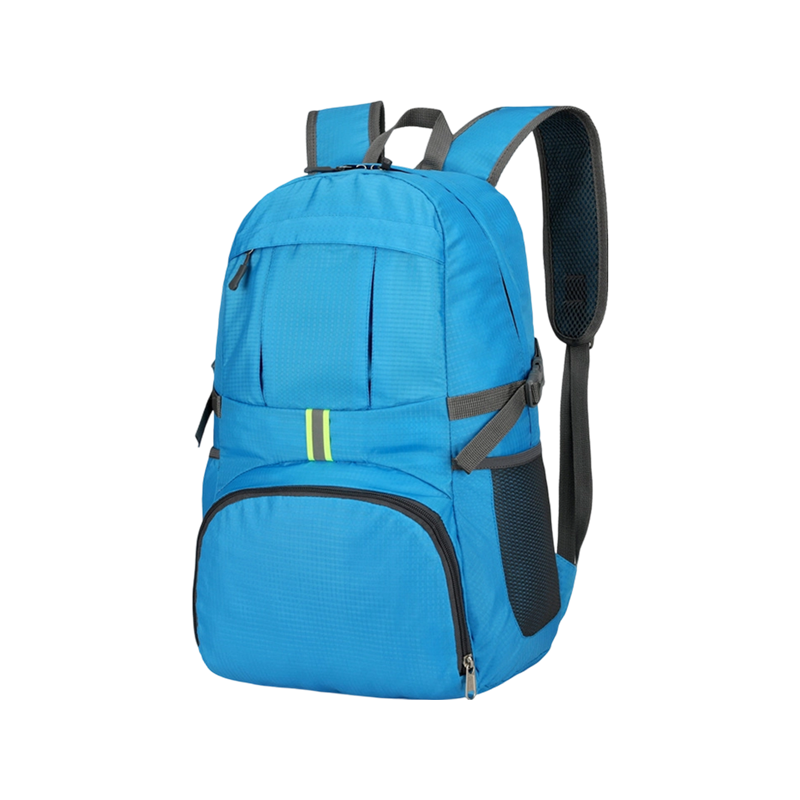
Ultralight folding outdoor hiking backpack, large capacity backpack
Key Advantages Over Conventional Outdoor Backpacks
Lower Storage Burden
The most obvious advantage is the ability to fold the backpack when it is not required. A conventional backpack may need a dedicated shelf, closet space, or luggage compartment. A folding model can be compressed and stored inside another bag, making it easier to transport and organize.
This feature is valuable for international travelers, outdoor guides, families, and retailers managing limited inventory space. It also improves convenience for consumers who want to carry one extra bag without permanently adding substantial volume to their equipment.
Useful Capacity Without Excessive Weight
The product is intended to provide a practical storage capacity while maintaining an ultralight profile. This balance is important because a backpack that is extremely light but too small may not satisfy users, while a large pack with unnecessary structural components can become uncomfortable to transport.
The design focuses on carrying the items normally required for short hiking trips and day-to-day outdoor use. Clothing layers, snacks, water, a camera, personal accessories, a light jacket, and basic emergency supplies can be organized within the available space.
Durable Fabric for Repeated Outdoor Use
High-density polyester provides a dependable foundation for a lightweight backpack. Its dimensional stability helps the product maintain its shape during normal use, folding, and unfolding. The material also offers good resistance to everyday abrasion and contributes to reliable color retention for retail products.
Compared with very thin, low-density fabrics, a carefully selected high-density polyester can provide a more reassuring user experience. Consumers are less likely to perceive the backpack as fragile when the fabric feels stable and resists common contact with branches, equipment, luggage surfaces, and outdoor ground conditions.
Protection Against Light Rain
The DWR treatment improves the backpack’s suitability for changing outdoor conditions. During light rain or short exposure to moisture, the surface can help reduce rapid water absorption. This gives users additional time to seek shelter or protect sensitive contents.
The water-repellent finish is particularly suitable for hiking, travel, and short outdoor activities where the user needs basic weather protection but does not require a fully waterproof expedition pack. Retail communication should clearly distinguish water repellency from complete waterproofing so that customer expectations remain accurate.
Multiple Outdoor Applications
Many backpacks are designed for a narrow activity. A technical mountaineering pack may be unsuitable for travel, while a casual city backpack may lack the durability required for outdoor use. This folding backpack occupies a flexible middle position. It can support hiking, camping, travel, emergency storage, and general outdoor activities.
This versatility can reduce the need for consumers to purchase several specialized bags. For retailers, it supports broader product positioning and makes the item suitable for different departments, including travel accessories, hiking equipment, camping supplies, and outdoor lifestyle collections.
Material Selection and Performance Considerations
Material selection has a direct effect on backpack weight, tear resistance, abrasion resistance, appearance, folding performance, and service life. A manufacturer must consider these characteristics together rather than focusing on a single specification.
| Material Type | Main Performance Characteristics | Typical Application |
|---|---|---|
| Ripstop Nylon | Lightweight, strong, and resistant to progressive tearing | Hiking and backpacking products |
| Polyester | Stable dimensions, good color retention, and practical durability | General outdoor and travel products |
| PU-Coated Fabric | Improved water resistance through a coating layer | Rain-oriented outdoor applications |
| High-Density Nylon | Strong abrasion resistance and long-term durability | Frequent or demanding outdoor use |
High-density polyester is appropriate for this model because it supports the product’s intended balance between lightweight portability and daily outdoor durability. The fabric is not selected solely because it is inexpensive or light. It is selected because it can provide consistent performance across several common use cases while remaining suitable for folding construction.
Fabric density should be matched with the intended capacity and load level. A larger backpack may place greater stress on seams, shoulder strap attachment points, zippers, and the base panel. These areas require careful pattern development and stitching to prevent the material from being overloaded during normal use.
The DWR finish adds another layer of functional value. Surface treatment can improve the user’s experience in light rain, but its long-term performance depends on use, cleaning, friction, and storage conditions. Buyers should therefore evaluate not only the initial water-repellent effect but also the consistency of application during production and the care instructions provided to end users.
Capacity Planning for Different Users
Capacity is one of the most important purchasing factors because it determines what the user can carry and how the backpack will be positioned in the market. A bag that is too small may not satisfy hikers, while a bag that is unnecessarily large may reduce portability and increase weight.
| Approximate Capacity | Recommended Use | Typical Contents |
|---|---|---|
| 10–20 liters | Short walks, city travel, and emergency backup | Water, snacks, phone, light clothing, and personal items |
| 20–30 liters | Day hiking and light outdoor activities | Food, water, rain layer, first-aid items, and small equipment |
| 30–40 liters | Camping and extended hiking | Clothing, cooking accessories, sleeping equipment, and supplies |
| 40 liters and above | Multi-day trekking and mountaineering | Large equipment loads and extended expedition supplies |
The large-capacity positioning of the product gives buyers room to target consumers who need more than a compact emergency bag. At the same time, its folding construction keeps the unused product easy to store. This combination is useful for travelers who may need a larger bag during a trip but do not want to carry a full-size backpack throughout the journey.
Retailers should select the final capacity according to their target market. A travel-focused collection may emphasize compact storage and moderate capacity, while a camping collection may require additional volume and reinforced construction. Capacity should also be considered alongside strap design, pocket layout, zipper performance, and load distribution.
Foldability and Storage Efficiency
Foldability is not simply a matter of making the fabric soft enough to bend. A well-designed folding backpack must collapse efficiently while protecting the fabric, seams, hardware, and storage structure from unnecessary stress.
The folding mechanism should be intuitive. Users should be able to understand where and how the backpack folds without consulting complicated instructions. Quick folding and unfolding improve the practical value of the product, especially when it is used during travel or changing weather conditions.
- Compact folded dimensions reduce storage requirements.
- An integrated storage pouch keeps the folded product organized.
- A quick folding process improves convenience during travel.
- Low added weight preserves the ultralight character of the backpack.
- The folded item can be placed inside larger luggage or another backpack.
Repeated folding is an important manufacturing consideration. Sharp creases, excessive tension, or poorly positioned seams can reduce the service life of a packable product. The design and sampling process should therefore examine how the fabric behaves after repeated folding cycles, how the storage pouch accommodates the product, and whether the backpack unfolds without permanent deformation.
For buyers, foldability should be assessed through physical samples rather than photographs alone. A sample review can reveal whether the product is genuinely easy to pack, whether the pouch is large enough, and whether the folded dimensions match the intended packaging and retail claims.
Carrying Comfort and Load Distribution
Ultralight construction should not mean that comfort is ignored. Even a lightweight backpack can become uncomfortable if the shoulder straps are narrow, the load sits too far from the user’s back, or the adjustment system does not provide adequate stability.
| Comfort Feature | Purpose | Buyer Evaluation Point |
|---|---|---|
| Breathable shoulder straps | Improve airflow and reduce pressure | Check padding, width, and edge finishing |
| Adjustable chest strap | Improve stability during movement | Review adjustment range and buckle operation |
| Waist strap | Help distribute heavier loads | Confirm whether it matches the intended capacity |
| Padded back panel | Increase comfort during longer use | Assess thickness, ventilation, and flexibility |
| Ergonomic construction | Support natural body movement | Test fit with different body sizes |
For a foldable product, comfort features must be balanced with packability. Excessive rigid padding may improve structure but reduce the ability to fold the backpack into a compact form. The product’s design therefore needs to determine which comfort elements provide the greatest practical benefit without creating unnecessary volume.
Buyers should test the backpack with representative loads rather than evaluating it empty. A sample that feels comfortable without contents may behave differently when filled with water bottles, clothing, or camping supplies. Testing should include walking, bending, climbing, and accessing the main compartment.
Adjustment hardware is also important. Buckles and strap adjusters should operate smoothly and remain secure during movement. Stress points should be reinforced because the shoulder straps and chest strap experience repeated pulling forces during use.
Weather Resistance and Outdoor Reliability
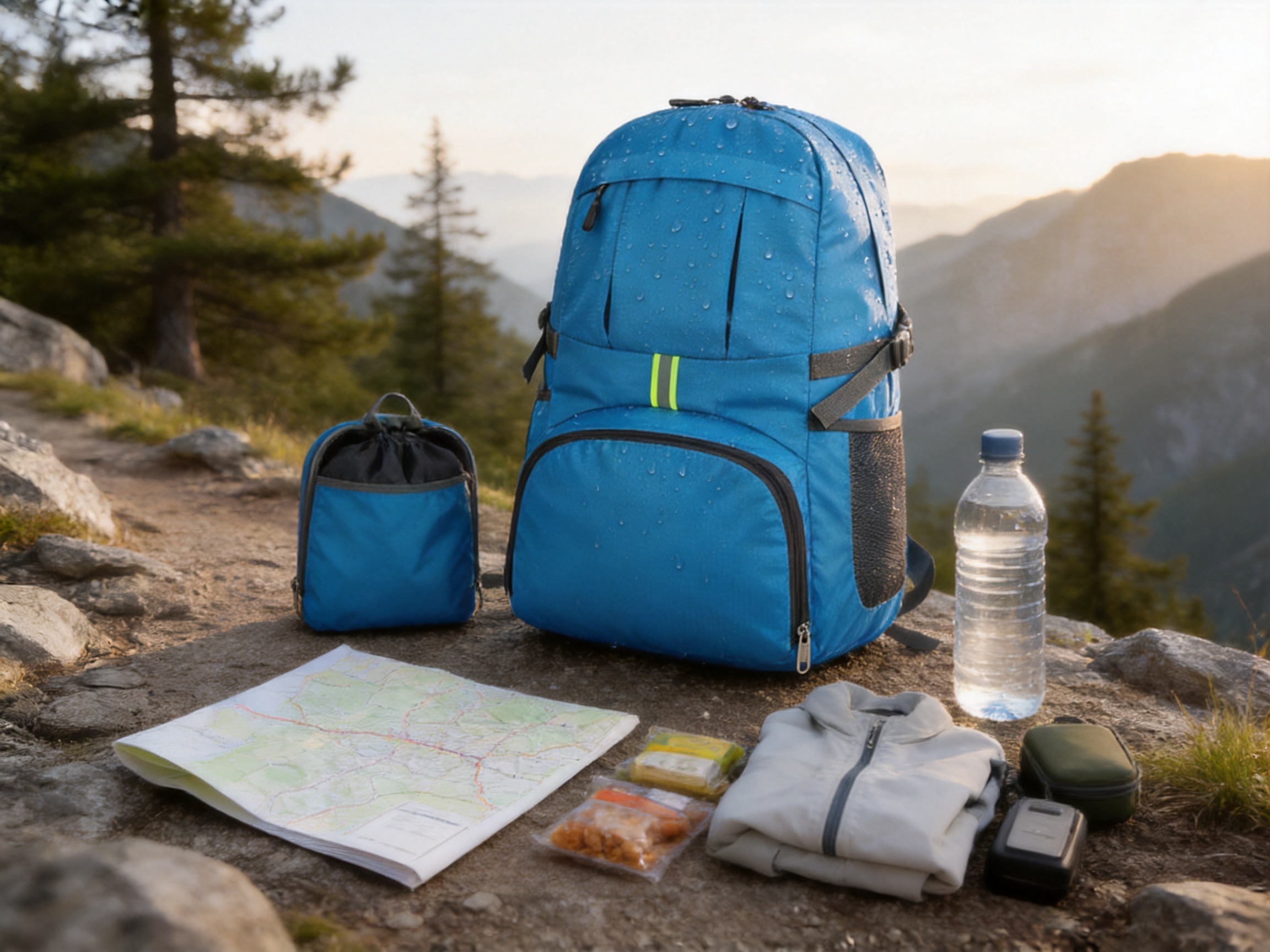
Outdoor products are exposed to changing conditions, including light rain, damp ground, dust, abrasion, temperature changes, and repeated handling. A reliable backpack should be designed with these situations in mind.
The water-repellent surface treatment helps protect the outer fabric during brief or light rainfall. It can also reduce the speed at which moisture spreads across the surface. This is useful when the backpack is used for hiking, travel, or camping in generally variable conditions.
However, buyers should distinguish between water-repellent fabric and waterproof construction. Water repellency usually concerns the fabric surface, while waterproof performance may also require coated materials, waterproof zippers, seam sealing, storm flaps, and carefully controlled construction. The product is intended to protect against light rain rather than replace a specialist waterproof pack.
Durability should be evaluated through several factors:
- Fabric resistance to tearing and abrasion.
- Strength of shoulder strap attachment points.
- Reinforcement at high-stress seams.
- Reliable zipper operation after repeated opening and closing.
- Consistent stitching quality throughout the main body.
- Stable performance after folding and unfolding.
These details influence the total ownership experience. A backpack may appear attractive when new, but its commercial value depends on how well it performs after months of use. Consistent manufacturing and inspection are therefore as important as the initial material specification.
Manufacturing Strengths and Process Control
CragHaven Outdoor is based in Hangzhou, China, and operates as both an outdoor brand and a cross-border manufacturing partner. Its approach is centered on real outdoor applications rather than catalog development alone. Product decisions are connected to weather, terrain, usage patterns, and long-term service requirements.
This approach gives the manufacturer an advantage when developing functional equipment. Outdoor products must work in real environments, and a specification sheet cannot fully describe how a backpack behaves when wet, overloaded, folded repeatedly, or carried over uneven terrain. Product development therefore benefits from practical scenario analysis and repeated evaluation.
Scenario-Based Product Development
The development process begins with the intended use. For a foldable hiking backpack, relevant questions include how quickly it should unfold, where it will be stored, what type of equipment it will carry, how frequently it will be folded, and what weather exposure is expected.
These questions help determine fabric selection, capacity, pocket arrangement, strap construction, reinforcement, folding method, and finishing details. Instead of adding features without a clear purpose, the design can focus on solving specific user problems.
Material Selection for Long-Term Value
Material decisions are made with attention to durability, reliability, and long-term use. High-density polyester supports the product’s need for low weight and practical resistance to abrasion and tearing. The DWR treatment adds protection against light rain without changing the product into a heavier waterproof expedition bag.
Choosing materials according to use rather than short-term trends can help buyers reduce product returns and maintain a more consistent customer experience. It also supports more predictable production because the selected fabric and components can be evaluated through sampling before larger orders are placed.
Sampling, Testing, and Optimization
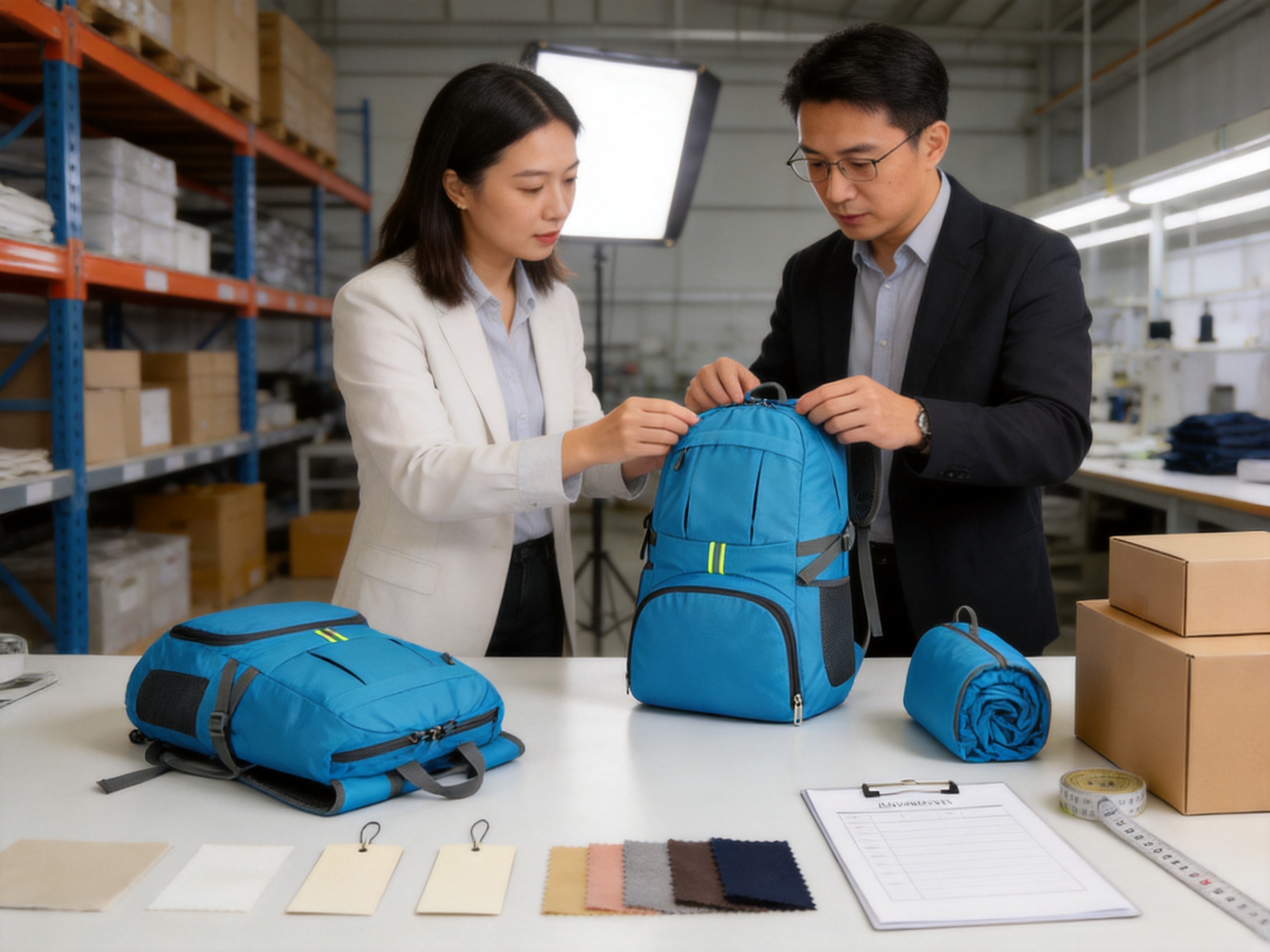
Sampling is an important stage in the company’s manufacturing philosophy. A sample provides an opportunity to review dimensions, fit, fabric hand feel, folding behavior, stitching, hardware, logo placement, and packaging before production begins.
Testing and optimization allow potential issues to be identified early. For example, a sample may reveal that a storage pouch is too small, that a zipper opening does not provide sufficient access, or that a shoulder strap attachment requires additional reinforcement. Correcting such issues before bulk production can improve consistency and reduce avoidable supply chain problems.
Repeatable Production
For global buyers, reliable repeat production is essential. Retailers need confidence that a second order will maintain the same basic dimensions, material characteristics, colors, workmanship, and packaging standards as the first order.
Consistent manufacturing depends on controlled materials, clear specifications, approved samples, standardized sewing procedures, and quality inspections. These systems are particularly important for private-label customers, because brand reputation is directly connected to the quality of the supplied product.
Communication for International Buyers
CragHaven Outdoor positions itself as a cross-border manufacturing partner with a Western-market-oriented communication style. This is valuable when buyers need to discuss technical specifications, packaging requirements, product claims, labeling, sample revisions, and delivery expectations.
Clear communication reduces uncertainty. Buyers can define the intended market, required capacity, fabric preferences, color references, branding requirements, and testing expectations before production. A structured communication process also helps prevent misunderstandings caused by incomplete product descriptions or assumptions about outdoor use.
Quality Control Priorities for This Backpack
Quality control should cover the entire product rather than focusing only on appearance. A backpack can look acceptable while still having weaknesses in its seams, strap attachments, folding performance, or water-repellent finish.
| Inspection Area | What to Review |
|---|---|
| Fabric | Weight, density, color consistency, surface defects, and tear resistance |
| Stitching | Even stitch length, clean thread finishing, and reinforced stress points |
| Straps | Attachment strength, adjustment range, padding, and edge finishing |
| Zippers | Smooth operation, alignment, puller strength, and repeated-cycle performance |
| Folding function | Compactness, ease of folding, pouch fit, and unfolding recovery |
| Water repellency | Consistent surface treatment and resistance to light moisture |
| Dimensions | Finished size, folded size, capacity, and production tolerances |
| Packaging | Protection during transport, labeling accuracy, and retail presentation |
Inspection standards should be agreed before bulk manufacturing. Buyers may require pre-production samples, production samples, inspection reports, carton checks, or third-party testing depending on their market and distribution channels.
Packaging should also be considered part of product quality. A foldable backpack must arrive without unnecessary creasing, contamination, or damage to the fabric and hardware. The package should preserve the product’s appearance while maintaining the space-saving advantage of the design.
Competitive Positioning for Outdoor Retailers
The backpack’s strongest competitive advantage is its combination of portability and usefulness. Some compact bags prioritize minimal folded volume but sacrifice capacity or durability. Some larger backpacks provide more structure but are difficult to store and transport. This product is positioned between these extremes.
Its high-density polyester fabric supports durability while maintaining an ultralight profile. Its folding construction makes it more convenient than a conventional daypack for travel and backup use. Its DWR treatment adds practical protection for light rain. Its larger capacity gives it broader functionality than a small emergency pouch or basic foldable tote.
Retailers can position the backpack around several customer benefits:
- Carry an extra backpack without adding substantial luggage volume.
- Unfold a practical daypack when a larger bag is needed.
- Use one product for hiking, travel, camping, and outdoor backup.
- Benefit from a lightweight design suitable for short trips.
- Receive added protection from light rain through the water-repellent finish.
- Choose a product developed with attention to materials and manufacturing consistency.
For private-label programs, the product can be incorporated into outdoor collections that emphasize practical design, lightweight equipment, travel convenience, and dependable value. Buyers should ensure that all final product claims correspond to the approved specification and test results.
Applications Across Hiking, Camping, and Travel
Day Hiking
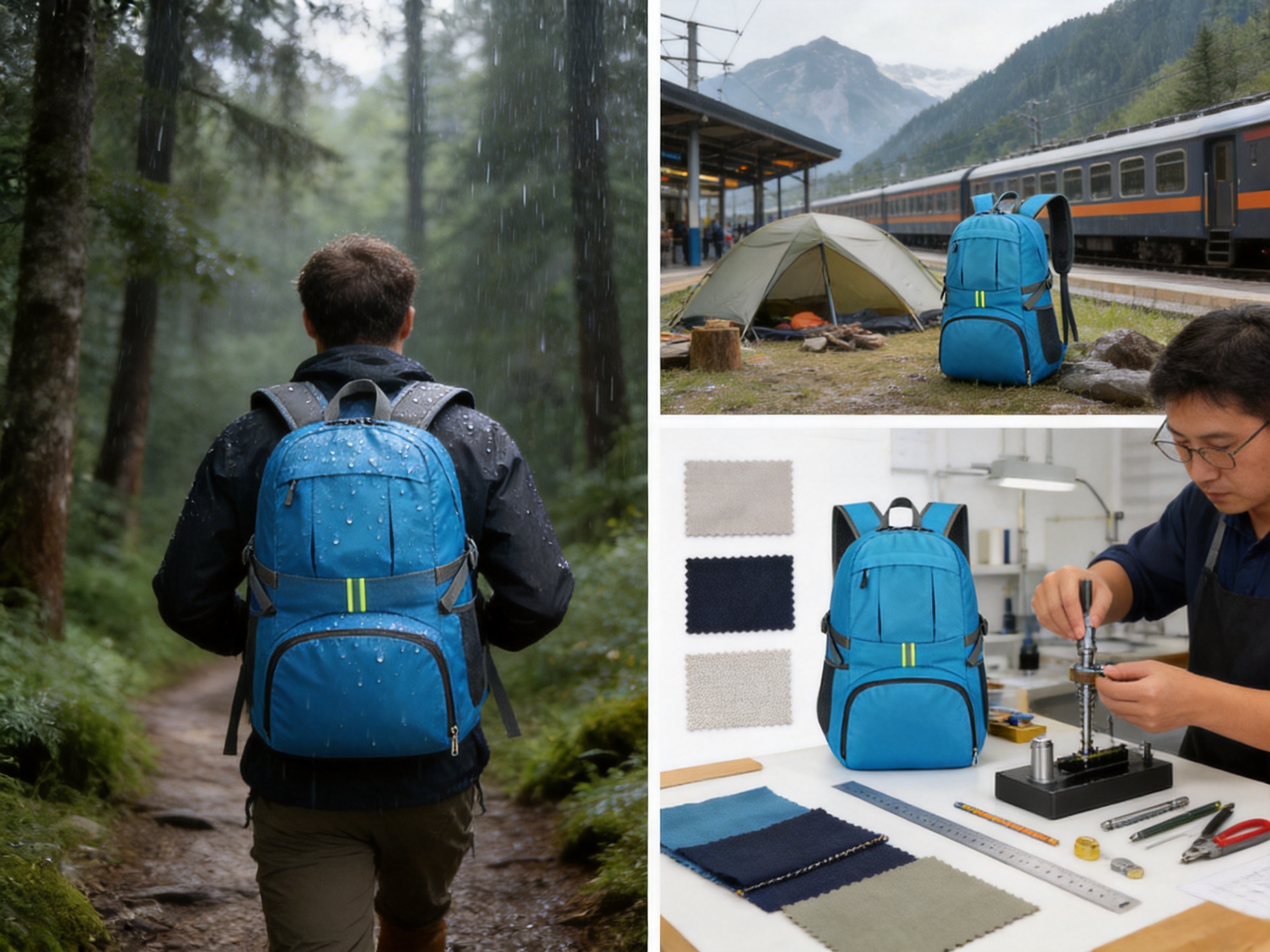
For day hikes, the backpack can carry water, snacks, a light jacket, personal items, navigation accessories, and basic first-aid supplies. The lightweight design helps reduce unnecessary fatigue, while the storage capacity provides room for changing conditions during the day.
Camping
Campers can use the backpack for short-distance transport around a campsite, collecting supplies, carrying clothing, or organizing smaller equipment. Its packable form also allows it to be stored inside a larger camping bag until it is needed.
Travel
Travelers often need a small or medium-sized bag after arriving at their destination. A folding backpack can remain inside a suitcase during transportation and then be used for sightseeing, shopping, day trips, or local excursions.
Mountaineering Support
For mountaineering and trekking, the backpack can function as a secondary or support bag for lighter loads. It should not automatically be marketed as a substitute for a specialized technical mountaineering pack unless the final product has the required structure, capacity, harness system, and tested load performance.
Emergency Backup
The compact storage profile makes the backpack suitable for emergency kits, vehicle storage, disaster preparedness, and workplace backup supplies. Its ability to remain stored until required is one of its most useful practical characteristics.
Purchasing Considerations for Wholesale Buyers
Wholesale buyers should establish the intended market before finalizing the product specification. A backpack for travel retailers may prioritize compact folding, appearance, and moderate capacity. A product for outdoor specialists may require stronger reinforcements, more technical details, and expanded testing.
Important purchasing questions include:
- What capacity is required for the target customer?
- What folded dimensions are acceptable for the intended packaging?
- Will the backpack be sold for hiking, travel, camping, or general use?
- What color range and branding method are required?
- Are chest straps, waist straps, or additional pockets needed?
- What water-resistance claims can be supported?
- What packaging, labeling, and carton requirements apply?
- What inspection standards must be completed before shipment?
Buyers should request an approved sample before placing a large production order. The sample should be checked with actual contents and folded repeatedly. It should also be reviewed for visual consistency, fabric feel, zipper performance, strap comfort, and the overall impression presented to the end consumer.
For private-label customers, the approved sample should include all important brand details, including labels, hangtags, logo placement, care instructions, packaging, and barcode information. A written specification can reduce confusion during repeat orders and make quality discussions more objective.
Customization and Private-Label Opportunities
Outdoor retailers often need products that match their brand positioning. Customization may include color selection, logo application, woven labels, printed labels, packaging design, hangtags, and product inserts. The extent of customization depends on the order volume, production schedule, and technical requirements.
Color selection should consider both outdoor practicality and retail presentation. Darker colors may be preferred for frequent outdoor use because they can help conceal ordinary marks, while brighter colors may improve visibility and create a stronger lifestyle appearance. The final selection should be evaluated under appropriate lighting and confirmed with production samples.
Branding placement should not interfere with folding, storage, zippers, seams, or high-contact areas. A logo positioned on a fold line may experience unnecessary wear, while a label attached near a strap seam may affect comfort or construction. The manufacturer can help identify a location that supports visibility without compromising function.
Packaging is another opportunity to communicate the product’s key benefits. Buyers may highlight compact storage, lightweight construction, light-rain protection, multi-use functionality, and outdoor versatility. Marketing language should remain accurate and should not claim complete waterproofing or technical expedition performance unless those characteristics have been specifically developed and verified.
Care, Handling, and Service Life
Correct care helps preserve fabric appearance and surface treatment. Users should follow the care instructions supplied with the final product. In general, excessive heat, harsh chemicals, aggressive brushing, and repeated high-friction washing may reduce the performance of coatings and fabric finishes.
The backpack should be stored clean and dry. If it becomes wet during use, allowing it to dry before long-term storage can help prevent odor and material deterioration. The product should also be folded according to its intended method rather than compressed under excessive weight.
Although the backpack is designed for outdoor use, it should be loaded according to its intended capacity and construction. Overloading can place stress on zippers, seams, shoulder strap anchors, and fabric panels. Retailers can improve customer satisfaction by providing clear guidance about suitable loads and use conditions.
Why Manufacturing Quality Supports Long-Term Brand Value
Outdoor equipment is closely associated with trust. A customer may rely on a backpack while walking in unfamiliar terrain, traveling far from home, or carrying essential supplies. If a zipper fails, a strap separates, or the fabric tears prematurely, the problem affects more than one purchase. It can damage the customer’s confidence in the retailer and the entire product category.
CragHaven Outdoor’s manufacturing philosophy emphasizes that products should be developed for weather, terrain, and time. This perspective supports a more disciplined approach to product creation. Design features are expected to solve practical problems, materials are evaluated for durability and reliability, and sampling and testing are treated as standard steps rather than optional additions.
The company’s location in Hangzhou provides access to China’s mature manufacturing ecosystem and efficient supply chain. This can support scalable production, coordinated material sourcing, product development, and international order fulfillment. For global customers, the combination of product understanding and manufacturing capability can simplify the process of turning a concept into a stable, repeatable product.
The company also aims to participate in both design and manufacturing rather than functioning only as a factory sourcing intermediary. This is valuable when buyers need help refining a product for a specific outdoor scenario. A knowledgeable manufacturing partner can identify conflicts between capacity, weight, reinforcement, comfort, packability, and cost before they become production problems.
Environmental and Commercial Efficiency
A foldable backpack can contribute to practical efficiency by reducing unused storage volume during transportation and retail handling. More compact products may be easier to organize in warehouses, carry in luggage, and display in stores. These advantages do not replace the need for responsible material and production decisions, but they can support more efficient product use and distribution.
Durability also has commercial and environmental value. A product that remains useful for a longer period may reduce the frequency of replacement. Consistent construction, reliable stitching, and appropriate material selection help support this goal.
Buyers interested in sustainability should discuss material composition, packaging reduction, production waste, durability testing, and end-of-life considerations with the manufacturer. Sustainability claims should be based on documented specifications and verifiable processes rather than general marketing language.
Recommended Product Evaluation Process
Step One: Define the Market
Identify whether the target customers are hikers, campers, travelers, mountaineers, emergency-preparedness buyers, or general outdoor consumers. This decision influences capacity, features, colors, packaging, and marketing claims.
Step Two: Confirm the Technical Specification
Review the fabric, surface treatment, dimensions, folded size, capacity, strap construction, zipper type, pocket configuration, and reinforcement details. Confirm which features are standard and which may require customization.
Step Three: Test the Physical Sample
Unfold the backpack, adjust the straps, load it with representative contents, walk with it, and fold it repeatedly. Check whether the storage pouch is practical and whether the product recovers its shape after unfolding.
Step Four: Review Quality Requirements
Agree on inspection points, acceptable tolerances, packaging requirements, labeling, color standards, and pre-shipment procedures. Document the approved sample for future reference.
Step Five: Confirm Commercial Details
Discuss minimum order quantities, lead times, customization, payment terms, shipping arrangements, and repeat-order procedures. Clear commercial planning helps prevent delays and inconsistent expectations.
Frequently Asked Questions
What is the main advantage of a foldable hiking backpack?
The main advantage is that it combines practical carrying capacity with compact storage. Users can carry the backpack inside luggage or another bag and unfold it when additional storage is needed. This makes it useful for hiking, travel, camping, and emergency backup purposes.
Is this backpack suitable for light rain?
Yes. The fabric surface is treated with a DWR water-repellent coating designed to help protect against light rain. It should not be described as fully waterproof unless the final construction includes and passes the necessary waterproof testing, such as seam sealing and waterproof closure evaluation.
What material is used in the backpack?
The backpack uses high-density polyester fabric. The material is selected for its lightweight character, abrasion resistance, tear resistance, dimensional stability, and suitability for general outdoor use.
Can the backpack replace a technical mountaineering pack?
It can support mountaineering-related activities as a lightweight secondary or backup bag, but it should not automatically replace a specialized technical mountaineering pack. Technical climbing and multi-day expeditions may require a structured frame, advanced harness system, specialized attachment points, higher load support, and additional safety features.
What capacity is suitable for day hiking?
A capacity between 20 and 30 liters is commonly suitable for day hiking because it provides space for water, food, clothing layers, personal items, and basic emergency supplies without becoming unnecessarily bulky.
Is the backpack suitable for travel?
Yes. Its folding design allows it to be stored in a suitcase or larger travel bag. Once unfolded, it can be used for sightseeing, shopping, day trips, and local transportation.
What should wholesale buyers check before ordering?
Wholesale buyers should confirm capacity, fabric, folded dimensions, water-repellent performance, strap construction, zipper quality, color, branding, packaging, inspection requirements, and production tolerances. A physical sample should be tested before bulk production.
Can the product be customized for private-label orders?
Private-label possibilities may include colors, logos, labels, packaging, hangtags, and product inserts. The available options depend on order requirements and production conditions. Buyers should confirm customization details during the sample and quotation stages.
How does the manufacturer support product reliability?
CragHaven Outdoor emphasizes scenario-based development, careful material selection, sampling, testing, optimization, and consistent manufacturing. These processes help address practical concerns such as folding durability, seam strength, fabric performance, and repeat-production consistency.
How should the backpack be stored?
The backpack should be cleaned according to its care instructions, dried thoroughly after exposure to moisture, folded using its intended method, and stored away from excessive heat, harsh chemicals, and prolonged dampness.
Conclusion
The ultralight folding outdoor hiking backpack is designed to address the modern need for equipment that is functional, durable, and easy to carry. Its high-density polyester fabric provides a useful balance between low weight and resistance to abrasion and tearing. Its DWR-treated surface supports protection against light rain, while its folding construction reduces storage and transportation demands.
Compared with conventional backpacks, the product offers greater convenience for travel, backup use, and multi-purpose outdoor activities. It can support day hiking, camping, travel, emergency preparation, and selected mountaineering support applications. This versatility gives retailers more opportunities to position the product across several outdoor categories.
Its value also depends on the quality of its development and production. CragHaven Outdoor combines outdoor product knowledge with cross-border manufacturing capability in Hangzhou, China. Through scenario-based design, material selection, sampling, testing, optimization, and quality control, the company works to reduce uncertainty for international buyers and deliver reliable, repeatable outdoor products.
For buyers seeking a packable outdoor backpack for retail, private-label, or distribution programs, the most important step is to match the final specification with the intended market. When capacity, comfort, weather resistance, foldability, and manufacturing quality are evaluated together, this product can provide a practical and commercially adaptable solution for global outdoor customers.
References
1. CragHaven Outdoor. Product Information for Ultralight Folding Outdoor Hiking Backpack, Product Code WFDS261001.
2. CragHaven Outdoor. Company Profile and Manufacturing Philosophy.
3. General outdoor equipment design principles concerning backpack capacity, load distribution, fabric durability, and weather resistance.
4. General textile product development practices for polyester fabrics, water-repellent treatments, stitching, and reinforcement.
5. General purchasing guidelines for private-label outdoor equipment, sample approval, quality inspection, packaging, and repeat production.
Product: Ultralight folding outdoor hiking backpack, large capacity backpack



- Phone: +86-15968800379
- E-mail: [email protected]
- Address: Room 1002, Huishang Building, Gongshu District, Hangzhou City, Zhejiang Province.
Copyright © CragHaven Outdoor All Rights Reserved. Outdoor Gear Manufacturers Wholesale Mountaineering Camping Gear Suppliers
