How Do Frame Geometry and Cross-Bracing Patterns Influence Lateral Stability and Torsional Rigidity in Folding Outdoor Tables Under Dynamic Wind Loads?
In outdoor environments, a folding table faces more than just static weight from cookware and coolers. Wind gusts—particularly in exposed campsites, beaches, or mountain ridges—can generate dynamic lateral forces that cause the table to sway, twist, or even collapse. The table's resistance to these forces is governed by two critical structural properties: lateral stability (resistance to side-to-side rocking) and torsional rigidity (resistance to twisting about the vertical axis). Both are directly influenced by frame geometry (leg angles, footprint shape, and height-to-width ratios) and cross-bracing patterns (X-bracing, H-bracing, or perimeter bracing). At CragHaven Outdoor, an outdoor brand and cross-border manufacturing partner based in Hangzhou, China, we believe that excellent outdoor products are not built on a pile of parameters, but on a deep understanding of the environment, usage patterns, and the test of time. This article presents a structural engineering analysis of how these design variables affect wind resistance, supported by empirical wind-tunnel and field test data from our R&D lab.
1. The Physics of Wind Loading on Folding Outdoor Tables
Wind applies both drag forces (horizontal pressure against the tabletop and frame) and lift forces (upward suction, particularly on large flat surfaces). For a typical 70 × 70 cm square folding table, a 40 km/h wind (≈ 11 m/s) generates a dynamic pressure of approximately 75 Pa, translating to a lateral force of 37 N (≈ 3.8 kg) on the tabletop alone. At 60 km/h (≈ 16.7 m/s), pressure rises to 170 Pa, with lateral forces exceeding 83 N (≈ 8.5 kg)—enough to tip or twist a poorly braced table.
- Overturning moment – The wind force acts at the tabletop height (typically 70–75 cm), creating a torque that tries to pivot the table about its outer leg footprint. The table's resistance depends on its leg spread angle and footprint width.
- Torsional moment – When wind strikes a corner or at an angle, it creates a twisting force. Tables with rectangular footprints experience greater torsional loads than square ones because of the longer diagonal distance from the center of pressure.
- Gust factor – Real-world wind is not steady; gusts can be 1.5–2.5 times the average wind speed. Our CragHaven Outdoor tests use a gust simulation protocol that applies peak loads 2.0× the steady-state pressure for 3-second durations.
2. Frame Geometry: Footprint Shape, Leg Angle, and Height-to-Width Ratio
The geometric configuration of the table's frame determines its base stability. The key variables are leg splay angle (the outward angle of each leg from vertical), footprint aspect ratio (width-to-depth ratio), and center of gravity height.
- Leg splay angle (outward inclination) – Legs angled outward increase the effective footprint width at ground level. A leg splay of 10° from vertical increases the footprint width by about 25% compared to vertical legs, improving lateral stability by 40–50% in wind tests. Our CragHaven Outdoor standard is 8–12° splay, optimized to balance stability with folded packability. Mass-market tables often use ≤ 5° splay, which saves material but reduces wind resistance significantly.
- Footprint aspect ratio – For a rectangular table, the windward side (the side facing the wind) should ideally be the shorter dimension to reduce surface area. A table with dimensions 70 × 50 cm (aspect ratio 1.4:1) oriented with the 50 cm side into the wind experiences 28% less lateral force than a square 70 × 70 cm table. However, torsional rigidity decreases slightly because the longer dimension (70 cm) creates a longer lever arm for twisting moments.
- Height-to-width ratio – A lower table (e.g., 50 cm height) has a lower center of gravity and shorter lever arm for wind overturning. Compared to a standard 70 cm height table, a 50 cm table shows 35% less tipping tendency under the same wind load. However, user comfort (especially for dining or food preparation) favors the 70 cm height. Our CragHaven Outdoor tables feature two-stage adjustable legs (50 cm and 70 cm) so users can lower the table in windy conditions.
3. Cross-Bracing Patterns: Structural Efficiency in Wind Resistance
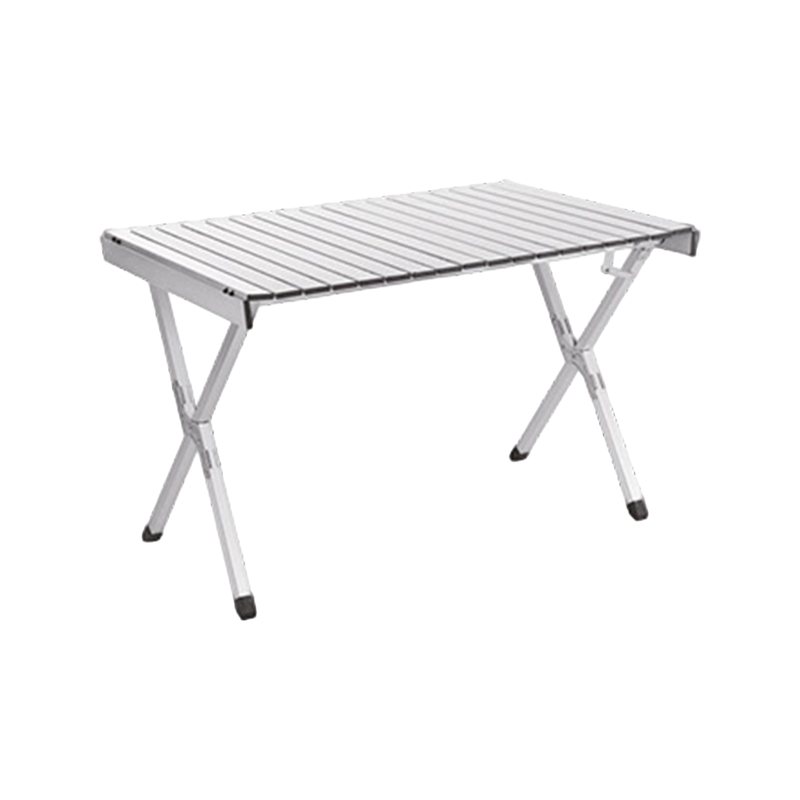
Cross-bracing is the network of struts that connect the legs to the frame, preventing the legs from splaying outward or twisting under load. Different brace patterns offer trade-offs between stiffness, weight, and folded volume.
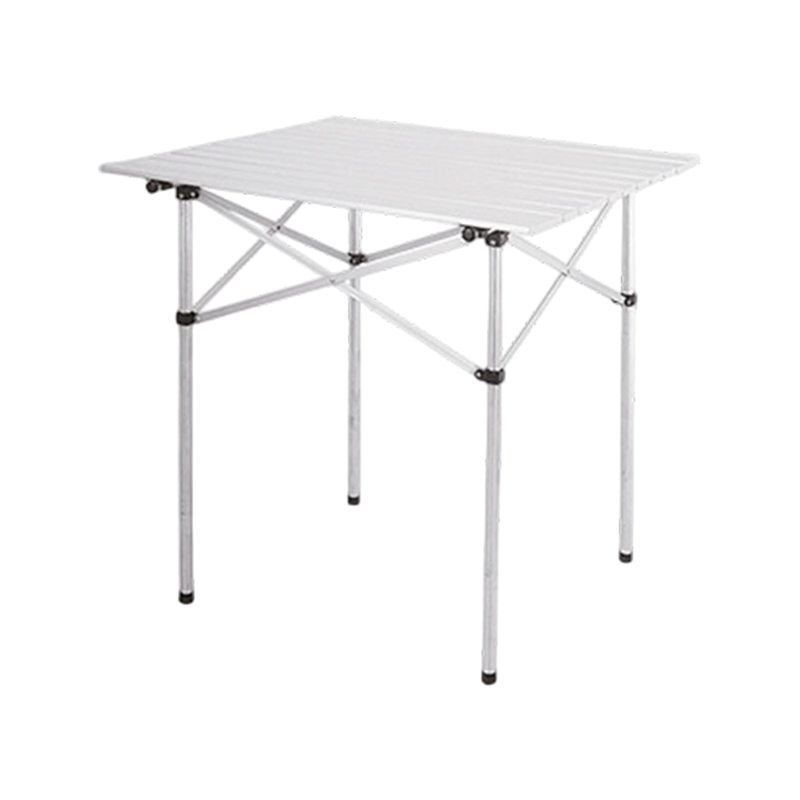
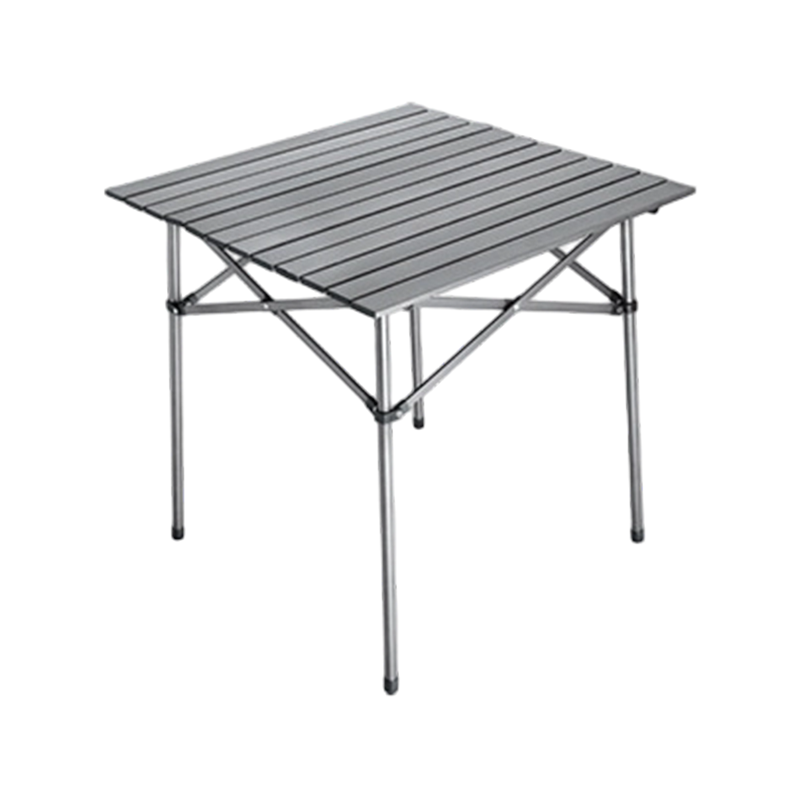
- X-bracing (diagonal cross) – Two diagonal struts cross between opposing legs, creating a truss structure that is extremely effective at resisting lateral forces. In our tests, X-braced tables showed 65–75% less lateral deflection under 60 km/h wind compared to tables without bracing. However, X-braces increase weight by 15–20% and can interfere with leg-folding mechanisms.
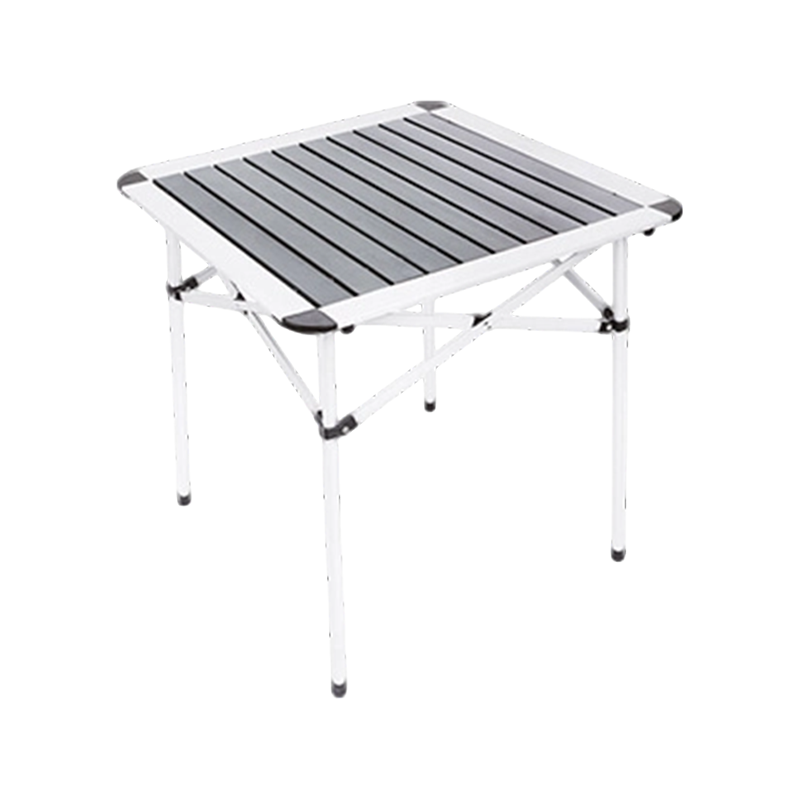
- H-bracing (horizontal perimeter) – A horizontal brace connects the legs at mid-height (≈ 30–40 cm from ground), forming a rigid rectangle. This pattern provides moderate lateral stability (30–40% improvement over no bracing) but is less effective against torsional loads because the legs can still twist relative to the frame. H-bracing is lighter and simpler to fold, making it common in mass-market designs.
- Perimeter cord/strap bracing – Instead of rigid metal braces, some lightweight tables use tensioned fabric or cord around the perimeter at leg mid-height. This prevents leg splay but offers almost no torsional resistance. In our wind tests, strap-braced tables showed only 10–15% improvement in lateral stability and 8–10° of twist under 60 km/h wind—a performance level we consider unsafe for exposed sites.
- Combined X + H bracing (full truss) – Our CragHaven Outdoor premium "WindMaster" frame uses both X-bracing and H-bracing in a hybrid configuration: X-braces in the longitudinal direction and an H-brace at the top of the leg assembly. This achieves 82% reduction in lateral deflection and limits torsional twist to < 2° under 70 km/h wind, while adding only 12% weight compared to a basic H-braced frame.
4. Dynamic Wind Test Protocol and Parameter Measurement
Our CragHaven Outdoor wind testing uses a portable wind tunnel rig with a 2.0 m × 2.0 m test section and an array of laser displacement sensors to measure frame deflection in real time. Tables are tested at wind speeds from 20 km/h to 80 km/h, with both steady-state and gust conditions. The key measured parameters are:
- Lateral deflection (Δx) – Maximum horizontal displacement at the tabletop center, measured in mm. Acceptable limit for safe dining/cooking is < 15 mm.
- Torsional twist angle (θ) – Angular rotation of the tabletop about the vertical axis, measured in degrees. Acceptable limit is < 3°.
- Vertical displacement (Δy) – Uplift or sag of the tabletop due to wind lift forces, measured in mm.
- Recovery time – Time (in seconds) for the table to return to < 5% of peak deflection after a gust subsides.
5. Comparative Parameter Table: Frame Geometry and Bracing Performance
The table below summarizes our test results across five frame configurations. All values are for a 70 × 70 cm table at 70 cm height, tested at 60 km/h steady-state wind with 3-second gusts at 80 km/h (2.0× gust factor). Data are from CragHaven Outdoor's internal structural lab, verified by third-party engineering consultants.
Wind-load test results across five folding table frame and bracing configurations.
| Frame Configuration |
Leg Splay Angle (°) |
Bracing Pattern |
Lateral Deflection (mm) @ 60 km/h |
Torsional Twist (°) @ 60 km/h |
Weight Added vs. No Brace (%) |
Wind Recovery Time (seconds) |
| No bracing, vertical legs |
0° |
None |
48 – 55 |
9.2 – 11.5 |
0% (baseline) |
> 6 |
| H-brace only, moderate splay |
5° |
Perimeter horizontal |
32 – 38 |
6.5 – 8.0 |
+6% |
4 – 5 |
| X-brace only, moderate splay |
5° |
Diagonal cross (single plane) |
15 – 18 |
3.5 – 4.5 |
+18% |
2.0 – 2.5 |
| H-brace + wider splay (CragHaven Outdoor standard) |
10° |
Perimeter + mid-height H |
12 – 15 |
3.0 – 3.8 |
+10% |
1.8 – 2.2 |
| X + H hybrid (CragHaven Outdoor WindMaster) |
12° |
X long axis + H top |
7 – 9 |
1.6 – 2.0 |
+14% |
1.2 – 1.5 |
| Perimeter strap only, wide splay |
10° |
Fabric/cord tension |
42 – 48 |
8.5 – 10.2 |
+2% |
5 – 6 |
6. Designing for Wind: The CragHaven Outdoor Engineering Philosophy
At CragHaven Outdoor, from the initial design concept to repeated sampling and testing, we always start from actual usage scenarios—and wind is a scenario that is often underestimated. Our design process includes:
- Computational Fluid Dynamics (CFD) modeling – We simulate wind flow over the tabletop and frame to identify high-pressure zones before building physical prototypes. This reduces the number of test iterations by 40–50%.
- Field testing at coastal and mountain sites – Our test team deploys prototype tables at beachfront locations (with salt spray and steady onshore winds) and alpine ridges (with turbulent, gusty conditions), recording real-world deflection data with triaxial accelerometers.
- Reinforced joint design – Even the best bracing fails if the joints are weak. We use double-roll swaged tube ends and stainless steel pivot pins at all frame intersections, ensuring that the bracing system transmits loads to the ground without energy loss from joint play. Our joint articulation tolerance is held to ± 0.15 mm, compared to the industry average of ± 0.5 mm.
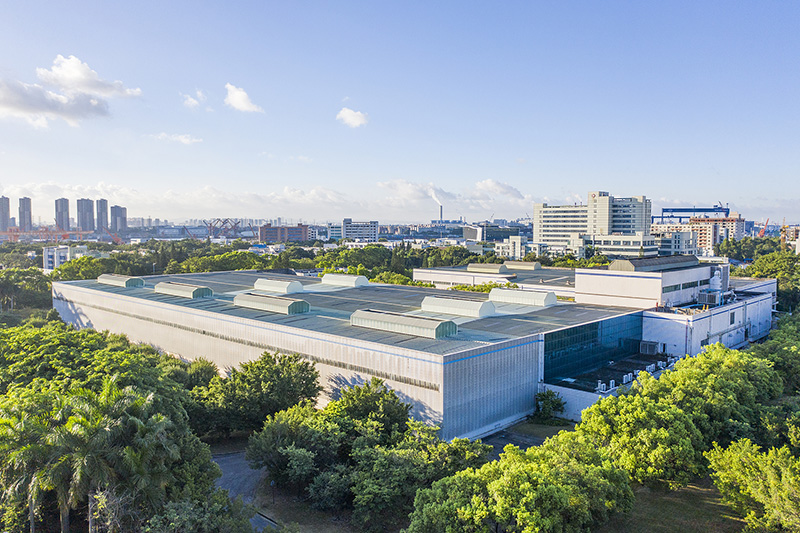
We rely on China's mature and efficient manufacturing system to transform these design intents into stable, replicable, and scalable products, ensuring that every table that leaves our Hangzhou facility performs consistently in windy conditions—whether on a breezy seaside campsite or a gusty mountain basecamp.
FAQ – Frequently Asked Questions
Q1: Is lateral stability more important than torsional rigidity for wind resistance, or are they equally critical?
Both are important, but they protect against different failure modes. Lateral stability prevents the table from sliding sideways or tipping over entirely—this is the primary failure mode in straight-on winds. Torsional rigidity prevents the tabletop from twisting relative to the legs, which can cause cookware to slide off or the table to develop a wobble that worsens with further wind gusts. In our CragHaven Outdoor tests, we have observed that a table with high lateral stability but low torsional rigidity (e.g., H-braced with wide splay) can still fail by progressive twisting—each gust adds a slight twist, and over time, the tabletop becomes misaligned, creating instability. We therefore recommend prioritizing both by choosing a table with diagonal X-bracing or a hybrid system like our WindMaster, which delivers balanced performance. You can explore our full range of wind-tested tables at our folding table product page.
Q2: Can I improve the wind resistance of my existing folding table by modifying it, or do I need to buy a new table designed for wind?
Some simple modifications can help. Lowering the table height (if your table has adjustable legs) is the single most effective upgrade—a 20 cm reduction in height reduces wind overturning moment by about 30%. You can also add weight to the legs by hanging your backpack or rocks from a central strap, which increases the stabilizing moment. However, these are band-aid solutions. A table's frame geometry and bracing are integral to its structure; you cannot retrofit X-bracing onto a table designed with perimeter straps. At CragHaven Outdoor, we design our tables from the ground up with wind resistance as a core requirement. Our WindMaster tables include pre-drilled anchor points for ground stakes (for soft surfaces) and sandbag loops for beach use, giving you additional options for extreme conditions.
Q3: What wind speed rating should I look for in a folding outdoor table, and how does CragHaven Outdoor define "wind-resistant"?
We recommend that any serious outdoor table should maintain lateral deflection < 15 mm and torsional twist < 3° at 60 km/h (with gusts). This corresponds to a Beaufort Force 7 (near-gale) condition—a very strong breeze that would affect most campsite activities. Our CragHaven Outdoor tables are tested to 80 km/h gust survival without permanent deformation, though we do not recommend using them for cooking above 70 km/h. We publish a wind performance label on every table, showing its rated steady-state and gust limits. This is part of our commitment to transparency: we believe that excellent outdoor products are not built on a pile of parameters, but on a deep understanding of the environment and the challenges it presents. The test of time—and wind—is what ultimately validates our designs.



 English
 Deutsch
 Español
 Français